
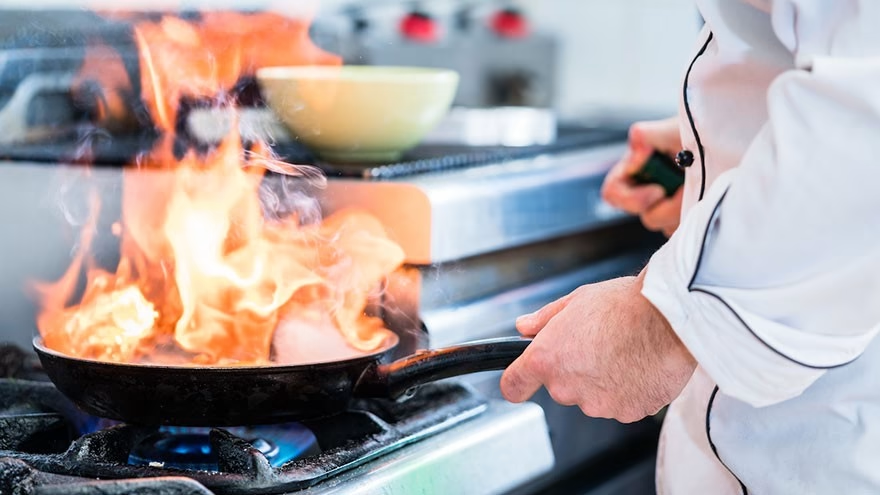
Here is a counterintuitive fact to open with: when you learn how to flambe a dish, you are not burning off all the alcohol. According to USDA data, roughly 75% of the original alcohol content remains in a flambéed dish after the flames die down. The blue fire is ethanol vapor combusting at the surface of the liquid, not the liquid itself being vaporized away. That changes how you should think about the technique — not as a purifying process, but as a flavoring one. And the flavor impact is real. The heat from the flame drives caramelization and Maillard reactions in the sauce or fruit below, producing complex brown and bitter-sweet compounds that simply cannot be replicated by simmering alone. The spectacle is a bonus.
What happens chemically when you flambe food?
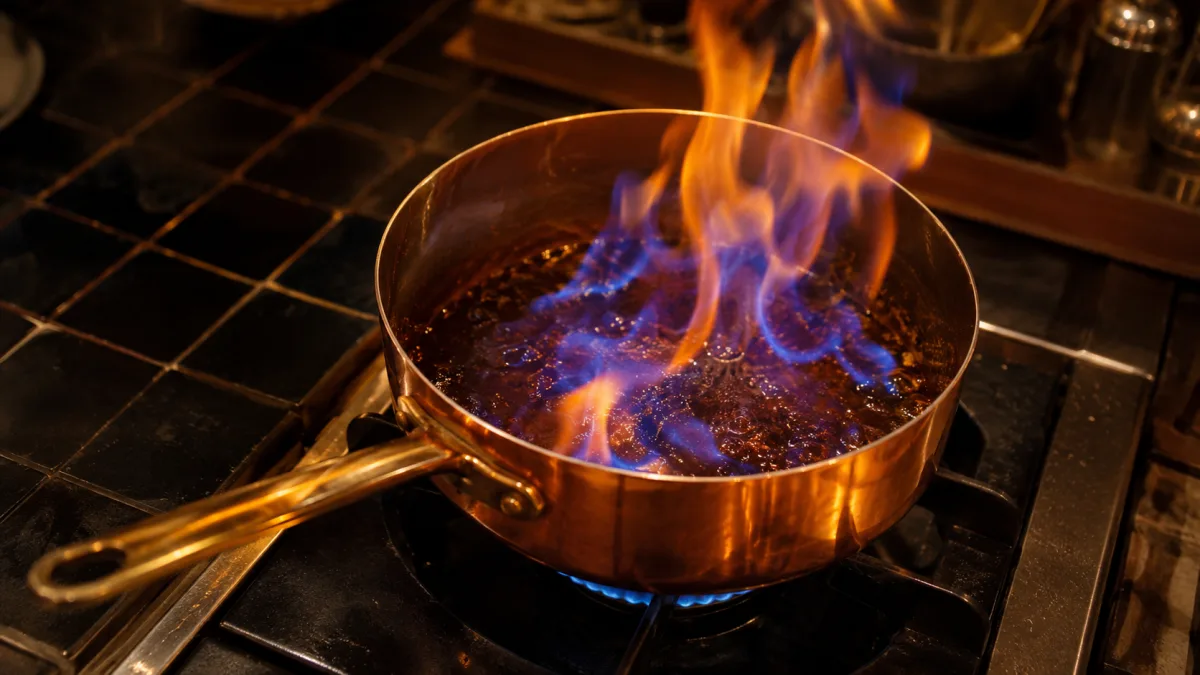
Ethanol has a boiling point of 173°F (78°C) — well below water's 212°F. When a pan of spirits reaches around 130°F, ethanol vapor begins rising visibly from the surface. That vapor mixes with atmospheric oxygen, and if you bring an ignition source near the edge of the pan, the vapor ignites. The flame you see is burning ethanol gas, not liquid. The liquid itself is never consumed by the flame.
This is why the fire self-extinguishes within 15 to 30 seconds. As the alcohol concentration drops and the vapor layer thins, the flame loses its fuel supply and goes out. The ethanol that does combust is mostly from that surface vapor layer. The majority remains dissolved in the liquid underneath, which is why the USDA's data shows approximately 75% alcohol retention after flambéing — far more than most home cooks expect.
What the flame actually accomplishes at the culinary level involves two reactions happening simultaneously. The radiant heat from the fire caramelizes sugars in the sauce or fruit beneath it, producing hundreds of aromatic compounds. And where the flame contacts the surface directly, it triggers Maillard browning — the same reaction responsible for the crust on a seared steak. These reactions add genuine flavor depth that no amount of stirring over a burner will replicate. The dish smells different after flambéing because it chemically is different.
Choosing the right alcohol for flambéing
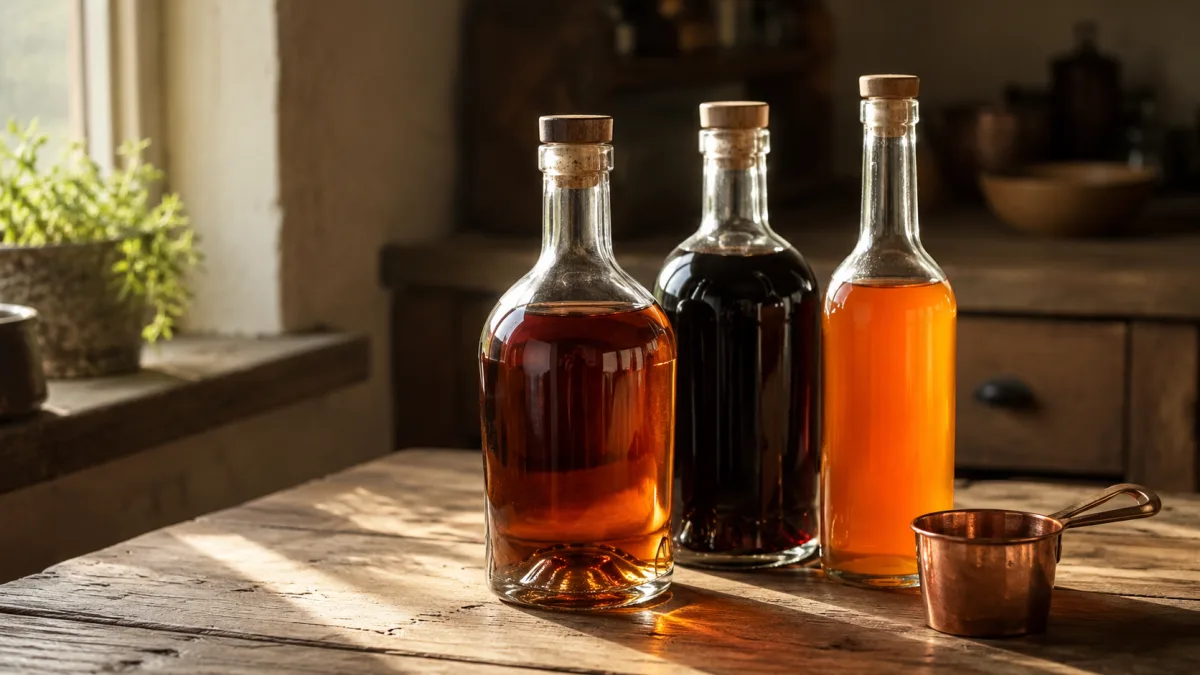
Proof is not a suggestion. Spirits below 40% ABV (80 proof) lack sufficient ethanol vapor pressure at cooking temperatures to sustain a flame reliably. Beer and wine, regardless of how you heat them, will not ignite. The ethanol concentration is too low to produce a flammable vapor layer.
The practical sweet spot runs between 40% and 50% ABV. At 40%, a properly warmed spirit ignites cleanly and produces a controlled, manageable flame. As you move toward 50%, the flame grows more vigorous but remains workable. Above 57% ABV (about 114 proof), the fire risk increases substantially — the vapors become aggressive and the flame can surge unexpectedly. Cask-strength whiskeys and overproof rums in the 60–75% range are dangerous choices and should be diluted before use.
Spirit selection should follow the dish. Cognac and brandy — around 40% ABV, with warm dried-fruit character — suit beef sauces like Steak Diane and work beautifully with stone fruits. Dark rum pairs with tropical preparations: Bananas Foster being the definitive example. Kirsch (cherry brandy) is the traditional choice for Cherries Jubilee, providing a complementary almond-cherry note. Orange liqueur (Grand Marnier or Cointreau) is the default for Crêpes Suzette. Whiskey works in savory applications like pan sauces for pork or steak. If you want the flame without a strong spirit flavor, a milder brandy at 40% gives you the visual drama with a lighter footprint on the dish.
One pairing approach worth learning: understanding sauce flavor layering will help you decide whether a flambéed spirit should be the dominant flavor or a background note in the final dish.
How to safely heat and handle spirits for flambéing
Cold spirits do not ignite. This is the most common reason a home cook's first attempt fails — they pour room-temperature brandy into a hot pan and cannot get it to catch. Ethanol needs to be warm enough to vaporize actively before ignition becomes reliable.
Heat the spirit separately in a small saucepan until you can see wisps of vapor rising from the surface and tiny bubbles form around the edges — approximately 130°F (54°C). A kitchen thermometer removes the guesswork. Do not bring it to a boil: ethanol's boiling point is around 173°F, and if you heat the spirit much past 140°F, you begin cooking off the very alcohol needed for ignition. Overheated spirits that have reached a rolling boil may not catch at all.
Measure your spirit into the saucepan before you begin. Never pour from the original bottle into a hot pan or a flaming pan — the pour stream creates a continuous alcohol bridge between the bottle and the flame, and that can travel backward. Use a ladle or pre-measured cup. Two to three tablespoons of warmed spirit is sufficient for most home portions; more alcohol means a higher, longer flame that does not improve the food.
Step-by-step flambé technique
Preparation matters more than execution here. Have everything in position before the spirit goes into the pan: your ignition source at hand, a metal lid within reach, guests standing back, overhead obstructions cleared. This is not a technique for improvisation once things are moving.
- Prepare your dish fully and bring it to serving temperature in the pan. The pan contents should be hot — cold food absorbs unburned alcohol and the result tastes harsh and raw.
- Warm your measured spirit separately to around 130°F. Visible vapor rising from the surface tells you it is ready.
- Remove the pan from the heat source (especially critical on gas, where an open flame could ignite the spirit prematurely as you add it). On induction or electric, this step is still good practice.
- Pour the warmed spirit into the pan in one steady motion. Do not delay once it is in — ignite before the food absorbs the raw alcohol.
- Tilt the pan slightly toward a gas burner flame to catch the vapor, or hold a long barbecue lighter at the edge of the pan. Never point the lighter into the center of the liquid. The flame should catch the vapor cloud above the surface.
- Let the fire burn naturally. It will die out in 15 to 30 seconds as the surface vapor burns off.
- If the flame persists past 45 seconds, cover the pan with a metal lid to smother it. Never blow on a flambé flame.
For richer cooking techniques with complementary flavor profiles, the principles in this guide to building depth in layered desserts apply equally well when finishing flambéed fruit dishes.
Safety rules for flambéing at home
Flambéing is a safe technique when the rules are followed consistently. These are not optional.
- Never pour from the original bottle into a flaming or near-flame pan. The alcohol stream can carry the flame back to the bottle. Always pre-measure into a separate vessel.
- Clear overhead hazards before starting — cabinets, hanging pot racks, paper towel dispensers, and exhaust fans all pose ignition risk. Turn off the exhaust fan.
- Tie back hair and push up sleeves. Natural fibers are safer than synthetics, which melt rather than char.
- Use a long barbecue lighter or fireplace matches. Standard matches put your hand too close to the ignition point.
- Keep a metal lid nearby — not a towel. The lid smothers by removing oxygen. A wet towel can spread flaming liquid.
- On gas cooktops, turn the burner off before adding the spirit to prevent premature ignition.
- Never carry a flaming pan. If you need to move it to a table, let the flame extinguish first.
- Do not exceed three to four tablespoons of spirit per portion. More alcohol means a longer, higher flame — not a better dish.
The single most important safety rule, worth stating plainly: never pour alcohol from the original bottle while the pan contains an open flame. This one practice accounts for the majority of kitchen flambé accidents.
Classic flambé dishes — history and recipes
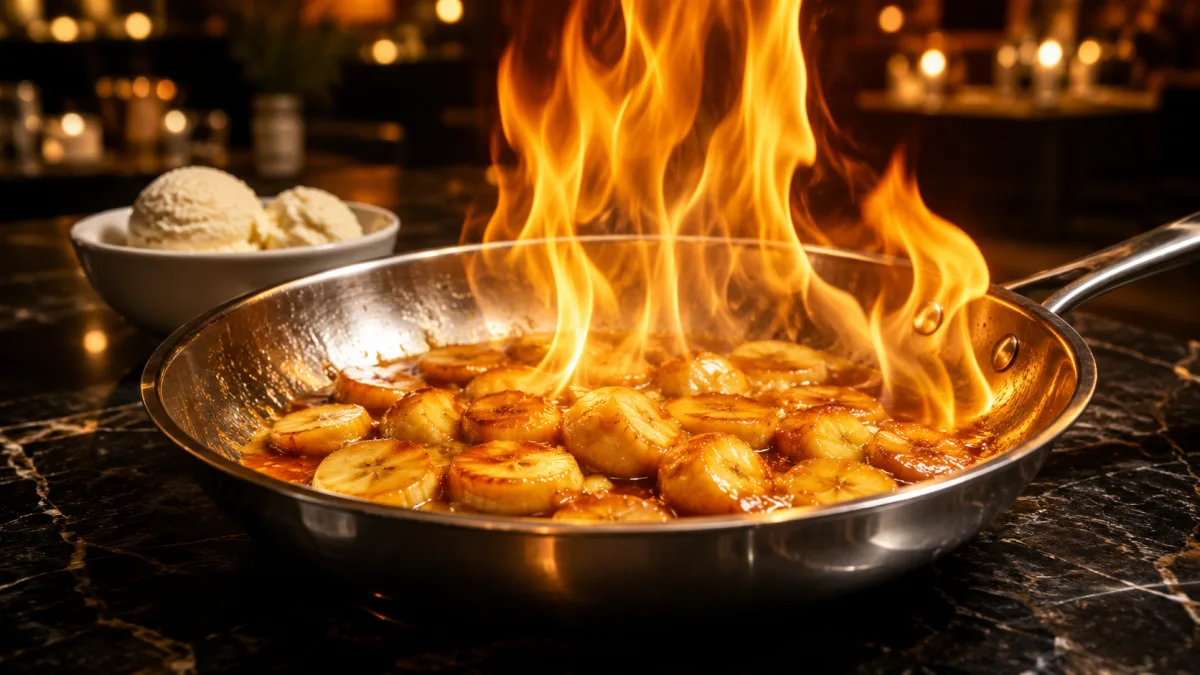
Three dishes define the flambé canon, and each has a documented origin story.
Bananas Foster was created in 1951 at Brennan's Restaurant in New Orleans. Chef Paul Blangé was tasked — on short notice — with creating a banana dessert to honor Richard Foster, a friend of restaurant owner Owen Brennan and chairman of the New Orleans Crime Commission. New Orleans was then the primary U.S. port of entry for Central and South American bananas, making the ingredient both abundant and locally significant. The dish remains Brennan's most-ordered item; the restaurant flames through roughly 35,000 pounds of bananas annually. Dark rum is the spirit, and the technique is tableside: butter, brown sugar, cinnamon, and rum are flambéed together, the bananas finish in the sauce, and the result is served over vanilla ice cream.
Cherries Jubilee dates to 1897 and Auguste Escoffier, who prepared it for Queen Victoria's Diamond Jubilee celebrations. Escoffier's original recipe called for sweet cherries in simple syrup, warmed brandy poured over and ignited at the table. Ice cream was not part of the original — that addition came later. His 1903 Guide to the Art of Modern Cookery adapted the recipe to include kirschwasser, a clear cherry brandy, per serving. The kirsch-cherry combination remains definitive.
Crêpes Suzette has a disputed origin, but the most widely repeated account credits Henri Charpentier, a young assistant at the Café de Paris in Monte Carlo in 1895. Charpentier claimed he accidentally ignited a sauce he was preparing for the Prince of Wales and, recognizing the result as an improvement, served it. The Prince reportedly asked that the crêpes be named after a young woman at the table named Suzette. The story appears in Charpentier's own memoir and has been questioned by culinary historians, but the dish itself — crêpes in an orange-butter sauce with orange liqueur — remains the standard by which tableside flambé theater in fine dining is measured.
For a broader exploration of technique-driven French-influenced cooking, the method shares principles with classical French cooking approaches where timing and heat control are decisive.
Cookware, heat source, and equipment
Pan selection affects both safety and outcome. Stainless steel is the standard choice — it handles high heat without issue and lets you see clearly what is happening in the pan. Copper sauciers are the traditional French option and conduct heat beautifully. Cast iron works but retains heat aggressively, which can cause the spirit to overheat before ignition. Avoid nonstick entirely: flambéing temperatures damage PTFE coatings and may release fumes. The pan should have rounded, deep sides — this contains splashing during ignition — and a long handle so your arm stays clear of the flame.
On a gas cooktop, you can tilt the pan edge slightly toward the burner flame to catch ignition naturally, without a separate lighter. Keep the burner low. On electric or induction, there is no open flame, so a long barbecue lighter is the only reliable ignition method. Turn the burner off before adding the spirit on any electric cooktop to avoid the element igniting the liquid unpredictably. America's Test Kitchen recommends stainless steel with a long handle and avoiding nonstick pans specifically because flambé heat damages the coating.
A 12-inch barbecue lighter is the most practical home tool. Fireplace matches work as well. Keep a flat metal lid — sized to cover your pan completely — within arm's reach throughout the process. If you want to explore how heat management across different cookware types shapes your cooking, the same attention to pan behavior applies when managing high-heat rendering with rich proteins.
Troubleshooting — when the flame won't catch or burns too long
If the spirit refuses to ignite, the most likely cause is temperature. Either the spirit is too cold (it needs to reach around 130°F with visible vapor rising), the pan contents cooled too much during preparation, or the spirit is below 40% ABV. Verify the proof on the label. If both temperature and proof are correct and the spirit still will not catch, heat it an additional 10 degrees — but stop well before it boils.
A second common failure: adding the spirit and then waiting too long before igniting. Food absorbs alcohol quickly. Once the spirit hits the pan, light it within a few seconds or the opportunity passes and you are left with a raw-alcohol taste in the finished dish.
If the flame burns longer than 30 to 45 seconds, excess alcohol is the cause. Cover the pan immediately with a metal lid. The flame extinguishes as soon as oxygen is cut off. Use no more than two to three tablespoons of spirit per home-size portion going forward.
If the spirit ignites with a surge rather than a controlled catch, you have heated it too high or used a spirit above 57% ABV. Reduce the temperature or dilute the spirit, and keep bystanders at a safe distance before the next attempt. Understanding how fats and acids behave under intense heat can inform how you build the base sauce before flambéing — a discipline also relevant when working with high-heat pan techniques for vegetables.
Frequently Asked Questions
Does flambéing burn off all the alcohol?
No. According to USDA data, approximately 75% of the original alcohol content remains in a flambéed dish after the flames die out. The fire burns ethanol vapor at the surface of the liquid, not the liquid itself. If you are avoiding alcohol for health, dietary, or religious reasons, flambéing is not an adequate removal method.
What is the minimum alcohol percentage needed to flambe?
40% ABV (80 proof) is the practical minimum for reliable ignition at home. Below that threshold, insufficient ethanol vapor forms even when the spirit is warmed, and the flame either will not catch or will not sustain. The optimal range is 40–50% ABV. Spirits above 57% ABV create an uncontrollably aggressive flame and should be avoided.
Why do you heat the spirit before flambéing?
Cold alcohol does not ignite. Heating the spirit to around 130°F increases the ethanol vapor pressure, generating the surface vapor layer that actually burns. This means you can use less alcohol and still get a reliable, clean flame. Heating also produces smoother ignition — the spirit catches quickly rather than requiring a sustained lighter application.
Can you flambe on an electric or induction stove?
Yes. The technique is identical except for one step: there is no open burner flame to tilt the pan toward for ignition, so you must use a long barbecue lighter held at the edge of the pan. Turn the burner off before adding the warmed spirit — an active electric element can cause unpredictable ignition.
What do you do if the flame won't go out?
Cover the pan with a flat metal lid. This removes oxygen and extinguishes the flame immediately. Do not blow on the fire, do not add water, and do not use a cloth — a cloth can spread flaming liquid. The most likely cause of an unusually long flame is excess alcohol; use no more than two to three tablespoons of spirit per home-size portion going forward.

Chiara Bradshaw
Covers education, culture and creative topics with an emphasis on readable explanations and verifiable references.
Leave a reply
Replying to