
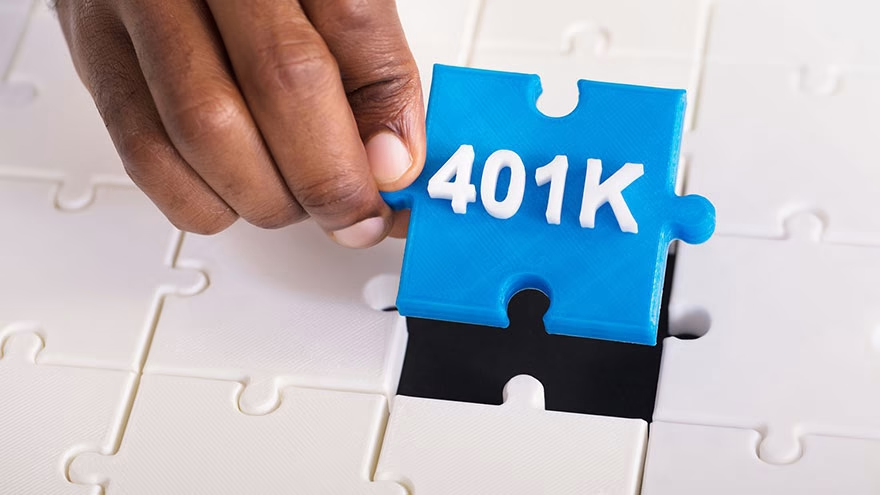
A 401(k) rollover to a Roth IRA can be taxable even when no cash lands in your checking account. The tax comes from changing pre-tax retirement money into after-tax Roth money, not from spending it.
That is why the paperwork matters. Before moving the account, identify pre-tax, Roth, and after-tax balances, then decide whether this year's income can absorb the conversion.
The Short Answer
Yes, you may owe taxes when rolling pre-tax 401(k) money into a Roth IRA. A Roth IRA is funded with after-tax money, so converting pre-tax retirement money generally creates taxable income for the year of the conversion.
That does not make the rollover bad. It makes timing and tax planning central. The same move can be sensible in a low-income year and painful in a high-income year.
Know Which Money Is Pre-Tax

The IRS rollover page explains that retirement plan distributions can be rolled over and that tax treatment depends on the type of distribution and destination account: IRS retirement plan rollovers. Traditional 401(k) deferrals and employer matches are usually pre-tax.
Pre-tax money converted to a Roth IRA is generally taxable. Roth 401(k) money follows different rules, and after-tax contributions add another layer.
Use A Direct Rollover When Possible
A direct rollover sends money from the plan to the receiving account without the participant taking possession. That reduces withholding and deadline problems.
If a check is made payable to you, withholding and rollover deadlines can complicate the transaction. Ask the plan administrator exactly how the check should be titled before initiating anything.
A Roth Conversion Can Raise Your Bracket

The taxable amount from a conversion adds to income for the year. That may affect federal tax bracket, state tax, credits, deductions, Medicare-related costs, and other income-based items.
IRS Topic 413 covers rollovers from retirement plans and tax treatment basics: IRS Topic 413 rollovers. The key planning question is not only whether tax is due, but how much other income is already in the same year.
After-Tax Contributions Need Special Care
The IRS has separate guidance on rollovers of after-tax contributions in retirement plans: IRS after-tax contribution rollovers. Some 401(k) plans contain after-tax employee contributions that may be split between destinations under specific rules.
Do not assume the plan recordkeeper's screen tells the whole story. Ask for pre-tax, Roth, and after-tax balances before requesting a rollover.
RMDs Cannot Be Converted First
If required minimum distributions apply, the RMD for the year generally must be taken before a conversion of remaining eligible funds. Skipping that step can create tax problems.
This rule catches people who retire later and try to tidy old accounts in one move. Ask the plan and tax preparer whether an RMD applies for the year.
Do Not Use The IRA To Pay The Tax Blindly
Paying conversion tax from the retirement account reduces the amount that gets future Roth treatment. If you are under penalty age, withholding can create additional issues.
Cash outside the retirement account often makes a conversion cleaner. If outside cash is not available, the conversion amount may be too large for the year.
Compare Roth IRA Benefits With The Cost
A Roth IRA can offer tax-free qualified withdrawals, no lifetime RMDs for the original owner under current rules, and flexible beneficiary planning. Those benefits must be weighed against the tax paid now.
Investor.gov explains IRA basics and retirement account types, but the account label alone does not decide the answer; the tax bracket path does.
Fit The Rollover Into The Whole Portfolio
Retirement accounts do not exist alone. Bond holdings, cash, annuities, taxable accounts, and family support all affect the decision. Livecub's guides to fixed annuity and fixed index annuity, find out how much saving bonds are worth, and calculate bond values can help inventory nearby pieces.
A conversion may be attractive if future tax rates look higher for you, heirs need flexibility, or current income is unusually low. It may be unattractive if it pushes income into an expensive bracket.
Get The Paper Trail Right

Keep plan statements, distribution forms, Form 1099-R, Form 5498, and any tax preparer notes. If the rollover is part of a family financial reset, Livecub's guide to teaching kids about money can help with age-appropriate money talks, but tax reporting belongs with adults and records.
Before pressing submit, ask three questions: what part is taxable, will withholding occur, and what form will prove where the money went?
Run A One-Page Stress Test
For 401k rollover to Roth IRA taxes, write the decision on one page before money moves. Include the amount, time horizon, tax account, expected cash need, worst reasonable outcome, and the point at which you would change course.
The exercise is plain, but it catches weak decisions. If a plan only works when rates, taxes, markets, and family needs all behave kindly, the plan is too thin.
Check The Exit Before The Entry
Investors often study how to buy and barely study how to leave. Before buying, rolling, converting, or holding, ask how cash comes back, what can delay it, what tax form appears, and who sets the price.
An exit rule is not pessimism. It is part of the purchase. Money that may be needed soon should not depend on a calm market to become usable.
Compare The After-Tax Result
A stated rate, yield, or account balance can mislead when taxes differ. Federal tax, state tax, ordinary income treatment, capital gains treatment, and retirement-account rules can all change the real result.
Do the comparison in dollars when possible. Percentages are useful, but a dollar estimate makes the trade-off easier to see and easier to discuss with a tax professional.
Watch Fees And Spreads
A low-risk product can still be a poor deal if the fee, spread, surrender charge, markup, or penalty is too high. The cost may not be labeled as a fee; it may be buried in the price or exit terms.
With Do I Have to Pay Taxes If I Rollover My 401k to a Roth IRA?, the cleanest question is often: what am I paying, what risk am I accepting, and what would a simpler choice cost?
Put The Reason In Writing
Write one sentence explaining the reason for the decision. Not the marketing reason. Your reason. Income for a known date, tax control, lower volatility, estate flexibility, or a better match for cash flow.
That sentence becomes a guardrail later. If the reason disappears, the holding or transaction deserves a fresh review.
Separate Education From Advice
General finance education can explain mechanics, risks, and vocabulary. It cannot know your full tax return, debt, pension, health costs, estate plan, or spouse's needs.
Use articles to ask sharper questions. Use licensed, qualified professionals for decisions that could change taxes, retirement income, insurance, legal rights, or long-term security.
Before You Move Money
Before acting on 401k rollover to Roth IRA taxes, check the account type, tax treatment, timing, and exit route in the same sitting. Splitting those checks across days is how small mistakes slip through.
If a decision depends on a rate, rule, or tax detail that could change, verify it directly before submitting paperwork or placing an order. Keep a dated note of the source you checked, because memory is a poor audit trail.
A pause is cheap. Reversing a tax election, bad bond sale, or unsuitable purchase can be expensive, slow, or impossible.
If the answer is still unclear after one pass, reduce the transaction size or wait for advice. Uncertainty is a cost, even when it does not appear on a statement.
For retirement or taxable accounts, keep the confirmation, prospectus, tax form, and notes together. The paperwork may be boring today and valuable when a question appears months later.
Also write down what would make you regret the decision: needing cash early, a tax bill, a credit downgrade, a rate move, or a product feature you did not notice. Regret scenarios are often better teachers than optimistic projections.
If the regret list feels too long, the simpler choice may be the better one for now.
Frequently Asked Questions
Do I pay taxes on a 401(k) to Roth IRA rollover?
Usually yes for pre-tax 401(k) money converted to a Roth IRA. Roth or after-tax balances may be treated differently.
Is a direct rollover taxable?
A direct rollover can still be taxable if pre-tax money is converted to a Roth IRA. Direct refers to how the money moves.
Can I avoid tax by rolling to a traditional IRA instead?
A direct rollover from a traditional 401(k) to a traditional IRA is often tax-deferred, but Roth conversion is different.
Should I convert the whole 401(k) at once?
Not always. A large conversion can raise taxable income, so partial conversions may be easier to manage.
Do I need a tax professional?
For large balances, after-tax money, RMD age, state taxes, or high income, professional tax advice is usually wise.
This article is for general information only and is not financial, legal, insurance, medical, or tax advice. Policy terms, prices, eligibility, and laws change; read the policy and ask a licensed professional.

Patrick Harwood
Edits sports, consumer-finance and general legal explainers. Regulated or time-sensitive topics link to primary sources and are not professional advice.




Leave a reply
Replying to