
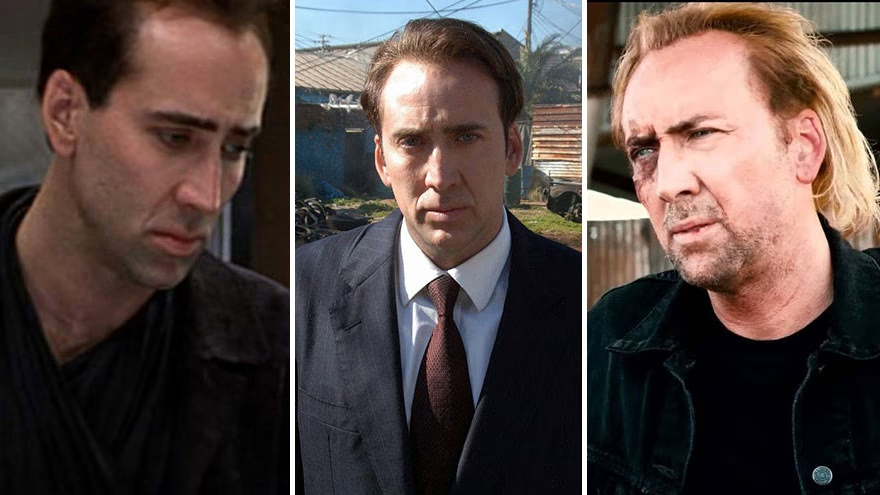
A Better Way to Watch Nicolas Cage
Nicolas Cage movies do not fit neatly into a normal best-to-worst list. The same actor can give a bruised, quiet performance in one film, then swing for the rafters in the next. That is the reason he is still interesting after decades on screen: the risk is always visible.
The safest way into his filmography is to stop asking if every choice is tasteful. Cage is at his best when the film understands the size of his performance. Some directors use that intensity as tragedy, some use it as comedy, and some let it run loose with mixed results.
The Academy's 1996 ceremony record still marks the center of the serious argument: Cage won Best Actor for Leaving Las Vegas. The meme version of Cage came much later, but the craft was never a joke.
The best entry point depends on mood. A viewer looking for warmth needs a different first film than a viewer who wants full-volume absurdity. That is why the list below is sorted by use, not by a fake claim that every title can be compared on one clean scale.
Start With the Performances That Explain the Devotion
If someone only knows Cage through internet clips, start with Moonstruck, Raising Arizona, Leaving Las Vegas, and Adaptation. Those four films show the range without turning the night into homework.
Leaving Las Vegas is the rawest of the group. The performance is not polished in the comfortable sense. It is exposed, sad, and sometimes hard to watch, which is why it still holds up better than many prestige performances from the same era.
Adaptation is the cleaner doorway for viewers who want something clever. Cage plays twin brothers without turning the device into a circus trick. One brother is blocked, anxious, and sour; the other is sunny in a way that slowly becomes touching.
For a lighter evening, pair Moonstruck with a home dinner instead of treating the movie like a museum piece. If you are building a full night around a film, Livecub's Mom's Best Fudge Icing can carry dessert without stealing the room.
The Action-Star Run Still Works When You Let It Be Loud
The mid-to-late 1990s action run is its own lane: The Rock, Con Air, and Face/Off. They are not subtle movies, and they do not need to be. They move fast, the supporting casts know the assignment, and Cage gives each hero a slightly cracked emotional center.
The Rock works because Stanley Goodspeed is nervous before he becomes brave. Con Air works because Cameron Poe is absurdly noble inside an absurd plot. Face/Off works because the film lets Cage and John Travolta treat identity theft as opera.
The fun is in the swing. These films are cleaner than their reputation because they understand speed, villainy, and escalation. They also prove that Cage's oddness can sell popcorn spectacle rather than fight it.
If you are cooking during a loud Cage night, keep the food as direct as the movie. A pan of noodles or rice with one of Livecub's 6 Stir Fry Sauces makes more sense than a fussy plate you have to babysit while planes explode on screen.
The action era is also where many arguments start. Some viewers treat these films as guilty pleasures. That sells them short. Their confidence is part of the pleasure, and Cage is the reason the confidence does not feel anonymous.
The Strange Middle Years Need Sorting
Cage worked constantly, and that volume produced uneven decades. The weaker films are not all weak in the same way. Some are bland thrillers, some are cheap-looking genre pieces, and some are fascinating messes with one or two scenes worth remembering.
The trick is to separate boredom from risk. A bad Cage movie can still be alive if the performance has a pulse. A forgettable Cage movie is worse, because it sands down the very thing people showed up to see.
Not every detour deserves rescue. Still, viewers who enjoy film as behavior study may find value in watching how Cage adjusts to scripts that are too thin for him. He often tries to add a private rhythm where the page gives him very little.
This is where review sites can help without making the decision for you. The Rotten Tomatoes Nicolas Cage page is useful for seeing the rough shape of critical response across his career, but it cannot tell you which strange failure will be fun in your living room.
The Wicker Man Problem
The Wicker Man sits in a special corner because people often know the clips before they know the movie. The bees, the bear suit, the shouting, the panic: they have been stripped from context so many times that the film now arrives with its own laugh track.
Is it good? Not in the normal sense. Is it dull? Rarely.
It is one of those remakes where tone keeps sliding around the floor. Cage pushes the terror and confusion hard, sometimes past the line, and that is exactly why the film refuses to disappear.
Watch it late, with people who are open to talking back to the screen. Do not put it beside Leaving Las Vegas and ask it to survive as drama. Put it after something lighter, or make it the strange centerpiece of a bad-movie night.
Its reputation is now part of the viewing. Pretending otherwise makes the film less useful. The better question is not whether it failed, but why that failure stayed so easy to remember.
If the gathering is more social than scholarly, fold in something unrelated but useful from the site, such as Livecub's Ultimate Guide to Cookie Displays. A table of snacks is more honest than pretending everyone is there for strict film theory.
The Comeback Was Quieter Than the Memes
The later run gave Cage a different kind of respect. Mandy leaned into fury and grief. Pig surprised people who expected another revenge picture and got a wounded story about loss, taste, and memory. The Unbearable Weight of Massive Talent turned the public idea of Cage into a comic partner.
Dream Scenario and Longlegs kept that late-career interest alive by using his face and voice in stranger ways. The point is not that every new role is a masterpiece. The point is that the work again feels selected for shape, not just volume.
Pig is the modern reset button. It is quiet enough to remind viewers that Cage can hold a close-up without fireworks. After years of jokes, that restraint felt like a correction.
That late-period shift is also why old punchlines feel lazy now. The performances are still recognizably Cage, but the projects often give him a cleaner frame. He no longer has to overpower the film to keep it alive.
Build a Cage Night That Actually Flows
For a balanced three-film night, start with Moonstruck, move to Face/Off, then close with Pig. That order gives you romance, spectacle, and ache without exhausting the room. For a chaos night, swap in Vampire's Kiss, The Wicker Man, and Mandy.
If the movie night is tied to a birthday or memorial gathering, the film choice should match the person being remembered. Livecub's Ideas for Memorial Birthdays is a better fit than forcing a loud cult title onto a night that needs warmth.
The good Cage films prove his control. The bad ones show what happens when the movie cannot meet him. The Wicker ones explain why people keep watching anyway. Few actors make failure this readable, and fewer still turn it into part of the appeal.
That is the real reason the filmography still travels. It is not just nostalgia, and it is not only irony. Cage gives viewers enough sincerity to keep the wild choices from feeling empty.
Frequently Asked Questions
What Nicolas Cage movie should a new viewer watch first?
Start with Moonstruck for charm, Raising Arizona for comedy, or Leaving Las Vegas for serious drama. Face/Off is the best action entry point.
Is The Wicker Man actually worth watching?
Yes, if you know what kind of night you want. It is not the best showcase of his dramatic skill, but it is a strange, memorable piece of cult viewing.
Which later Nicolas Cage movie changed the conversation?
Pig did the most to remind casual viewers that Cage could still deliver quiet, controlled work. It is one of the cleanest late-career starting points.
Are the 1990s action movies still fun?
Yes. The Rock, Con Air, and Face/Off still work because they understand their own scale and give Cage enough room to be odd inside the spectacle.

Tory Stearns
Edits practical household, travel and lifestyle explainers. Claims that can change are linked to current primary or subject-authority sources.
Leave a reply
Replying to