
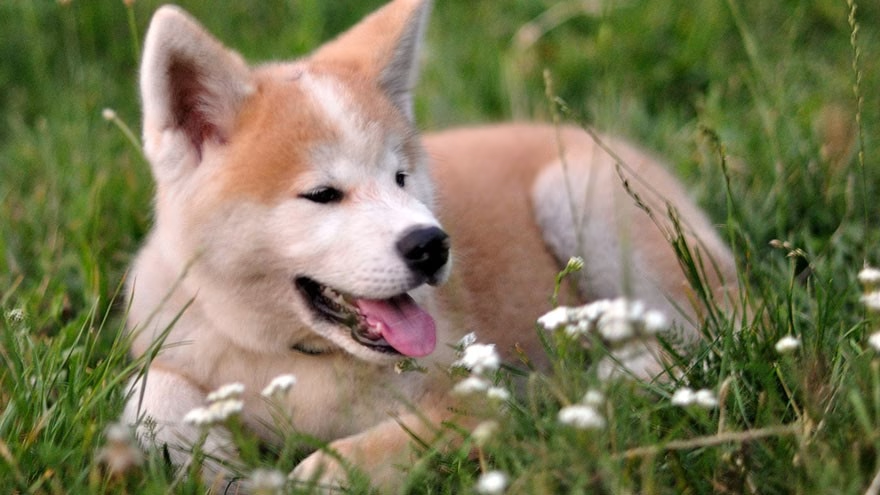
Akita Inu questions usually begin with admiration and worry at the same time. The breed is beautiful, quiet, loyal, and powerful enough that casual ownership can become unfair to the dog and unsafe for the household. In the United States, people often say "Akita" for the large Japanese-origin working breed recognized by AKC, while Japanese Akita Inu and American Akita discussions can use different registry language. For a family buyer, the practical questions are simpler: can you handle an independent, strong, double-coated dog that needs early training, careful socialization, health screening, and adult-level boundaries?
Where does the Akita Inu come from?
AKC describes Akitas as muscular, double-coated dogs of ancient Japanese lineage, famous for dignity, courage, and loyalty. Its Akita breed page also notes that in Japan they are regarded as family protectors and symbols of good health, happiness, and long life.
The breed's cold-weather coat and powerful build reflect its northern Japanese roots. Older stories often connect Akitas with hunting and guarding, but a modern owner should not buy one for mythology. Buy one only if the day-to-day care makes sense: training, coat work, safe handling, space, vet care, and a plan for guests and other animals.
People comparing large dogs may look at the top 10 biggest dog breeds, but size is only part of the Akita question. Independence and management matter just as much as weight.
Does an Akita bark a lot?
Many Akitas are not constant barkers. That does not mean they are passive. A quiet Akita may still be watching the room, the fence, the delivery person, and the new dog across the street. Silence should not be mistaken for indifference.
If an Akita starts barking sharply, pay attention to the trigger. It may be alerting to a stranger, animal, odd sound, or frustration. Train a quiet cue and give the dog clear jobs, but do not encourage suspicious barking as a personality trait.
Quiet confidence is easier to live with than noisy suspicion. Socialization, routine, and calm handling help the dog learn what deserves attention and what can be ignored.
Is the Akita good with children?
Some Akitas live well with children in their own household, especially when raised with structure and supervision. The word "good" needs limits. Children should not climb on, hug tightly, take food, disturb sleep, or test the dog's patience. A powerful dog deserves respectful handling.
Supervision is not optional. Teach children to give the dog space and teach the dog to settle away from busy play. A crate, gated room, or quiet mat can protect everyone when the house is loud.
Breed comparisons help expectations. A family considering a Rottweiler's common questions will see the same principle: strong dogs can be loving, but love does not replace training and management.
How hard is Akita training?
The Akita Club of America says Akitas are intelligent, can get bored easily, and learn best with short training periods. Its overview of the Akita also says owners should train their own dogs rather than sending them away and expecting a finished product to come back.
That advice matters because Akitas bond through relationship and consistency. Training should include name response, recall on lead, leash manners, calm greetings, leave it, drop it, muzzle introduction, vet handling, and a settle cue. Sessions should be short and serious without being harsh.
Owner involvement is the core. A professional trainer can coach, but the owner has to practice daily. An Akita that listens only to a trainer is not trained for real life.
Can Akitas live with other dogs?
Some can, but this is one of the breed's serious management questions. Same-sex dog conflict and animal selectivity are discussed often by Akita owners and breeders. Do not assume a puppy will remain social with every dog after maturity.
Early socialization should teach calm neutrality, not forced dog-park friendliness. Dog parks are often a poor fit for Akitas because unknown dogs, speed, toys, and crowding can create trouble fast. Controlled walks, stable house rules, and careful introductions are safer.
For a calmer comparison, read Basset Hound common questions and notice how different breed problems can look. The Akita question is less about stubborn comedy and more about strength, space, and adult judgment.
What health questions should buyers ask?
Ask about hips, elbows, eyes, thyroid, autoimmune concerns, bloat history, temperament, and longevity in relatives. OFA's CHIC program explains that breed-specific health testing supports breeders and puppy buyers through a public health-information system. Its CHIC program page is useful background before talking to breeders.
The Japanese Akitainu Club of America says it encourages breeders to have potential sires and dams undergo hip and eye exams and to provide OFA and PRA results to people on waiting lists. Its breed health page is especially relevant if you are looking specifically at Japanese Akitainu lines.
Paperwork matters. A breeder's claim that the parents are healthy is not the same as registered results, clear family history, and willingness to discuss risks. Ask before you fall in love with a puppy.
What daily routine fits an Akita?
A workable Akita day is steady rather than frantic. Plan a real walk, a few minutes of training, coat checks, quiet rest, and controlled chances to see normal life. The dog should learn that delivery trucks, neighbors, children on bikes, and guests are not automatic problems.
Routine lowers friction. Feed in a calm place, store toys and food safely, and do not let the dog rehearse charging the front door. A mat cue near the living room can be more useful than another long lecture about dominance.
Exercise should match age and weather. A young Akita should not be pounded through forced distance, and an older one may need shorter walks with more sniffing time. Heat can be hard on a thick coat, so summer plans may need early mornings, shade, and water.
How should you meet an Akita breeder?
Go in with questions written down. Ask how the breeder chooses pairings, what health results are available, how puppies are handled, what the contract says, and what kind of owner they refuse. A good breeder should be interviewing you too.
Temperament history matters as much as photos. Ask what the relatives are like with guests, grooming, veterinary handling, cars, children, and other dogs. If every answer is vague or every dog is described as perfect, slow down.
Do not choose by color alone. A pretty puppy from careless breeding can leave you with years of medical bills or management problems. The better choice is the puppy whose breeder can explain the whole litter, the parents, the health records, and the support they provide after sale.
What mistakes make Akita ownership harder?
The common mistakes are predictable: waiting to train, encouraging guard behavior, allowing rough play, visiting dog parks, ignoring coat care, and assuming loyalty means obedience. Akitas often respect calm consistency more than noise.
Control the environment before the dog is over threshold. Use gates when guests arrive, keep food bowls private, teach children house rules, and practice calm handling before the vet visit. Management is not failure. With this breed, it is part of responsible ownership.
One more question belongs before any deposit: what will your life look like on a bad Tuesday? If the answer includes loose gates, rushed walks, visiting dogs, and no training time, wait. The breed will not become easier just because the puppy is beautiful.
Fit beats fantasy. A well-matched Akita can be calm, affectionate, and impressive without drama. A poorly matched one can make ordinary life tense. Honest timing is part of good ownership.
Frequently Asked Questions
Is an Akita a good first dog?
Usually not for casual first-time owners. A committed beginner with breed mentors, training help, and realistic boundaries may succeed, but the learning curve is steep.
Do Akitas shed?
Yes. Akitas have a thick double coat and can shed heavily, especially during seasonal coat drop. Brushing, vacuuming, and skin checks are part of ownership.
Are Akitas protective?
Many are naturally watchful and reserved with strangers. Protection should be managed through training and judgment, not encouraged as uncontrolled suspicion.
How much exercise does an Akita need?
Most need daily walks, training, and mental work rather than frantic exercise. Heat, age, joints, and temperament should shape the routine.
An Akita Inu is best for someone who respects independence without romanticizing it. Choose the breed for the real work: training, records, coat care, supervision, and lifelong management.

Tory Stearns
Edits practical household, travel and lifestyle explainers. Claims that can change are linked to current primary or subject-authority sources.


Leave a reply
Replying to