
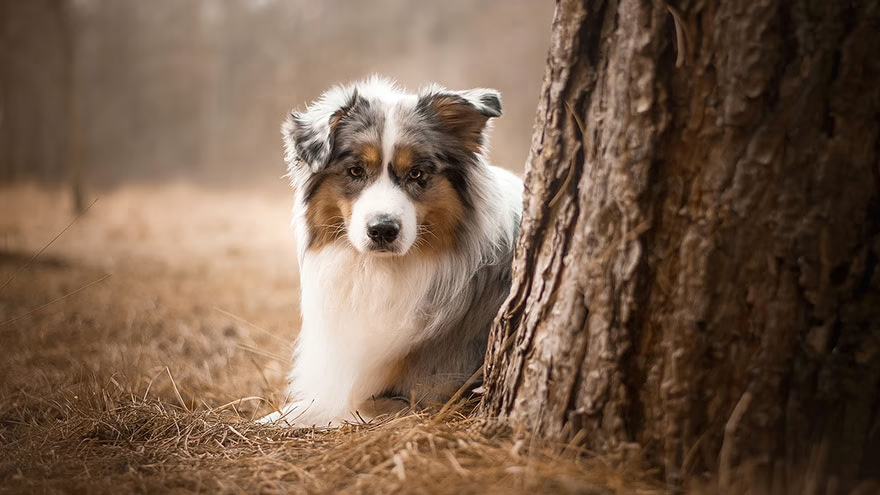
The Australian Shepherd is one of America's most popular working breeds — and one of its most misnamed. Despite the word "Australian" in the title, the breed was developed entirely in the American West, shaped by the ranching demands of California, Colorado, Wyoming, and Idaho. The "Australian" connection traces back to the 19th century, when Basque shepherds from Europe settled in Australia before eventually moving on to the American West, bringing their sheepdogs with them. Ranchers noticed these imported dogs arriving from Down Under and started calling every merle sheepdog an "Australian Shepherd." The name stuck. The country of origin never changed — it was always the United States.
Are Australian Shepherds Actually From Australia?
The short answer is no, and the longer answer is complicated in exactly the right way. Australian Shepherds belong to what geneticists call the UK Rural clade — the same family as the Border Collie, Collie, and Shetland Sheepdog. A landmark 2017 Cell Reports genomic study confirmed that today's Aussie descends primarily from British herding dogs, whether they arrived in the American West via eastern U.S. livestock operations or via Australia itself.
The Basque shepherds did play a role, arriving in large numbers during the Gold Rush era of the 1870s, but breed historians debate how much they shaped the final dog versus simply herding with the British-derived sheepdogs already working the western ranges. Meanwhile, a wave of Merino sheep traveling from Germany to Australia to the American West in the late 1800s brought working dogs along for the journey — and every merle sheepdog that arrived from Australian shores earned the "Australian Shepherd" label whether it had ever spent meaningful time in Australia or not.
The breed's AKC-recognized history reflects this American identity. The American Kennel Club classifies the Australian Shepherd in the Herding Group, with males standing 20–23 inches at the shoulder and weighing 50–65 pounds, and females running slightly smaller at 18–21 inches and 40–55 pounds. The Australian Shepherd Club of America was established in 1957; the AKC granted the breed full recognition in 1991, with the breed standard taking effect January 1, 1993.
What Colors Do Australian Shepherds Come In?
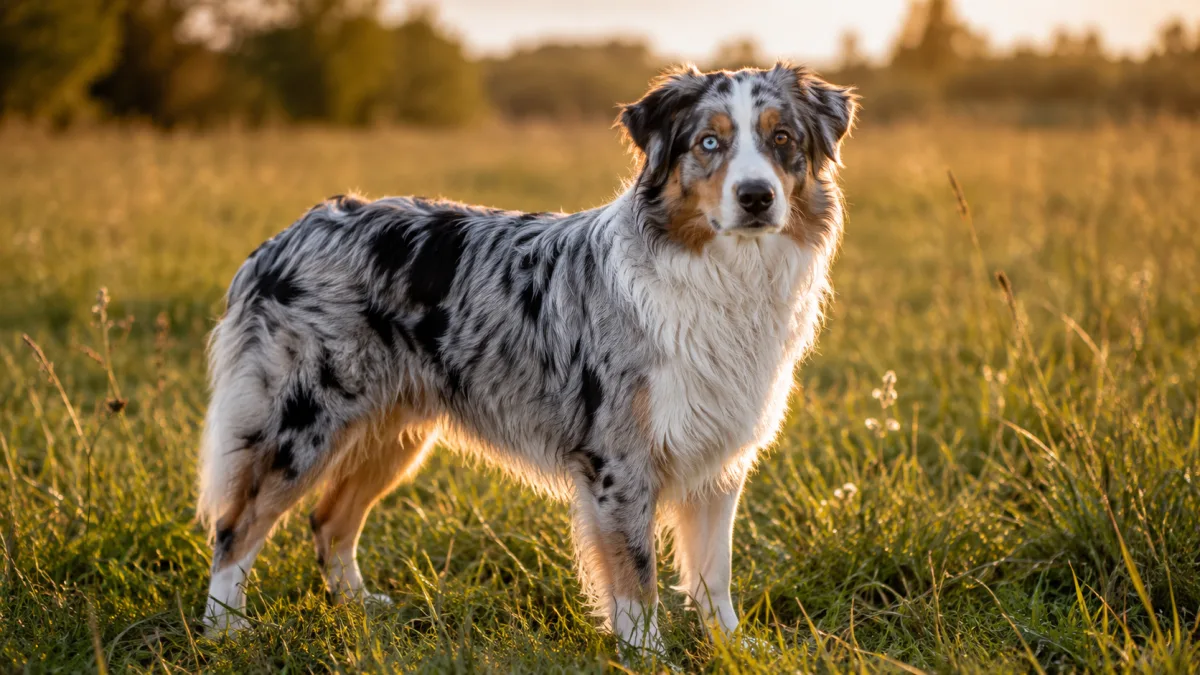
The AKC breed standard recognizes four base colors: blue merle, black, red merle, and red — each of which can appear with or without white markings, with or without copper (tan) points, and in any combination of those two additions. No color carries a preference over another in the show ring.
That produces a wide range of visual expressions. A black tri, for instance, carries a solid black base coat with warm tan markings above the eyes and on the cheeks, legs, and chest, plus white on the chest, belly, and paws. A blue merle takes that same pattern and overlays a random, torn-marble pattern of gray and black across the base, creating a different look on every single dog. Red merles follow the same marbling logic but on a reddish-brown base rather than black — the result is a warm coppery pattern that can read anywhere from pale fawn to deep liver.
Eye color adds another dimension entirely. Aussies can have brown, blue, or amber eyes — or any combination across both eyes. Heterochromia (two different-colored eyes) is common, and merle-patterned dogs frequently show "marbled" or flecked irises, where blue and brown appear within a single eye. This trait is directly linked to the merle gene and is one of the breed's most visually striking features.
If you're comparing Australian Shepherds with other breeds that come in multiple coat patterns, the Aussie's color variety is unusually broad for a single AKC-recognized breed.
How Much Exercise Does an Australian Shepherd Need?
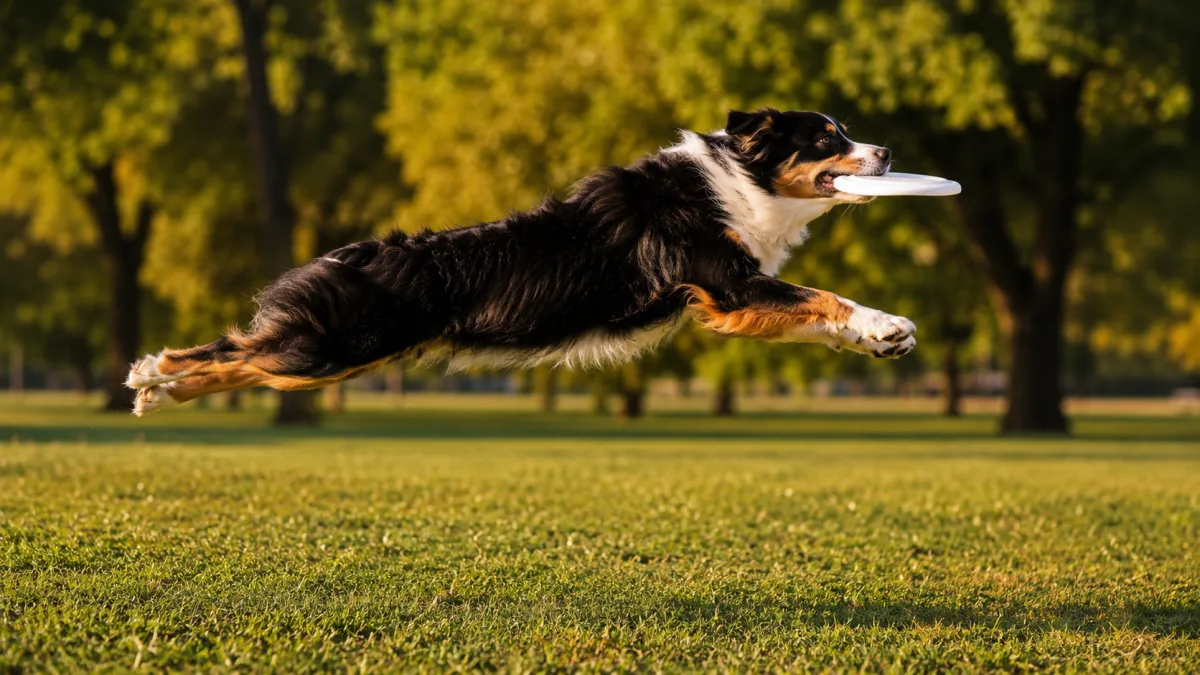
An adult Australian Shepherd needs a minimum of one to two hours of vigorous physical activity every day — and that figure assumes access to off-leash running, not just leashed neighborhood walks. Working-line Aussies, bred from dogs that covered miles of terrain daily while managing livestock, often push that requirement higher. The breed was built for endurance, not bursts, and a 20-minute toss of the ball won't cut it for most dogs.
Physical output alone doesn't satisfy an Aussie, either. The breed carries a high-drive intellect that needs its own outlet. Training sessions, puzzle feeders, nose work, and organized dog sports — agility, flyball, disc catching, herding trials — provide the cognitive engagement that keeps an Aussie mentally settled. Research in canine cognition suggests that 15 minutes of intensive scent work or focused obedience training can produce fatigue equivalent to a 30-minute run, which gives some sense of how much mental energy these dogs carry.
The consequence of under-exercising an Australian Shepherd shows up fast: destructive chewing, obsessive behaviors, excessive barking, and anxiety that can spiral into genuine behavioral problems. This is a working dog in a pet-dog body, and the working impulse doesn't disappear because the sheep are gone.
Why Does My Australian Shepherd Nip at Heels?
Heel nipping is the Aussie's primary herding tool, and understanding the mechanics explains why training — not punishment — is the only effective response. When moving livestock, a herding dog applies pressure to the animals' heels to shift direction. The contact is deliberate, low, and controlled: a quick nip at the hock tells a sheep to move left or right without escalating to a bite. The sheep respond; the herd moves. The behavior is rewarded every single time it works.
In a household environment, the target changes but the instinct doesn't. Children running across the yard, joggers on the sidewalk, cyclists passing by — anything moving at speed in an arc triggers the same chase-and-redirect sequence that would move a flock. The dog isn't being aggressive; it's doing its job on whatever is available.
Redirecting this drive works better than suppressing it. Structured fetch games, frisbee, and agility courses give the dog a legitimate outlet for the chase-and-control sequence. Actual herding trials, available through the Australian Shepherd Club of America, let Aussies do the thing they were bred for under controlled conditions. Early socialization and obedience training — particularly a reliable "leave it" and "sit-stay" — give the dog a behavioral off-switch for situations where nipping is inappropriate. For more on herding-breed temperament management, the experience with a similarly high-drive breed like the German Shorthaired Pointer offers useful comparison.
What Are the Most Common Health Problems in Australian Shepherds?
Australian Shepherds are a generally healthy breed with a lifespan of 12–15 years, but several conditions appear with enough frequency to warrant prospective owners' attention before they ever bring a puppy home.
Idiopathic epilepsy is relatively common in the breed. Seizures typically begin between one and five years of age in affected dogs. No genetic screening test currently exists for epilepsy in Aussies, making breeder history the most useful tool available — a reputable breeder should be able to speak to seizure incidence across multiple generations of their lines.
Hip dysplasia affects roughly 4.6% of Australian Shepherds, according to Orthopedic Foundation for Animals data. In this condition, the ball of the femur doesn't seat properly in the hip socket, generating abnormal wear that leads to degenerative joint disease over time. OFA hip certification on both parents is a baseline expectation from responsible breeders.
Collie Eye Anomaly (CEA) affects Australian Shepherds as well as their UK Rural clade relatives — Border Collies, Shelties, and Collies — because the breed shares British herding ancestry with all of them. CEA is a recessive condition that affects retinal and scleral development; severity ranges from clinically insignificant "choroidal hypoplasia" to complete blindness. A DNA test for CEA is available and should be performed on breeding dogs.
Autoimmune conditions, including hypothyroidism and certain inflammatory skin diseases, also appear in the breed. VCA Animal Hospitals notes that Aussies can be prone to a range of autoimmune-related presentations, and thyroid screening is increasingly standard practice among health-conscious breeders.
For owners interested in how health profiles compare across herding-adjacent breeds, detailed breed health breakdowns follow a similar structure across different working dog lines.
What Is the MDR1 Gene Mutation in Australian Shepherds?
The MDR1 mutation — now formally designated the ABCB1 variant — is the single most important health fact any Australian Shepherd owner should know before their dog receives any medication. The mutation affects P-glycoprotein (P-gp), a protein that normally acts as a cellular pump: it eliminates certain drugs after administration and physically prevents specific substances from crossing into the brain and other organs.
When the ABCB1 variant is present, P-gp function is compromised. Drugs that P-gp would normally move out of the brain instead accumulate there, reaching concentrations that cause severe neurological toxicity. The clinical signs range from vomiting and incoordination to tremors, seizures, blindness, and death.
According to Cornell University's Riney Canine Health Center, drugs requiring particular caution in MDR1-affected dogs include high-dose ivermectin (note: standard heartworm preventatives contain FDA-approved low doses that are generally safe), the anti-diarrheal loperamide (Imodium), certain chemotherapy agents, and the sedatives acepromazine and butorphanol. Some drugs become problematic in combination even in dogs without the variant — ketoconazole, cyclosporine, and spinosad (Comfortis) can all raise drug concentrations when used together.
The mutation is inherited. A dog with two copies of the variant (homozygous) is most severely affected; a dog with one copy can still experience toxicity with certain drugs. Among herding breeds, Australian Shepherds and Miniature American Shepherds have among the highest mutation frequencies in tested populations — approximately 50% of tested Aussies carry at least one copy of the variant. A DNA test from Washington State University's Veterinary Clinical Pharmacology Lab or similar services costs under $70 and tells you exactly which category your dog falls into. Every Aussie owner should know this result before a medication situation arises.
How Do You Groom an Australian Shepherd's Coat?
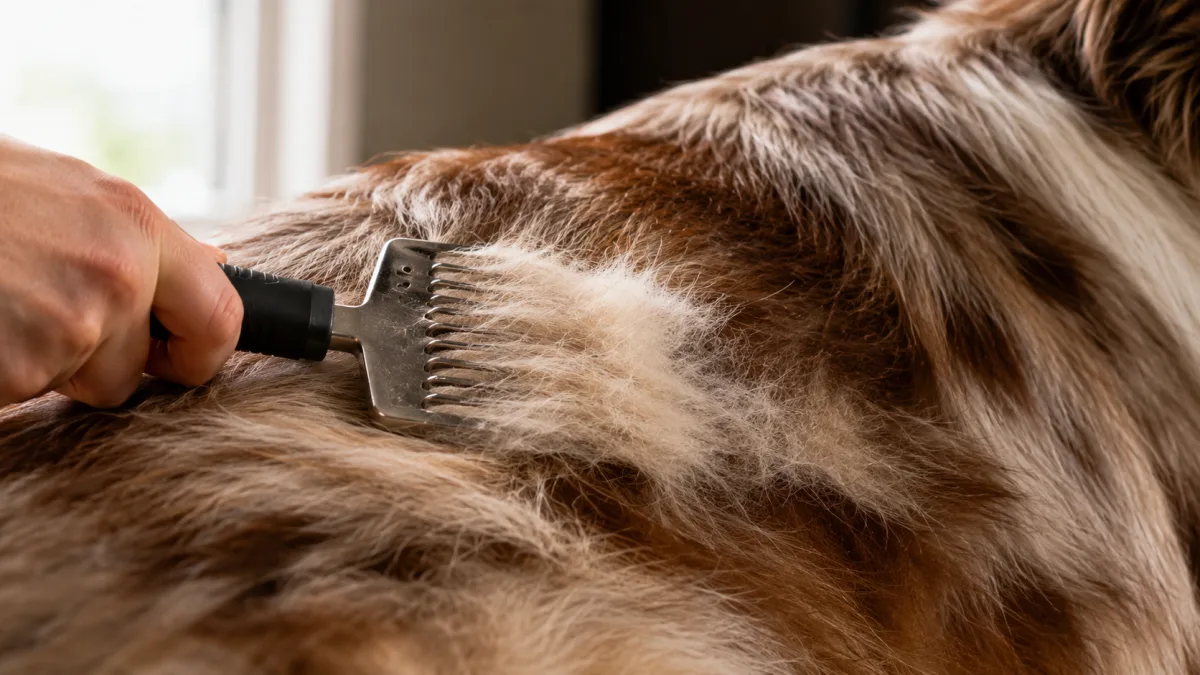
The Australian Shepherd carries a double coat: a weather-resistant outer layer of medium-length guard hairs, straight to slightly wavy, and a dense undercoat that provides insulation in both cold and hot conditions. The two layers work together as a system — the outer coat sheds rain and repels debris, while the undercoat regulates temperature by trapping air next to the skin.
Twice each year, in spring and fall, Aussies "blow" their undercoat — a shedding event that produces volumes of loose fur that dwarfs normal daily shedding. During these periods, daily brushing with a de-shedding tool (an undercoat rake or slicker brush) is the only way to stay ahead of the mats that form when shed undercoat tangles with the remaining guard hairs. Between coat blows, brushing two to three times per week keeps the coat clean and tangle-free for most dogs.
Shaving is not a solution for shedding and can cause lasting damage. Once shaved, the undercoat typically regrows faster than the guard hairs, leaving a coarse, fuzzy texture that lacks the original coat's waterproofing and UV-filtering properties. A shaved Aussie in summer is actually at higher risk of overheating and sunburn, not lower — the double coat functions as insulation in both directions. For more on managing double-coated breeds, proper coat care technique applies across several similar coat types.
Professional de-shedding treatments, timed to coincide with the twice-yearly coat blow, can remove significantly more loose undercoat than home brushing alone. Light trimming around the ears, paws, and chest for practical neatness is acceptable and does not disrupt coat function.
Are Australian Shepherds Good Family Dogs?
Australian Shepherds are good with children and other pets — with the caveat that "good" is not the same as "effortless." The breed's protective instincts, high energy level, and herding drive all require management, especially in homes with young children who run and squeal in ways that activate chase behavior.
Early socialization is the mechanism by which Aussies learn to generalize "safe" across a wide range of people, environments, and situations. A puppy that meets dozens of different people, children, sounds, and settings before 16 weeks of age builds a behavioral baseline that treats novelty as normal rather than threatening. An Aussie that lacks this foundation tends toward wariness of strangers and may take a protective stance that reads as aggression to people who don't know the breed.
With structure, consistent training, and adequate exercise, the Australian Shepherd is a loyal, affectionate family companion. The breed's intelligence makes training genuinely rewarding — Aussies learn commands quickly and enjoy the mental engagement of obedience work. They do well with other dogs and can adapt to multi-pet households when introduced properly. The breed's herding instinct means young children should be supervised early on, and the impulse to nip heels should be redirected rather than ignored.
Families considering the breed should be realistic about the time commitment. An Aussie that gets its exercise, training, and mental stimulation is a calm, devoted house dog. One that doesn't becomes an anxious, destructive one — and neither outcome is the dog's fault.
Frequently Asked Questions
What is the difference between a standard, miniature, and toy Australian Shepherd?
The standard Australian Shepherd is the only version recognized by the AKC in the Herding Group. The "Miniature American Shepherd" — which many people still call a Mini Aussie — was developed from small Australian Shepherds and gained full AKC recognition in 2015 as a separate breed, standing 13–18 inches tall. The name change from "Miniature Australian Shepherd" to "Miniature American Shepherd" was made specifically to qualify for AKC registration. Toy Australian Shepherds — dogs under 14 inches — are not separately recognized by the AKC or any major kennel club, and no breed standard exists for them. Prospective buyers searching for "toy Aussies" should vet breeders carefully.
Do Australian Shepherds have blue eyes?
Some do, and others don't. Eye color in Aussies can be brown, blue, amber, or any combination across the two eyes. Heterochromia — one blue eye and one brown — is common and accepted by the breed standard. Merle-patterned dogs are more likely to show blue or marbled (flecked) eyes because the merle gene affects pigmentation distribution. Blue eyes can appear in non-merle Aussies as well, though less frequently.
How long do Australian Shepherds live?
The typical Australian Shepherd lifespan is 12–15 years. Genetics, diet, weight management, and exercise all influence where individual dogs land within that range. Hip dysplasia, epilepsy, and autoimmune conditions are the health factors most likely to affect quality of life in older dogs. Genetic testing for MDR1/ABCB1 and CEA, combined with annual veterinary wellness checks, gives owners the best tools for proactive management as their dog ages.
When were Australian Shepherds recognized by the AKC?
The AKC approved the Australian Shepherd's breed standard on May 14, 1991, placing the breed in the Herding Group. The standard became effective January 1, 1993. The Australian Shepherd Club of America had been operating since 1957, with working dogs registered through the National Stock Dog Registry long before AKC recognition — many working-line Aussies are still registered with those organizations rather than the AKC.
What is the single most important health test to ask an Aussie breeder about?
MDR1/ABCB1 genetic testing. Hip certification (OFA or PennHIP), eye exams (CAER), and CEA DNA testing all matter — but MDR1 status is the one piece of information that affects every veterinary interaction your dog will ever have, from routine sedation to emergency treatment. A breeder who tests for MDR1 and can show you documented results for both parents demonstrates a level of health-program seriousness that should give you confidence in their other practices as well. If a breeder hasn't heard of MDR1, walk away.

Tory Stearns
Edits practical household, travel and lifestyle explainers. Claims that can change are linked to current primary or subject-authority sources.
Leave a reply
Replying to