

Treat the developmental calendar as a map, not a report card on your baby. Milestones describe skills that many children show by a certain age, which makes them handy for noticing progress and raising questions early. What they cannot capture is personality, culture, prematurity, illness, or the wide range of perfectly normal variation between two healthy babies.
How To Read Milestones Without Panicking
The CDC's Learn the Signs. Act Early program lists milestones from 2 months through 5 years and describes them as skills most children reach by a given age: CDC developmental milestones. One missed item is not a diagnosis. A cluster of missed skills, the loss of a skill a baby already had, or a parent's steady sense that something is off — those are the things that deserve a pediatric conversation, and you are not bothering the doctor by asking.
For babies born early, adjusted age matters. A baby born eight weeks premature may not match a full-term calendar for a while, and that is expected rather than alarming. Reading on premature baby development gives more context for judging progress fairly instead of against the wrong clock.
A Month-By-Month Snapshot

The table below sketches common skills by age. Read it left to right as a general direction of travel, not as a set of deadlines to pass or fail on a particular day.
| Age | Skills many babies show | Worth a mention to the doctor |
|---|---|---|
| 0–2 months | Brief eye contact, turning to voices, social smiling, moving both arms and legs | Very floppy or stiff, no response to loud sound, no social smile |
| 3–4 months | Smiling back, cooing, pushing up on forearms, following movement | No smiling, not tracking objects, weak head control |
| 5–6 months | Rolling, reaching, laughing, sitting with support | Not rolling either way, no reaching, poor head control |
| 7–9 months | Sitting steadily, passing toys hand to hand, babbling, responding to name | Not sitting with support, no babble, no response to name |
| 10–12 months | Pulling to stand, cruising, gestures, looking for hidden objects | No gestures, not bearing weight on legs, loss of any skill |
The First Six Months

Early on, development is subtle. In the first weeks you may notice brief eye contact, head-turning toward voices, hands near the mouth, startle reflexes, and short stretches of alertness. By two months, the CDC's milestone list includes social smiling, calming when spoken to or picked up, looking at faces, and moving both arms and legs. Tummy time while awake and supervised builds neck and shoulder strength; keep sessions short if your baby hates them, since several tiny sessions beat one long battle.
The three-to-six-month window usually brings more personality: smiling back, cooing, watching hands, pushing up on forearms, and following movement with the eyes. Early communication is back-and-forth, not word count, so face-to-face talk, a soft rattle, a mirror, and songs do more than any screen. Near six months many babies roll, reach, bring objects to the mouth, laugh, and sit with support, and some show early feeding readiness. Feeding and development overlap here, so let growth, allergy, or swallowing questions go to the pediatrician. If your baby was low birth weight or preterm, track growth and motor progress more closely using low birth weight and preterm infant guidance alongside visits rather than guessing from a chart.
Half A Year To The First Birthday
Between seven and nine months, many babies sit more steadily, transfer toys between hands, babble strings of sounds, respond to their name, and prefer familiar people. This is also a safety turning point: once rolling, scooting, or crawling begins, the floor becomes the baby's main workspace, which makes baby-proofing room by room relevant before the first fast crawl, not after. Separation anxiety often appears too, not because you created a bad habit but because attachment and memory are changing.
By the first birthday, many babies pull to stand, cruise along furniture, use gestures, imitate sounds, look for hidden objects, and follow simple routines. The CDC's 1-year page frames milestone watching as a way to see how a child plays, learns, speaks, acts, and moves: CDC milestones by 1 year. The overall pattern matters more than any single party trick, and daily care doubles as practice, since bath time, dressing, and meals all teach language and body awareness.
Milestones Parents Often Misread
Crawling is not always the classic hands-and-knees version. Some babies army crawl, scoot, roll with purpose, or head straight for pulling up. What is worth asking about is movement that is very one-sided, absent, or paired with stiffness. Walking has a similar range: some babies step before twelve months and others need more time, so the real questions are strength, symmetry, coordination, and steady progress rather than a date on the calendar.
Speech begins well before words. Looking, taking turns with sounds, gesturing, pointing, and responding to a name are all part of communication. A quiet baby who does not gesture or respond deserves more attention than a chatty baby who simply has no clear word yet, because the back-and-forth is the skill that words are built on.
When To Call The Pediatrician
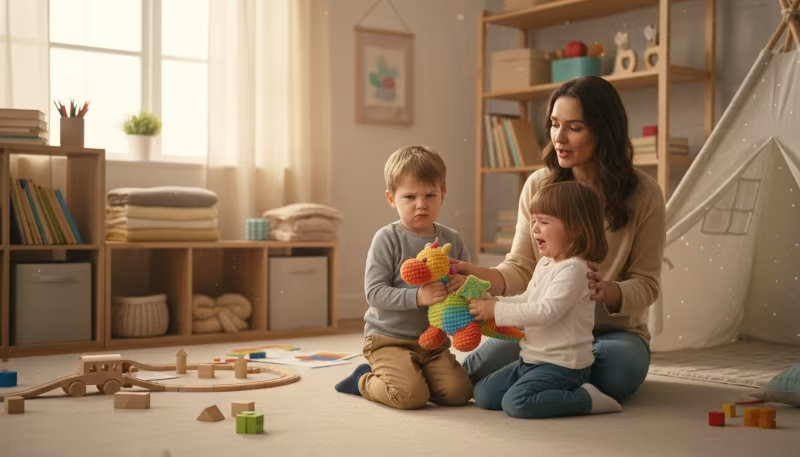
Call if your baby loses skills, has feeding trouble, seems unusually floppy or stiff, does not use one side of the body well, does not respond to sound, has no social smile by around two months, or is not sitting with support by the expected window. Also call if your gut keeps raising the same concern, since parents notice patterns in daily life that a short visit can miss; bring a short video if the behavior is hard to describe in words. As babies grow into toddlers, regulation and behavior enter the picture, and the same principle carries into toddler tantrum guidance: watch the child, not just the chart.
How To Support Development At Home
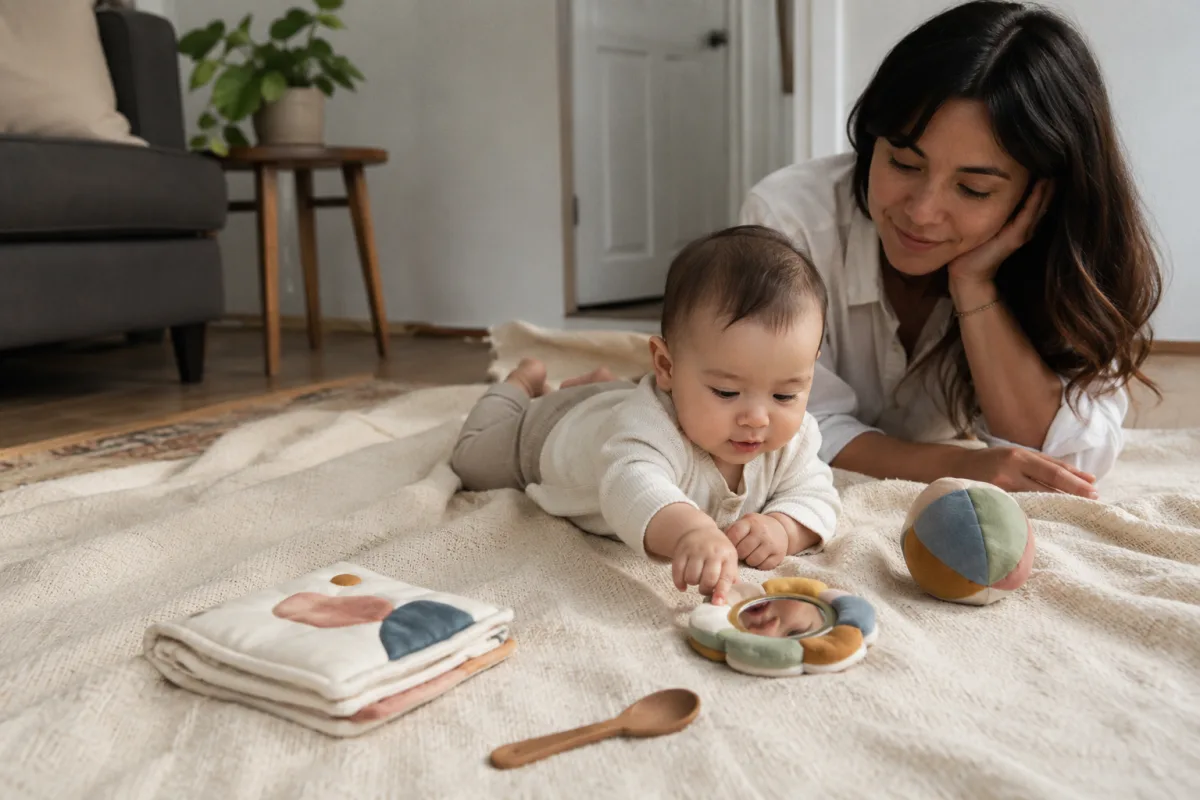
Talk during ordinary care. Narrate the diaper change, name body parts, pause for baby sounds, and answer them as if they matter, because that is exactly how turn-taking starts. Offer floor time every day so your baby can kick, roll, reach, and pivot; swings and seats help briefly but do not replace movement. Rotate a few simple toys — a soft ball, a cloth book, a cup, a spoon, a mirror — rather than burying the baby in a noisy pile.
Use notes for patterns, not scoring. A short phone note ("smiled at song, rolled to side, grabbed spoon") makes appointments more useful without turning parenting into homework, and babies have off days after vaccines, poor sleep, or a growth spurt. If a specialist is recommended, that is not a parenting failure; early physical, occupational, speech, or feeding support can reduce frustration and hand families better tools. Ask what to practice between visits, keep it to one or two clear exercises, and keep the tone playful — a baby does not know they are doing therapy, only that a trusted adult is nearby, responsive, and patient.
Frequently Asked Questions
Are baby milestones exact deadlines?
No. They are guideposts. Patterns, progress, and the loss of skills matter more than one isolated item.
Should I use corrected age for a premature baby?
Often, yes. Ask your pediatrician how long corrected age should be used for your baby.
What if my baby skips crawling?
Some babies move differently or go straight toward standing. Ask if movement is absent, very one-sided, or paired with stiffness.
Do apps replace developmental screening?
No. Trackers can help you notice patterns, but screening and diagnosis belong with qualified clinicians.
Can I speed up milestones?
You can support development with sleep, food, floor time, language, and safe play, but you cannot force a nervous system to mature on command.
This article is for general information only and isn't a substitute for medical advice. Talk to a clinician who knows your full history before making changes.

Chiara Bradshaw
Covers education, culture and creative topics with an emphasis on readable explanations and verifiable references.



Leave a reply
Replying to