
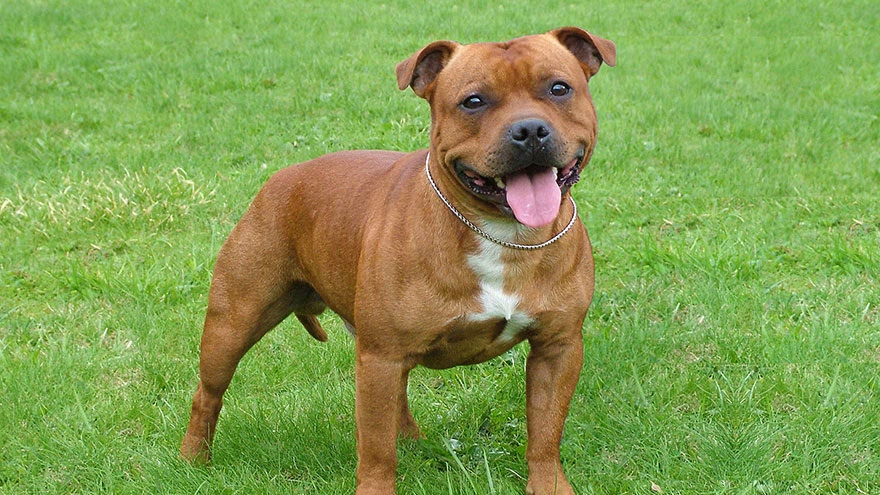
Learning how to identify a Staffordshire Bull Terrier starts with a clear warning: visual breed identification is never perfect. A registered pedigree, breeder records, or DNA testing gives stronger evidence than a quick look. Still, the breed standard can help you understand the body type, size, head, coat, and movement people mean when they say Staffy or Stafford.
This guide is for general breed education, not for legal, housing, insurance, or shelter decisions. If a breed label affects a lease, law, bite case, adoption, or insurance policy, do not rely on appearance alone. Visual labels can be wrong, especially for short-coated muscular dogs.
What Is A Staffordshire Bull Terrier?
The Staffordshire Bull Terrier is a compact, smooth-coated terrier from Britain. The AKC breed standard describes a smooth-coated dog of great strength for its size, muscular but active and agile. That balance is the breed's center: strength without heaviness.
A true Staffordshire Bull Terrier is not simply any muscular short-coated dog. American Staffordshire Terriers, American Pit Bull Terriers, mixed-breed bully-type dogs, and American Bullies may share traits, but they are not the same breed. If you are comparing powerful breeds, Livecub's Rottweiler questions show how different breed purpose changes build and behavior.
How Big Should A Staffordshire Bull Terrier Be?
According to the AKC standard, height at the shoulder is 14 to 16 inches. Males weigh 28 to 38 pounds, and females weigh 24 to 34 pounds, with height related to weight. That surprises many people because the breed is strong but not large.
A dog that is much taller, much heavier, or very bulky may be another bully-type breed or a mix. Size alone cannot prove breed, but it can rule out some guesses. Livecub's biggest dog breeds guide is a reminder that Staffords are not giant dogs.
What Does The Body Look Like?
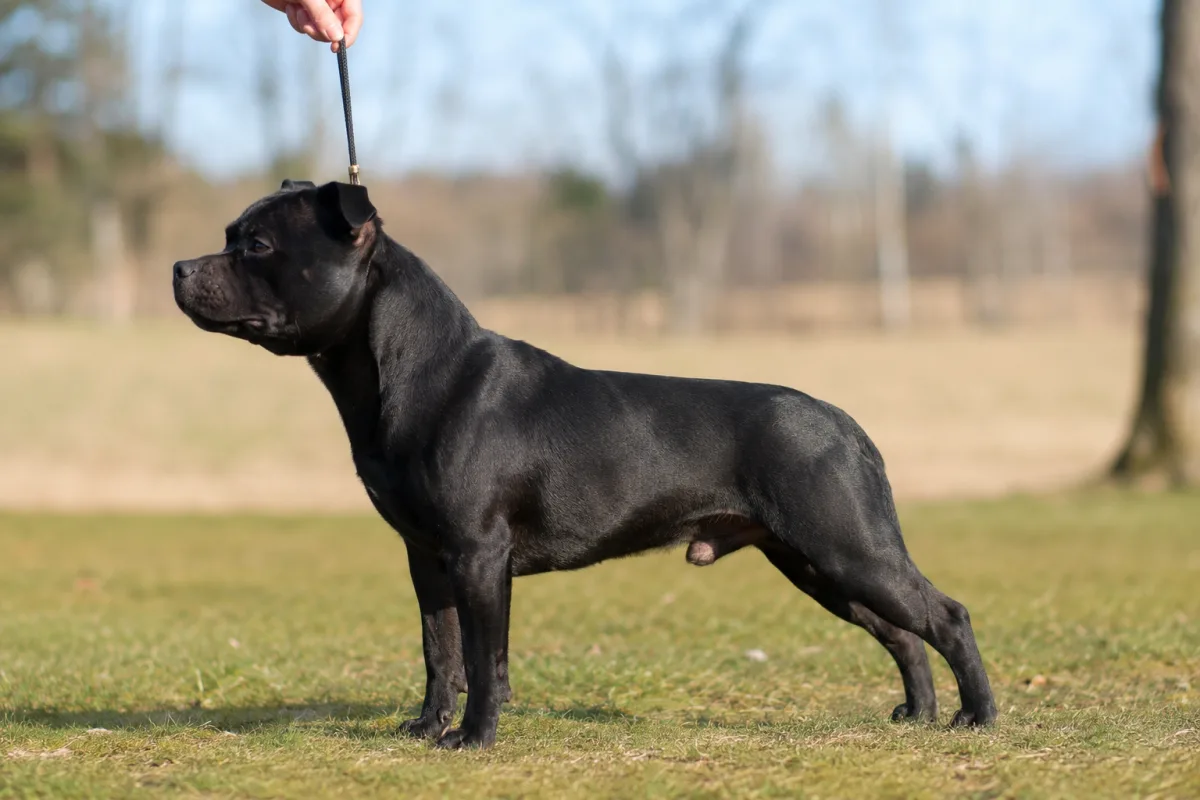
The body should look compact, balanced, muscular, and athletic. The dog should not look fragile, long-backed, or clumsy. The chest is broad and deep for the size, the neck is strong, and the topline should look steady. The breed gives the impression of a lot of dog in a small frame.
Do not confuse overdone bulk with correct type. The standard calls for activity and agility. A Stafford should be able to move freely, turn, jump, and play. A body that is so heavy the dog waddles or overheats quickly is not the same thing as breed strength.
How Do You Recognize The Head?
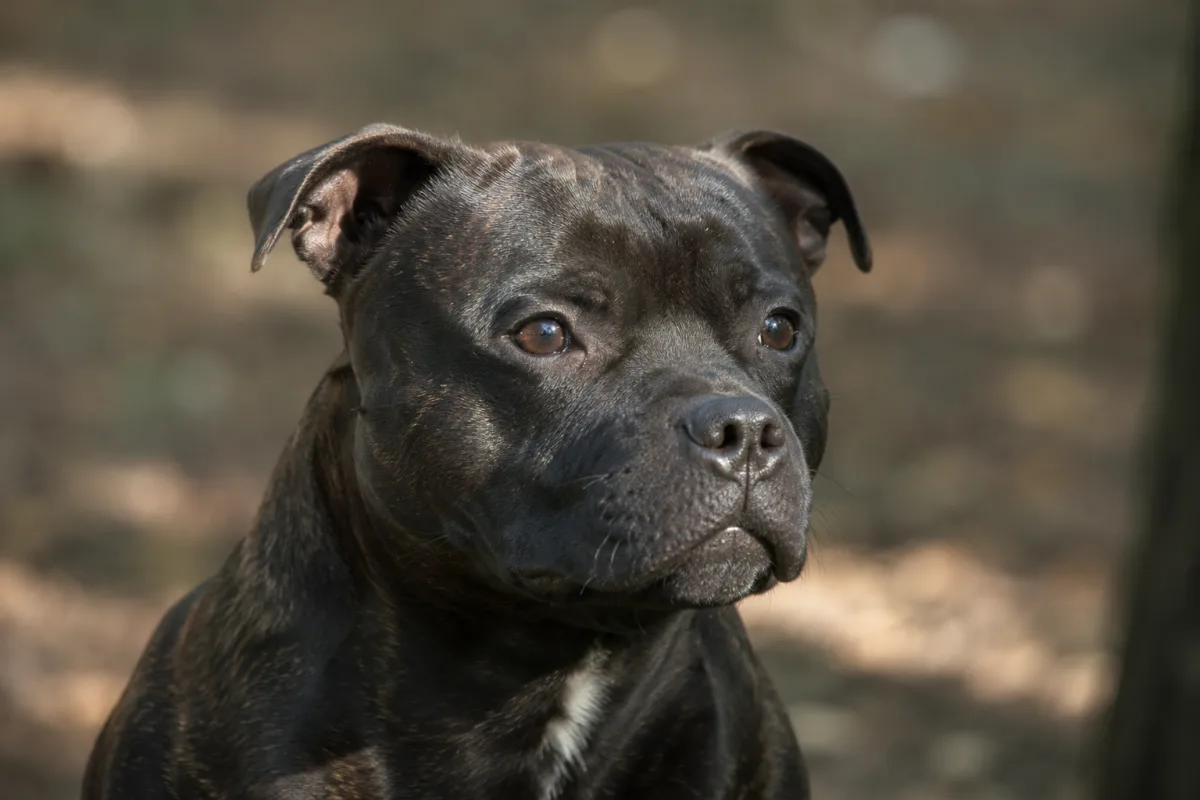
The Royal Kennel Club standard describes the head as short and deep with a broad skull, pronounced cheek muscles, a distinct stop, and short foreface. Eyes are round and medium size, and ears are rose or half-pricked rather than large heavy drop ears.
The head is one of the traits people notice first, but it is also where mistakes happen. Many mixed dogs can have broad heads. Look at the whole dog: height, weight, body, coat, movement, ears, and behavior history. A single broad skull does not identify a breed by itself.
What Coat And Colors Are Typical?
Staffords have a smooth, short coat that lies close to the body. The AKC standard allows red, fawn, white, black, blue, or any of those with white, plus any shade of brindle or brindle with white. Black and tan or liver are not accepted in the AKC standard.
Coat color is a weak identification tool. Plenty of dogs share these colors. Use color only after the body, size, head, and records make sense. Grooming is simple, but skin, nails, ears, teeth, and weight still need routine checks. Livecub's longhair Dachshund grooming guide is a different coat type, but it shows why grooming time doubles as health inspection.
How Should A Staffordshire Bull Terrier Move?
Movement should look powerful, free, and agile. The dog should not drag, paddle, stumble, or look overloaded in front. From the front or rear, the legs should move with reasonable parallel action. Good movement supports the idea of a muscular dog that can still work and play.
If you are identifying a dog from photos only, movement is missing. Video helps, but still does not prove breed. A dog can look Staffy-like in one still photo and very different when standing next to people or moving.
What Temperament Clues Fit The Breed?
Breed standards and breed clubs often describe Staffords as courageous, intelligent, affectionate, and people-oriented. Many are enthusiastic with family and enjoy human contact. That said, temperament does not prove breed. Many dogs are affectionate, and many Staffords need careful dog-dog management like other terriers.
Judge the individual dog in front of you. Ask about social history, training, dog tolerance, prey drive, children, resource guarding, and health. Livecub's Staffordshire Bull Terrier health problems article can help owners think beyond looks and into care needs.
What Dogs Are Commonly Confused With Staffords?
American Staffordshire Terriers are usually taller and heavier. American Pit Bull Terriers vary by registry and line. American Bullies often have more mass and different proportions. Mixed-breed dogs may borrow traits from several lines and still not be one clear breed.
Photos on social media can make these dogs look more similar than they are. Camera angle, cropping, weight, age, and muscle condition change the impression. A short dog photographed from low angle can look larger; a young dog can look narrow; an overweight dog can look like a different type.
Why Is Visual Identification Limited?
A study indexed in PubMed measured agreement among shelter staff assigning pit bull-type breed labels and compared labels with DNA signatures. The broader lesson is practical: people do not always agree when identifying short-coated bully-type dogs by sight.
Use appearance as a clue, not a verdict. Pedigree papers, microchip records, breeder records, veterinary records, and DNA testing may provide stronger evidence. In high-stakes situations, ask the relevant authority what proof it accepts.
What Should You Check In Person?
Stand the dog on level ground. Estimate height at the shoulder. Look at weight, muscle, coat, head, ears, chest, legs, and movement. Take clear side, front, rear, and head photos. Note age and sex. A teenage dog may not show adult width yet, and an overweight dog may hide structure.
Do not rely on a shelter card, neighbor opinion, or app result alone. Ask for history. If the dog came from a breeder, ask for registration details. If it came from rescue, accept that the answer may be uncertain. Uncertainty is more honest than a confident guess with no records.
What Records Help Confirm Breed?
Registration papers, breeder contracts, microchip records, veterinary files, and parent information can all help. Records are not perfect, but they are stronger than guessing from a head shape. If a dog is a mix, DNA testing may give useful ancestry clues, though results still need to be read carefully.
For everyday ownership, the exact label may matter less than care needs: training, health screening, social behavior, exercise, and safe management around other dogs. For legal or housing decisions, the exact label may matter a lot. That is where written proof and local rules become more useful than opinions.
If you are helping someone identify a dog, avoid turning the conversation into a label fight. Measure, compare, gather records, and admit uncertainty. That approach is fairer to the dog and more useful to the owner.
Frequently Asked Questions
Is a Staffordshire Bull Terrier the same as a pit bull?
No. The phrase pit bull is used loosely, while Staffordshire Bull Terrier is a specific recognized breed.
How tall is a Staffordshire Bull Terrier?
The AKC standard gives 14 to 16 inches at the shoulder.
Can I identify a Staffy from a photo?
You can spot clues, but a photo cannot prove breed. Size, movement, records, and DNA may change the answer.
Do all Staffords have broad heads?
They often have broad skulls and pronounced cheek muscles, but many mixes can share that look.
What is the safest way to confirm breed?
Use registration or breeder records when available. DNA may help with ancestry, especially for mixed dogs.
What Is The Fair Way To Identify One?
Use the breed standard as a reference, then stay humble. A Staffordshire Bull Terrier is compact, smooth-coated, muscular, agile, and within a defined size range. But labels affect dogs and owners, so the fair answer sometimes is not "yes" or "no." It is "Stafford-like, but unconfirmed."

Timothy Davidson
Edits step-by-step general-interest guides for clarity, realistic limits and source verification.
Leave a reply
Replying to