
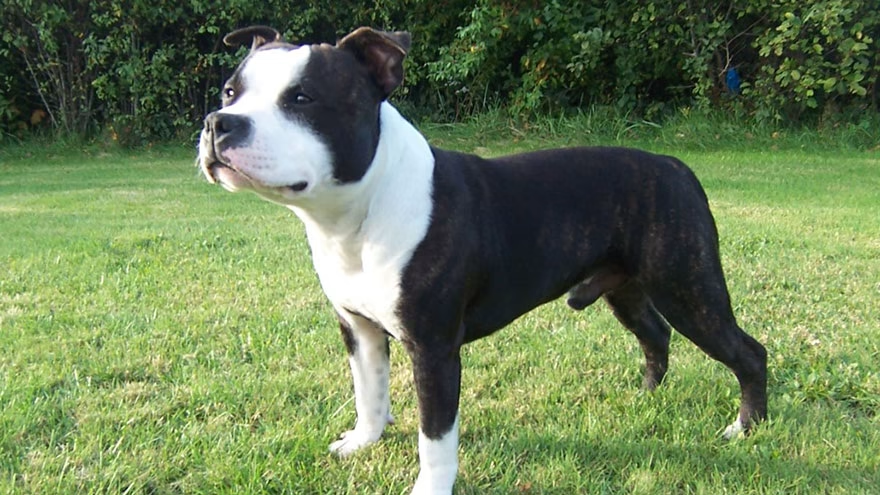
The Staffordshire Bull Terrier ranks among the healthiest medium-sized breeds, yet the handful of hereditary conditions the breed does carry are serious enough to cut short a life that should span 12 to 14 years. Understanding exactly what those conditions are — and how they develop at the molecular and mechanical level — gives owners and prospective buyers the clearest picture of what responsible Staffie ownership actually requires.
What is L-2-Hydroxyglutaric Aciduria and how does it affect Staffies?
L-2-Hydroxyglutaric Aciduria (L2HGA) is a metabolic disease caused by a defect in the L2HGDH gene, which encodes the enzyme L-2-hydroxyglutarate dehydrogenase. That enzyme's job is to oxidise L-2-hydroxyglutaric acid in the mitochondria, converting it into alpha-ketoglutarate so it can enter normal energy metabolism. When two copies of the mutant allele are inherited — the condition is autosomal recessive — the enzyme is effectively absent. L-2-hydroxyglutaric acid accumulates in the cerebrospinal fluid, blood, and urine, and the excess acid progressively damages the brain and nervous system.
In a 2016 study of 27 affected Staffies published in Veterinary Record, gait dysfunction was present in 26 of 26 dogs evaluated, with four-limb stiffness the most common presentation. Behavioural changes — staring into space, signs of cognitive decline, loss of trained responses — appeared in 24 of 27 dogs. Symptoms typically emerge between four months and one year of age, though onset in older animals has been documented. Seizures, tremors, and episodes of muscle cramping triggered by exercise or excitement are also characteristic signs. The Staffordshire Bull Terrier is the breed in which the canine form of this disease was first identified, though a separate mutation in the same gene was later documented in a Yorkshire Terrier.
There is no cure and no disease-modifying treatment. DNA testing — available through laboratories including Paw Print Genetics and the UK's Animal Health Trust — identifies dogs as Clear, Carrier, or Affected. Carriers are clinically healthy and can be bred selectively to Clear dogs to eliminate the mutation from offspring over time. Any breeding pair should be tested before mating.
What orthopedic conditions are Staffordshire Bull Terriers prone to?
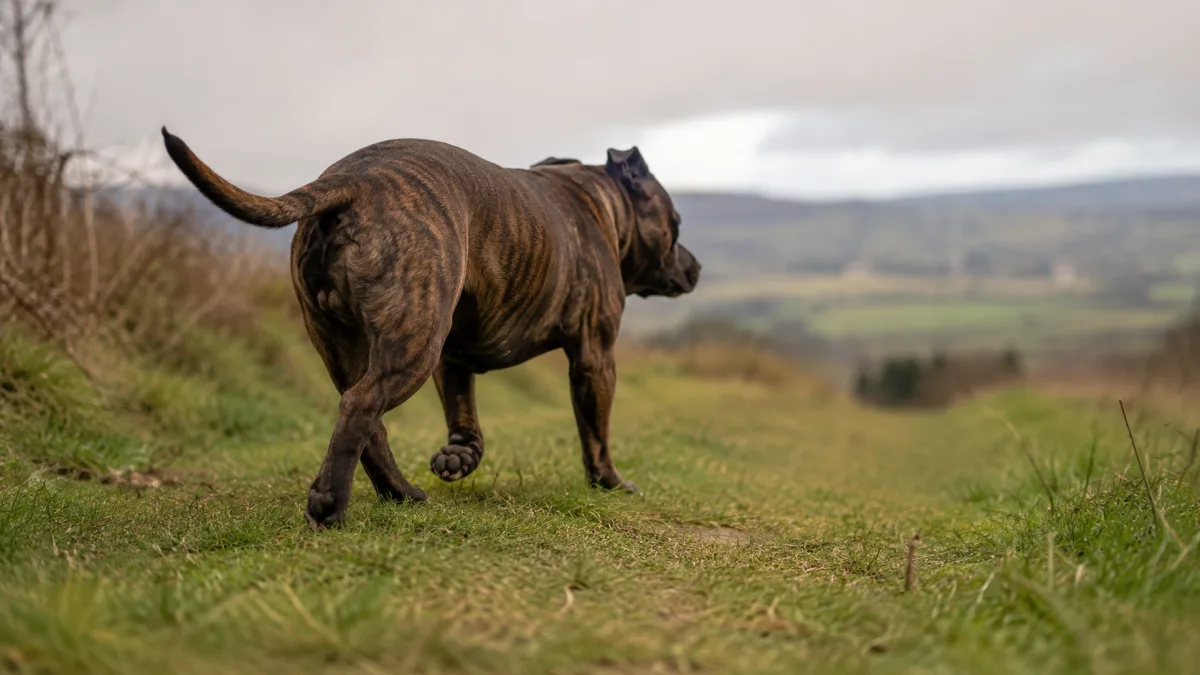
Staffies carry inheritable risk for three distinct orthopedic problems: hip dysplasia, elbow dysplasia, and patellar luxation. Each follows a different mechanical pathway to pain and disability, but all three benefit from early detection.
Hip dysplasia begins with a loose, poorly congruent fit between the femoral head and the acetabular cup. Under normal weight-bearing, the femoral head should sit evenly in the socket; in dysplastic hips it pistions — moving in and out of the socket with each stride rather than rotating smoothly. That abnormal motion abrades the articular cartilage, which lacks its own blood supply and cannot regenerate once damaged. As cartilage thins down to bone, secondary osteoarthritis sets in and the joint becomes chronically inflamed. The Orthopedic Foundation for Animals (OFA) grades hips through radiographic evaluation as Excellent, Good, Fair (all passing), Borderline, Mild, Moderate, or Severe. The Staffordshire Bull Terrier Club of America's CHIC program lists hip evaluation — via OFA radiographs or PennHIP distraction index — as a required test for CHIC certification. Breeding stock should score within the passing grades.
Elbow dysplasia is a collective term for several developmental abnormalities of the elbow joint — fragmented medial coronoid process, osteochondrosis dissecans, and ununited anconeal process being the most common. Any of these lesions creates incongruity in the elbow, leading to joint laxity, progressive cartilage loss, and lameness that typically appears before two years of age. Management in mild cases relies on controlled exercise, anti-inflammatory medication, and weight optimisation; more severe cases require surgical intervention to remove bone fragments or resurface the joint.
Patellar luxation occurs when the kneecap slips out of the femoral groove, either medially or laterally. Veterinarians grade it on a scale of I to IV: at Grade I, the patella luxates only when manually pressed and immediately returns to position; at Grade II, it pops out during activity but reduces spontaneously; Grade III is a patella that stays out unless manually repositioned; and Grade IV involves permanent dislocation with significant tibial deformity. Grades I and II are often managed conservatively, while Grades III and IV almost always require surgical correction — deepening the trochlear groove, realigning the tibial crest, or both. Patellar luxation is listed as an optional test under the SBTCA's CHIC requirements.
Do Staffordshire Bull Terriers get juvenile cataracts?
Hereditary cataracts in Staffies are caused by a mutation in the HSF4 gene (heat shock transcription factor 4), which regulates proteins that maintain the clarity of the lens. The mutation is autosomal recessive: a dog must inherit two copies — one from each parent — to develop cataracts. Carriers show no signs. The condition is often detectable by ophthalmic examination as early as 8 to 12 weeks, but cloudiness in the lens typically becomes visually significant between 12 months and 3 years of age. Without intervention, bilateral cataracts can cause total blindness before a dog's third birthday.
DNA testing for the HC-HSF4 mutation is offered by the Kennel Club in the UK and multiple accredited laboratories. It is one of the five Required tests under the SBTCA's CHIC programme, alongside the L2HGA DNA test. A CERF or OFA eye examination by a board-certified veterinary ophthalmologist is separately required as well, since it can identify other ocular abnormalities the DNA test does not screen for. Surgical removal of the affected lens — phacoemulsification — can restore functional vision if performed before significant retinal damage occurs, making early diagnosis genuinely important.
What skin conditions are common in Staffordshire Bull Terriers?
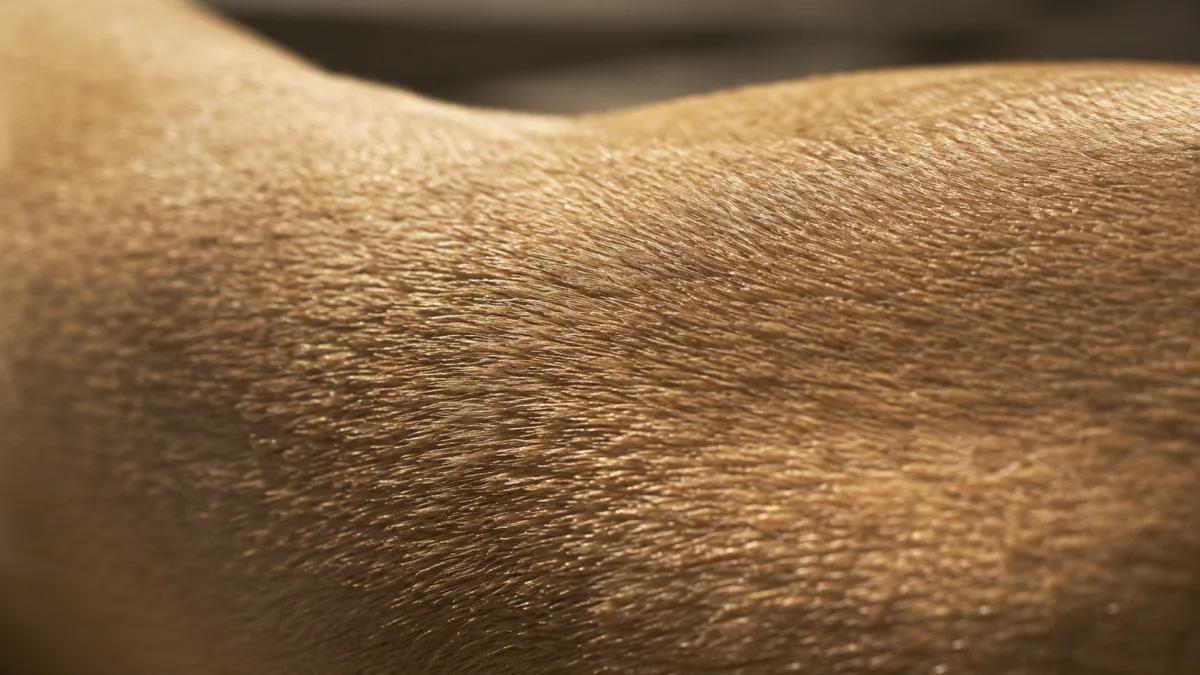
The Staffie's short, single-layered coat offers little barrier between its skin and environmental allergens, and the breed carries a demonstrably elevated susceptibility to canine atopic dermatitis. Research has placed Bull Terrier-type breeds at roughly 21 times the baseline risk for clinically significant atopic disease compared to the general dog population. Atopic dermatitis is driven by a dysfunctional skin barrier that allows environmental allergens — pollen, dust mites, mould spores, and flea saliva chief among them — to penetrate and trigger an IgE-mediated inflammatory response. The result is chronic, recurring pruritus concentrated on the face, paws, groin, and axillae. Secondary bacterial pyoderma and yeast infections (most commonly Malassezia pachydermatis) compound the skin damage when dogs scratch and break the skin surface. Treatment is lifelong and typically involves a combination of allergen avoidance, medicated shampoos, essential fatty acid supplementation, and immunomodulatory drugs such as oclacitinib or lokivetmab.
Demodectic mange is a separate and distinct condition — caused not by allergens but by the mite Demodex canis, which lives in normal numbers in the hair follicles of every dog. In young animals with an immature immune system, or in adults whose immunity is suppressed, mite populations overgrow and cause localised or generalised hair loss, scaling, and secondary bacterial folliculitis. Localised demodicosis in puppies under 18 months often resolves without treatment as immune function matures, but generalised cases in adult Staffies require veterinary management with isoxazoline antiparasitics or other prescription treatments. Unlike sarcoptic mange — which spreads between animals by contact — demodicosis is not contagious.
Are Staffordshire Bull Terriers prone to breathing problems?
Staffies sit in an interesting anatomical middle ground. They are not as severely brachycephalic as Bulldogs or Pugs, but their skull is proportionally wide relative to its length — a conformation that the University of Cambridge's 2026 cross-sectional study identified as a risk factor for Brachycephalic Obstructive Airway Syndrome (BOAS). The study placed Staffordshire Bull Terriers among twelve breeds showing elevated BOAS risk, with approximately half of dogs in the study displaying some degree of noisy breathing and a smaller subset showing clinically significant respiratory compromise.
BOAS is a cluster of structural abnormalities — stenotic nares, an elongated soft palate, and everted laryngeal saccules — that collectively reduce the diameter of the upper airway. Dogs compensate by breathing harder, which increases turbulence, generates further inflammation, and over time can cause secondary changes to the larynx and trachea. The practical consequences are most obvious during exercise and in warm weather: a Staffie struggling with partial airway obstruction cannot dissipate heat efficiently through panting, since panting itself is impaired. This makes heat intolerance, exercise intolerance, and sleep-disordered breathing the characteristic signs. Dogs that are overweight face compounded risk, since fat deposits around the throat further narrow the airway. Surgical correction of stenotic nares and a shortened soft palate resolves symptoms in many cases, and early intervention produces better long-term outcomes than waiting for secondary laryngeal damage to develop.
What health tests should you request before buying a Staffie puppy?
The Staffordshire Bull Terrier Club of America's CHIC programme, active since January 2014, defines the minimum screening standard responsible breeders should meet. Five tests are Required for a dog to receive a CHIC number:
- Hip Dysplasia — OFA radiographic evaluation or PennHIP distraction index
- Elbow Dysplasia — OFA radiographic evaluation
- Eye Examination — by a board-certified ACVO ophthalmologist, minimum age 12 months, results registered with CERF or OFA
- L2HGA — DNA test identifying Clear, Carrier, or Affected status
- Hereditary Cataracts (HC-HSF4) — DNA test identifying Clear, Carrier, or Affected status
Patellar luxation and congenital cardiac evaluation are listed as optional tests but are worth requesting from a breeder. In the UK, the Kennel Club operates parallel DNA health schemes for both the L2HGDH and HC-HSF4 mutations, and Kennel Club Assured Breeders are required to participate. Ask to see the OFA or Kennel Club certificates for both parents — not just a verbal assurance — and verify them independently through the OFA's public database at ofa.org. A CHIC number on its own does not guarantee clear results; it guarantees the tests were done and results were made public, which is itself a meaningful signal of transparency.
For those purchasing in the UK, the Kennel Club publishes breed health statistics and maintains a searchable DNA testing register. The Staffordshire Bull Terrier Club of America provides detailed CHIC guidance for North American buyers.
How long do Staffordshire Bull Terriers live?
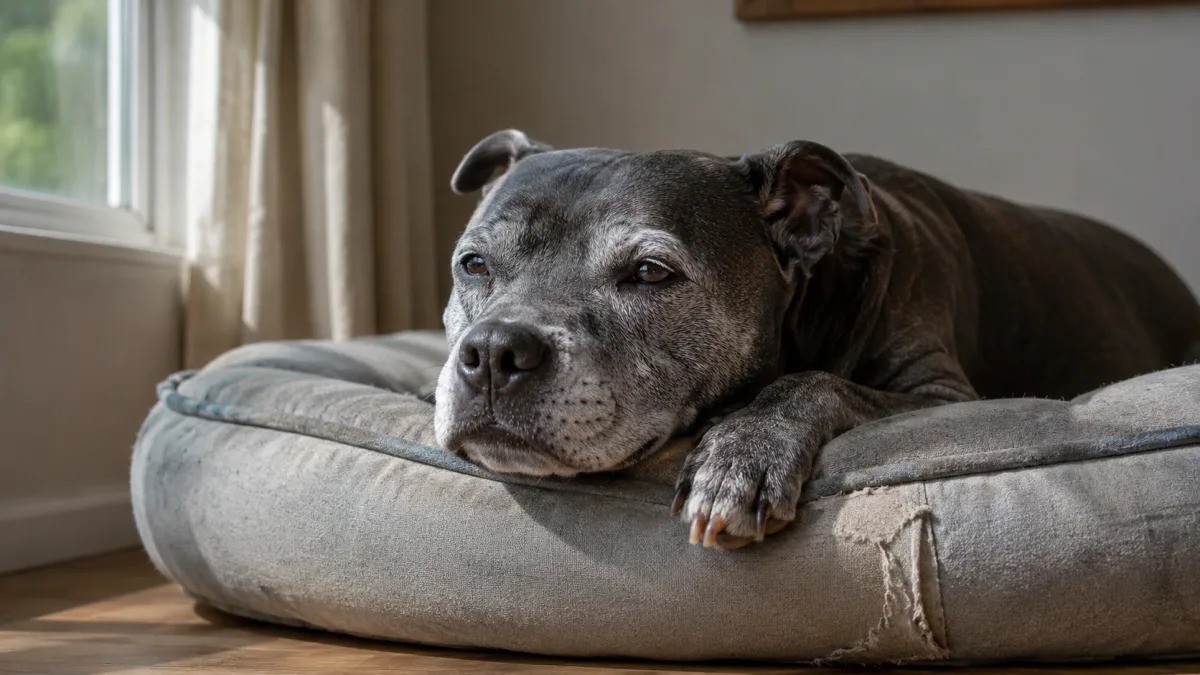
Current UK veterinary data places the Staffordshire Bull Terrier's median lifespan at approximately 12 to 14 years, with pedigree Staffies averaging around 12.7 years — a figure that compares favourably with many breeds of similar build and weight. That figure assumes a dog free from serious genetic disease; an L2HGA-affected dog may not reach adulthood at all, and one with severe hip dysplasia or BOAS may experience a significantly reduced quality of life regardless of longevity. Cancer — including mast cell tumours — appears in the breed and becomes a more common cause of death in middle-aged and older Staffies. Maintaining a lean body weight, providing appropriate daily exercise, and attending annual veterinary check-ups all have measurable effects on healthspan, not just lifespan.
The Staffie's reputation as a tough, stoic breed can work against it: owners sometimes interpret signs of discomfort as normal behaviour. Early lameness from developing hip dysplasia, intermittent skipping from patellar luxation, or exercise intolerance from BOAS can all be mistaken for personality quirks. Recognising these signals early keeps treatment options open and outcomes better.
Frequently Asked Questions
Is L2HGA always fatal in Staffordshire Bull Terriers?
L2HGA is a progressive neurological disease for which there is no cure. Affected dogs typically develop symptoms before their first birthday, and the condition generally worsens over time. Euthanasia is often chosen when quality of life deteriorates. DNA testing of breeding dogs eliminates the risk entirely — a Clear-to-Clear mating cannot produce an Affected puppy.
Can a Staffie carrier of L2HGA or hereditary cataracts be bred?
Yes, but only to a DNA-tested Clear dog. A Carrier-to-Clear mating produces no Affected offspring: statistically, 50% of puppies will be Clear and 50% will be Carriers, but none will develop the disease. Carrier-to-Carrier matings risk producing Affected offspring and should be avoided.
What is the average hip score for a Staffordshire Bull Terrier?
The Kennel Club records the breed's mean hip score at approximately 12.9 (combined total for both hips on the British Veterinary Association scoring system, where lower is better). Breeders should aim to use dogs scoring below the breed mean. On the OFA system, dogs should receive an Excellent, Good, or Fair rating — Borderline and below indicate dysplasia.
Are Staffies at risk from BOAS even if they do not look flat-faced?
Yes. Staffies are classed as semi-brachycephalic: their skull width-to-length ratio is broad enough to predispose some individuals to airway narrowing even without the extreme facial flattening seen in Bulldogs or Pugs. University of Cambridge research published in 2026 confirmed the breed's elevated BOAS risk. Noisy breathing during sleep or exercise, and difficulty recovering from exertion in warm weather, are the key signs to watch for.
At what age do juvenile hereditary cataracts appear in Staffies?
The HSF4 mutation causes early-onset cataracts that may be visible to an ophthalmologist as early as 8 to 12 weeks of age. Clinically significant visual impairment most commonly develops between 12 months and 3 years. Without surgical treatment, bilateral blindness before age 3 is possible. Annual eye examinations by a specialist are recommended for Staffies from affected lines.
Does patellar luxation always need surgery?
Not always. Grade I luxations are often managed conservatively with weight control, restricted high-impact exercise, and joint supplementation. Grade II may be monitored unless clinical signs are persistent. Grades III and IV almost always require surgical correction — deepening the femoral groove (trochleoplasty) and realigning the tibial crest — to restore normal joint mechanics and prevent progressive cartilage destruction.
What is the single most important health test for a prospective Staffie owner to insist on?
The L2HGA DNA test. Because the disease is breed-specific, uniformly devastating, and completely preventable through responsible breeding, asking for documented Clear status on both parents is the most impactful single action a buyer can take. Follow it immediately with the HC-HSF4 (hereditary cataracts) DNA test and the hip OFA evaluation — but L2HGA is the non-negotiable starting point.
For further reading, the American Kennel Club's guide to patellar luxation covers grading and treatment in detail, and the OFA's hip dysplasia page explains radiographic evaluation standards and the public database where you can verify a dog's records. You may also find our coverage of common Rottweiler health questions, Miniature Schnauzer health FAQs, and Basset Hound health concerns useful if you are comparing breeds.

Timothy Davidson
Edits step-by-step general-interest guides for clarity, realistic limits and source verification.
Leave a reply
Replying to