
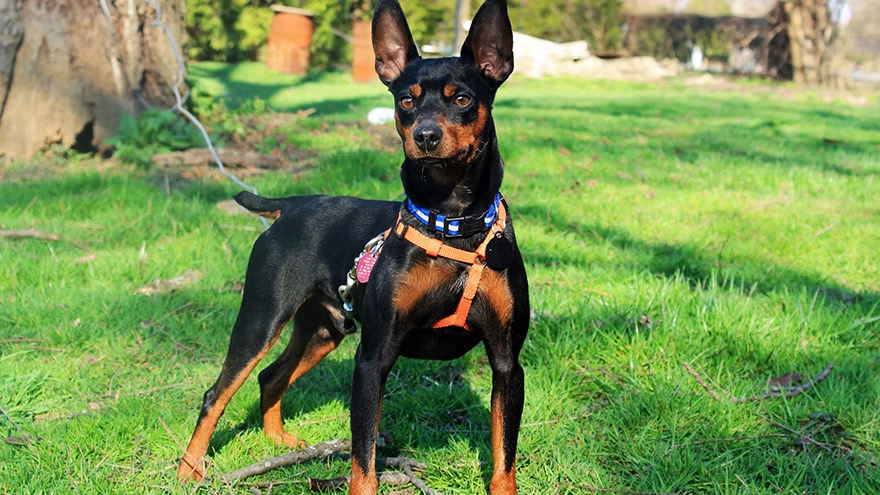
Understanding the Min Pin before you start training
Here is the thing most new owners discover in the first week: the dog that struts around with its chest out, picking arguments with dogs three times its size, is also surprisingly sensitive to the tone of your voice. The Miniature Pinscher — nicknamed the Min Pin and titled the "King of Toys" by the American Kennel Club — packages genuine fearlessness and genuine emotional sensitivity in the same compact frame. Understanding that contradiction is the starting point for all effective miniature pinscher training.
According to Stanley Coren's widely cited obedience intelligence rankings, the Min Pin sits at position 37 among 138 breeds — squarely in the "above average" tier. That means most Min Pins can learn a new command in 25 to 40 repetitions and will obey a known command on the first request about 50 percent of the time or better. Not Border Collie territory, but solidly trainable — provided you approach the dog on its own terms. The breed was developed as a German ratter, which explains the sharp alertness, the independent problem-solving instinct, and the prey drive that still switches on like a light when a squirrel crosses the yard.
That history also explains the hackney gait — the distinctive high-stepping front movement that looks theatrical but is simply how this dog moves at an efficient trot. The muscle engagement behind that gait reflects real energy output. Min Pins are not slow-burn dogs. They need 45 to 60 minutes of vigorous exercise each day despite weighing only 8 to 10 pounds, and the connection between unmet exercise needs and problem behaviors is direct: a bored, under-exercised Min Pin barks, chews, and escapes. Address the energy first and training becomes considerably easier.
Why positive reinforcement works better than dominance for Min Pins
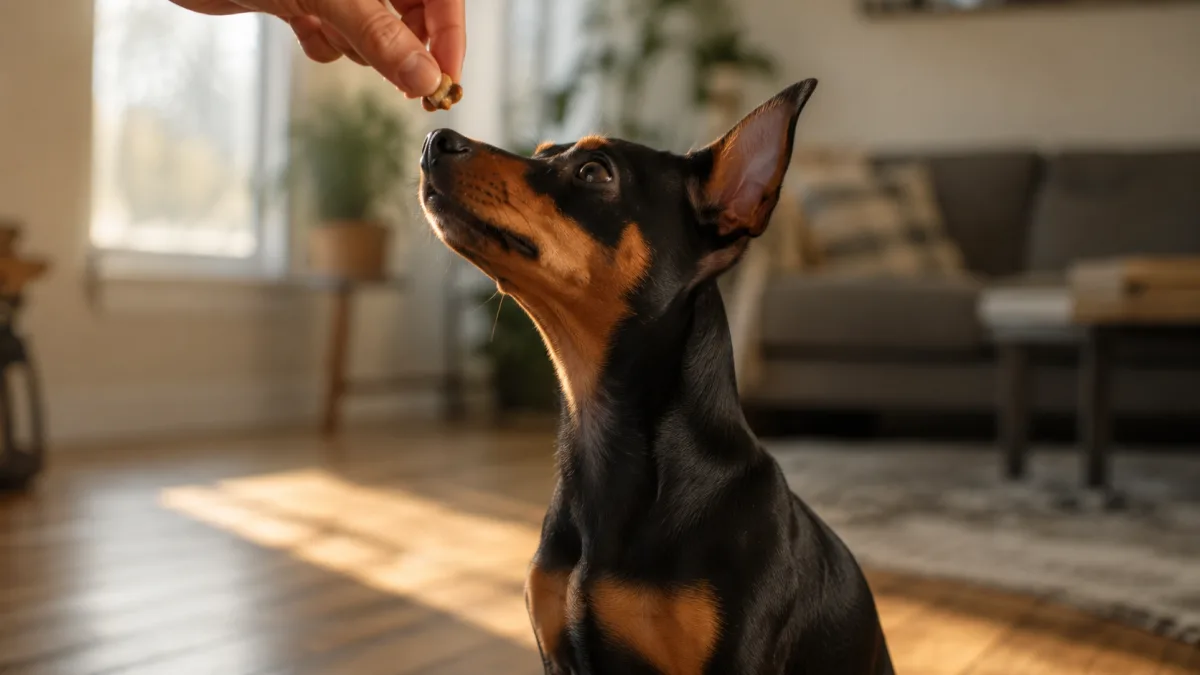
Dominance-based training — corrections, leash pops, intimidation — tends to backfire with Min Pins in a specific and predictable way. The dog does not visibly submit and cooperate. Instead, it shuts down or turns sneaky. What looks like stubbornness is actually a stress response: the Min Pin's boldness is a front-facing trait, but its sensitivity to social pressure is genuine, and harsh handling damages the working relationship without producing the compliance the handler expected.
The neurological explanation is straightforward. When a dog learns through positive reinforcement, the brain's dopamine system activates during the reward moment, creating a strong associative pathway between the behavior and the outcome. The dog is motivated to repeat the behavior because it was genuinely pleasurable to perform it. Fear-based training activates different pathways — the dog avoids the behavior that produces discomfort, but it is not building the same durable, happy association. For a breed that is always reading the room and deciding whether compliance serves its interests, dopamine-driven learning produces far more reliable results than avoidance-driven learning.
Practically, this means high-value treats (small pieces of chicken or cheese work well for the food-motivated Min Pin), consistent verbal markers or a clicker, and short sessions. The clicker deserves a particular mention: the click marks the exact instant of correct behavior, and that precision matters more for an intelligent dog that is always analyzing what specifically earned the reward. A verbal "yes" a half-second late can mark the wrong moment. A clicker fired at the moment the sit completes marks the sit itself. For a breed ranked in the upper third of working intelligence, that specificity accelerates learning.
Keep sessions to five to ten minutes, run two or three per day, and end on success. A Min Pin that starts associating training with fun and treats will seek out sessions rather than avoiding them. One that has been corrected harshly will find ways to make itself scarce when you reach for the leash.
For owners wondering where to look for guidance on related toy breeds, the Maltese training FAQ on Livecub covers similar challenges around independent temperament in small dogs.
Starting early — age and the foundation commands
Training can begin the day a puppy comes home, typically around eight weeks. At that age the dog's brain is forming associations rapidly, and every interaction is already teaching something — it is only a question of whether you are directing the lesson. Start with the five commands that form the practical foundation: sit, stay, come, down, and leave it. These are not arbitrary obedience exercises; each one addresses a real safety or management situation that Min Pin owners encounter regularly.
Sit interrupts jumping-up behavior before it starts. Down is a calmer position than sit and useful for longer stays. Come (recall) is the most important command this breed can learn, and also the hardest — more on that in the next section. Stay extends the other commands into duration. Leave it is the safety command: Min Pins will investigate and mouth things they should not, and a reliable "leave it" can prevent ingestion of something harmful.
Crate training started in puppyhood does double duty. It provides a safe, calm space for rest and prevents destructive behavior when the dog cannot be supervised. A crate should never be used as punishment — it needs to be the dog's preferred resting spot, which means feeding meals inside it initially and keeping early crating sessions brief and positive.
Socialization is not separate from training; it is part of the foundation. Puppies have a critical socialization window that closes around 16 weeks. During that period, expose the Min Pin to as many people, sounds, surfaces, and calm dogs as possible. A Min Pin that received adequate socialization before four months is far less likely to develop the reactive behavior toward strangers and larger dogs that the breed is sometimes known for. The Miniature Pinscher Club of America — the breed's parent club — consistently stresses early socialization as the single most important investment in a Min Pin's temperament.
The Miniature Schnauzer FAQ on Livecub addresses early training timelines for another assertive small breed with similar energy and independence challenges.
Managing the Min Pin's fearlessness — safety first
The Min Pin does not know it is a small dog. That is endearing until it results in a confrontation with a Rottweiler or a chase into traffic. The breed has a documented tendency toward dog-aggression aimed specifically at larger dogs — not out of fear but out of the same competitive boldness that defines the breed's temperament. VCA Animal Hospitals notes that Min Pins "may be cocky and even scrappy with other dogs" and may not do well in dog parks where large and small dogs are mixed.
The more urgent safety issue is the escape artist tendency. Min Pins can squeeze through gaps that seem implausibly small and will jump fences relative to their size with surprising ease. The prey drive — that original ratting instinct — does not pause for traffic signals. When a Min Pin spots a squirrel, a rabbit, or a small animal across the yard, the pursuit response is essentially instantaneous and very difficult to override with a verbal command alone. Recall training is worth doing and worth practicing constantly, but a secured yard with a fence of at least four to five feet — checked regularly for gaps at the base — is non-negotiable.
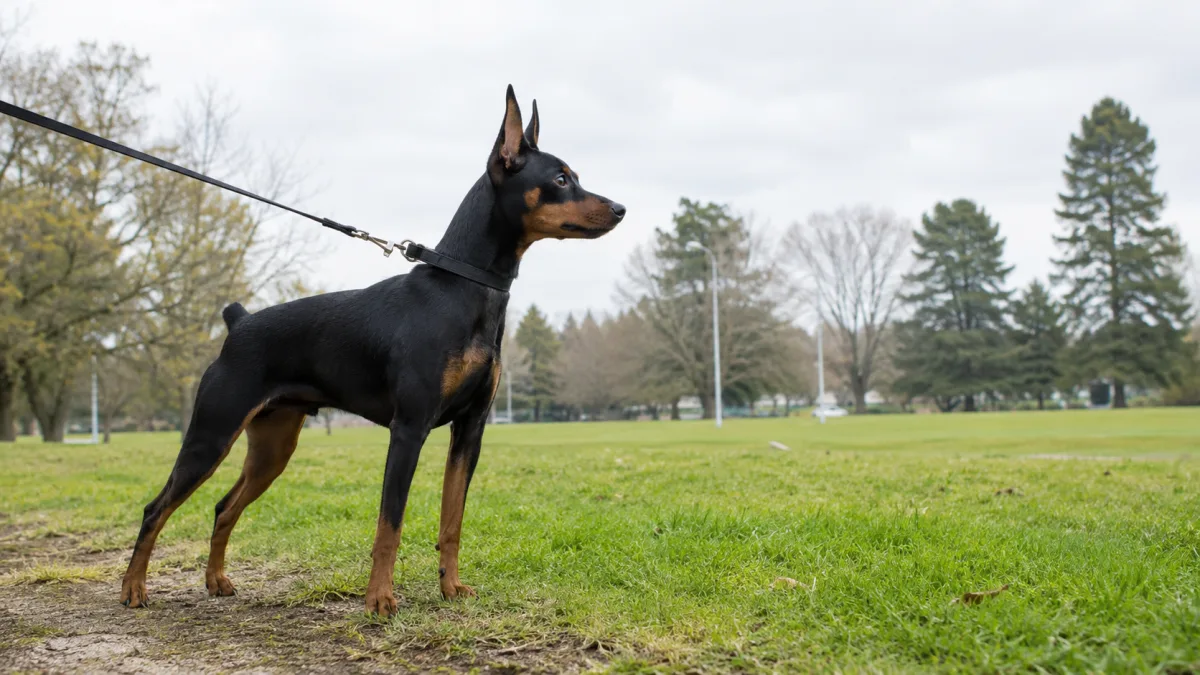
Outdoors, a leash is mandatory. This is not a dog that can be trusted off-leash in an unsecured area regardless of training level. The prey drive is a biological trait, not a training failure, and no amount of conditioning fully eliminates it once a visual trigger appears. The practical solution: build a strong recall, use a long training lead (20 to 30 feet) for practicing come in open spaces, and accept that an unfenced outdoor area requires a leash.
Dog-on-dog aggression toward larger breeds can be managed through early socialization and controlled introductions, but owners should not push Min Pins into high-density dog park situations and then be surprised by the result. The breed does far better in one-on-one introductions with known, calm dogs than in chaotic multi-dog environments.
Leash manners and outdoor training
Min Pins pull. The same drive and confidence that makes the breed entertaining to live with translates directly into forward momentum on the leash. Standard buckle collars can put pressure on the trachea of a small dog that pulls hard, which makes equipment choice meaningful rather than cosmetic. A front-clip harness — where the leash attaches at the chest rather than the back — redirects the dog's forward momentum toward you when it pulls, making the behavior self-correcting. The Gentle Leader head collar is another effective option for dogs that have developed strong pulling habits; it works by steering the head, which steers the body.
Leash training itself follows the same positive reinforcement logic as any other command. The dog earns treats for walking with a loose leash, and forward progress stops the moment tension appears in the lead. Stop walking, wait for the dog to release the tension, and then resume. It requires patience — especially with a breed this energetic — but the pattern becomes clear to the dog within a few sessions.
Two practical points for outdoor training specific to Min Pins: first, keep early leash sessions in low-distraction environments. A Min Pin encountering a squirrel on its third leash training session is not going to perform leash manners. Build the behavior in the yard before taking it to the sidewalk, and to the quiet sidewalk before the busy park. Second, watch for the dog scanning — the moment the head swings toward a trigger and the body tenses is the moment to redirect attention back with a verbal cue and a treat, before the full prey drive response engages.
For a comparison of leash challenges in large, powerful breeds, the Rottweiler FAQ on Livecub covers similar leash work from the opposite end of the size spectrum.
Housebreaking, barking, and problem behaviors
Housebreaking a Min Pin takes longer than many owners expect. The combination of a small bladder, high distractibility, and occasional stubbornness means that accidents happen later into the process than with some other breeds. The solution is structure: take the dog outside on a consistent schedule — first thing in the morning, after every meal, after every nap, and before bed — and reward elimination outdoors immediately. Not in thirty seconds, not when you get back inside: within two seconds of the finish, while the dog is still in the act of wrapping up. Crate training significantly accelerates housebreaking by reducing the opportunity for indoor accidents when you cannot supervise directly.
Barking is one of the most common complaints Min Pin owners report, and it is almost always a symptom rather than a cause. Under-exercised Min Pins bark. Bored Min Pins bark. Under-stimulated Min Pins bark at every sound through the window. Increase exercise and mental stimulation first, then address remaining barking with the "quiet" command: wait for a natural pause in the barking, mark that silence with "quiet" and a treat, gradually extend the required silence before rewarding. Do not inadvertently reward barking by providing attention — even negative attention — when the dog vocalizes for it.
Jumping up is taught out rather than corrected in. The moment all four paws hit the floor, the dog gets attention and a reward. Jumping produces a turned back and zero engagement. The behavior extinguishes because it stops working. Teaching an incompatible behavior — sit to greet — accelerates the process: a dog that sits for greeting cannot simultaneously jump.
Trick training and AKC performance sports
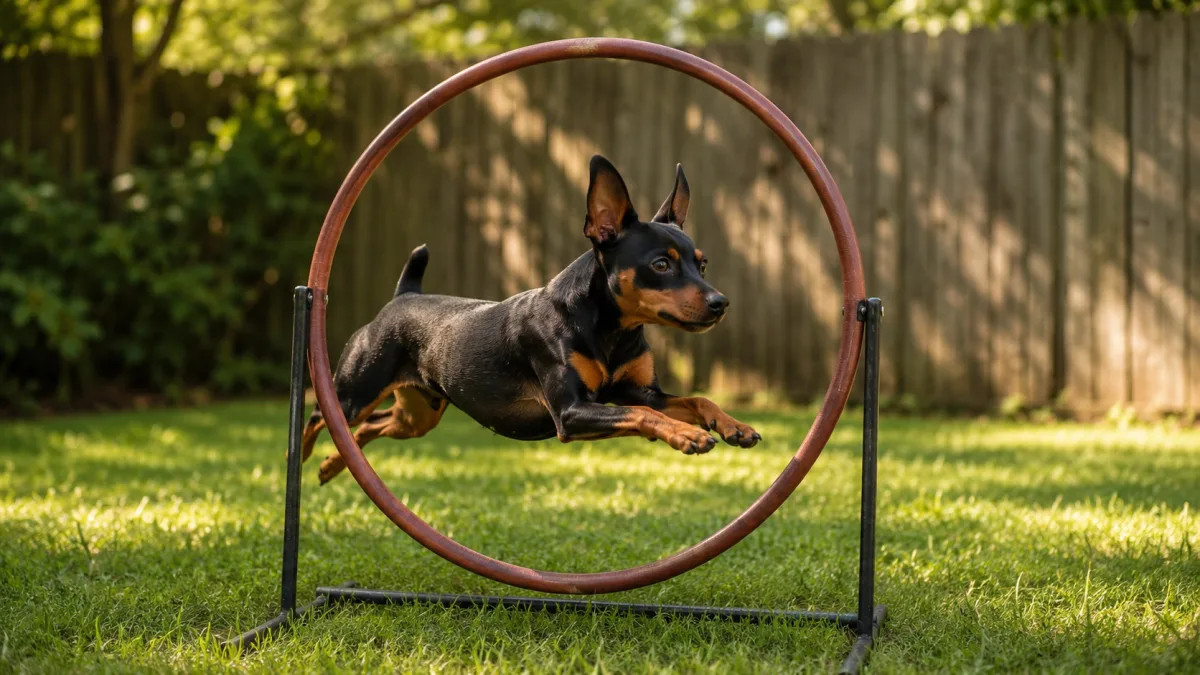
The Min Pin's natural showmanship — the prancing gait, the expressive face, the theatrical self-confidence — translates almost perfectly into trick training. These dogs are natural performers, and the audience feedback of "watching" registers as a reward in itself. Spinning in circles, weaving through legs, jumping through arms, playing dead on cue: the Min Pin picks these up with the kind of enthusiasm that makes training feel more like choreography than obedience work.
The AKC Trick Dog program offers five official titles — Novice (TKN), Intermediate (TKI), Advanced (TKA), Trick Dog Performer (TKP), and Elite Performer (TKE) — that build progressively from basic behaviors to full choreographed routines. Min Pins are well-suited to every level, and the Trick Dog Performer title in particular rewards exactly the kind of connected, theatrical performance this breed enjoys. Canine Good Citizen (CGC) certification provides a shortcut to Novice Trick Dog: a dog with a CGC certificate only needs to perform five Novice tricks rather than ten to earn the title.
Beyond tricks, Min Pins compete successfully in AKC Obedience, Rally, and Agility. Agility is a particularly good fit: the breed's athleticism, speed, and responsiveness to handler cues make it a natural on the course, and the combination of physical exertion and mental engagement addresses both sides of the Min Pin's exercise needs simultaneously. An agility-trained Min Pin is typically a calmer, better-mannered house dog — because the energy has somewhere to go.
Cold weather and exercise considerations
The Min Pin's single-layer short coat and minimal body fat mean that temperature affects training outcomes in a direct, practical way. Below about 50°F (10°C), most Min Pins become noticeably uncomfortable. Below 40°F (4°C), outdoor training sessions stop being productive: the dog is focused on being cold, not on the handler. A shivering dog is not learning.
A well-fitted dog coat for winter walks is functional equipment, not an indulgence. The same dog that is alert and enthusiastic on a 65°F morning may be hunched and distracted at 38°F without one. Boots can help on salted sidewalks, both for warmth and to protect paws from chemical irritation.
When outdoor training is limited by weather, indoor alternatives maintain the mental engagement that this breed requires. Short training sessions inside, puzzle feeders, and indoor fetch games using a soft toy in a hallway all address the stimulation need without exposing the dog to cold. The five-to-ten-minute session structure that works for Min Pin training in general is especially well-suited to indoor work: it keeps the sessions fresh and frequent without requiring outdoor conditions.
The key principle: a tired Min Pin is an easier Min Pin to train and live with. Whether that tiredness comes from a brisk autumn walk, an agility session, or a fifteen-minute indoor trick-training session with a clicker, the result is the same — a calmer, more focused dog that is ready to engage with what you are asking. The breed's trick-training aptitude and natural showmanship make that indoor option genuinely satisfying for both dog and owner, and for many Min Pin owners it becomes the primary training outlet through the colder months.
For owners comparing small-breed cold-weather care, the Lhasa Apso FAQ on Livecub covers a similarly compact breed with different coat characteristics but overlapping seasonal management needs.
Frequently Asked Questions
Are Miniature Pinschers easy to train?
Min Pins fall into the "above average" intelligence tier in Stanley Coren's rankings, which means they learn quickly but also require engagement to stay motivated. They are easier to train than many people expect when positive reinforcement is used consistently, but they resist repetitive, correction-heavy training. Sessions need to be short (five to ten minutes), varied, and reward-based to get reliable results.
Why does my Min Pin ignore the "come" command?
Recall is the hardest command for this breed because prey drive competes directly with it. When a Min Pin is locked onto a squirrel or a small animal, the neurological pull of that drive is stronger than a verbal cue. Practice recall with a long training lead rather than in uncontrolled open spaces. Never punish a dog for eventually coming — the dog must associate returning to you with something positive, every single time.
How do I stop my Min Pin from barking excessively?
Start with exercise and mental stimulation — most excessive barking in Min Pins traces back to under-stimulation. For barking that persists after exercise needs are met, teach the "quiet" command by rewarding silence: wait for a natural pause in barking, mark it with "quiet" and an immediate treat, and gradually extend the required silence. Avoid inadvertently reinforcing barking by responding to it with any attention, even redirecting or scolding.
At what age should I start training my Miniature Pinscher?
Training starts the day the puppy arrives home, typically around eight weeks. The socialization window closes around 16 weeks, making that period the highest-leverage time for exposure to people, other animals, and new environments. Basic commands — sit, down, come, leave it — can begin immediately. Housebreaking and crate training should also start at eight weeks with a consistent schedule.
What AKC sports are good for Miniature Pinschers?
Agility, Obedience, Rally, and the Trick Dog title program are all well-suited to Min Pins. Of these, Trick Dog and Agility tend to be the strongest matches: Trick Dog rewards the breed's natural showmanship and enthusiasm, while Agility combines physical exertion with handler-directed mental engagement. The AKC's Canine Good Citizen test is also a worthwhile starting point and provides a shortcut to the Novice Trick Dog title.

Chiara Bradshaw
Covers education, culture and creative topics with an emphasis on readable explanations and verifiable references.
Leave a reply
Replying to