
Research published in the Journal of Personality and Social Psychology by Arthur Aron and colleagues found that couples who regularly participated in novel, arousing activities together — as opposed to routine or mundane ones — reported significantly higher relationship satisfaction and lower feelings of boredom. A separate line of work from The Gottman Institute identifies shared laughter and play as one of the most reliable predictors of long-term relationship success: in their landmark studies, happy couples used humor during disagreements far more often than dissatisfied ones, and fleeting moments of shared laughter during tense discussions turned out to be among the most consequential data points in the entire dataset. None of that requires a weekend trip or a restaurant reservation. Some of it can happen at your kitchen table with a deck of romantic card games and two willing people.
Why playing games together is good for your relationship
Play is not a reward you earn after the hard work of maintaining a relationship. According to Gottman's research, it is part of the maintenance itself. Couples who laugh together regularly — who treat silliness and competition and low-stakes fun as normal features of their time together — consistently show stronger friendship foundations and more capacity to repair after conflict. Humor, the research suggests, works physiologically: it lowers heart rate, reduces the cortisol that floods the system during arguments, and creates space for affection to re-enter a tense conversation.
Aron's self-expansion model adds another dimension. The theory holds that humans are drawn to experiences that expand their sense of self — and that when a partner is present during those expansive, novel moments, the positive arousal gets attributed to the relationship itself. In plain terms: doing something new and a little exciting with your partner makes you feel more attracted to them. A game you have never played before, with mild stakes and real unpredictability, qualifies. The novelty does not have to be extreme. A seven-minute novel task in a controlled laboratory setting was enough to produce measurable increases in relationship satisfaction compared to a mundane control task.
All of which is a long way of saying: the deck of cards sitting in your junk drawer is more useful than it looks. Here are seven romantic card games — three adapted from classic formats you may already know, and four that go further — along with the psychological reason each one works.
What you need to play romantic card games
Most of the games below require only a standard 52-card deck. A few need index cards or slips of paper prepared in advance. Set aside 30 to 60 minutes, silence your phones, and sit somewhere comfortable — across from each other at a table, not side by side on a couch. Eye contact matters more than you might expect in a game built on bluffing or reading your partner. Keep a pen and paper nearby for the games that involve written promises. The investment is minimal. The payoff scales with how much you actually commit to playing.
Sexy Eights
Before you deal a single card, each of you writes down one secret fantasy on a slip of paper — something you would like to do, have done to you, or experience together if you win. Fold those slips and set them face down. The game itself follows standard Crazy Eights rules: each player receives seven cards, the remainder forms a draw pile, and the top card of that pile is turned face up to start the discard pile. On your turn, play a card that matches either the suit or the rank of the card showing. If you cannot match either, draw from the pile until you can. Eights are wild and can be declared any suit you choose. The first player to empty their hand wins — and collects their partner's written fantasy to be fulfilled at a time of their choosing.
The mechanism that makes this work romantically is anticipation. The fantasy slip sits there throughout the game, a tangible reminder of what is at stake. Anticipation, according to behavioral research, amplifies desire more reliably than immediate gratification. You are not just playing cards; you are building toward something.
Romantic Poker
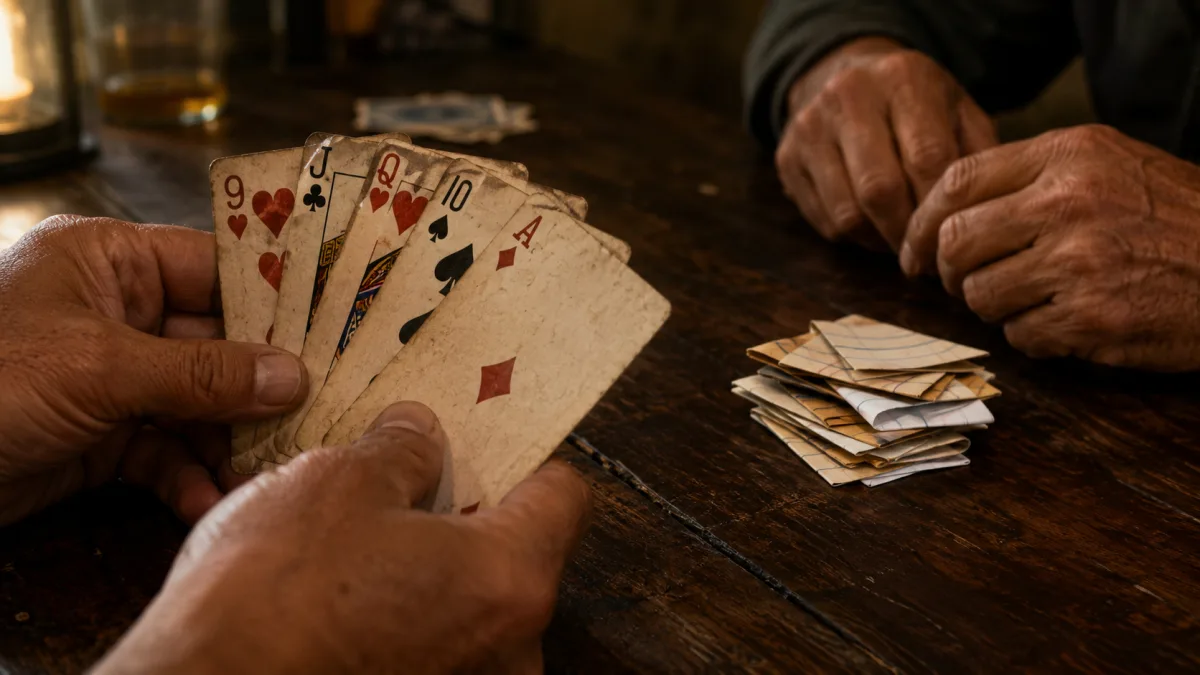
Standard poker with a twist in the currency. Before the game, each player writes out ten favors on separate slips of paper — things you would like to give or receive, or household chores you would gladly skip. Mix the romantic and the practical freely: a back massage, cooking dinner for a week, choosing the next three movies, an afternoon of complete uninterrupted reading time. Cut the slips into uniform pieces and shuffle them face down. Each player draws ten at random, so neither knows exactly what the other is holding. These slips become your chips.
Play standard five-card draw poker. Bet with your favor slips, bluff freely, and read your partner's expression the way you would at any serious table. The winner collects the pot and can redeem the favors on any future occasion — there is no expiration date. The asymmetry is part of the appeal: you might win a back massage you did not write, or find yourself cooking dinner for a week when you only wagered the movie rights. That randomness, combined with the mild competitive pressure of a real poker hand, keeps both players genuinely engaged in a way that a simple coin flip never could. For couples who want to review creative ways to mark milestones, redeeming a stack of won favors on an anniversary makes for a low-cost celebration with genuine personal meaning.
Kissing Royals
This one is fast and physical in the best possible way. Deal the full 52-card deck evenly — 26 cards each — and place your piles face down in front of you. Taking turns, flip the top card of your pile onto a shared center pile. When a face card appears (jack, queen, king, or ace), the first player to slap the pile wins that round and earns a kiss from their partner. The catch: where they get to be kissed is their choice, not the winner's. If you slap on a non-face card, you forfeit one card from your pile to your partner as a penalty. The game ends when one player runs out of cards entirely.
The Slap Jack format creates genuine excitement through speed and surprise — you cannot predict when a face card will appear, so both players stay alert and present throughout. That heightened attention is exactly the kind of mild arousal that Aron's research suggests can transfer into positive feelings about the relationship itself. The physical element — even something as simple as a kiss to the hand or forehead — keeps the game from feeling purely cerebral.
Truth or Dare Draw
Before the game, spend ten minutes writing your own truth questions and dare challenges on two separate sets of index cards. Truths should mix light and meaningful — "What is something you have never told anyone about our first month together?" alongside "What is your most embarrassing habit?" Dares can range from playful to genuinely romantic: recreate your first kiss, give a two-minute shoulder massage, sing the first verse of a song you associate with your partner. Shuffle each stack separately and place them face down.
To play, draw from the standard 52-card deck. Red cards mean you draw from the Truth pile and answer honestly. Black cards mean you draw from the Dare pile and complete the challenge within 60 seconds. Face cards of any suit double the stakes: the other player gets to add a condition or a follow-up. There is no winner in the traditional sense — the point is the conversation and the physical play that the cards prompt. For couples looking to build physical intimacy through touch, stacking the dare pile with massage and touch-based challenges makes this game particularly effective.
Love Language Challenge
Gary Chapman's five love languages — Words of Affirmation, Acts of Service, Receiving Gifts, Quality Time, and Physical Touch — describe how different people prefer to give and receive love. Most couples have at least one language mismatch, where one partner expresses love through acts of service while the other primarily feels loved through words or physical presence. This game is designed to close that gap.
Before playing, each person assigns one love language to each card suit: Hearts for Physical Touch, Diamonds for Words of Affirmation, Clubs for Acts of Service, Spades for Quality Time. The fifth language, Receiving Gifts, is assigned to all face cards regardless of suit. Then take turns drawing from a shuffled deck. Whatever card you draw, you must express love to your partner in the language that suit represents — right now, in the moment, for at least 90 seconds. Draw the three of Hearts? Spend 90 seconds on physical connection: hold hands, touch their face, give a proper hug. Draw the king of Diamonds? Write them three genuine sentences of appreciation before you speak them aloud. The number on the card determines the intensity: low cards are brief and simple, high cards require more effort and creativity. Play for 20 rounds and you will have moved through all five languages multiple times — including the ones that do not come naturally to either of you.
A structured activity like this works because it removes the self-consciousness that often blocks people from expressing love in unfamiliar ways. The card made you do it. That small permission is sometimes enough.
Strip Card Challenge
The romantic card game tradition that needs the least explanation but benefits from clear ground rules set in advance. The format is simple: choose any two-player card game you both know well — War works perfectly because it requires no skill and is entirely luck-based, which keeps the playing field even regardless of card game experience. The player who loses each round removes one item of clothing, starting with accessories and working inward. The game ends when one player reaches a predetermined stopping point, which you agree on before you deal the first card.
The game works best when you approach it with genuine humor rather than forced seduction. Gottman's research on shared laughter applies directly here: the silliness of losing to a card you had no control over, the negotiation over whether a hair tie counts as an item, the mutual absurdity of the whole enterprise — that shared lightness is the point. For couples who have been together long enough that physical intimacy has become routine, the playful structure creates novelty around something familiar. For newer couples, it moves things forward at a pace set by the cards rather than by either person, which can feel less pressured. For a related activity that builds physical closeness outside the bedroom, see how to give a relaxation massage.
Memory Match with Relationship Photos
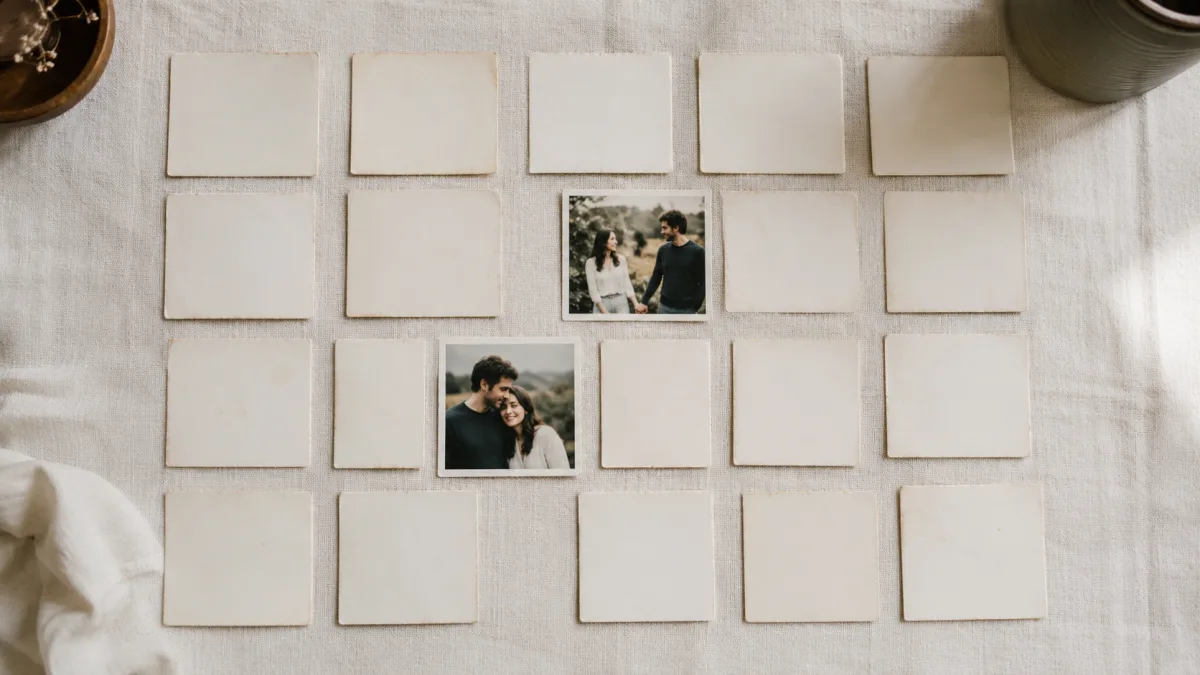
This one requires some preparation but almost no budget. Print 20 to 30 photos from your relationship — first dates, vacations, ordinary Tuesdays that turned into something memorable — at wallet size, two copies of each. Shuffle all copies together face down in a grid. Take turns flipping two cards at a time, trying to find matching pairs as in classic concentration. When you make a match, you must share one memory or detail about that photo before the round ends: where you were, what happened just before or after the shutter clicked, what you were thinking. If you cannot remember, your partner tells the story instead.
The game does something unusual: it turns passive nostalgia into an active, shared exercise. Remembering relationship history together — what researchers call "relationship narrative coherence" — is consistently associated with stronger attachment and higher satisfaction. Couples who can tell the story of their relationship in rich, detailed terms tend to report feeling more secure in it. A first anniversary is a natural occasion to introduce this game, but it works equally well for couples celebrating decades together — the longer you have been together, the more material you have to play with.
Commercial romantic card games worth trying
If you want something ready out of the box, several commercial options have earned genuine followings. We're Not Really Strangers: Couples Edition contains 150 questions arranged in three escalating levels of vulnerability, designed to surface honest answers in both new and long-term relationships. TableTopics: Date Night has sold over two million copies and takes a lighter approach — 135 thought-provoking questions that work well at restaurants or while waiting for food to arrive. BestSelf Co.'s Intimacy Deck leans toward emotional depth, with prompts like "Describe our first kiss" and "What's one thing I can do to make you feel more supported?" — structured similarly to Arthur Aron's famous 36 questions, which were designed to accelerate closeness between strangers and have since been widely studied as a tool for deepening existing relationships. Any of these makes a low-effort gift that signals genuine attention to the relationship. For couples who want to deepen connection through physical care rather than conversation, learning a simple head massage pairs well with a quiet evening after a card game session.
Frequently Asked Questions
Do you need any special equipment to play romantic card games?
Most of the games described here use a standard 52-card deck, which you likely already own. Games like Truth or Dare Draw and Memory Match require index cards, printed photos, or slips of paper prepared before you play. None of them require purchasing anything beyond a basic deck, which costs a few dollars at most grocery stores.
Which romantic card game works best for a first date?
Truth or Dare Draw is well-suited to early-stage relationships because you control the content of both the truth questions and the dares. You can calibrate the intimacy level to whatever feels right for where you are — starting light and going deeper as the evening progresses. Kissing Royals also works well early on because it introduces physical contact through a playful, low-pressure format.
Are these games appropriate for long-term couples?
All of them are, but some are specifically designed to benefit couples who have been together for years. Memory Match with Relationship Photos is most rewarding when you have a substantial shared history to draw on. The Love Language Challenge is particularly useful for couples who feel they have been speaking past each other — it structures the expression of love in ways that both people may have stopped attempting on their own.
How long do these card games typically take?
Sexy Eights and Kissing Royals run 20 to 40 minutes depending on how the cards fall. Romantic Poker can stretch to an hour or more if you want multiple hands. Truth or Dare Draw and the Love Language Challenge work well in 30-minute sessions or extended over a whole evening. Memory Match depends entirely on how many photo pairs you prepare — 20 pairs typically takes about 45 minutes once you include the storytelling component.
What is the best setting for playing romantic card games at home?
The kitchen or dining table, after dinner, with the overhead light dimmed and candles or a lamp providing softer light. Phones in another room. Drinks if you want them, but not as the main event. The physical setup — sitting across from each other at a table rather than on opposite ends of a couch — keeps eye contact natural and makes reading your partner's expressions easier. Save the bedroom for after the game, not during: the slight formality of a table creates genuine anticipation.
Can these games replace couples therapy or relationship counseling?
No, and they are not designed to. Structured play and shared laughter support relationship health, but they cannot substitute for professional support when couples are navigating significant conflict, grief, or communication breakdown. What card games can do is maintain the friendship layer of a relationship — the part that Gottman's research identifies as the foundation that makes everything else more resilient. Think of them as regular maintenance rather than repair.

Olivia Prete
Edits culture and personal-development articles, distinguishing opinion and experience from verifiable claims.




Leave a reply
Replying to