
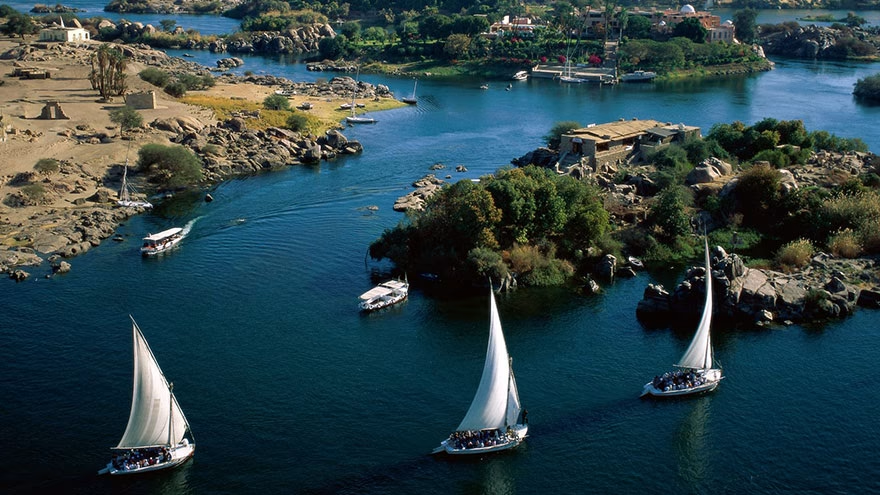
River Length Is Harder Than It Sounds
The top 5 longest rivers in the world are usually listed as the Nile, Amazon, Yangtze, Mississippi-Missouri system, and Yenisei-Angara system. The exact order can shift depending on how a source defines the headwaters, mouth, side channels, and connected river systems.
That is why serious geography sources often use approximate lengths. A river is not a straight line on a ruler. It bends, splits, floods, erodes, changes course, and may be measured with different source points.
Use river rankings as careful estimates, not fixed scoreboard numbers.
1. Nile River
The Nile is traditionally treated as the world's longest river, often listed at about 6,650 kilometers, or roughly 4,130 miles. It flows north through northeastern Africa toward the Mediterranean Sea.
The river is closely tied to Egypt, Sudan, South Sudan, Ethiopia, Uganda, and the wider Nile basin. Its two famous branches, the White Nile and Blue Nile, show why river length can be difficult to define.
National Geographic Kids notes that the Nile has long been recognized as the longest river while also acknowledging debate over whether the Amazon may be longer.
The Nile remains the classic answer, but the debate is real.
2. Amazon River
The Amazon is commonly listed near 6,400 kilometers, or about 3,976 miles, though some measurements place it longer. It carries more water than any other river and drains a vast area of South America.
National Geographic reported on scientific claims that the Amazon may be longer than the Nile, based on a different source point in southern Peru. That does not erase the usual classroom ranking, but it explains why modern lists often include a note.
The Amazon's scale is not only length. Its flow, tributaries, floodplain forests, and river communities make it one of Earth's defining freshwater systems.
The Amazon is the river that makes the ranking argument interesting.
3. Yangtze River
The Yangtze is widely listed at about 6,300 kilometers, or about 3,915 miles. It is the longest river in Asia and flows across China from the Tibetan Plateau region toward the East China Sea.
WWF's page on the Yangtze describes it as rising in Qinghai province on the Tibetan Plateau and flowing 6,300 kilometers to the East China Sea near Shanghai. That length places it firmly among the world's longest rivers.
The Yangtze is also central to Chinese cities, farming, transport, hydropower, and freshwater habitats. Length is only one reason the river matters.
For another nature topic shaped by geography, Livecub's flowering trees in Utah article shows how place affects living landscapes.
4. Mississippi-Missouri River System
The Mississippi-Missouri system is North America's usual entry in the top five. The National Park Service says the Mississippi-Missouri combination ranks fourth in length compared with other world rivers.
Lists differ on whether they measure only the Mississippi, combine it with the Missouri, or include farther upstream headwaters. That is why the number varies across sources.
The system drains a large part of the United States and supports navigation, farming regions, cities, wetlands, and cultural history. It is better understood as a connected river network than as one simple channel.
For long-river lists, the Mississippi is usually counted with the Missouri.
5. Yenisei-Angara River System
The Yenisei-Angara system is commonly listed around 5,539 kilometers, or about 3,445 miles, depending on how the Angara and upper headwaters are counted. It flows through Mongolia and Russia toward the Arctic Ocean.
Because the Yenisei runs through Siberia, it is less familiar to many readers than the Nile or Amazon. Its length, cold-region setting, hydropower role, and northern flow make it one of the major river systems on Earth.
In a top-five list, the Yenisei often beats out the Yellow River and Ob-Irtysh system by a small margin, again depending on method.
Why the Top Two Are Debated
The Nile and Amazon debate comes from measurement choices. Where does the river truly start? Which tributary counts as the farthest source? Where does the river end when it reaches a delta, estuary, or tidal channel?
National Geographic's reporting on the Amazon length claim shows how a change in the selected source point can change the headline. That is why many writers still list the Nile first while noting the Amazon challenge.
Measurement method decides the close calls.
Approximate Lengths to Remember
A practical study list is Nile about 6,650 kilometers, Amazon about 6,400 kilometers, Yangtze about 6,300 kilometers, Mississippi-Missouri roughly around 6,000 kilometers depending on the tributary chain used, and Yenisei-Angara about 5,500 kilometers.
Do not memorize those numbers as exact survey results. Use them as rounded geography anchors. The order matters more than the last few kilometers.
Why River Systems Are Counted
Many long rivers are not a single named channel from start to finish. They are systems of tributaries and main stems. The Mississippi-Missouri example makes that clear.
If a list counted only names printed on a map, rankings would miss how water actually travels from distant headwaters to the sea. River systems give a better picture of continuous flow.
Livecub's planetary magnetic fields article is a reminder that nature rankings often depend on definitions and measurement choices.
Length Is Not the Only Measure
A river can be long without having the largest flow, deepest channel, widest basin, or highest number of people living along it. The Amazon dominates by water volume, while the Nile carries a long human history through dry regions.
The Yangtze is tied closely to China's population and economy. The Mississippi-Missouri anchors North American transport and farming regions. The Yenisei shows the scale of northern Asia.
Longest does not mean most powerful in every sense.
What About the Rivers Just Below the Top Five?
The Yellow River, Ob-Irtysh, Parana, Congo, and Amur often appear in longer top-ten lists. Their order can also shift because of measurement choices and the way connected channels are grouped.
This is why a top-five article should not pretend the sixth-place river is small. These are all continental-scale waterways, and several are central to farming, cities, power, trade, and wildlife.
How Deltas and Mouths Complicate Length
Deltas and estuaries make measuring the end of a river difficult. A river may split into channels, meet tides, build sediment, or shift its outlet over time.
That matters for the Amazon, Nile, Mississippi, and many other long rivers. If two researchers choose different mouths or tidal channels, their totals can differ even when both are careful.
Why School Lists May Differ
School atlases, encyclopedias, park agencies, and science articles may choose different reference points. One source may count a named river alone. Another may count the longest connected tributary system.
That does not mean one list is careless. It often means the source is answering a slightly different question. Always check whether the list says river, river system, or combined river length.
How to Remember the Top Five
A simple memory order is Africa, South America, Asia, North America, Siberia: Nile, Amazon, Yangtze, Mississippi-Missouri, Yenisei-Angara.
After the first three, the ranking becomes easier to mix up because names may be written as systems rather than single rivers. Writing the paired names helps: Mississippi-Missouri and Yenisei-Angara.
Why These Rivers Matter
Long rivers carry water, sediment, food, transportation routes, stories, borders, and risk. Flooding, dams, drought, pollution, and changing land use can affect millions of people far downstream.
For food and plant geography on a smaller scale, Livecub's root vegetables guide shows another way water, soil, and climate shape daily life.
Read Rankings With Context
A clean top-five list is useful for memory, but rivers are living systems. Their value cannot be reduced to length alone. Flow, seasonal flooding, sediment, navigation, water use, and local stewardship all shape how a river supports people and places.
Frequently Asked Questions
What is the longest river in the world?
The Nile is usually listed first, though some measurements argue that the Amazon may be longer depending on the source and mouth used.
What are the top 5 longest rivers?
The common list is Nile, Amazon, Yangtze, Mississippi-Missouri, and Yenisei-Angara, using approximate river-system lengths.
Why do river lengths vary by source?
River lengths vary because sources define headwaters, mouths, deltas, bends, and connected tributaries differently.
Is the Mississippi River one of the longest in the world?
Yes, when counted with the Missouri River system. The Mississippi alone is shorter than the combined river system usually used in world rankings.

Timothy Davidson
Edits step-by-step general-interest guides for clarity, realistic limits and source verification.

Leave a reply
Replying to