
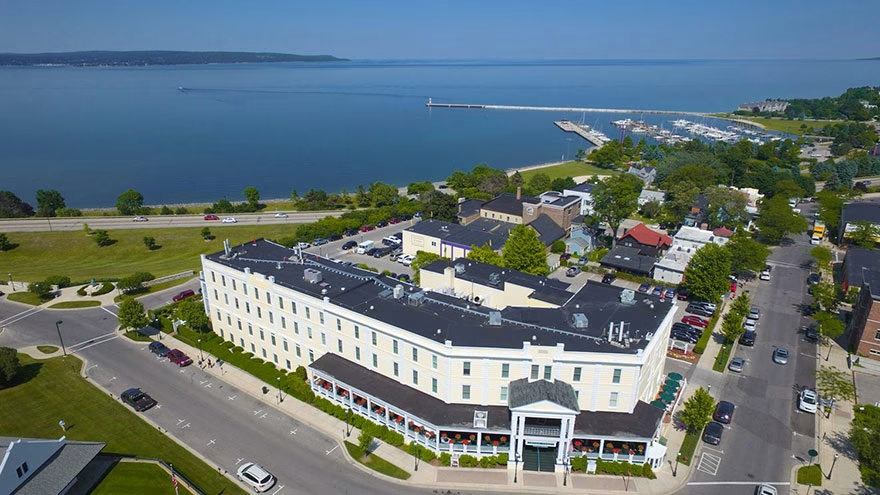
Petoskey Michigan sits on the curved southern shore of Little Traverse Bay, a small city of about 6,000 people in Emmet County that punches well above its weight as a travel destination. It has the classic bones of a Northern Michigan resort town — a compact Victorian downtown, cold clear water, and forests that turn incandescent every October — but it also has something most small towns lack: a genuine story. The fossil that gives the city its name lies scattered across the beach. Ernest Hemingway spent his boyhood summers in the surrounding countryside and set more fiction here than anywhere else on earth. And just north of the city limits, 440 painted Victorian cottages surround a green that has been the site of continuous summer culture since 1875. There is more depth per square mile in Petoskey than the drive-through traveler ever discovers.
Petoskey State Park and the art of Petoskey stone hunting
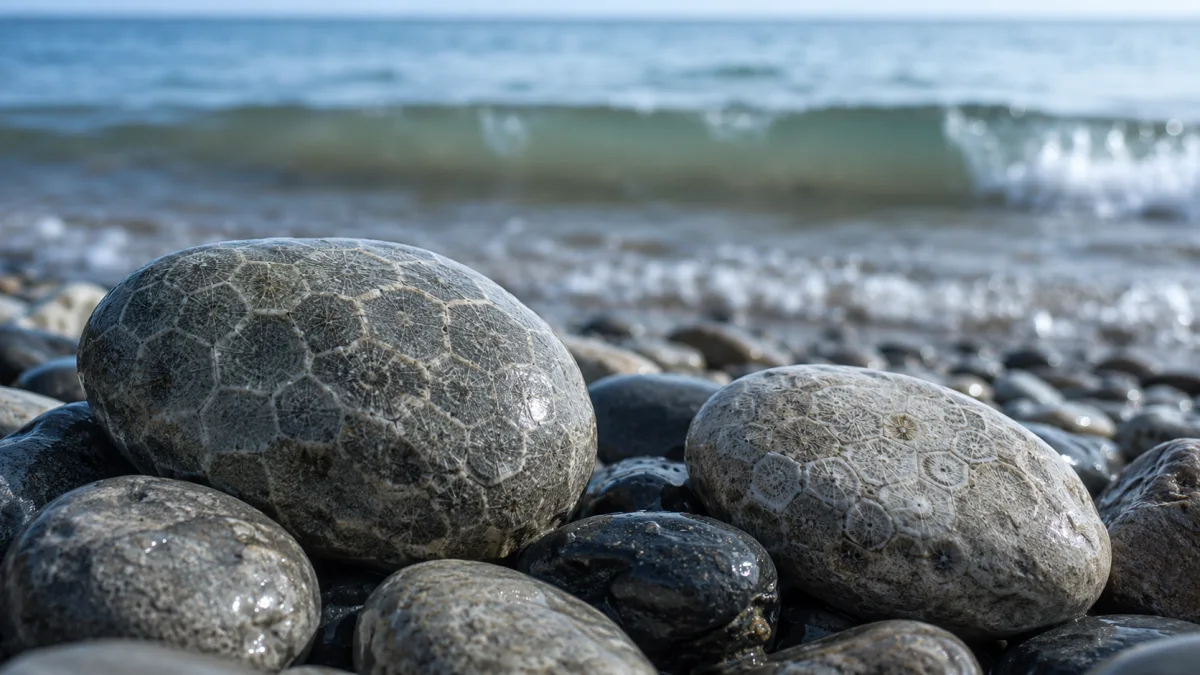
The stone that gives this city its name is not a gemstone and not particularly rare — it is a fossil, and understanding what it actually is makes finding one considerably more satisfying. A Petoskey stone is a fragment of colonial rugose coral, Hexagonaria percarinata, that lived in the shallow tropical sea covering what is now Michigan roughly 350 million years ago. Each stone is composed of tightly packed, six-sided corallites — the individual skeletal chambers of coral polyps — and when wet, the pattern resolves into something unmistakable: a honeycomb of dark-eyed hexagons with fine radiating lines, like a cluster of tiny suns. Dry, the stone looks like ordinary gray limestone, which is why experienced hunters carry a small spray bottle and wet every promising cobble before passing judgment.
The stones are found along this particular stretch of Lake Michigan shoreline because glaciers scraped them from ancient Devonian-era bedrock and deposited them in concentrations along the lake bottom. Wave action gradually works them onshore — which is why spring, right after ice-out, and the hours following a storm produce the best hunting. Fresh stones arrive. Picked-over stretches replenish.
Petoskey State Park, about two miles northeast of downtown on M-119, sits on a mixed sand-and-gravel beach that is one of the most reliable Petoskey stone locations in the state. The park features over 300 acres and a mile of shoreline along the north end of Little Traverse Bay. Stone seekers should walk well past the parking lot access points — the first 50 yards of any easy-access beach are almost always cleaned out — and work close to the waterline where pebbles are perpetually wet and the hexagonal pattern shows clearly. When you find one, stop and search the surrounding area carefully before moving on: the same glacial deposition that put one stone there likely put others nearby. Michigan DNR rules allow visitors to take up to 25 pounds of stones per year from state-managed shorelines.
Beyond stone hunting, the park offers a modest trail network through dune and forest terrain, and swimming along the bay beach in summer. Camping is available seasonally. For anyone making Petoskey stones the centerpiece of a trip, early May — just after the last ice clears — gives the best odds of finding fresh specimens on a beach that hasn't yet seen the summer crowd.
The Gaslight District — shopping, dining, and the town's beating heart
Downtown Petoskey has been a destination in its own right for more than a century, and the Gaslight District — named for the vintage-style street lamps that line its sidewalks — is where visitors spend the most unhurried time. Smithsonian Magazine has recognized it as one of the best small-town downtowns in the United States, a designation that feels earned rather than promotional once you spend an afternoon walking it. The district holds roughly 170 businesses: independent boutiques, art galleries, wine tasting rooms, restaurants, and specialty shops that together create the rare downtown where chain stores are conspicuously absent.
The Gaslight District also carries a literary footnote. The City Park Grill, one of the oldest bars in Michigan, occupies a building where the young Ernest Hemingway is documented to have sat at the bar. Hemingway spent the winter of 1919–1920 at Potter's Rooming House nearby, a period during which he was working on early fiction while recovering from World War I wounds and sorting out his identity as a writer. The Carnegie Library building, also in the district, is where he gave a talk about his experience as an ambulance driver in Italy. A self-guided Hemingway walking tour map connects these sites and is available from the local visitors bureau.
For dining, the district rewards wandering more than reservation-planning. Kilwins, a Northern Michigan institution, handles chocolate and ice cream with a rigor that justifies the line that forms on summer evenings. The surrounding blocks offer everything from casual lakefront dining to locally focused fine dining that leans on Michigan produce and Great Lakes fish.
McLean & Eakin Booksellers and Roast and Toast — two Petoskey institutions
Some towns have a bookstore. Petoskey has McLean & Eakin Booksellers, which is a different thing entirely. Located at 307 E Lake Street in the heart of the Gaslight District, it carries the full range you'd expect from a serious independent — strong children's section, regional Michigan titles, an admirably curated fiction floor — plus an unusually deep Hemingway section that serves the literary tourism the city quietly sustains. The store also stocks vinyl records, comics, and tabletop games, giving it a personality that extends past the strictly bibliographic. It has earned a reputation as one of the finest independent bookstores in the Great Lakes region, drawing customers from across northern Michigan who make a trip to Petoskey partly as an excuse to browse its shelves.
Next door, Roast and Toast has been a fixture of the morning ritual for Petoskey locals and returning visitors for years. The coffee is taken seriously, the soup-and-sandwich menu lands reliably, and the interior has the worn-in comfort of a place that has never needed to manufacture atmosphere. These two establishments sit close enough together that the natural order of a Petoskey morning writes itself: coffee and something to eat, then an hour in the bookstore. Neither is flashy. Both are exactly what they are, which is part of what makes them worth mentioning at all.
The neighborhood around this block — a few steps from the main Gaslight District pedestrian flow — also connects to the Little Traverse Wheelway, a paved multi-use trail that runs 26 miles from Harbor Springs through Petoskey to Charlevoix along the Lake Michigan shoreline. The Bayfront section, accessible near downtown, offers some of the most scenic flat walking or cycling in Northern Michigan, with views across Little Traverse Bay that are particularly good in morning light.
Bay View Association — a National Historic Landmark hiding in plain sight
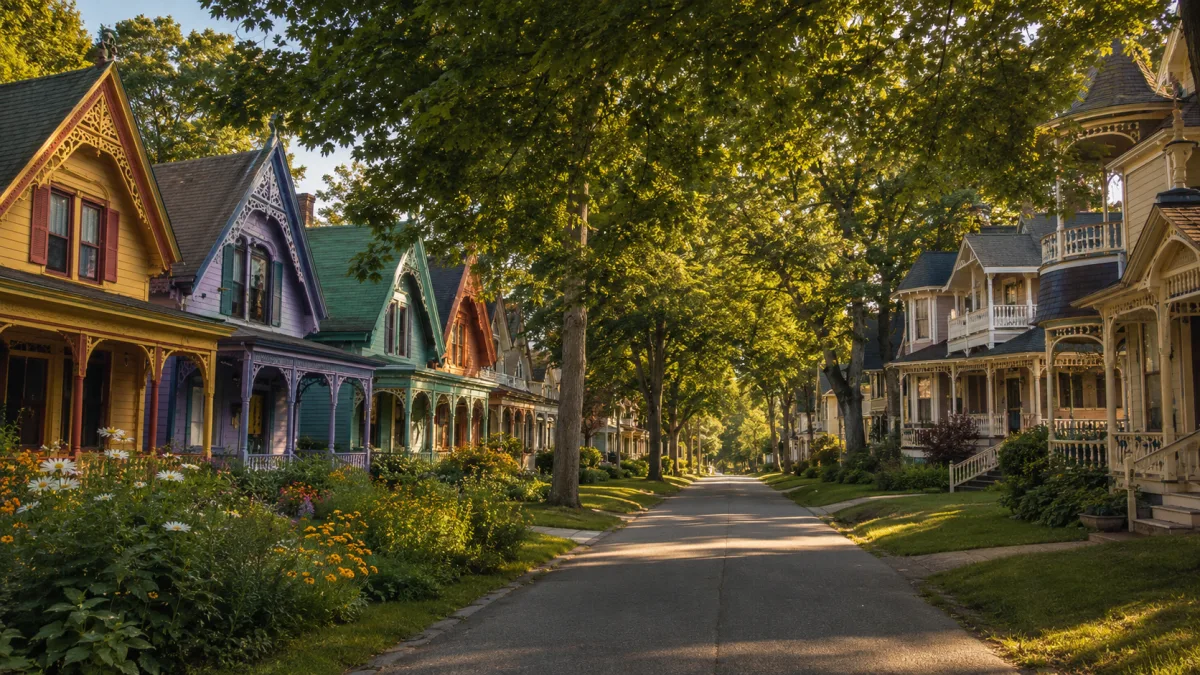
A five-minute drive north of downtown Petoskey, a neighborhood begins that most visitors pass without realizing what they're looking at. The Bay View Association is a community of more than 440 Victorian cottages arranged along curving streets around a central green, and it has been continuously occupied since 1875 — making it, in terms of surviving Victorian architecture, one of the best-preserved communities of its kind anywhere in the United States. The National Park Service designated it a National Historic Landmark in 1987, citing it specifically as "one of the finest remaining examples of two uniquely American community forms, the Methodist camp meeting and the independent Chautauqua."
The history is specific and worth knowing. In September 1875, a group of Michigan Methodists organized a summer camp meeting on Little Traverse Bay, choosing the site for its location and its accessibility by rail and lake steamer. Within a decade, tents had been replaced by simple cottages, and the program had evolved from religious revival to something closer to a summer university — lectures, concerts, performing arts, literary circles. By 1895 there were 400 cottages. By 1901, 500. The Bay View Association today still runs a summer program that is open to the public, including a music festival recognized as the longest continuously running music festival in the United States. Sunday morning worship services and the Religion and Life lecture series are also open to visitors.
The architecture itself is reason enough to walk the streets. Most cottages date from the 1880s and 1890s, built in Eastlake and Stick styles, with some Queen Anne and Shingle variations. The characteristic decorative woodwork — carved brackets, patterned shingles, wraparound porches — appears on virtually every structure. Many current cottage owners represent the third, fourth, or fifth generation of their families to summer here. A free self-guided walking tour map available at the Bay View entrance identifies the significant buildings and explains the community's development.
This is the place most Petoskey visitors miss entirely. It sits just far enough off the downtown core to escape the day-tripper circuit, but it is accessible on foot or by bicycle from the Gaslight District via the Little Traverse Wheelway, and the walking tour takes less than an hour.
Bear River Valley and the outdoor scene
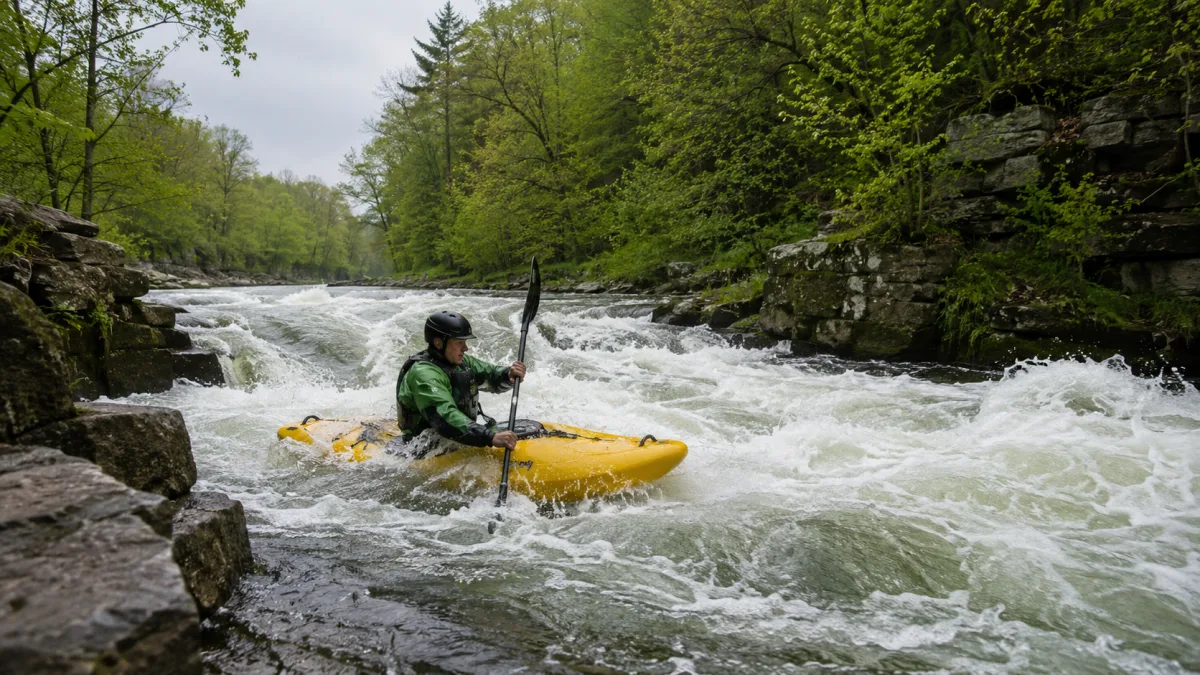
Petoskey's outdoor options extend well beyond the beach, and the Bear River Valley Recreation Area makes the point emphatically: this is a whitewater river running through the middle of a small town. The Bear River flows more than 15 miles from Walloon Lake — Hemingway's Walloon Lake, where his family's cottage Windemere sat, where he fished and hunted and stored up the raw material of his Michigan fiction — before dropping 75 feet in its final mile through downtown Petoskey in a series of rapids, eddies, and a small waterfall. The whitewater course within the recreation area is the only one of its kind in Michigan's lower peninsula, and in May and early June, when flows are highest, kayakers work the Class III sections while hikers on the flanking trails watch from the bluffs above.
The 36-acre recreation area runs along both banks between Lake Street and Standish Avenue, connected by a footbridge across the river. Trails range from paved accessible paths to unpaved bluff-top routes, and the North Country Trail, marked with blue blazes, passes through the area. A round-trip hike from Riverbend Park covers about 3.3 miles; shorter loops are possible from multiple trailheads. The whole complex is free and open from dawn to dusk, which makes it the kind of place you return to multiple times during a stay rather than checking off a list once.
For those wanting to get on the water rather than watch it, kayak rentals are available in the area, and the Bear River itself is paddleable in the calmer upper sections. Lake Michigan fishing, charter boat trips on Little Traverse Bay, and sailing are all accessible within a short drive. Winter brings a different outdoor character: Boyne Highlands and Nub's Nob, two downhill ski resorts within 15 miles of town, keep Petoskey busy through January and February in a way that many summer visitors don't expect. Cross-country skiing and snowshoe trails thread through the surrounding state and national forest lands.
Day trips — Harbor Springs, Charlevoix, and the northern shoreline
Petoskey sits at the center of a triangle of small towns that each warrant half a day. Harbor Springs, eight miles to the north along M-119 — a road that travels through the famous Tunnel of Trees, one of Michigan's most celebrated scenic drives — is an old resort town built around what is described as the deepest natural harbor on the Great Lakes. It has a compact waterfront district with good galleries and restaurants, and its own set of beaches where Petoskey stones wash up. The Tunnel of Trees stretch of M-119 between Harbor Springs and Cross Village is at its best in early October, when sugar maples along the road create an unbroken canopy of red and gold above the pavement.
Charlevoix, 17 miles to the south, offers a different character: a harbor town bisected by a channel connecting Lake Michigan to Lake Charlevoix, with boat traffic moving through a drawbridge that defines the rhythm of summer afternoons. The Earl Young stone houses — locally called the Mushroom Houses for their organic, flowing shapes — are a genuine architectural curiosity worth tracking down on a short walking tour. The drive between Charlevoix and Petoskey along US-31 follows the Lake Michigan shoreline with views across the bay.
The Little Traverse Wheelway connects all three towns along a paved multi-use trail for cyclists and pedestrians, running 26 miles with Lake Michigan views for much of its length. E-bike rentals in Petoskey make the full route accessible to most fitness levels. For visitors interested in the broader Great Lakes region, the ferry crossings to Mackinac Island operate from Mackinaw City and St. Ignace, about an hour's drive north — a logical extension of a northern Michigan itinerary that is worth planning for rather than deciding on a whim.
When to visit Petoskey — seasonal guide
Each season in Petoskey has a distinct character, and the right choice depends entirely on what you're after. Summer — late June through August — is peak season for beach access, boating, the Bay View Association's performing arts program, and the full range of Gaslight District activity. Lodging is most expensive and least available; booking well in advance is not optional. The weather is reliably warm, with Lake Michigan moderating temperatures that rarely become oppressively hot.
Fall is the season that surprises first-time visitors most. October color in Northern Michigan is serious — sugar maples throughout Emmet County and along the Tunnel of Trees reach full peak between the first and third weeks of October, and the combination of fall foliage with the lake views creates conditions that photographers specifically travel to capture. Crowds are smaller than summer, lodging rates drop, and the light has a quality the summer haze doesn't allow. The Gaslight District remains fully open through the fall season.
Spring — particularly April and May — is the season for Petoskey stone hunters. Wave action from late winter storms deposits fresh stones on beaches that have had no foot traffic for months, and the serious hunters know to arrive as soon as the ice clears. The crowds are minimal. Some lodging options are limited, but the trade-off in beach solitude is considerable.
Winter is ski season. Boyne Highlands and Nub's Nob draw skiers from across the Midwest, the Gaslight District maintains a charming snow-covered character, and a different, quieter Petoskey reveals itself to visitors who bother to come. If the goal is understanding why people keep returning to this town through decades, winter is not a bad time to find out.
Frequently Asked Questions
What exactly is a Petoskey stone, and how do I know if I've found one?
A Petoskey stone is a fossilized fragment of colonial rugose coral called Hexagonaria percarinata, dating to the Devonian period roughly 350 million years ago. The identifying feature is a honeycomb pattern of six-sided cells, each with a darker center and fine radiating lines — the skeletal chambers of individual coral polyps. The pattern is vivid when the stone is wet, nearly invisible when dry. Carry a water bottle or kneel at the waterline, wet any gray cobble that catches your attention, and look for the hexagonal structure. Once you've seen a genuine Petoskey stone pattern, you'll recognize it immediately in subsequent finds.
Is the Bay View Association open to the public?
Yes. While Bay View is a private residential community with seasonal occupancy (May through October), the grounds are open to visitors. The summer performing arts program, Sunday worship services, and Religion and Life lecture series are all open to the public. A self-guided walking tour of the historic cottages and community buildings is available at the entrance. The music festival, recognized as the longest continuously running festival of its kind in the United States, draws audiences from well beyond Michigan each season.
What is the Hemingway connection to Petoskey?
Ernest Hemingway spent every summer from 1900 through 1920 (except 1918, when he served in World War I) at his family's cottage Windemere on Walloon Lake, a short distance from Petoskey. He fished and hunted the streams and forests of the surrounding countryside, and the region — Petoskey, Horton Bay, Charlevoix, the Bear River — became the direct source material for his Nick Adams stories, a collection set in Michigan that represent some of his most autobiographical fiction. He spent the winter of 1919–1920 in Petoskey itself, writing and recovering, and gave a public lecture at the Carnegie Library building. More of Hemingway's fiction is set in Michigan than in any other single place.
When is the best time to find Petoskey stones?
Spring — specifically April and early May, right after ice-out — produces the most consistent stone hunting. Winter storm waves carry fresh stones from the lake bottom and deposit them on beaches that have seen no foot traffic for months. Immediately after any major storm is also productive, regardless of season. Early morning on any visit is better than midday: fewer people have walked the waterline ahead of you. Petoskey State Park's beach and the Petoskey breakwall are the most reliable locations near town.
How far is Petoskey from other Northern Michigan destinations?
Harbor Springs is about 8 miles north via the scenic M-119 Tunnel of Trees corridor. Charlevoix is 17 miles south on US-31. Traverse City, the largest city in Northern Michigan and a destination in its own right, is approximately 60 miles south. Mackinaw City, gateway to Mackinac Island, is about 55 miles north. All of these are reasonable day trips from a Petoskey base, and the Little Traverse Wheelway trail connects Petoskey to both Harbor Springs and Charlevoix for cyclists.

Timothy Davidson
Edits step-by-step general-interest guides for clarity, realistic limits and source verification.



Leave a reply
Replying to