
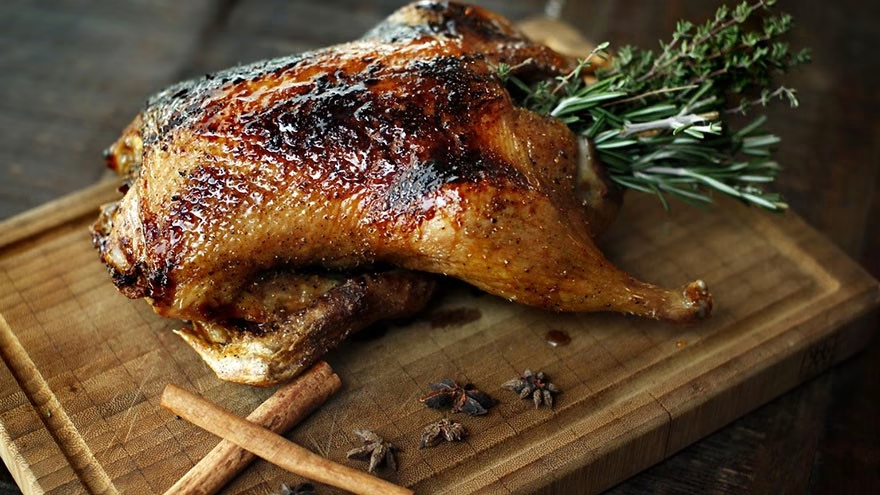
What makes duck different from chicken or turkey on the grill?
Unlike chicken or turkey, duck is entirely dark meat — every muscle in the bird, from breast to leg, carries the high myoglobin content that gives the meat its deep color, rich flavor, and significantly different behavior on heat. Myoglobin is the iron-binding protein that supplies working muscles with oxygen. Because ducks fly, their breast muscles work continuously and store far more myoglobin than a chicken breast ever could. The result is meat that behaves less like poultry and more like lamb or beef.
That muscle composition isn't the only difference. Beneath the skin, duck carries a thick, continuous layer of subcutaneous fat — a buoyancy aid that keeps the bird insulated on cold water. On a chicken, fat is scattered in pockets; on a duck, it wraps the entire carcass in a slab that can be a quarter-inch thick. Grill a duck over direct flame without a drip pan and that fat renders out rapidly, drips onto hot coals, and ignites in a column of fire that chars the outside before the inside has had time to cook through. This is why the grilled whole duck recipe described here relies on indirect heat with a drip pan positioned directly under the bird — the fat falls into the pan, not the coals, and the temperature stays steady at around 325°F rather than spiking with every drip.
There is one more distinction worth naming: duck skin is far thicker than chicken skin, and it does not crisp unless the fat beneath it fully renders. Prick the skin all over with a sharp skewer or fork tip before the bird ever touches the grill — this opens channels so liquid fat can escape rather than steam the skin from below.
Wild duck vs. farmed duck — which should you grill?
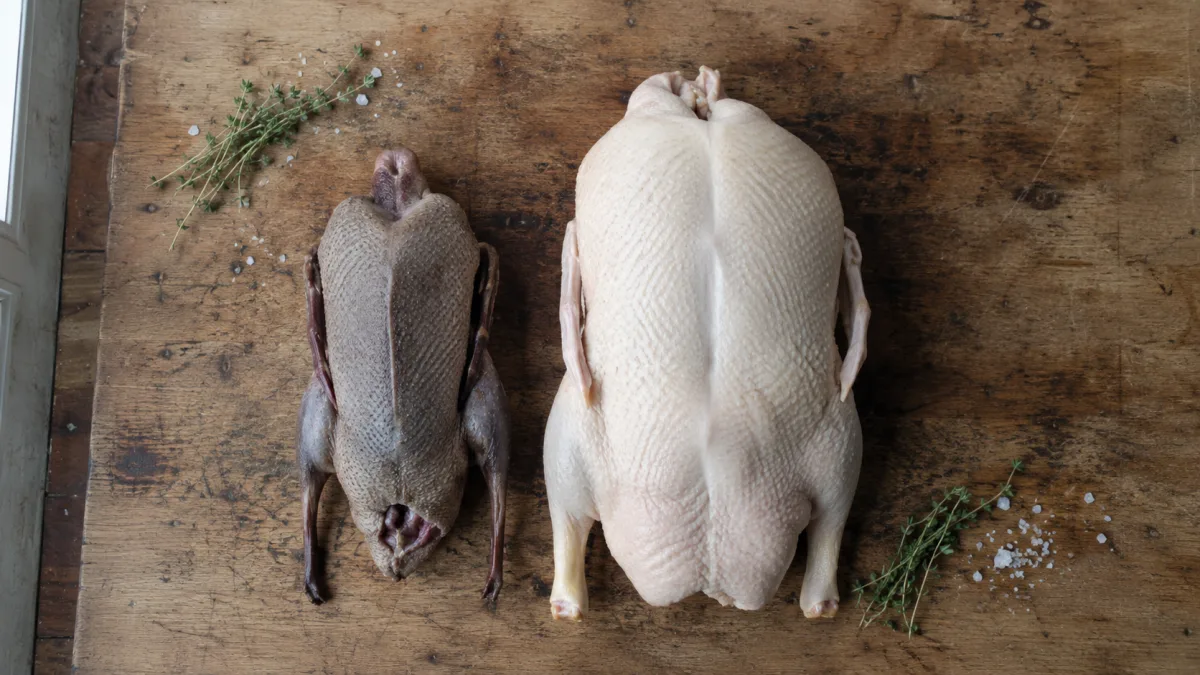
The original recipe calls for wild ducks at 2 to 3.5 pounds each, which places them squarely in Mallard or Teal territory — leaner birds with a pronounced, iron-forward flavor shaped by a mixed diet of aquatic plants, invertebrates, and grain. That leanness has direct consequences for the grill. A wild duck has less subcutaneous fat than a Pekin (farmed) duck and its muscle fibers are denser from a lifetime of actual flight. It will cook faster, it will dry out more easily if pushed past medium doneness, and its gamey character will come through clearly in every bite.
Farmed Pekin ducks — which account for roughly 95 percent of all duck sold in the US — are a different animal in the most literal sense. Raised on corn and soybean feed with limited activity, they develop significantly more fat and produce milder, cleaner-tasting meat. On the grill, a Pekin duck requires more time for that thicker fat layer to render, but it is far more forgiving of a few extra minutes' heat than a wild bird.
Muscovy ducks occupy a middle ground: bred for meat with 50 percent less surface fat than Pekin and a bolder flavor, they behave on the grill somewhat like a wild bird — lean, firm, and quick to tighten if overcooked. If you are working with wild-harvested birds, consider salting them 12 to 24 hours in advance. Dry-brining draws moisture out through osmosis, then pulls it back in carrying dissolved salt. The result is seasoning that penetrates the meat rather than sitting on the surface, and a slightly drier skin that crisps more readily.
For those hunting their own birds, marinating in red wine with aromatics overnight is a proven method for toning down the gamey iron notes that put some diners off Mallard. If you prefer the full wild flavor, skip the marinade — it is a matter of taste, not necessity. See also our guide on how to cook goose, another lean waterfowl that rewards the same indirect-heat approach.
How to prepare a whole duck for the grill
Start with clean birds. If working with wild ducks, they should already be plucked, gutted, and hung for at least 24 hours in a cool environment — hanging allows enzymes in the muscle to break down connective tissue, improving tenderness. Farmed ducks arrive ready to cook; rinse and pat completely dry.
Before any seasoning, prick the skin systematically — every inch or so across the breast, thighs, and back. Use a skewer or the tip of an instant-read thermometer probe, angling slightly so you pierce skin without going deep into the meat underneath. This step is non-negotiable for fat rendering.
Season generously inside and out with sea salt and freshly ground pepper. For the cavity, a thick slice of onion, a rib of celery, and half an apple provide aromatics that perfume the meat gently from inside as the bird cooks — the aromatics also add a small amount of steam that helps keep the cavity from drying out. Skewer or truss the cavity shut so the aromatics stay in place and the bird holds a compact shape that cooks more evenly.
If dry-brining, apply salt 12 to 24 hours ahead, leave uncovered on a rack in the refrigerator, then bring to room temperature for 30 to 45 minutes before grilling. Cold meat straight from the refrigerator will cook unevenly, with the outside moving faster than the still-cold interior.
Grilled whole duck recipe — ingredients and step-by-step
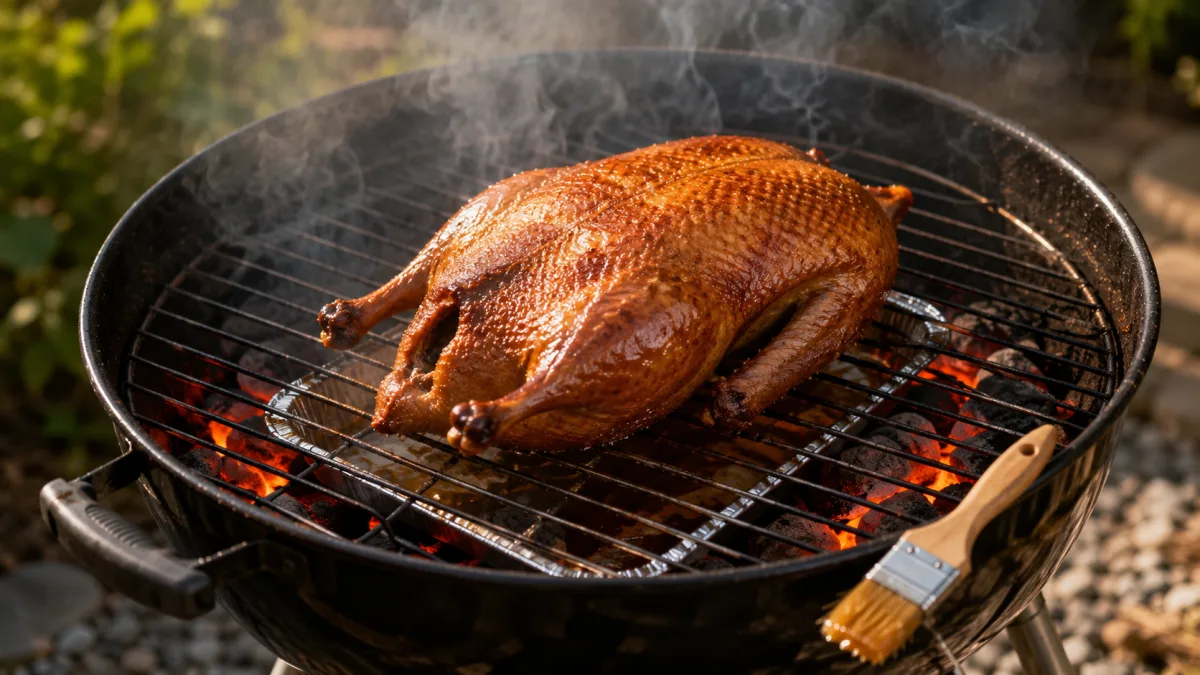
This recipe is built for a standard charcoal kettle grill using the indirect method. The two-zone fire — coals banked on either side of a central drip pan — keeps the cooking temperature in the 300 to 325°F range that renders duck fat without scorching the skin. Total active cooking time is 90 minutes to two hours depending on bird size; use a thermometer to confirm doneness rather than relying on the clock.
Ingredients
- 2 wild ducks (2 to 3.5 lbs each), or 1 farmed Pekin duck (4 to 5 lbs), cleaned and dried
- Melted unsalted butter, for basting
- 2 oz brandy or cognac, warmed (optional, for flambé)
- Sea salt and freshly ground black pepper
- Cavity aromatics: 1 thick onion slice, 1 celery rib, ½ apple
Directions
- Pat the ducks completely dry. Prick the skin all over with a skewer — breast, thighs, back — without piercing through to the meat. Season generously inside and out with salt and pepper.
- Place the cavity aromatics (onion, celery, apple) inside each bird. Skewer or tie the cavity shut.
- Set up the grill for indirect heat: bank 20 lit charcoal briquettes (or equivalent lump charcoal) on each side of the charcoal grate, leaving the center clear. Set a drip pan in the center, directly on the charcoal grate between the two coal banks.
- Position the cooking grate 4 to 6 inches above the drip pan. Lightly wipe the grate with a folded paper towel dipped in neutral oil.
- Place the ducks breast-side up directly over the drip pan — not over the coals. Cover the grill and cook for 10 minutes.
- Baste the birds all over with melted butter. Replace the lid and baste every 5 minutes, rotating the birds 180 degrees at the 45-minute mark to equalize heat from each coal bank.
- Begin checking internal temperature after 60 minutes for wild ducks, 90 minutes for farmed. The USDA minimum safe temperature for whole duck is 165°F (74°C), measured in the thickest part of the thigh — away from bone — and in the thickest part of the breast. Remove the birds when they reach this temperature.
- Transfer to a cutting board and rest, loosely tented with foil, for 10 to 15 minutes. The temperature will rise another 3 to 5 degrees during this time.
- Optional flambé: warm 2 oz of brandy in a small saucepan over low heat until just steaming (do not boil away the alcohol). Pour over the rested ducks and carefully ignite with a long-reach lighter. Stand back and let the flame burn out — about 30 to 60 seconds. Carve immediately.
For a different but equally satisfying bird to cook outdoors, the easy clambake recipe on this site offers another crowd-pleasing option for open-fire cooking.
How to tell when a whole grilled duck is done
Color is not a reliable indicator for duck. Because duck meat is so high in myoglobin, it can remain pink at the center even when it has reached a fully safe temperature — the USDA explicitly notes this on their duck and goose guidance. The only reliable test is a calibrated instant-read thermometer.
Insert the probe into the thickest part of the thigh, angling away from the thighbone, and check the thickest part of the breast as well. The USDA FSIS recommends a minimum of 165°F (74°C) for whole duck and goose — the same standard that applies to all whole poultry.
It is worth knowing that many chefs and food writers cook duck breast to lower temperatures — 130 to 135°F for medium rare — reasoning that duck is not a significant Salmonella carrier and that its beef-like meat dries out at higher temperatures. ThermoWorks notes that duck breast at 135°F (57°C) stays far more tender than breast pushed to 165°F, while the thighs and legs should reach 165°F to break down their connective tissue properly. That gap between breast and leg doneness is the central challenge of cooking a whole duck. For home cooks and anyone in a high-risk group — children under 5, pregnant women, elderly adults, or immunocompromised individuals — the full 165°F minimum across the whole bird is the safest path. For experienced cooks willing to accept some culinary risk, pulling the bird when the breast hits 135 to 140°F and the thighs hit 165°F produces a noticeably more succulent result. ThermoWorks covers this temperature distinction in detail for those who want to explore further.
Whatever temperature you target, rest the birds for at least 10 minutes before carving. Resting allows the juices that have been driven toward the center during cooking to redistribute through the muscle fibers. Cut straight into a hot bird and a significant amount of that moisture runs off onto the board.
What sauces and sides pair best with grilled duck?
Duck's richness and dark, slightly gamey depth call for accompaniments with bright acidity or fruity sweetness — something that cuts through the fat rather than compounding it. Three classic combinations have remained staples in French and American cooking for good reason.
Orange sauce (duck à l'orange): The acidity of orange juice and the bitterness of orange zest balance duck fat with precision. A basic version uses duck or chicken stock reduced with orange juice, a splash of Grand Marnier, a small amount of shallot, and a pinch of clove. The sauce is finished with a cold butter swirl off the heat to give it body without making it heavy.
Cherry sauce: Tart cherries — Morello or Montmorency varieties — work far better here than sweet ones. Combine pitted cherries with a port reduction, a small amount of thyme or rosemary, and duck stock. The tartness mirrors the iron notes in duck meat rather than fighting them. Cherry-rosemary sauce has appeared in Ted Allen's Food Network recipes and remains one of the cleaner flavor matches for wild duck in particular.
Red wine reduction: A simple reduction of red wine, shallots, and stock with a cold butter finish provides savory depth without fruit sweetness — better suited to strongly flavored wild birds where you want the gamey character to stay in front.
For sides, wild rice holds up better alongside duck than standard white rice — its nuttiness and slight chew are a match for the meat's density. Roasted root vegetables, celery root purée, or polenta all work well. For a lighter complement, the asparagus-forward approach in our asparagus rolls recipe makes an elegant starter before you carve the birds at the table.
Tips for flambéing your grilled duck with brandy
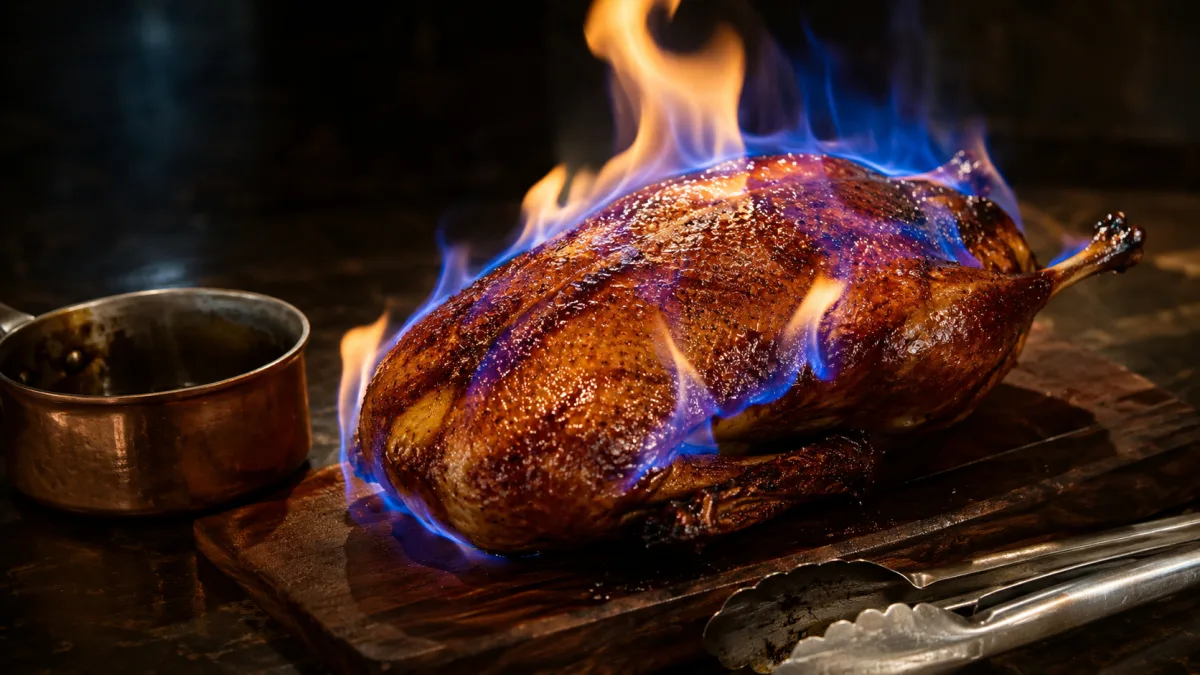
Flambéing is a finishing technique, not a cooking method. The flame burns for 30 to 60 seconds at most and does not add significant heat to the meat — what it does is rapidly volatilize and burn off the raw alcohol edge of the brandy while caramelizing a thin layer of the spirit's sugars on the skin. The result is a subtle, toasty brandy note in the crust and an impressive visual effect.
The mechanism matters: brandy must be warm before you ignite it. Cold spirits at 40 percent ABV will not sustain a flame because the alcohol vapor does not diffuse readily from a cool liquid. Warm the brandy in a small saucepan over low heat until it steams — not to a boil, which would drive off the alcohol you need for ignition. Pour the warm brandy directly over the duck, then hold a long-reach lighter just above the surface at the edge of the drip. The vapor ignites, the flame spreads across the surface, and it burns out on its own within a minute.
Safety notes: turn off any overhead exhaust fan before flambéing outdoors or in a covered grill space — a running fan can push flames unpredictably. Keep the brandy bottle well away from the ignition point. Use a long match or long-reach lighter to keep your hand clear. Never cover the duck while the flame is active; a lid smothers the fire quickly if something goes wrong, but only keep it nearby as a backup, not over the bird.
For those curious about techniques on other poultry, our easy Yugoslavian chicken recipe uses a similarly bold finishing approach that pairs well with a casual outdoor meal.
Frequently Asked Questions
Can I use a gas grill instead of charcoal for this recipe?
Yes. Light the outer burners and leave the center burner off, placing a drip pan on the center grate. Preheat to 325°F with the lid closed, then cook the duck over the unlit center section. The principle is identical to the charcoal setup — indirect heat, drip pan below the bird. You will not get the subtle smoke character of charcoal, but the cooking results are otherwise the same.
How long does it take to grill a whole duck?
Wild ducks at 2 to 3.5 lbs each generally take 60 to 90 minutes over indirect heat at 300 to 325°F. A larger farmed Pekin duck at 4 to 5 lbs will need 90 minutes to 2 hours. Use an instant-read thermometer rather than the clock — the only reliable endpoint is 165°F in the thigh and breast.
Do I need to prick the skin before grilling?
For farmed ducks, yes — the thick fat layer needs escape channels or it will steam the skin rather than render cleanly. For wild ducks, which carry far less fat, pricking is less critical but still recommended. Use a sharp skewer and angle it shallowly so you pierce the skin without cutting into the meat.
Can I marinate wild duck before grilling to reduce the gamey flavor?
A red wine marinade with garlic, thyme, and juniper berries for 8 to 12 hours in the refrigerator will mellow wild duck's iron-forward flavor noticeably. Dry brining (coating with kosher salt and leaving uncovered in the refrigerator for 12 to 24 hours) is an alternative that reduces gaminess without masking the natural duck character entirely. Rinse and pat dry before grilling either way.
What kind of duck is best for grilling whole?
Wild Mallard ducks (2 to 3.5 lbs) are traditional for this recipe and deliver full flavor, though they require careful monitoring to avoid drying out. Farmed Pekin ducks (4 to 5 lbs) are milder and more forgiving on the grill, with a richer fat layer that yields crispier skin. Muscovy ducks fall in between — less fat than Pekin, bolder flavor, slightly quicker cooking time.
Is duck safe to eat pink?
According to the USDA FSIS, duck can remain pink at the center even after reaching a safe minimum internal temperature of 165°F — the color does not indicate undercooked meat. If you choose to cook the breast to a lower temperature (130 to 135°F for medium rare, as many professional kitchens do), be aware this is below the USDA minimum and carries a higher food safety risk, particularly for high-risk groups including young children, pregnant women, elderly adults, and immunocompromised individuals.

Chiara Bradshaw
Covers education, culture and creative topics with an emphasis on readable explanations and verifiable references.




Leave a reply
Replying to