

How to Develop the Skill of Self-Confidence means treating confidence like a trained behavior. You practice noticing fear, choosing a small action, learning from the result, and returning without turning every miss into a verdict.
Some people are naturally bold in certain settings, but reliable confidence is built. It comes from repeated evidence that you can prepare, act, repair, and try again.
Define The Skill
Self-confidence is not loudness. It is the ability to move toward a chosen action while carrying uncertainty.
APA's self-efficacy work frames belief in capability as something tied to tasks and challenges: APA self-efficacy.
Pick A Training Field
Choose one training field: speaking, exercise, dating, parenting, work, school, driving, health care, or money.
A clear field lets you measure practice instead of asking whether your whole personality has changed.
Audit The Starting Point
Write what you avoid, what you overprepare, what you ask others to do, and what you assume will go wrong.
This is not a shame list. It is a map of the skill.
Create A Proof Log

List past evidence that you can learn: finished tasks, repaired mistakes, survived hard conversations, helped someone, practiced a skill, or asked for help.
Livecub's food journal guide is built for food patterns, but the same written tracking idea works for behavior change.
Use Small Reps
A confidence rep is one small action that asks the nervous system to tolerate uncertainty.
Say hello, send the draft, walk into the class, lift a lighter weight, ask one question, or practice one line.
Train Before The Event
Do not make the real event your first practice. Rehearse before the meeting, tryout, talk, exam, or appointment.
Livecub's sports tryout nerves guide can help when performance confidence needs both practice and pressure management.
Lower The Stakes
If the task feels too exposed, lower the stakes without canceling the task.
Practice with one person, record yourself privately, do a shorter version, or choose a setting where mistakes are expected.
Build Speaking Tolerance
Speaking confidence grows through repeated exposure, not by waiting for fear to disappear.
Livecub's stage fright guide can help readers use body cues, rehearsal, and attention shifts.
Use Accurate Self-Talk
Mayo Clinic suggests recognizing troubling situations, noticing thoughts, challenging negative thinking, and replacing it with more accurate thoughts: Mayo Clinic self-esteem.
Accurate self-talk sounds like I am learning this, not I am the best and not I am doomed.
Train The Body
Confidence is easier when the body feels supported. Sleep, food, movement, breath, and pain management affect how much threat the brain reads.
Even a practical body skill can build self-trust. Livecub's Kegel exercise for men guide shows how quiet repetition can train a hidden muscle group.
Ask For Feedback
Ask for feedback that is narrow enough to use. What should I keep? What should I change? What should I practice next?
Broad praise feels nice for a moment. Specific feedback trains the next rep.
Study Models
Watch someone who handles the task well. Notice their preparation, pacing, language, and recovery after mistakes.
Do not copy their personality. Copy the repeatable behaviors.
Use Recovery Practice
Confidence depends on recovery as much as success. Practice what you will do after an awkward moment.
You might pause, breathe, correct yourself, ask a clarifying question, or say let me try that again.
Make A Confidence Ladder
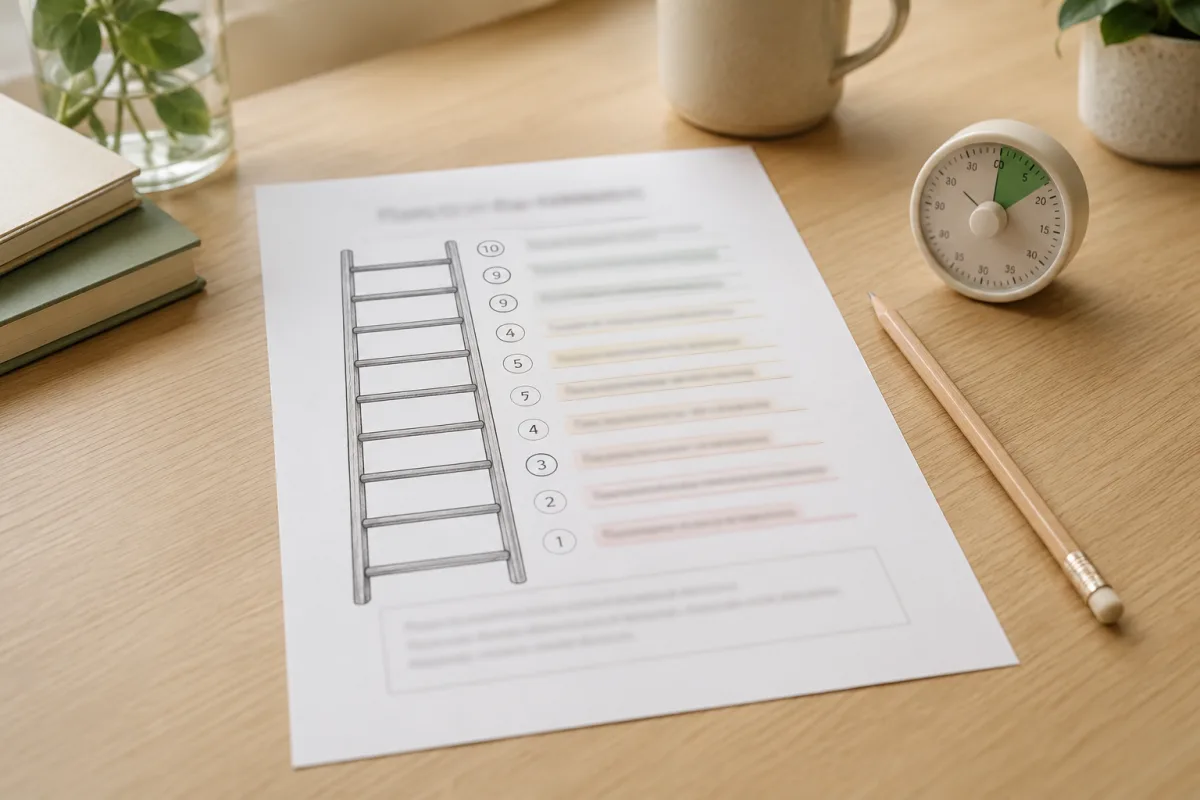
Put ten rungs on paper. Rung one should feel almost too easy; rung ten should be the current hard thing.
Move one rung at a time. Skipping rungs can turn practice into panic.
Schedule The Reps
Confidence practice needs a place on the calendar. Good intentions often disappear under email, fatigue, and chores.
Choose a day, time, place, and minimum version before the week gets noisy.
Use Support Without Dependence
Support helps, but the goal is not to need someone else to carry every step.
Ask for a practice partner, reminder, ride, or feedback, then keep one piece of the action as yours.
Confidence In Later Life
Confidence can drop when age, illness, grief, or retirement changes what a person can do.
Livecub's motivating elderly loved ones guide can help families support agency rather than taking over.
Review Without Drama

After each rep, write three lines: what I did, what happened, what I will adjust.
This keeps review practical and prevents one awkward moment from becoming a story about your entire future.
Handle Plateaus
A plateau does not mean practice stopped working. It may mean the next rep needs to be smaller, clearer, or more frequent.
Return to the ladder and change the step instead of quitting the whole skill.
Know The Clinical Line
NHS advises seeking help when low self-esteem feels hard to manage or is tied to mental health struggles: NHS self-esteem support.
If fear, panic, trauma, depression, or self-harm thoughts are present, confidence drills are not enough by themselves.
Keep The Practice Honest
Do not fake confidence so hard that you stop learning. Honest confidence can say I do not know yet.
That sentence leaves room for skill, humility, and the next attempt.
Keep A Confidence Journal
Use one page a week for confidence practice. Write the rep, the fear level, what happened, and what you learned.
The journal should be brief. If it becomes homework you avoid, make it smaller.
Ask Better Questions
Replace what is wrong with me with what skill is missing, what support would help, and what is the next safe rep.
Better questions turn shame into a plan.
Train The First Minute
Many confidence tasks are hardest in the first minute. Practice that minute on purpose.
Start the call, open the meeting, walk into the gym, or say the first line, then pause and reset.
Use Microcommitments
A microcommitment is a promise small enough to keep today.
Examples include ten minutes of practice, one question, one draft paragraph, one stretch, or one honest answer.
Practice I Do Not Know
Being able to say I do not know is a confidence skill. It protects honesty and leaves room to learn.
Try adding the next sentence: I can find out, or I need help with that part.
Train Boundaries
Boundaries are confidence reps because they test whether you can tolerate another person's disappointment.
Start with low-stakes limits before practicing in harder relationships.
Manage Energy
Practice at a time when your body has some fuel. Exhaustion can make every rep feel like proof of failure.
If energy is low, reduce the rep instead of canceling the skill.
Use A Reset Sentence
A reset sentence helps after a stumble. Try that came out wrong, let me start again, or I need a second.
This keeps one awkward moment from ending the whole attempt.
Collect Private Wins
Not every win needs an audience. Private wins may be the strongest evidence because they are not performed for approval.
Keep them in the proof log even if nobody clapped.
Practice With Neutral People
Neutral interactions can be useful practice: asking a clerk a question, calling an office, or confirming an appointment.
These moments are short, real, and usually safer than the relationships where confidence feels loaded.
Make The Next Rep Easier
After each attempt, remove one friction point. Prepare the bag, save the phone number, choose the route, or write the opening line.
Confidence grows faster when the next rep is easier to begin.
Do Not Perform Confidence All Day
Confidence practice needs recovery. Nobody has to act bold in every room and every hour.
Rest protects the practice from becoming another standard you use against yourself.
Frequently Asked Questions
Is self-confidence a skill?
Yes. Confidence can be practiced through small actions, feedback, evidence tracking, recovery after mistakes, and repeated exposure.
How long does it take to build confidence?
It depends on the task and history. Small improvements can happen quickly, while deeper fear patterns may need months and support.
What is a confidence rep?
A confidence rep is one manageable action that lets you practice uncertainty, such as asking a question or rehearsing a hard conversation.
Can I build confidence without feeling ready?
Yes. Many people act before they feel ready and gain confidence from the evidence that follows.
When is therapy a better step?
Therapy may be needed when low confidence is tied to trauma, panic, depression, self-harm thoughts, or severe avoidance.
Developing self-confidence is practice. Pick one field, take small reps, record proof, ask for feedback, recover from mistakes, and keep the work honest.

Linda Fehrman
Edits general wellness and relationship explainers. Health material is educational, avoids diagnosis and links to health-authority guidance.




Leave a reply
Replying to