
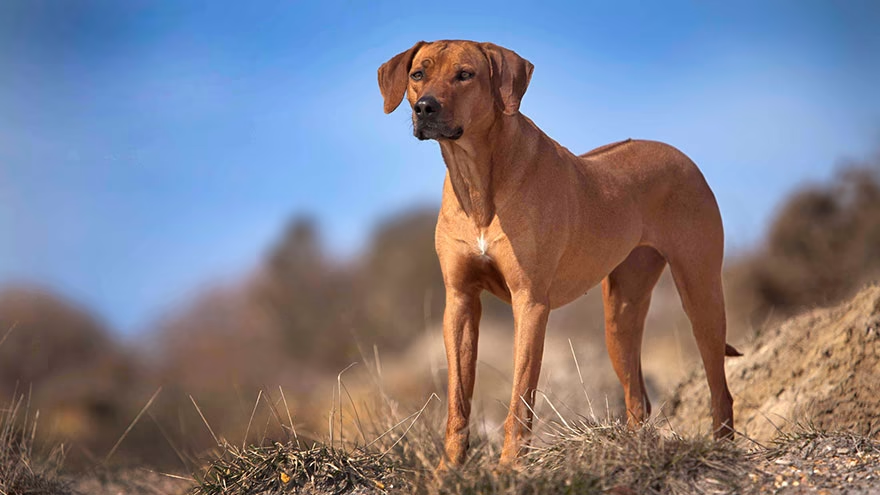
The Rhodesian Ridgeback's athletic heritage — understanding the exercise need
The story that explains everything about Rhodesian Ridgeback exercise is the lion story — and it isn't what most people expect. The Ridgeback didn't attack the lion. It tracked the animal across miles of African bush, using both sight and scent, then darted and feinted around the big cat for hours, keeping it cornered and distracted without ever closing in for a kill. That job demanded something rarer than raw speed: sustained, high-intensity effort combined with the restraint not to burn out early. The hunter had to arrive. The dog had to still be going when he did.
That heritage is the reason Rhodesian Ridgeback exercise needs are in a different category from most breeds. The Ridgeback is classified in the AKC Hound Group — recognized by the AKC in 1955 — and traces its lineage to the ridged dogs of the Khoikhoi people of southern Africa. European settlers at the Cape Colony crossed those indigenous dogs with breeds including Greyhounds, Mastiffs, and Bloodhounds to produce the versatile hunting dog that Cornelius van Rooyen refined over decades in what is now Zimbabwe. The result was a breed that hunts by both sight and scent, an unusual combination that explains why physical exercise alone isn't enough — the Ridgeback's brain needs to work too.
Males stand 25–27 inches at the shoulder and typically weigh around 85 pounds; females are slightly smaller. That deep chest, muscled hindquarters, and aerodynamic build are purpose-built for endurance. The same conformation that makes the Ridgeback an exceptional athlete also creates a specific vulnerability, but we'll come to that in the safety section.
How much exercise does a Rhodesian Ridgeback need?
The honest answer is more than most people think before they get one. An adult Ridgeback needs a minimum of one hour of vigorous, purposeful exercise every day — not a leisurely sniff-walk around the block, but genuine aerobic effort. Two hours is a more realistic target for a dog living in a house with a yard rather than working daily on a farm or trail. The Rhodesian Ridgeback Club of the United States (RRCUS) recognizes this through its performance programs, which include endurance trials specifically designed to test the breed's working capacity.
What that hour or two looks like matters as much as the total time. A Ridgeback that spends ninety minutes trotting at a moderate pace on leash will be calmer at home than one that does the same distance at a slow walk. The breed's cardiovascular system was built for sustained effort; short, intense bursts followed by long periods of rest don't satisfy it. Think in terms of activity that genuinely elevates the dog's heart rate and holds it there: running, cycling pace, a hard hike with elevation, or sport sessions.
Consequences of under-exercising a Ridgeback show up fast and are hard to miss. Destructive chewing, attempts to escape the yard, excessive barking, and relentless indoor energy aren't behavior problems in the traditional sense — they're a fit athlete with nowhere to put the energy. Addressing them with training alone, without first addressing the exercise deficit, rarely works.
For readers who own other large, active breeds, the comparison can be useful. If you've looked into German Shorthaired Pointer ownership, you'll recognize the pattern: high-output sporting heritage translated into a pet context means the owner has to deliberately substitute working conditions. The Ridgeback's demand is comparable, though the lion-baying endurance model produces a dog that prefers sustained effort over frantic bursts.
Running and cycling with a Rhodesian Ridgeback
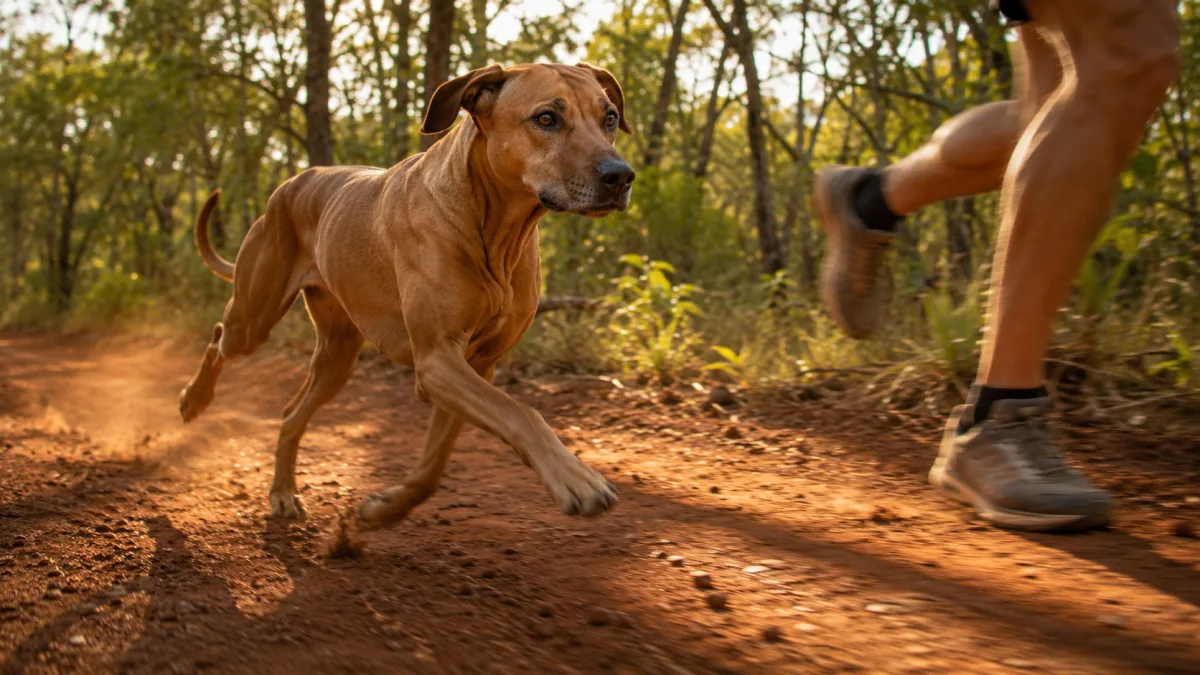
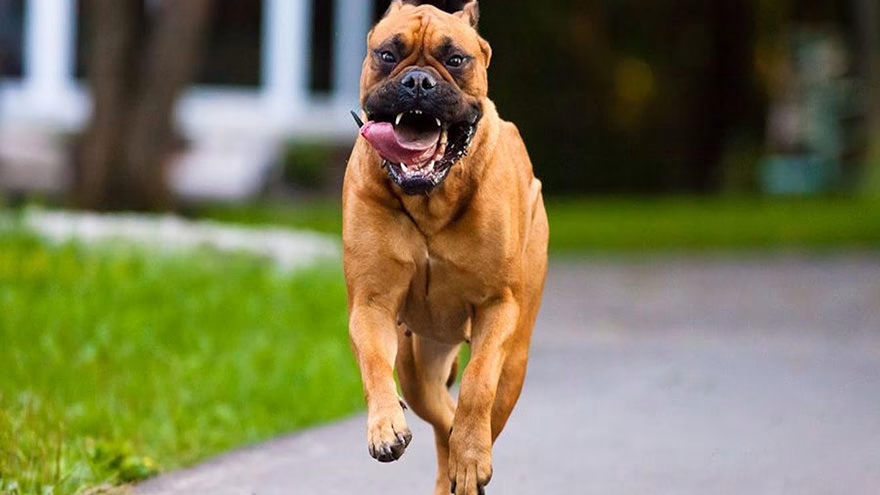
Running is the most natural exercise format for this breed, and a well-conditioned adult Ridgeback can comfortably hold a six-to-eight-minute mile for extended distances. Many owners report their dogs settle into an easy loping pace at 10–12 miles and show no signs of distress. The critical word is "conditioned" — a dog pulled off the couch and taken on a ten-mile run will suffer, just as a human would. Build distance over eight to twelve weeks, starting with twenty-minute runs and adding roughly ten percent to weekly mileage.
Paw pad toughening is a real consideration. A Ridgeback that mostly runs on grass or dirt will need several weeks of gradual exposure before sustained pavement running, otherwise pad abrasions become a limiting factor. Check pads after every run during the conditioning phase; slight redness warrants a rest day. Hydration on longer runs is non-negotiable — carry water and offer it every twenty to thirty minutes in warm weather.
Cycling works well for owners who can't maintain a running pace the dog finds aerobically meaningful. A hands-free attachment that connects to the seatpost rather than the handlebars keeps the dog from pulling you into traffic. Start at a walk beside the bike for the first few sessions; the novel experience of a moving bicycle beside them unnerves some dogs initially. Once comfortable, Ridgebacks typically thrive at cycling pace, covering distance that satisfies even high-drive individuals.
Hiking and swimming
Trail hiking suits the Ridgeback's scent-and-sight hunting style better than road running in one key respect: varied terrain and unpredictable smells keep the brain engaged alongside the body. A six-mile trail hike with 800 feet of elevation typically tires a Ridgeback more thoroughly than eight miles on a flat road, because the mental load of reading a new environment adds to the physical output.
Keep the dog on leash in areas with wildlife. The breed's hunting drive runs deep, and a Ridgeback that picks up an interesting scent may disappear at speed into terrain where recall is unreliable. This isn't a training failure; it's a sighthound-scenthound hybrid doing exactly what it was built to do. Reliable recall off leash in an open field and reliable recall when the dog has its nose locked on a deer trail are two entirely different skills.
Swimming is an excellent low-impact exercise option, particularly for aging dogs or those recovering from orthopedic issues. Most Ridgebacks take to water willingly, though the breed isn't an instinctive water dog in the way a Labrador is. Introduction should be gradual — shallow entry points, encouragement rather than forcing. Once comfortable, swimming provides a full-body cardiovascular workout with zero joint impact, making it valuable during rehabilitation or on recovery days between harder workouts.
Exercising a Rhodesian Ridgeback puppy safely
The puppy exercise question is where good intentions can cause genuine, lasting damage. Growth plates — the cartilaginous regions at the ends of developing bones — remain open and vulnerable in large breeds until approximately 18 months of age, and in male Ridgebacks potentially up to 24 months. These physeal plates are the last part of bone to calcify, and before they close, they are softer than mature bone and susceptible to injury from repetitive high-impact stress.
What that means practically: sustained jogging on hard surfaces, long runs alongside a bike, and repetitive jumping are inappropriate for a Ridgeback puppy. The damage from growth plate injuries isn't always immediately visible — a puppy may not limp — but the cumulative microtrauma can affect bone alignment and joint development in ways that show up as arthritis years later.
The guideline most vets and experienced breeders use is five minutes of structured exercise per month of age, twice per day. A four-month-old puppy gets four five-minute sessions of leash walking; an eight-month-old gets eight. This rule applies to forced, repetitive exercise — not to free play. Self-directed play in the yard, where the puppy chooses its own pace and stops when it wants to, is generally safe and should be the dominant form of activity under eighteen months. The puppy's instinct to rest mid-play exists for a reason.
Mental exercise matters even more during this phase. A Ridgeback puppy that can't run five miles can absolutely spend twenty minutes on a sniff walk, work through a training session, or figure out a puzzle toy. Building those neural pathways early pays dividends in a calmer, more biddable adult dog. If you're reading about puppy development across breeds, the growth plate issue applies to any large-breed puppy — it comes up in discussions of the biggest dog breeds for the same physiological reasons.
Lure coursing and AKC dog sports
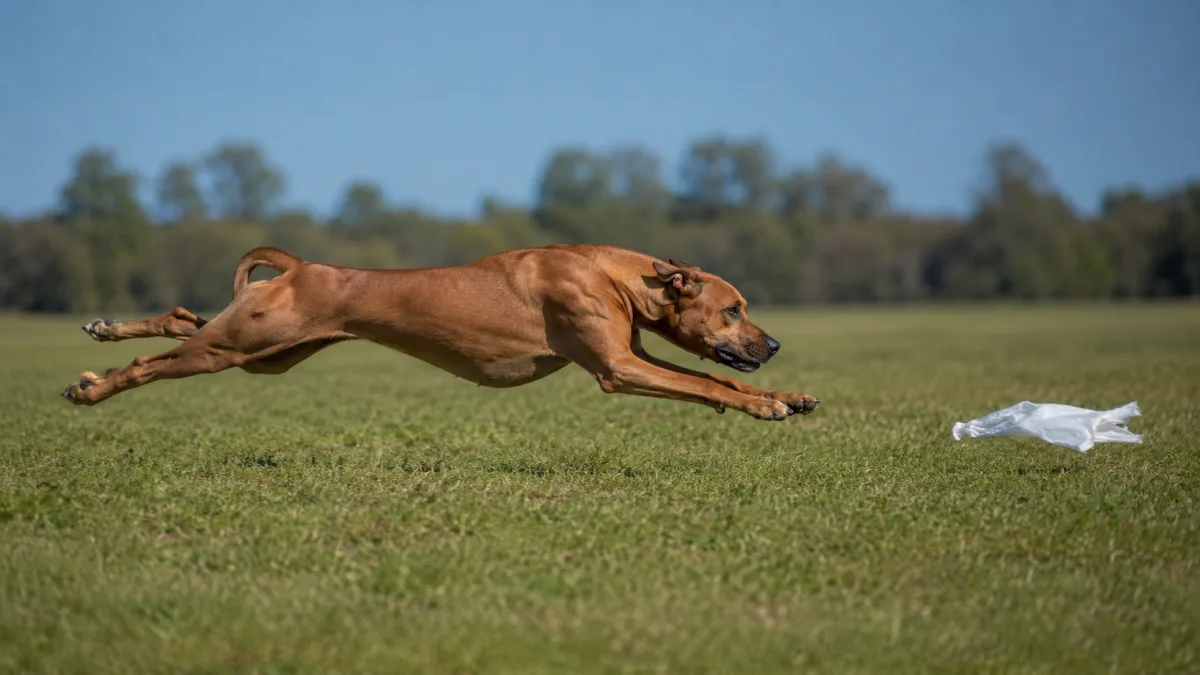
Lure coursing is the sport that comes closest to replicating the Ridgeback's original work. A mechanical lure — a white plastic bag attached to a motorized line — is run across a 600-yard or longer course in patterns that simulate the erratic movement of prey. The dog doesn't know the bag is plastic. Every hunting instinct activates: the visual lock-on, the explosive acceleration, the tracking through turns. For a breed that spent centuries baying large game, this is deeply satisfying in a way that a game of fetch simply isn't.
According to the RRCUS Lure Coursing program, Ridgebacks were accepted by the AKC for lure coursing on August 10, 1992, with the first eligible trials held in September of that year. The AKC titling pathway runs from Junior Courser (JC) — two qualifying passes running alone — through Qualified Courser (QC), Senior Courser (SC), Master Courser (MC), and ultimately Field Champion (FC). Competitive events judge dogs on follow, speed, agility, and endurance.
For owners who want to test the water before committing to full trials, the CAT (Coursing Ability Test) and FAST CAT are more accessible entry points. FAST CAT is a timed 100-yard straight-line sprint; the dog's time is converted to miles per hour and accumulated into a points total. Both formats are open to any registered AKC breed and require no previous experience. A single FAST CAT run takes about thirty seconds and tells you immediately whether your Ridgeback has the instinct — the answer is almost always yes.
Beyond coursing, Ridgebacks compete in AKC agility, tracking, nose work, and obedience. Tracking aligns particularly well with the breed's scenting ability. Agility demands more patience on the handler's part — the Ridgeback is an independent thinker rather than an eager-to-please breed, and agility relies heavily on fast handler communication — but many Ridgebacks compete successfully once their drive is channeled correctly.
Mental exercise and problem-solving activities
A Ridgeback that has covered ten miles but had nothing to think about is not the same as one that covered five miles while also navigating a novel environment, solving a puzzle feeder, and completing a training session. Physical and cognitive fatigue are different systems, and the breed needs both addressed.
Training sessions are among the most efficient mental exercise tools available. Short, varied sessions of ten to fifteen minutes — working through commands at different locations, adding distractions, introducing new cues — demand sustained attention that genuinely tires the brain. The Ridgeback is intelligent and learns quickly, which means it also gets bored quickly if the same routine is repeated. Vary the sequence, add complexity, and end before the dog loses interest.
Puzzle feeders replace part of the dog's daily food allocation with a problem-solving task. The dog works to extract kibble from a compartmented toy rather than inhaling it from a bowl. This slows eating (relevant for bloat-risk deep-chested breeds — more on this below) and provides a cognitive challenge. Rotate puzzle toys regularly; a Ridgeback that has solved the same toy fifty times completes it in forty seconds and gains nothing from the exercise.
Nose work — structured scent-detection training based on competition formats where dogs find hidden odors — is particularly well-suited to a breed that hunts by scent as well as sight. A basic nose work introduction teaches the dog to find birch oil hidden in a room or a car; more advanced competition involves searches of entire buildings. The concentration required exhausts even high-drive dogs faster than most physical exercise.
For owners of Rottweilers or other working-heritage breeds, the mental exercise principle applies equally — but with Ridgebacks the independent, problem-solving streak of a coursing hound means engagement tools need to be genuinely challenging, not just novel.
Heat, bloat, and exercise safety
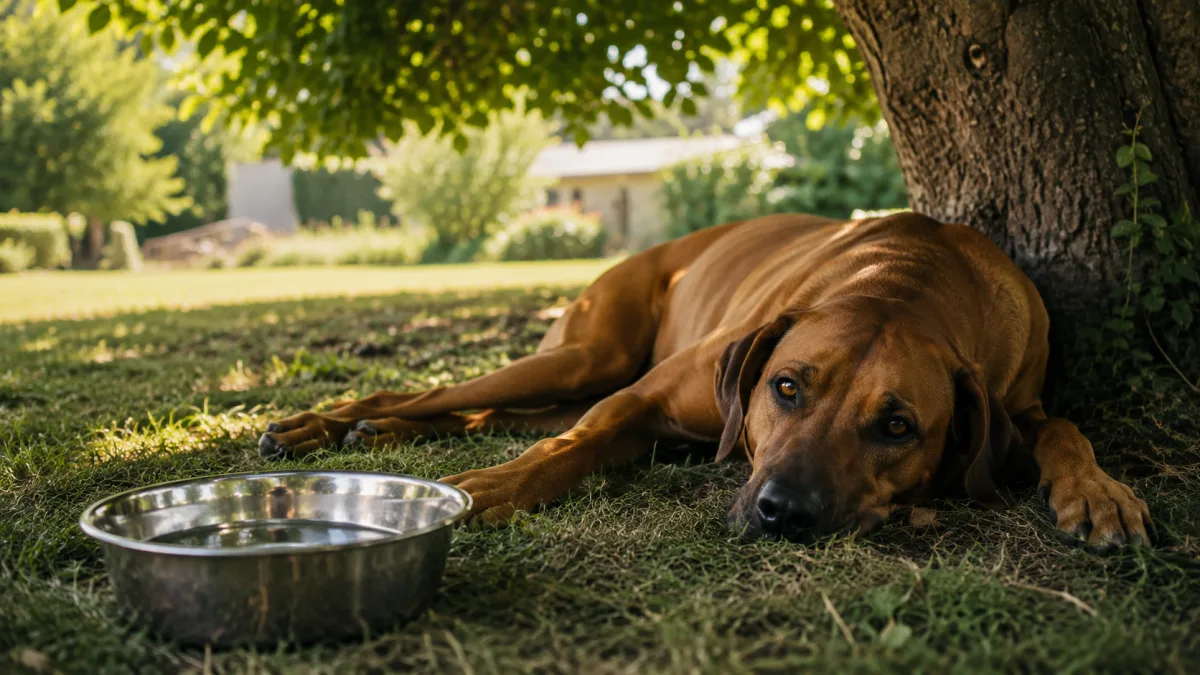
Two specific safety considerations apply to Ridgebacks that don't get enough attention in general dog exercise guides.
The breed's southern African origin means it tolerates heat reasonably well compared to brachycephalic dogs, but vigorous exercise in high summer temperatures still carries genuine heatstroke risk. Exercise during the cooler hours — early morning or evening — when ambient temperatures exceed 80°F. Signs of overheating include excessive panting that doesn't resolve with rest, drooling thicker than normal, disorientation, and gum color changes toward pale or bright red. Any suspected heatstroke is a veterinary emergency.
The second issue is more specific and more commonly overlooked: gastric dilatation-volvulus, known as GDV or bloat. The Ridgeback's deep chest — the same conformation that contributes to its athletic capacity — places it in the at-risk category for this condition. GDV occurs when the stomach fills with gas and rotates on its axis, cutting off blood supply. It can become fatal within hours without emergency surgery.
According to VCA Animal Hospitals, vigorous exercise immediately before or after a large meal is an established risk factor for GDV in deep-chested breeds. The recommendation is to wait at least one to two hours after feeding before exercise, and to avoid heavy exercise in the period immediately before meals as well. Feeding smaller portions two or three times daily rather than one large meal reduces stomach volume and the associated risk.
This is the exercise rule Ridgeback owners most commonly overlook — not because they don't care, but because the connection between mealtime and exercise timing isn't instinctive. A dog that ate an hour ago and seems fine going for a run may not be fine; the stomach distension from a recent large meal combined with the physical agitation of running is precisely the scenario that elevates GDV risk. Build the habit early: feed, wait at least an hour, then run. It is one of the simplest, most protective routines an owner of a deep-chested breed can establish.
Frequently Asked Questions
How far can a Rhodesian Ridgeback run?
A conditioned adult Ridgeback can comfortably cover ten or more miles at a steady pace. The breed was developed for multi-hour endurance hunts, and the cardiovascular capacity is genuine. That said, conditioning is required — build mileage gradually over eight to twelve weeks, check paw pads for wear, and always carry water on runs longer than three to four miles. Unconditioned dogs should start with twenty-to-thirty-minute runs and build from there.
At what age can I start running with a Rhodesian Ridgeback puppy?
Sustained jogging on hard surfaces should wait until growth plates have closed — approximately eighteen months for females, up to twenty-four months for males. Before that age, use the five-minute rule: five minutes of structured leash exercise per month of age, twice per day. Free play in a yard is generally fine at any age because the puppy self-regulates pace and rest. The risk is specifically repetitive, forced, high-impact exercise on developing bones.
What happens if a Rhodesian Ridgeback doesn't get enough exercise?
Under-exercised Ridgebacks are vocal about their dissatisfaction. Destructive chewing — furniture, baseboards, garden hoses — is common. Escape attempts, digging under fences, or clearing them outright follow. Persistent barking, hyperactivity that doesn't settle in the evenings, and difficulty with any form of impulse control are also typical. These behaviors typically resolve quickly once adequate exercise is restored; they are symptoms of a working dog without work, not character flaws.
Is lure coursing good exercise for a Ridgeback?
Yes — and it's more than exercise. Lure coursing engages the hunting sequence that the breed was specifically built for: visual lock-on, pursuit, cornering. The physical output of a full coursing run is considerable, but the psychological satisfaction is the more important factor. A Ridgeback that courses regularly tends to be noticeably calmer at home than one that only does road miles. The AKC lure coursing program offers a structured pathway from beginner tests to Field Champion titles; the FAST CAT 100-yard sprint is a quick, low-barrier way to start.
Can Rhodesian Ridgebacks swim?
Most can and will, though they aren't natural water dogs in the retriever sense. They typically need a calm introduction with a gentle entry point rather than being dropped into deep water. Swimming is particularly valuable for older Ridgebacks or those managing joint issues because it delivers a full cardiovascular workout with zero impact on bones and cartilage. It also works well as a recovery-day activity between harder running or hiking sessions.

Timothy Davidson
Edits step-by-step general-interest guides for clarity, realistic limits and source verification.

Leave a reply
Replying to