
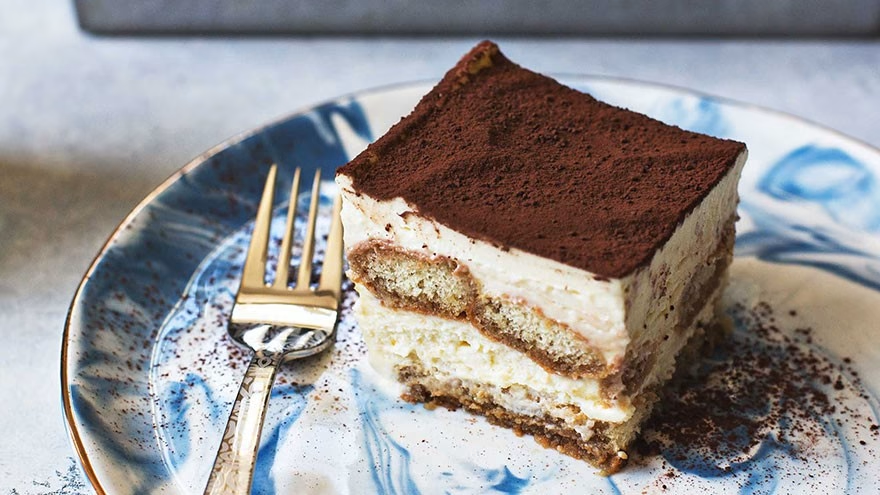
What is tiramisu and where did it actually come from?
Ask most people about tiramisu's birthplace and they'll confidently say Tuscany — specifically Siena, where legend holds that the dessert was created in the late 1600s in honor of Grand Duke Cosimo III de' Medici and originally called zuppa del duca. It's a charming story. It's also almost certainly wrong. The word tiramisù does not appear in any Italian cookbook, food encyclopedia, or dictionary before 1980. A 1983 regional cookbook devoted to Veneto cooking is among the first published sources to include the recipe. If Cosimo's cooks had invented it in the 17th century, the dessert managed to vanish completely for nearly three hundred years before quietly reappearing in northeast Italy.
The stronger, better-documented account places the perfect tiramisu's creation at Le Beccherie restaurant in Treviso, Veneto, on Christmas Eve 1969. Restaurateur Ado Campeol and his wife Alba di Pillo worked alongside pastry chef Roberto Linguanotto, who is credited with the actual recipe. The dish appeared on Le Beccherie's menu in 1972 and spread through northern Italy across the decade that followed. A 1978 restaurant column in the Sydney Morning Herald mentions it — proof the dessert was already traveling internationally within a decade of its creation. When Linguanotto died in July 2024, Le Beccherie's tribute explicitly credited him as the creator. The Siena story has no documentary trail. The Treviso story has eyewitnesses, a restaurant, and a date.
There is one further wrinkle: some food historians point to a semi-frozen tiremesù served at the Vetturino restaurant in Pieris, in the Friuli-Venezia Giulia region, as far back as 1938. Whether this was a true predecessor or a coincidental naming parallel, it fits the broader picture of a dessert rooted in the culinary traditions of northeastern Italy rather than Tuscany. In 2013, the President of Veneto pushed for EU-protected status for the dish based on the 1970 original ingredients — the application did not succeed, but it underlined how seriously the region takes its claim.
What are the classic tiramisu ingredients and why does each matter?
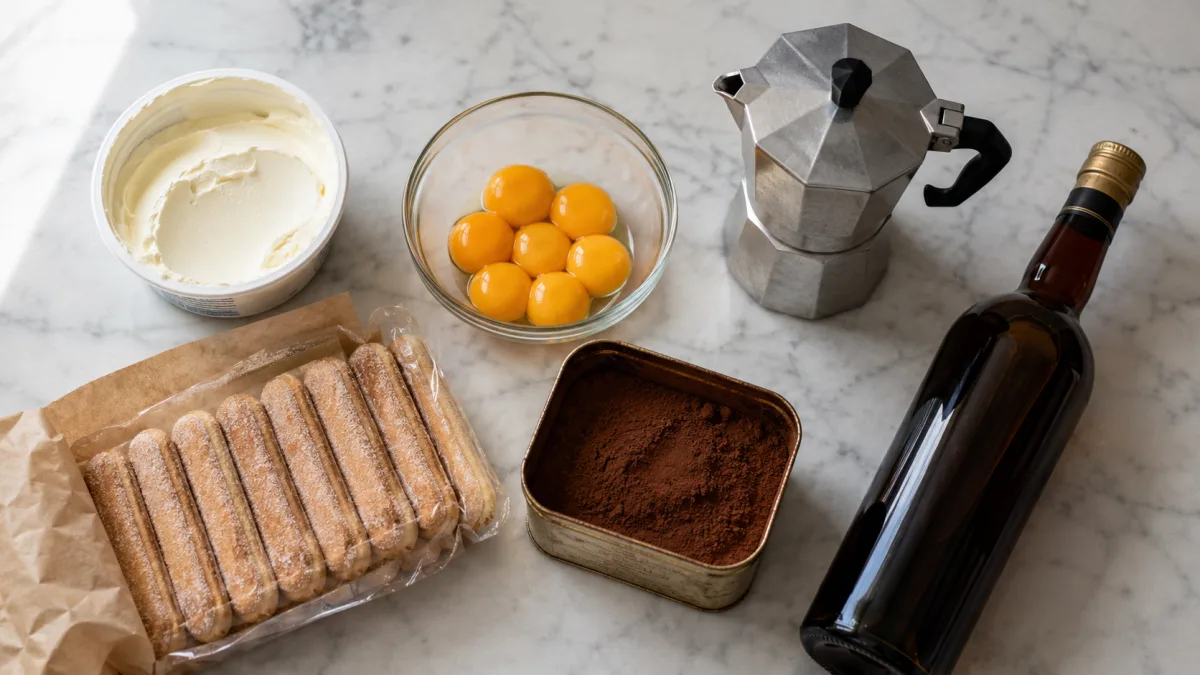
Tiramisu has six core ingredients, and each one is doing specific structural or flavor work. Understanding what they actually contribute will tell you exactly why substitutions so often fall flat.
Savoiardi (ladyfingers): These Italian sponge biscuits are engineered for absorption. Their open, aerated crumb soaks up liquid quickly — faster than most home bakers expect — but their exterior crust holds enough structure to prevent immediate collapse. The dry center, left deliberately undersoaked during dipping, slowly draws moisture from the mascarpone cream during refrigeration, softening the biscuit from the inside out while the cream sets. Substituting with sponge cake produces a denser texture and a less defined layer; it holds together differently and releases liquid back into the dish more readily.
Espresso: The recipe calls for espresso specifically, not filter coffee, and the difference matters. Espresso has a higher concentration of dissolved solids and coffee oils than drip coffee, which means more flavor per tablespoon of liquid absorbed by the ladyfinger. Using strong filter coffee works in a pinch but produces a thinner, slightly more bitter soak with less aromatic complexity. Allow the espresso to cool completely to room temperature — hot liquid causes the ladyfingers to absorb too much too fast, leading to mushiness.
Mascarpone: This is a double-cream fresh cheese with a fat content around 75 percent, made by acidifying heated cream with citric or tartaric acid rather than bacterial cultures. That high fat content is what gives tiramisu its signature dense richness and what allows the cream to set firmly when chilled without gelatin. Cold mascarpone straight from the refrigerator will clump and break when beaten; let it sit at room temperature for 15 to 20 minutes before working with it.
Egg yolks and sugar: Beaten together, these form a zabaglione — a thick, aerated custard that provides the structural skeleton of the cream layer. The sugar partially dissolves into the yolks during beating, lowering water activity and contributing to the final set. This mixture is what gives tiramisu its characteristic pale yellow cream rather than a white one.
Marsala wine: Sweet Marsala is the traditional fortified wine used in the original Le Beccherie recipe. Its warm caramel and dried-fruit notes complement both the espresso and the mascarpone without competing. Kahlúa (coffee liqueur) adds extra coffee intensity; Amaretto introduces an almond note that works well but isn't traditional. Dark rum and brandy are common modern alternatives. The original Le Beccherie recipe actually contained no Marsala in the soaking liquid — the wine went into the cream only. Many modern recipes add it to the espresso as well.
Cocoa powder: The finishing layer is unsweetened cocoa powder, not grated chocolate. Cocoa powder blooms slightly as it absorbs moisture from the cream during refrigeration, creating the characteristic dusty-matte surface and a clean cocoa bitterness that cuts through the richness below. Grated chocolate sits on top as a separate textural element and does not meld into the cream the same way; it also melts unevenly. Stick with good-quality Dutch-process cocoa for depth without excess bitterness.
Raw eggs or cooked eggs — which tiramisu method is safer?
Traditional tiramisu uses raw egg yolks — beaten with sugar and folded into mascarpone without any heat application. The flavor is cleaner and the texture lighter, with none of the faint cooked-custard quality that heat can introduce. But raw egg yolks carry a genuine Salmonella risk, and it's worth being clear-eyed about who that risk affects most: pregnant women, young children, older adults, and anyone with a compromised immune system should not eat raw egg preparations.
The cooked alternative is to make a proper zabaglione over a double boiler. Place the egg yolks and sugar in a heatproof bowl set over a saucepan of barely simmering water, making sure the base of the bowl does not touch the water. Whisk continuously for 5 to 8 minutes until the mixture doubles in volume, turns pale, and falls back as thick ribbons when the whisk is lifted. The target temperature is 160–176°F (71–80°C) — sufficient to eliminate Salmonella without scrambling the yolks. Remove from the heat and continue whisking until the bowl cools slightly before folding into the mascarpone.
A third route: pasteurized shell eggs. These are heat-treated at the carton level to eliminate pathogens, and they can be used raw in tiramisu without modification. They cost roughly 50 to 100 percent more than standard eggs and are stocked at most larger supermarkets. The flavor of the finished cream is indistinguishable from the traditional raw version. For anyone cooking for a group that includes vulnerable guests, pasteurized eggs eliminate the need to choose between authenticity and safety.
One thing that does not make raw eggs safe: sugar. At typical dessert concentrations, sugar lowers water activity enough to slow some microbial growth but does not reliably inactivate Salmonella. The same applies to alcohol. Neither Marsala nor rum at typical recipe quantities kills the bacteria. The only reliable options are heat or pasteurization.
How do you make the perfect tiramisu step by step?
This recipe makes one standard 9x13-inch dish, serving 10 to 12. It uses the cooked zabaglione method for safety while preserving the classic flavor.
Ingredients:
- 6 large egg yolks
- ¾ cup (150g) granulated sugar, divided
- 3 tablespoons sweet Marsala wine (plus more for the soak, optional)
- 500g (about 2 cups) mascarpone cheese, at room temperature
- 1½ cups (360ml) heavy cream, cold
- 1½ cups (360ml) brewed espresso, cooled to room temperature
- 2 to 3 tablespoons dark rum or brandy (optional)
- About 36 to 40 savoiardi (ladyfinger biscuits)
- 2 to 3 tablespoons unsweetened Dutch-process cocoa powder, for dusting
Before anything else, brew your espresso and let it cool completely — at minimum to room temperature, ideally to 65–70°F (18–21°C). Pull the mascarpone from the refrigerator 20 minutes ahead. Cold mascarpone seizes and breaks when beaten.
- Make the zabaglione. Combine the egg yolks, ½ cup (100g) of the sugar, and the Marsala in a heatproof bowl. Set it over a saucepan of barely simmering water; the base of the bowl should not touch the water. Whisk continuously for 5 to 8 minutes until the mixture is pale, thick, and doubled in volume, and reads 160°F (71°C) on an instant-read thermometer. Remove from the heat. Continue whisking off-heat for another 2 minutes, then set aside to cool for 10 minutes.
- Beat the mascarpone. In a separate bowl, beat the mascarpone briefly with a spatula until smooth and creamy. Fold the cooled zabaglione into the mascarpone in two additions, using a light hand to preserve the aeration.
- Whip the cream. Using the remaining ¼ cup (50g) of sugar, whip the heavy cream to medium-stiff peaks — it should hold its shape but not appear grainy. Fold it into the mascarpone mixture in three additions. The finished cream should be thick, smooth, and pale.
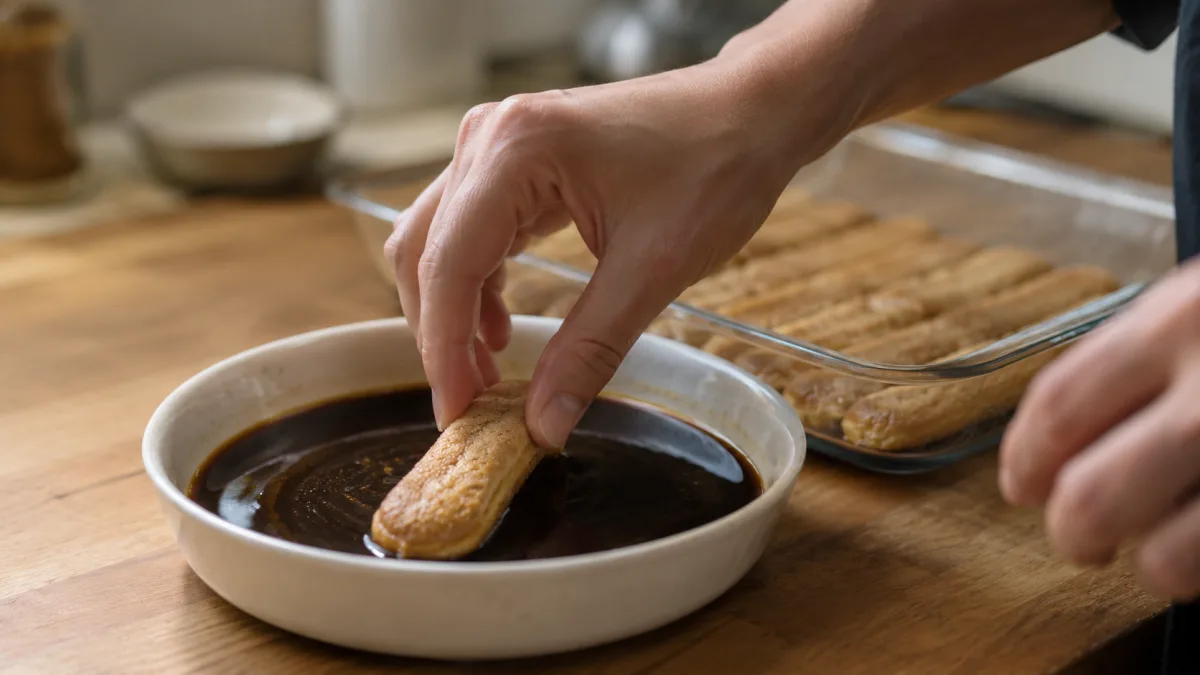
- Prepare the soak. Combine the cooled espresso with rum or brandy, if using. Pour it into a shallow dish wide enough to fit a ladyfinger lengthways.
- Soak and layer. Working one at a time, dip each ladyfinger into the espresso — one quick pass per side, roughly 1 to 2 seconds each. The biscuit should be moistened but not saturated; the dry center will absorb further moisture from the cream during refrigeration. Arrange the dipped ladyfingers in a single tight layer across the base of the dish, trimming to fit as needed.
- Add the cream. Spread half the mascarpone cream over the ladyfinger layer in an even coat, reaching all the edges.
- Repeat. Arrange a second layer of dipped ladyfingers over the cream, then spread the remaining cream on top. Smooth the surface with an offset spatula.
- Refrigerate. Cover tightly with plastic wrap and refrigerate for a minimum of 8 hours; overnight is better. Do not add the cocoa yet.
- Finish and serve. When ready to serve, dust the surface generously with cocoa powder through a fine-mesh sieve. Cut into portions with a sharp knife wiped clean between cuts.
What are the most common tiramisu mistakes?

The ladyfinger soak trips up more first-timers than any other step. The instinct is to submerge each biscuit and count to ten — the result is a layer of mush that collapses and releases liquid into the dish as the tiramisu sits. Savoiardi absorb liquid at a surprisingly fast rate; one to two seconds per side is genuinely enough. The deliberate dry core left behind acts as a moisture reservoir: as the assembled tiramisu refrigerates, that dry center pulls liquid down from the cream layer above, softening gradually while the structure around it stays intact. It's the same hygroscopic principle that makes overnight rest essential.
Using hot espresso is the second most common mistake, and it compounds the soaking problem — hot liquid accelerates absorption, compresses the biscuit structure, and can cause the cream to weep when the warm dish meets the cold mascarpone.
Breaking the mascarpone is the mistake that takes the longest to diagnose because it happens quietly. Cold mascarpone beaten aggressively will split into a grainy, curdled mass that no amount of additional folding will repair. Let it reach room temperature, beat it briefly by hand with a spatula to loosen it, then fold in the zabaglione. If you do see graininess developing, try placing the bowl over a very gentle bain-marie for 30 seconds while stirring — warmth can sometimes bring it back together.
Adding the cocoa before refrigeration is another frequent error. Cocoa applied immediately absorbs moisture, darkens, and forms a damp crust. Applied after the chill — just before serving — it stays dry and powdery, providing the textural contrast the dessert requires. For an extra layer you can also look at how layering and presentation work for other desserts to inform your serving approach.
Can you make tiramisu without alcohol or eggs?
Yes to both, with trade-offs worth understanding. For an alcohol-free version, replace Marsala or rum in the soak and cream entirely with additional espresso. Some cooks add a splash of pure vanilla extract or a teaspoon of almond extract to the cream to recover some of the aromatic complexity the wine would have provided. The result is lighter and somewhat less complex, but the essential structure of the dessert is unchanged. If you enjoy building depth through layered flavoring, this is the same principle applied to dessert.
Egg-free tiramisu replaces the zabaglione with additional whipped cream or whipped aquafaba — the liquid from a can of chickpeas, whipped to stiff peaks, works surprisingly well as an aerator. The cream will be whiter and slightly less rich than the egg yolk version, and it will set less firmly, so assembly needs to be neat. Cream cheese can also substitute for mascarpone at a ratio of roughly 225g cream cheese plus 60ml sour cream per 250g mascarpone; the flavor is sharper and less delicate, but the texture holds well. For special occasions like birthday or memorial gatherings, an egg-free tiramisu means the dessert is accessible to more guests.
How far in advance can you make tiramisu?
This is where the question of timing intersects with the science of what overnight rest actually does. Mascarpone is hygroscopic — it slowly absorbs moisture from adjacent wet ingredients. During the first several hours of refrigeration, the partially dry ladyfingers absorb liquid from both the espresso soak and the cream above them, evening out into a uniformly moist but still structured layer. The cream simultaneously loses a small amount of surface moisture, setting more firmly as the fat crystallizes slightly at refrigerator temperature (around 38°F/3°C). The flavors — coffee, Marsala, egg, cocoa — diffuse across the layers and round out. A tiramisu eaten at the 4-hour mark is perfectly edible. One eaten at the 12-hour mark is markedly better.
Tiramisu can be made up to 2 days in advance and refrigerated, covered tightly. Beyond 48 hours, the ladyfingers begin to break down and the structure softens past the ideal point. For freezing: wrap the entire assembled dish in plastic wrap and then foil; it keeps for up to 3 months. Thaw overnight in the refrigerator, dust with fresh cocoa immediately before serving. The texture changes slightly — the cream becomes a touch denser — but a frozen-and-thawed tiramisu is still excellent, particularly for those already familiar with the freezing process for other foods.
Serve tiramisu cold, straight from the refrigerator. Letting it warm to room temperature softens the cream past its structural point and dulls the contrast between the cold cream and the cocoa surface. Portions cut cleanly from a cold dish; portions cut from a room-temperature one tend to slide.
Frequently Asked Questions
Can I use regular coffee instead of espresso in tiramisu?
You can, but the flavor will be noticeably thinner. Espresso has roughly 40–60mg of caffeine per ounce versus about 12–16mg for drip coffee, but more importantly it has a higher concentration of dissolved flavor compounds and coffee oils. If you don't have an espresso machine, brew a very strong stovetop moka pot coffee, or dissolve 2 teaspoons of good instant espresso powder in ½ cup of hot water. Allow any version to cool fully before using.
Why did my mascarpone cream turn grainy and lumpy?
Mascarpone split, almost certainly because it was too cold when beaten. Cold mascarpone's fat structure seizes under mechanical force and breaks into small curds. Let it rest at room temperature for 15 to 20 minutes before working with it, and fold rather than whisk it into the zabaglione. If it's already broken, try setting the bowl briefly over warm water (not simmering) and stirring gently — sometimes warmth redistributes the fat.
What is the difference between savoiardi and regular ladyfingers?
Savoiardi are the Italian variety: crisper, drier, and more porous than soft European-style ladyfingers. That dryness is exactly what the recipe relies on — the biscuits need structural integrity before soaking and residual dry capacity to absorb cream from above during refrigeration. If your supermarket only stocks soft ladyfingers, reduce the soaking time to a single brief dip of one second per side and watch the assembly carefully. The margin for error is smaller.
Can I use something other than Marsala wine?
Yes. Dark rum, brandy, and Amaretto are the most common substitutes. Dark rum adds a molasses-and-vanilla depth; brandy is warmer and slightly drier; Amaretto brings almond sweetness that pairs well with cocoa. Kahlúa doubles down on the coffee note, which works but can make the espresso flavor overwhelming. For a non-alcoholic cream, a teaspoon of pure vanilla extract and a tablespoon of strong espresso folded into the mascarpone approximates the aromatic role Marsala plays.
How do I know when the zabaglione is ready?
The mixture should be pale — almost white — and roughly doubled from its original volume. Lift the whisk: a thick ribbon of mixture should fall back into the bowl and sit on the surface for several seconds before dissolving. On a thermometer, you're looking for 160–165°F (71–74°C). Under-cooked zabaglione will be too loose and won't set the cream; over-cooked will begin to smell of scrambled eggs. If you see any solid pieces forming at the edges of the bowl, lower the heat immediately and whisk more vigorously.
What is the single most important step not to skip?
The overnight rest. It is the step most first-timers skip because the assembled dish looks finished and the urge to taste is strong — but four hours is a minimum, and twelve is where the dessert becomes what it's supposed to be. The structure sets, the flavors unify, and the ladyfingers transition from damp biscuits into the smooth, yielding layer that defines a properly made tiramisu. Cover tightly, refrigerate, wait. Every other technique in the recipe supports this one result.
Sources and verification
Check current details with these primary or subject-authority sources before acting on the information.

Timothy Davidson
Edits step-by-step general-interest guides for clarity, realistic limits and source verification.




Leave a reply
Replying to