
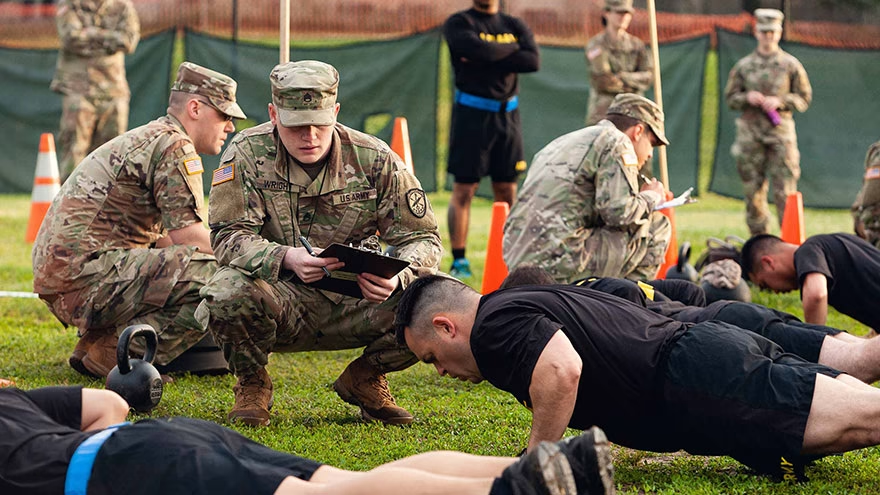
Why Army Basic Combat Training Is Designed to Be Stressful
If you are preparing for Army Basic Combat Training — or you are already counting down the days until you ship out — the single most useful thing you can understand about army basic training stress is this: it is not an accident. The stress is the curriculum.
Military psychologists call it stress inoculation. The principle is straightforward — controlled, graduated exposure to stressors builds resistance to those same stressors. Drill sergeants do not yell at recruits because they enjoy it, though some days that may be debatable. They yell because the brain's threat-response system needs to be desensitized to high-pressure commands before a soldier can execute under fire. BCT is engineered to break down civilian habits, compress years of psychological adaptation into ten weeks, and rebuild a person who can function when every biological instinct is screaming to freeze or run.
Knowing this changes everything. The recruit who arrives believing the stress is random punishment will spend cognitive energy resisting it, which amplifies the physiological load. The recruit who arrives knowing the stress is a training tool — and accepts it as such — moves through BCT at a fundamentally lower psychological cost. That is not a motivational platitude. Research published in Frontiers in Psychology on cognitive resilience in military personnel confirms that appraisal and reappraisal — how a soldier mentally frames a stressor — is one of the strongest predictors of performance under pressure. The framing you carry into BCT matters.
Understanding BCT Phases — What You Are Actually Facing
According to the official Army BCT structure published on GoArmy.com, Basic Combat Training runs ten weeks across four sequential phases. Each phase has a distinct psychological signature, and knowing that signature in advance is itself a stress-reduction tool.
Yellow Phase (Weeks 1–2) is the disorientation period. You arrive, your civilian identity gets stripped — haircut, uniform, new name ("trainee") — and you begin adapting to Army values, formation schedules, and physical training. The shock is real. Almost everyone feels it. The key is that disorientation is temporary and physiologically predictable.
Red Phase (Weeks 3–4) is where BCT concentrates its maximum psychological pressure. Drill sergeant intensity peaks. Personal autonomy is minimal. You begin weapons familiarization and land navigation, and you go through your first field exercise, The Hammer. This is the phase most recruits dread, and for good reason — it is deliberately designed to be the hardest. Your cortisol response will be elevated. Sleep may be irregular. The battle buddy system, covered below, becomes your primary psychological anchor.
White Phase (Weeks 5–7) shifts emphasis toward rifle marksmanship, small-unit tactics, and fieldcraft. The pressure does not disappear, but the nature of the work becomes more technical. Competence starts building, and with it, confidence. The Anvil, a two-day field training exercise, tests what you have absorbed.
Blue Phase (Weeks 8–10) is when the training cohort begins to function as a unit. Advanced weapons, sustained field operations, and The Forge — a multi-day culminating exercise — close out BCT. For most recruits, this phase feels hard but manageable, because they have already been through Red Phase and survived it.
Mapping out what each phase actually demands lets you approach BCT one phase at a time rather than staring down the whole ten weeks as a single undifferentiated wall of difficulty.
Physical Fitness: The Most Effective Stress Inoculation
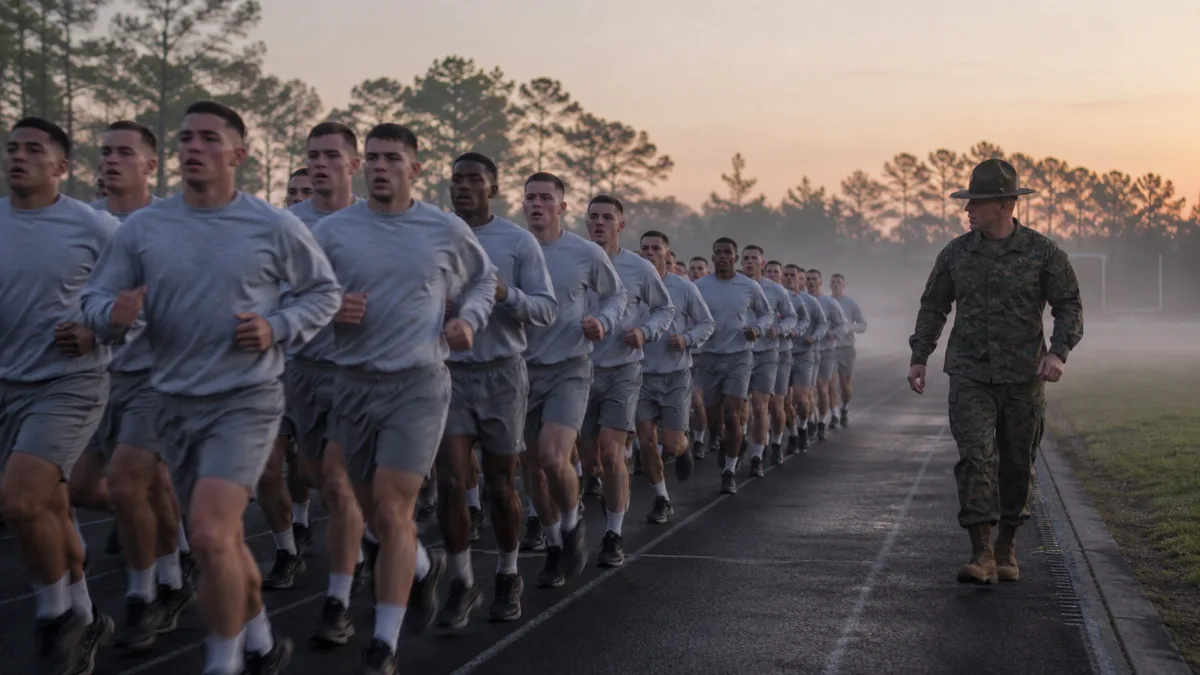
The physiology here is not complicated, but it is worth understanding precisely. Aerobic exercise reduces circulating cortisol. When your body is already conditioned to physical output, the cortisol spike triggered by a morning PT session is smaller, resolves faster, and does not cascade into the chronic stress state that impairs learning, immune function, and sleep quality. A recruit who arrives physically prepared is not just faster and stronger — they are biologically calmer.
Research published in PLOS ONE tracking soldiers through military training exercises found that field training produced significant changes in cortisol and testosterone levels, with the testosterone/cortisol ratio — a reliable marker of physiological strain — dropping markedly during high-intensity periods. The researchers noted substantial individual variation in how soldiers responded, which is consistent with what BCT veterans consistently report: the recruits who struggle most physically also tend to struggle most psychologically, because physical competence and psychological confidence are not separate systems.
The Army's current fitness standard is the Army Fitness Test (AFT), which replaced the ACFT in June 2025. The AFT comprises five events: the 3-rep max deadlift, hand-release push-up, sprint-drag-carry, plank, and the 2-mile run. BCT uses baseline AFT testing to track physical development across the ten weeks. Arriving with a solid base in all five areas — particularly the 2-mile run and the sprint-drag-carry, which test cardiovascular and muscular endurance under load — will reduce your physical stress load during Yellow and Red Phase when the training volume is highest and recovery time is shortest.
If you have time before shipping out, prioritize three things: cardiovascular base (run at least four days per week), lower body strength for the deadlift, and upper body endurance for push-up volume. You do not need to peak before BCT. You need to arrive ready to keep improving, not already behind. For nutrition guidance that applies directly, the physical fitness and nutrition principles used by law enforcement recruits are highly transferable to BCT preparation.
The Battle Buddy System and Social Support
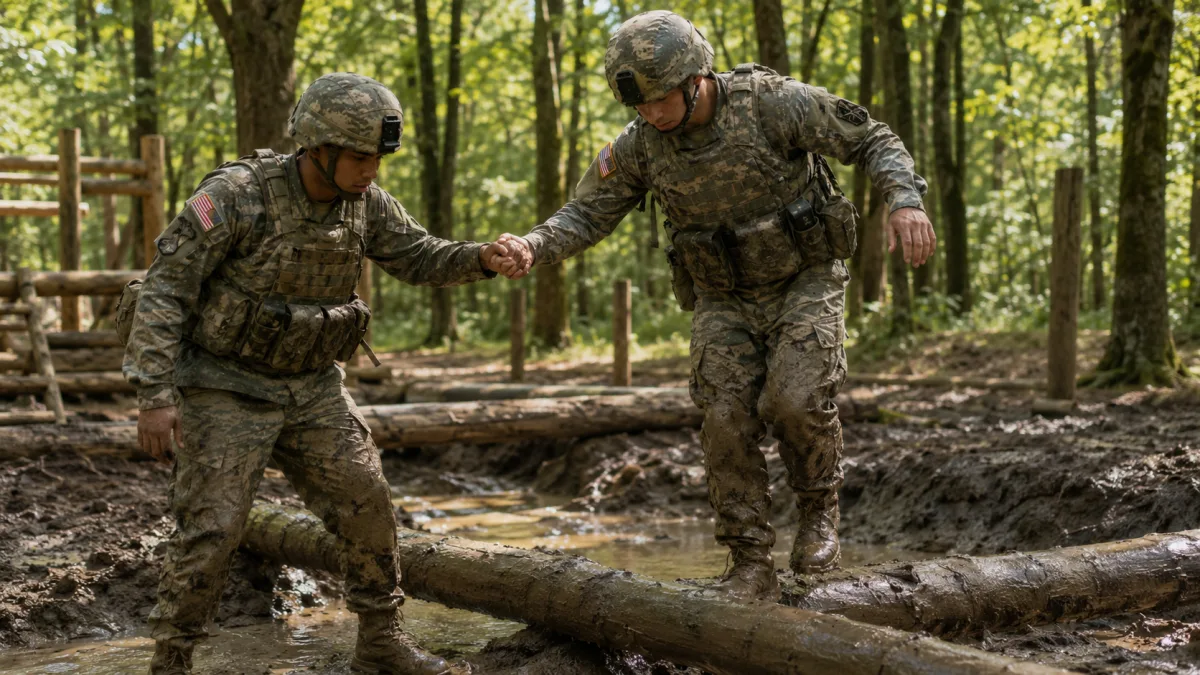
The Army mandates that recruits operate in pairs — the battle buddy system — from day one of BCT. This is described by the Army as both a safety protocol and an accountability mechanism, and both of those are accurate. But the deeper function is psychological.
Social support is the most consistently documented buffer against acute stress response in the research literature. When your nervous system is flooded with cortisol during a high-pressure evolution, having a trusted companion nearby — someone who is going through exactly the same thing — signals to your threat-detection system that you are not alone. That signal reduces the perceived severity of the stressor. This is not metaphorical. The neurobiological pathway is documented: social connection activates the same reward circuitry that cortisol suppresses, partially counteracting the physiological stress response.
Battle buddies in BCT watch each other's physical state, back each other up during inspections, and — critically — notice when someone is deteriorating before a drill sergeant does. Research on the battle buddy concept applied to high-stress environments, including a study published in Academic Medicine documenting its use during the COVID-19 pandemic, confirmed that paired social support reduces acute stress reactions and increases early help-seeking behavior. In BCT, this translates to recruits who advocate for sick or injured buddies, who share information about upcoming training, and who provide the kind of steady reassurance that no official Army program can replicate.
Take the buddy system seriously. Your battle buddy is not an administrative requirement. They are your primary stress management resource for ten weeks.
Cognitive Strategies That Work in BCT
Three mental approaches have documented effectiveness in high-stress military environments. None of them require special training. All of them require deliberate practice.
Psychological chunking. Do not think about ten weeks. Think about today. At the hardest moments, narrow it further — think about this evolution, this task. The research on cognitive performance under stress consistently shows that breaking a large challenge into discrete, completable units reduces perceived threat and preserves decision-making capacity. In BCT this means your mental horizon during Red Phase is not "six more weeks" — it is "get through today's PT, then get through inspections, then get through this afternoon's land nav." Each completed chunk is evidence that you can do this.
Cognitive reappraisal. A drill sergeant screaming at you from three inches away is not a personal attack. It is a performance. The DS's job is to apply pressure; your job is to respond correctly under that pressure. Recruits who interpret drill sergeant intensity as personal hostility — as evidence that they are disliked or failing — generate a secondary stress response on top of the primary physical one. Recruits who reframe it as part of the training architecture perform better and recover faster. Published research on cognitive resilience in military personnel identifies this reappraisal capacity as one of the strongest distinguishing factors between recruits who adapt and those who do not.
Shared hardship reframing. The military culture norm sometimes called "embrace the suck" is more psychologically sophisticated than it sounds. When difficulty is reframed as something your entire cohort is experiencing together — not something happening to you alone — it becomes bonding material rather than isolating pressure. The recruit who can find the absurdity in the third push-up iteration of the morning alongside their squad is doing something cognitively important: converting an aversive experience into shared narrative. That narrative is what builds unit cohesion, and unit cohesion is what BCT is designed to produce. If you have had to manage a difficult authority figure in a civilian workplace, some of those reframing skills transfer directly here.
Sleep, Food, and the Basics of Physiological Recovery
GoArmy.com states that recruits can expect seven to eight hours of sleep per night in BCT, with lights out at 2100 hours. The reality recruits report varies: guard duty rotations, early wake-ups for special training events, and administrative tasks can compress actual sleep time. Still, BCT structures the schedule to allow more sleep than many recruits expect going in.
Sleep is not passive. It is when the brain consolidates the day's learning, when hippocampal processing converts acute stress experiences into manageable memories, and when cortisol normalizes from the previous day's elevations. PLOS ONE research tracking soldiers through military training found that sleep deprivation during field exercises produced the most significant suppression of testosterone and elevation of cortisol markers. Recovery began within four days once normal sleep resumed, but the physiological debt was real.
The practical implication for BCT: treat sleep as training. When you have personal time in the evening and you face the choice between socializing and sleeping, sometimes sleeping is the right call. Recruits who sacrifice sleep to socialize in the first weeks of BCT tend to compound the physiological stress load at exactly the point when it is already highest. This is not about being antisocial — it is about managing your recovery budget when that budget is tight.
Food in BCT is nutritionally adequate. Meals in the dining facility (DFAC) are designed to fuel physical training, and recruits have access to three meals daily. Do not underestimate calories during high-output periods. Under-eating compresses recovery just as surely as under-sleeping, particularly during field exercises when MREs may be the only option. Eat what you are given. This is not the time for dietary restrictions that are not medically necessary.
Staying Connected to Home
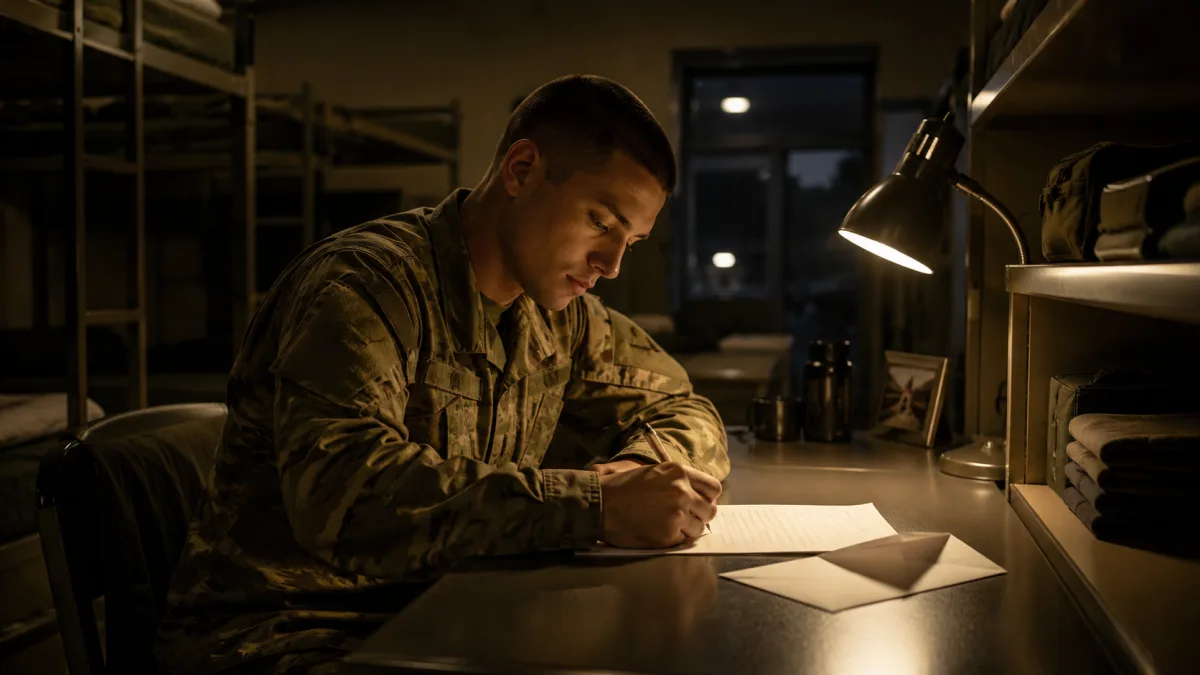
Phone access in BCT is limited. Typically, brief calls are permitted on weekends, and the duration depends on the phase and the discretion of drill sergeants. Letters remain the most reliable form of home communication across all ten weeks.
This matters for a specific reason: phone calls and letters affect mood differently. Veterans and counselors who work with recruits consistently note that phone calls can stir up homesickness acutely — hearing a familiar voice can satisfy a short-term need while intensifying the longing that follows. Letters work differently. Writing a letter requires articulating your experience, which is itself a form of processing. The VA's Whole Health Library documents the stress-reduction effects of therapeutic journaling, noting that writing about feelings helps regulate emotional response, including loneliness and anxiety. You are not just staying in touch when you write home — you are doing something cognitively useful for yourself.
Keep letters practical and forward-looking. Tell your family what you are learning, what surprised you, what you are getting better at. This frames your BCT experience as progression rather than endurance, which reinforces the psychological chunking strategy described above. If you struggle with what to say, describe one specific thing that happened today. One thing is enough.
Mental Preparation Before You Ship Out
The recruits who handle BCT best are almost never the fittest or the toughest. They are the most prepared. Knowing what to expect removes the amplifying effect of surprise — and surprise is a major driver of the acute stress response. When your first formation at 0430 feels familiar because you researched it, its threat signal to your brain is lower than if it came from nowhere.
Start with the official source. GoArmy.com's Basic Combat Training page describes the four phases, the daily schedule, sleeping arrangements, and what drill sergeants are actually trying to accomplish. Read it straight, not as marketing material — the practical details about the schedule and phase structure are accurate.
If you want perspective on how basic training compares across military branches, the overview of Air Force boot camp shows where BCT differs and where the psychological arc is the same. Understanding the pattern helps.
Understand that mental toughness is not a fixed trait you either have or do not. Research on military resilience, including the ARMOR longitudinal study tracking young recruits through adaptation, consistently shows that resilience is built through exposure and supported by social connection — exactly what BCT provides, by design. You are not supposed to arrive mentally tough. You are supposed to leave that way.
One practical pre-ship checklist: research your training location (Fort Moore, Fort Jackson, Fort Leonard Wood, and Fort Sill each have distinct cultures). Connect with veterans who attended your specific post if possible. Understand the Army values — Loyalty, Duty, Respect, Selfless Service, Honor, Integrity, Personal Courage — not as words to memorize but as the behavioral framework your drill sergeants will reference when correcting you. And internalize this final point: the stress is not a problem to be solved. It is the training. Your job is to let it work.
Frequently Asked Questions
How long is Army Basic Combat Training?
Army BCT runs ten weeks, structured across four phases: Yellow (weeks 1–2), Red (weeks 3–4), White (weeks 5–7), and Blue (weeks 8–10). Each phase has a different focus — initial adaptation, weapons familiarization, marksmanship and tactics, and a culminating field exercise called The Forge. Graduation follows Blue Phase completion.
Why do drill sergeants yell so much in basic training?
The intensity is deliberate rather than personal. BCT uses high-pressure verbal environments to desensitize recruits to stress signals — a process military psychologists call stress inoculation. The goal is to build the ability to receive and execute commands clearly when conditions are chaotic. Recruits who reframe drill sergeant intensity as training stimulus rather than personal hostility adapt faster and perform better.
How do you deal with homesickness in Army basic training?
Phone access is limited in BCT; letters are the most reliable communication channel. Writing home has documented psychological benefits beyond simple contact — the act of articulating your experience in writing helps regulate emotions and reduce the acute loneliness response. Focus letters on what you are learning and improving. Homesickness in BCT is near-universal in the first two weeks, and it typically diminishes as unit cohesion builds through Red Phase.
Does physical fitness before BCT actually reduce stress during training?
Yes, and the mechanism is physiological. Recruits who arrive physically conditioned experience smaller cortisol spikes during physical training, recover faster between sessions, and carry less allostatic load into each day. Physical competence also builds psychological confidence — knowing you can execute the physical demands reduces one major source of anticipatory anxiety. The Army's current fitness test is the AFT (five events: deadlift, hand-release push-up, sprint-drag-carry, plank, 2-mile run), which replaced the ACFT in June 2025.
What is the hardest phase of BCT?
Red Phase, covering weeks 3–4, is widely considered the most psychologically demanding. Drill sergeant pressure is at its peak, sleep may be irregular, and the battle buddy system is most critically tested. Red Phase is designed to be maximally stressful because the Army needs to know — and recruits need to discover — how they perform when civilian comfort structures are removed. Most recruits who complete Red Phase report that the remaining weeks feel progressively more manageable, not because the training gets easier, but because their stress threshold has shifted.
Sources and verification
Check current details with these primary or subject-authority sources before acting on the information.

Timothy Davidson
Edits step-by-step general-interest guides for clarity, realistic limits and source verification.




Leave a reply
Replying to