
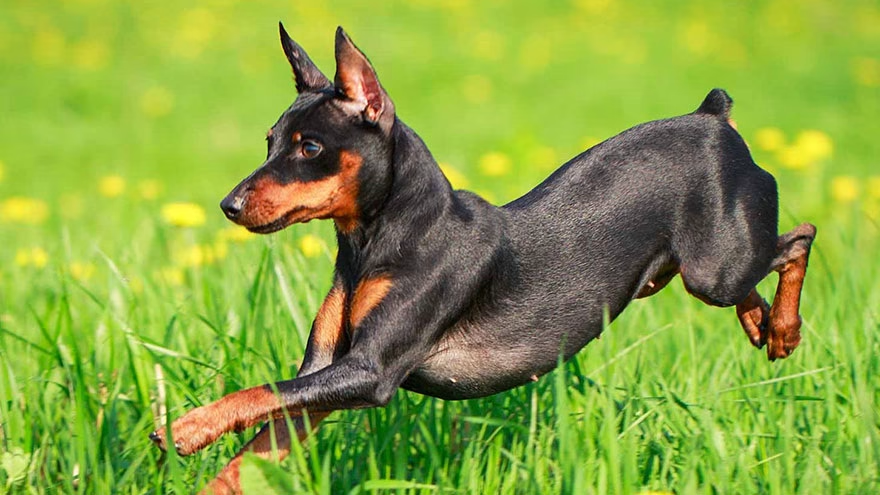
Nearly every first-time Miniature Pinscher buyer walks into a breeder's home carrying the same misconception: that a Min Pin is simply a scaled-down Doberman Pinscher. The two breeds share a name, a silhouette, and a talent for looking imperious — but they share no direct ancestry. The Miniature Pinscher predates the Doberman and developed independently in Germany from a combination of smaller German smooth-haired Pinschers, the Italian Greyhound, and the Smooth Dachshund. Understanding that history is the first step toward understanding what you are actually bringing home — and toward finding a Miniature Pinscher breeder who takes the breed seriously.
What is the Miniature Pinscher's actual history — are they miniature Dobermans?
The short answer is no, and the confusion has persisted long enough to frustrate breed historians for decades. The Min Pin traces its roots to German farm life, possibly as far back as the early 1600s, where compact, quick dogs were needed to clear barns of rats and mice. The forerunner of the breed was called the Reh Pinscher — named after the small roe deer (Reh) of the German Rhineland forests, whose reddish coat the dogs resembled. In 1870, the breed was documented as a purebred type. By 1883, the German Kennel Club had registered Miniature Pinschers under an official standard, and specialized shows were drawing large entries by the turn of the century.
The Doberman Pinscher, by contrast, was developed in the 1890s by tax collector Louis Dobermann — partly from the same ancestral German Pinscher stock, but bred toward an entirely different purpose: personal protection. The physical resemblance is a product of shared ancestry several generations back, not a direct miniaturization. Think of them as distant cousins, not parent and child.
The breed reached the United States around 1919. The AKC recognized it in 1925 under the name Pinscher (Toy), and the Miniature Pinscher Club of America (MPCA) was organized in 1929. The breed moved from the Terrier Group to the Toy Group in 1930, and the word "Miniature" was formally added to the name in 1972. Today the MPCA remains the parent club responsible for the breed standard and breeder ethics in the United States.
What is the Miniature Pinscher's temperament really like?
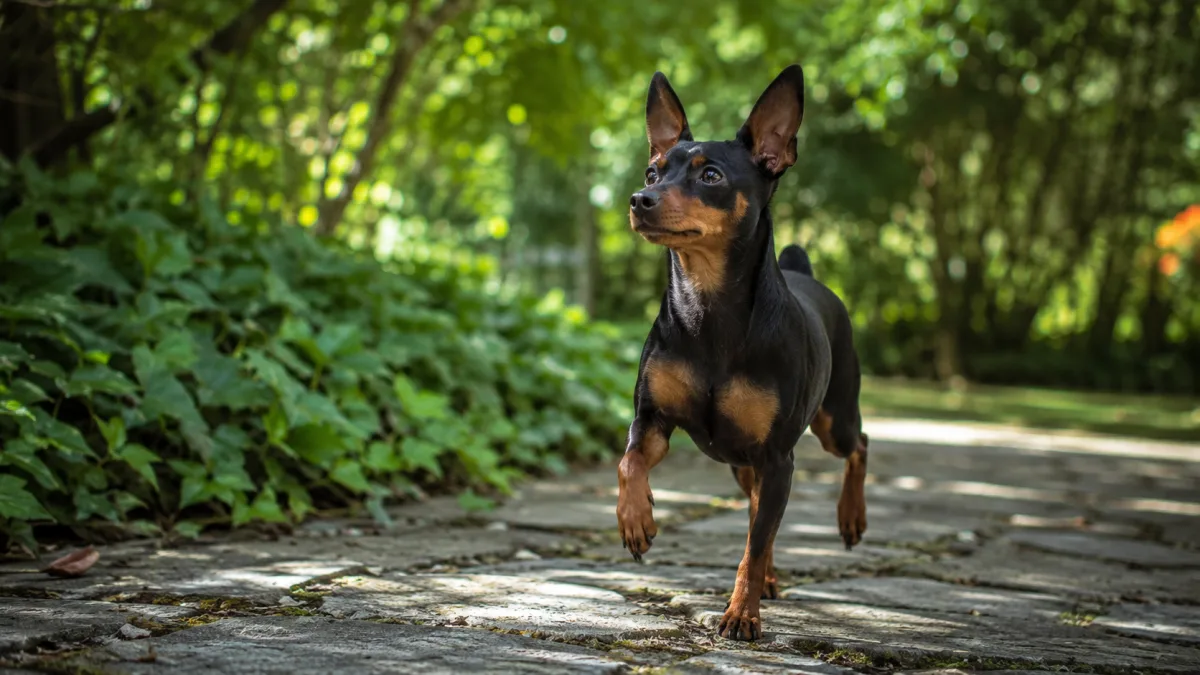
The AKC breed standard describes the Min Pin's temperament with a specific phrase: "fearless animation, complete self-possession, and spirited presence." That language is not promotional fluff — it is a functional description of a dog that genuinely does not register its own size as a limitation. Fans of the breed call it the "King of Toys," a nickname earned not through gentleness but through sheer force of personality. An 8-pound Min Pin will challenge a neighbor's Labrador at the fence line without apparent hesitation.
What that means in practical terms is that the breed demands engaged ownership. A Min Pin left to its own devices will appoint itself household manager. The dog is intensely curious — bred for generations to investigate every corner of a barn for hidden vermin — and that prey drive does not switch off in a suburban living room. A squirrel glimpsed through a gap in the fence, a mouse in the garage, a passing cat: any of these can trigger a sprint that covers thirty feet before you finish saying "stay." The Min Pin has a strong prey drive and is not reliably safe with small animals such as hamsters, guinea pigs, or cats it has not been raised alongside.
Despite the independent streak, Min Pins bond tightly with their families and are genuinely playful. They tend to be reserved with strangers rather than aggressive — they will watch from a distance and decide for themselves whether a newcomer is trustworthy. Early and consistent socialization shapes how that assessment process goes. A well-socialized Min Pin is confident and curious; an under-socialized one can become skittish or sharply reactive. The breed is also athletic in ways that surprise people: one breeder described a Min Pin leaping from the back of a couch to the seat of an armchair across the room "like a pet monkey," a description that captures both the agility and the mischief.
What health problems should you know about before buying a Min Pin?
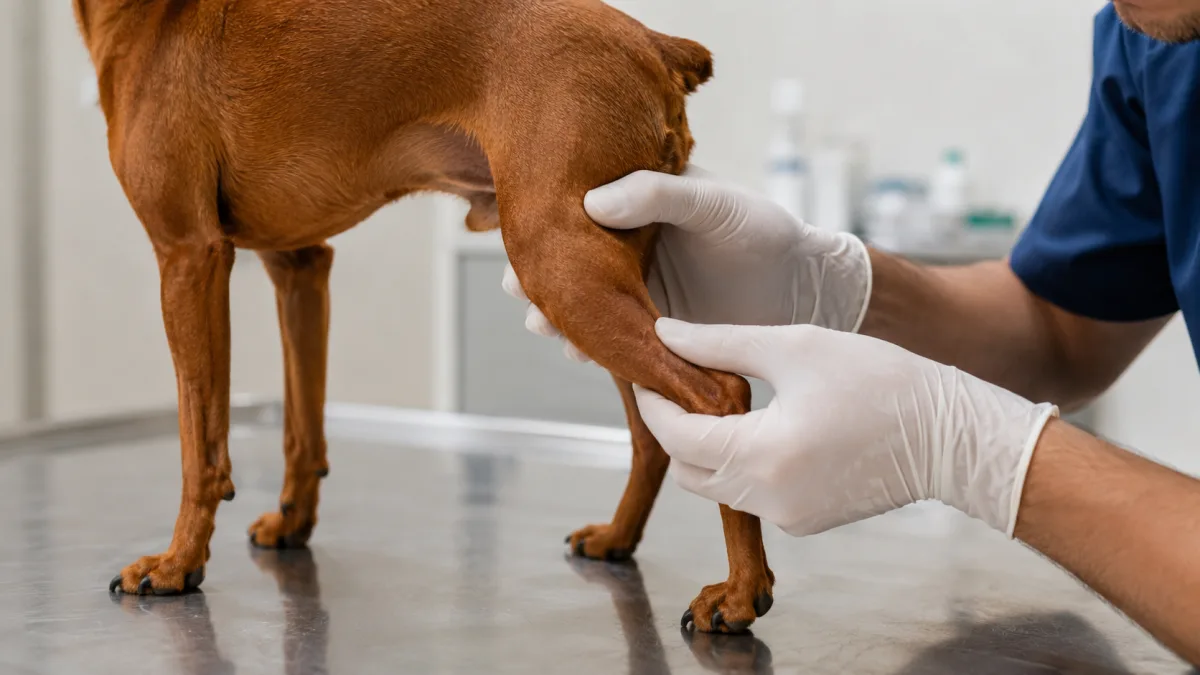
The Min Pin is a relatively healthy breed with a lifespan of 12 to 16 years, but several heritable conditions appear often enough that any responsible buyer should ask about them directly. Knowing the mechanism behind each condition — not just the name — makes it easier to assess whether a breeder's health testing program actually addresses the risk.
Patellar luxation is the most common orthopedic issue in the breed. The patella (kneecap) sits in a groove at the end of the femur; in dogs with luxation, the groove is too shallow or misaligned, causing the kneecap to slide out of position — medially (inward) in most small breeds. The condition is graded I through IV. A Grade I luxation is mild and may cause only occasional skipping or hopping; a Grade IV is severe enough that the kneecap cannot be manually replaced and the dog is often in chronic discomfort. Reputable breeders have both parents evaluated and registered with the Orthopedic Foundation for Animals (OFA) before breeding.
Legg-Calvé-Perthes disease tends to appear in young Min Pins between four and twelve months of age. The condition involves avascular necrosis of the femoral head — the blood supply to the ball-shaped top of the thigh bone is interrupted, causing the bone tissue to die and the femoral head to collapse. No one fully understands why the blood supply is disrupted in affected dogs, but the condition has a heritable component in toy breeds. Symptoms include progressive hind-leg lameness, muscle wasting in the affected leg, and pain on hip extension. Surgical removal of the damaged femoral head (femoral head and neck ostectomy) typically produces a good outcome, as scar tissue fills the joint and the dog learns to bear weight on the repaired leg.
Hypothyroidism — insufficient production of thyroid hormones — can cause weight gain, lethargy, hair loss, and skin thickening. It is manageable with daily oral medication but requires diagnosis through bloodwork and ongoing monitoring. Epilepsy also appears in the breed; idiopathic epilepsy (no identifiable underlying cause) typically presents as the dog's first seizure between one and five years of age. A rare but documented condition called Mucopolysaccharidosis VI (MPS VI) involves a lysosomal enzyme deficiency that causes connective tissue and skeletal abnormalities; DNA testing can identify carrier dogs. Ask any prospective breeder whether they screen for MPS VI in their lines.
The CHIC (Canine Health Information Center) program maintained by the OFA sets minimum health testing requirements for each breed. For Miniature Pinschers, a CHIC number requires OFA patella evaluation and an annual eye examination by a board-certified veterinary ophthalmologist (a Diplomate of the ACVO). Cardiac evaluation by a board-certified cardiologist is also recommended for breeding dogs. A breeder who cannot produce CHIC numbers or OFA certificates for both parents is not doing the minimum required work.
What should you look for in a reputable Miniature Pinscher breeder?
The Min Pin's compact size and vivid personality have made it consistently popular — and popularity in dog breeding creates pressure that cuts both ways. Demand encourages volume producers who prioritize output over temperament, socialization, and health screening. The result is puppies that may look correct at eight weeks but arrive in their new homes with skeletal problems, fear-based reactivity, or both. Visiting at least three breeders before committing gives you a baseline for comparison: you will quickly notice the difference between a breeder who knows every puppy in the litter by personality and one who moves dogs like inventory.
A legitimate Miniature Pinscher breeder will be a member of or affiliated with the Miniature Pinscher Club of America, which maintains a breeder referral program and requires members to adhere to a code of ethics. The MPCA's breeder referral chairpersons can help connect you with members in your region. The AKC Marketplace also lists breeders who have voluntarily completed health testing and registration requirements, though marketplace listing alone does not guarantee quality — ask for OFA documentation regardless of where you find a breeder's name.
Look at the physical environment. Puppies raised in a clean, stimulating environment — where they hear household sounds, interact with multiple people, and encounter different textures underfoot — are neurologically better prepared for normal domestic life than puppies kept in a barn, a back shed, or stacked crates. A breeder who keeps dogs inside the home, integrates puppies into daily family routines, and handles each one individually from birth is giving them something no supplement or training class can fully replace later.
Prices from reputable breeders typically range from $1,000 to $3,000, depending on pedigree, show potential, and location. A dramatically lower price — particularly from a seller offering multiple breeds, who cannot name the sire, or who declines to let you visit in person — should raise immediate questions. The cost of one OFA patella evaluation, one ophthalmologist exam, and a cardiac clearance alone runs several hundred dollars per dog; a breeder selling Min Pin puppies for $350 has not done that testing.
What questions should you ask a Miniature Pinscher breeder?
Prepare your questions in advance and pay attention to how a breeder responds — not just what they say. Evasiveness, impatience, or a rush to close the sale are meaningful signals. A good breeder is typically asking you as many questions as you are asking them, because they have a stake in where each puppy lands.
Ask to see the OFA health certificates for both parents, covering patella, cardiac, and ophthalmologist evaluations. Ask whether either parent has produced offspring with Legg-Calvé-Perthes disease or patellar luxation Grade III or IV. Ask whether the breeder screens for MPS VI. Ask how puppies are socialized during the first eight weeks — what sounds they hear, what surfaces they walk on, how many people handle them. Ask what the breeder's policy is if a puppy develops a heritable condition within the first two years. Ask whether the breeder takes a puppy back at any point in the dog's life if the owner can no longer keep it — a hallmark of breeders who treat their animals as a lifelong commitment, not a sale.
You should also ask about the parents' temperaments directly. Because Min Pins can become territorial or snappy if handled poorly during development, meeting both parents (or at minimum the dam, who is nearly always on-site) gives you a reasonable forecast of the puppies' baseline dispositions. A nervous, reactive dam who charges the gate when you arrive is telling you something about both genetics and early environment.
Why is early socialization especially important for Min Pins?
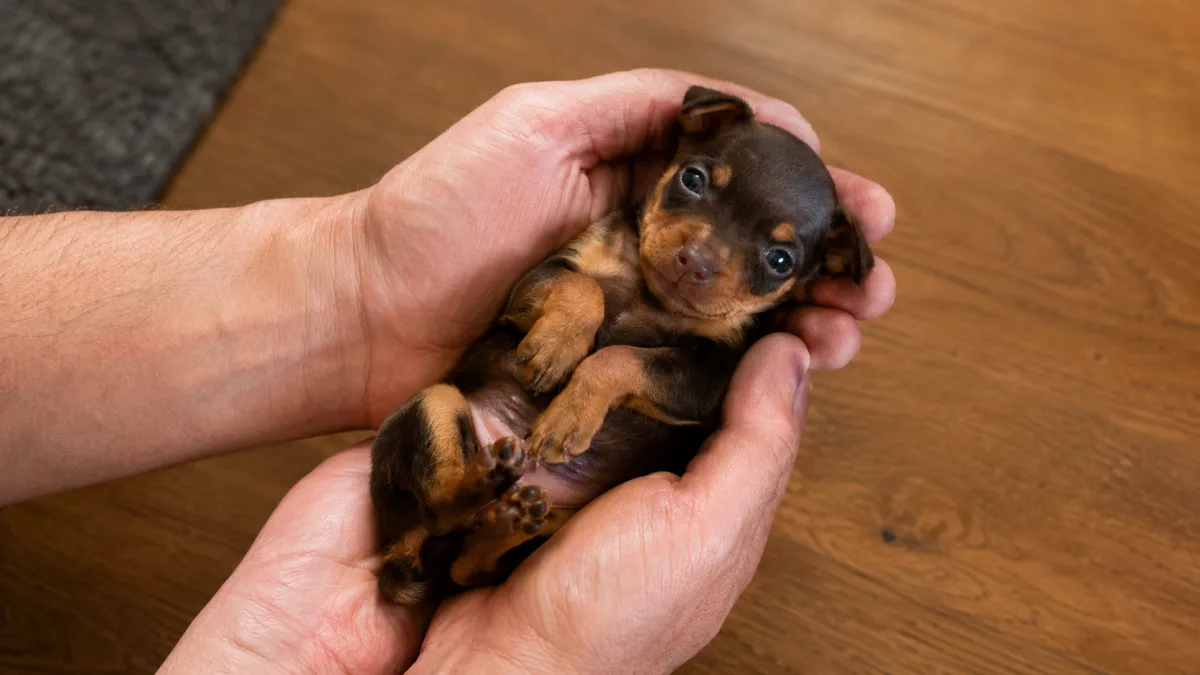
Between three and twelve weeks of age, a puppy's brain is undergoing what behaviorists call the critical socialization period — a window during which positive exposure to novel stimuli reduces the likelihood of fear-based responses to those same stimuli later in life. During this period, the amygdala (the brain's threat-detection center) is calibrating its baseline sensitivity. Puppies exposed to a wide variety of sounds, smells, surfaces, people, and gentle handling during this window tend to approach new experiences with curiosity rather than alarm. Puppies deprived of those exposures show heightened fear reactivity that can persist into adulthood and is difficult to fully reverse through training alone.
For Min Pins specifically, this matters more than average. The breed's baseline confidence and territorial drive mean that a poorly socialized specimen does not simply become timid — it can become defensively aggressive, using bluster and biting as a strategy for managing everything it has not learned to assess calmly. A well-socialized Min Pin channels that same intensity into engagement, play, and loyalty. The difference between the two outcomes is largely determined in the first eight weeks of life, which is exactly the period a breeder controls entirely. This is why the question "how do you socialize your litters?" belongs near the top of your list, not as an afterthought.
For more on small dog training and temperament development, see our guide to common Miniature Schnauzer questions — many of the socialization principles carry across toy breeds.
What should a written breeder contract for a Miniature Pinscher include?
A written contract is not a formality — it is the mechanism that makes a breeder's promises enforceable. Verbal guarantees evaporate; a signed document does not. Before you hand over any money, make sure you have a contract that addresses several specific scenarios.
The contract should define what happens if the puppy is diagnosed with a heritable health condition within a specified window — typically 24 months, though some breeders extend to five years for genetic conditions with later onset. It should specify whether the remedy is a replacement puppy, a partial refund, or both, and under what conditions. It should state clearly whether a veterinary diagnosis is required to trigger the guarantee and from whom (the breeder's vet, your vet, a specialist). It should also address what happens to the puppy in those circumstances — some breeders require the affected dog to be returned, which has implications you should think through before you sign.
A responsible contract will also include a spay/neuter clause for pet-quality puppies, preventing them from being bred; a clause requiring the buyer to return the dog to the breeder rather than rehoming or surrendering to a shelter; and a clause prohibiting resale. These provisions protect the breed and signal that the breeder thinks of themselves as a steward rather than a seller. For comparison, see how similar considerations apply to other small breeds in our article on owning a Brittany Spaniel.
Should you consider Miniature Pinscher rescue instead?
The MPCA operates a rescue program and maintains information about available dogs at minpin.org/rescue. Regional rescue organizations and Petfinder also list Min Pins regularly — adoption fees typically run $50 to $500 and often include spay/neuter, vaccinations, and microchipping, making the total cost significantly lower than a puppy from a breeder.
Rescue is a particularly good option if you want an adult dog whose temperament is already established and observable. Many Min Pins end up in rescue not because of behavioral problems but because owners underestimated the breed's energy level and need for engagement. A rescue coordinator who has fostered a dog for several weeks can tell you whether that specific animal does well with cats, with children under ten, or with other dogs — information no breeder can give you about an eight-week-old puppy. The trade-off is that you have less control over early socialization history and health documentation may be incomplete.
Whether you adopt or buy, the same fundamental requirement applies: know what you are signing up for before you commit. The Min Pin is a 12-to-16-year relationship with a dog that will demand daily engagement, secure fencing (they can jump surprisingly high for their size and will probe fence lines for weaknesses with the persistence of a terrier), leashed walks, and consistent training. See also our piece on Maltese owner questions for perspective on the general challenges of toy breed ownership, and Lhasa Apso ownership for another breed that combines small size with strong-willed temperament.
Frequently Asked Questions
Is the Miniature Pinscher related to the Doberman Pinscher?
No. The two breeds share a name and some distant ancestral stock in the German Pinscher family, but the Min Pin is the older breed and was not developed from the Doberman. The Doberman was created in the 1890s; Min Pins were already being shown in Germany by the 1880s. Their visual similarity is a product of common ancestry, not a direct parent-offspring relationship.
How big do Miniature Pinschers get?
The AKC breed standard calls for a height of 10 to 12.5 inches at the shoulder, with 11 to 11.5 inches considered ideal. Weight is not specified in the standard but typically falls between 8 and 10 pounds. Dogs outside the 10-to-12.5-inch range are disqualified from the show ring.
Are Min Pins good with children?
Min Pins can be excellent with children who understand how to handle a small dog, but they are not well suited to very young or unruly children who may squeeze, drop, or startle them. A Min Pin that is handled roughly will defend itself. Supervision is essential with children under six, and any interaction should be taught and monitored rather than assumed safe.
How much does a Miniature Pinscher puppy cost from a reputable breeder?
Expect to pay between $1,000 and $3,000 from a breeder who conducts OFA health testing and proper socialization. Prices toward the higher end reflect show-quality pedigrees and breeders with long track records. Significantly lower prices often reflect corners cut on health testing, socialization, or both.
Do Min Pins really escape from yards?
Yes — this is one of the most consistent things owners report about the breed. A Min Pin will probe fence lines for gaps, squeeze through openings that look impossibly small, dig under fencing, and jump higher than most people expect from an 8-to-10-pound dog. Any outdoor enclosure should be fully fenced with no gaps at the base and a height of at least five feet. Off-leash time in unfenced areas is genuinely risky; a Min Pin that spots prey or gets startled can cover distance faster than most people can react.

Chiara Bradshaw
Covers education, culture and creative topics with an emphasis on readable explanations and verifiable references.

Leave a reply
Replying to