
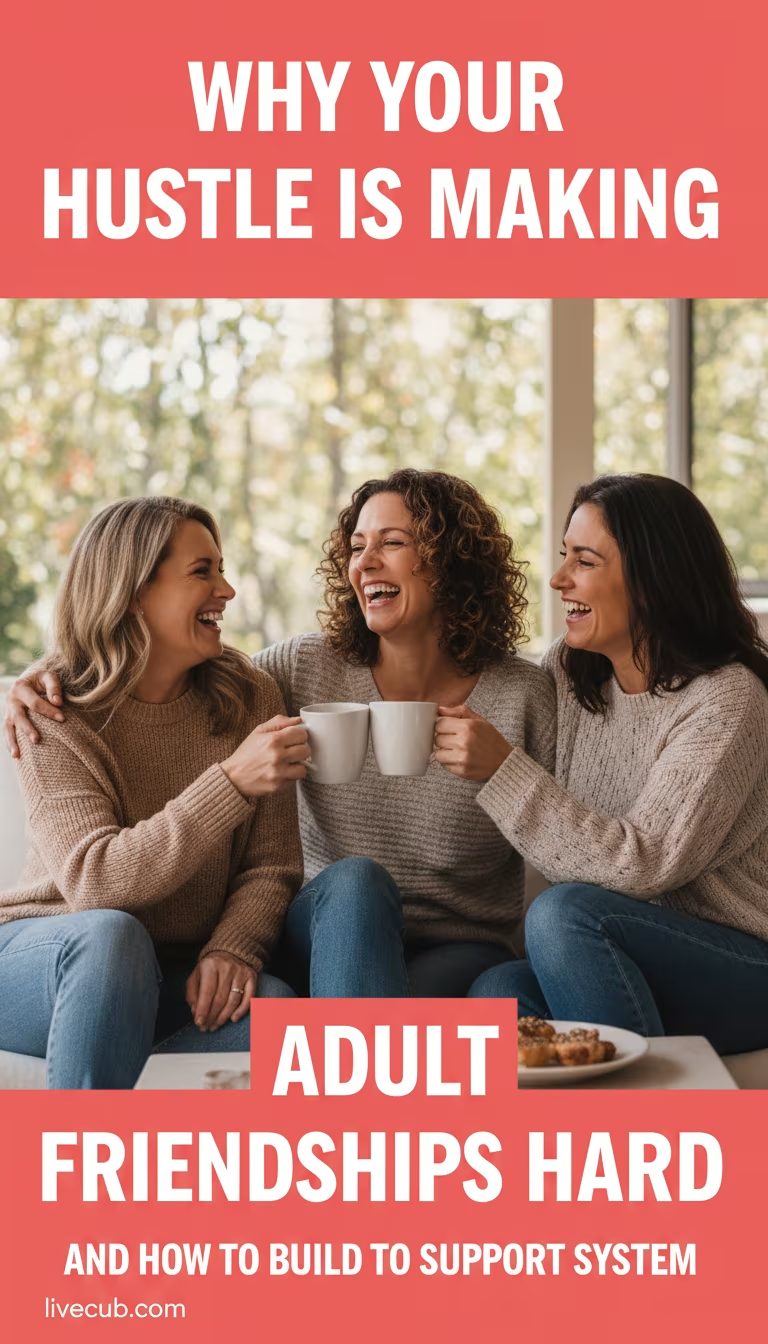
Somewhere after school or the early job years, the built-in machinery for making friends quietly disappears. No more shared classrooms, no more forced proximity, no more everyone being free on a Friday. What replaces it is schedules, moves, caregiving, money, tiredness, and the specific awkwardness of trying to start again as an adult who is out of practice.
The good news buried in that list is that almost none of it is about you being unlikable. It is about friction — the practical drag that makes connection slow — and friction is something you can engineer around once you stop reading it as a personal verdict.
It Is Friction, Not a Character Flaw
Adults are quick to blame themselves for thin social lives. The more accurate diagnosis is usually mechanical: time is scarce, distances are longer, everyone is tired, and invitations are vague enough to fizzle. Social connection genuinely matters for health — the U.S. Surgeon General has treated loneliness as a public health issue affecting individuals and communities alike (HHS on social connection) — but naming it as a shared, structural problem takes the sting out of it.
Once you see the gap as friction rather than failure, the next move gets smaller and more doable. You are not trying to fix your personality. You are trying to remove one obstacle between you and the next ordinary hangout.
Lower the Cost of Saying Yes

The plans that survive adult life are the cheap ones — cheap in effort, not money. A walk, a standing lunch, a class you both already attend, a short phone call on a commute. These work because they do not require a good mood, a clean house, or a free evening carved out weeks ahead. The easier a plan is to say yes to, the more often it actually happens.
This is also where recurring beats spontaneous. A one-off "we should get coffee sometime" almost always dies in the calendar. A repeating Tuesday walk needs to be arranged exactly once and then runs on its own. Public-health guidance on loneliness leans on the same principle — regular, low-barrier contact rather than grand gestures.
Build for Repetition, Not Intensity

People overvalue the deep, hours-long heart-to-heart and undervalue the fifth casual encounter. Closeness in adulthood is mostly a byproduct of repeated, unremarkable contact — the same faces, the same time, the same low-stakes activity, again and again. Repeatable does not mean shallow. It means the relationship has a reliable place to happen instead of depending on both people spontaneously having a free, motivated evening at the same moment.
So when you meet someone you click with, resist the urge to plan the perfect outing. Plan the second easy one. Momentum between two busy adults comes from frequency far more than from any single memorable event.
Offer the Version of You That Can Show Up

A quiet trap in adult friendship is waiting until you can present an ideal self — the version with a tidy home, spare energy, and an impressive update. That version rarely arrives, and the waiting reads to others as disinterest. Honesty about your actual capacity works better: "I only have thirty minutes, but I'd love a quick walk" is a real, acceptable offer.
Naming your real life stage also removes pressure on both sides. A monthly breakfast, a Tuesday walk, a voice memo instead of a call, a playdate that doubles as adult company, a no-host dinner where everyone brings something — these are honest containers that fit around jobs and caregiving. The friend who shows up for thirty imperfect minutes beats the ideal friend who is perpetually about to reschedule.
Spread the Weight Across Several Ties
A durable support system is not one best friend carrying every need. It is a small web of different ties, each doing a different job: the neighbor you wave to, the walking friend, the old friend you call twice a year, the group chat that makes you laugh, the coworker who gets the work stress. No single relationship has to be everything, which is precisely what keeps any one of them from buckling under the load.
Thinking in a web also lowers the stakes of any one connection cooling off. If a friendship fades because someone moved or life shifted, a web absorbs it. A single-thread social life feels catastrophic to lose, so you cling; a web lets people come and go with the seasons of life, which is how adult friendship actually behaves.
It is worth counting the quality of contact, not just the quantity. If a particular relationship consistently leaves you smaller, rushed, judged, or drained, that is data too. More contact is not the same as better connection, and a support system is meant to add energy, not siphon it.
When Loneliness Is More Than Logistics
Sometimes the problem is not scheduling. When loneliness comes tangled with low mood, lost interest, dread, or a pulling-away that has lasted weeks, friendship tactics alone will not reach it, and it is not a failure of effort to say so. Persistent distress deserves support beyond a better calendar. The National Institute of Mental Health suggests reaching out for help when severe or distressing symptoms last two weeks or more and interfere with daily life (NIMH on caring for your mental health).
Social anxiety in particular can masquerade as "I'm just bad at this." The racing heart, the blank mind, the replaying of a conversation for hours afterward — those are body-and-brain responses that make ordinary contact feel dangerous. Livecub's guide to calming performance nerves covers physical tools that transfer directly to the moment before you walk into a room full of people you barely know.
Rebuilding After a Move or a Life Change
Certain transitions wipe the slate whether you wanted it wiped or not: a move to a new city, a divorce, a new baby, a job change, a friend group that quietly reorganized without you. These are the moments adults most often feel friendless, and it helps to know the feeling is situational rather than permanent. You did not lose the ability to make friends; you lost the scaffolding that used to make it automatic.
Rebuilding after a reset runs on proximity and patience. Say yes to more than feels comfortable for the first few months, because early on you cannot yet tell which loose acquaintance becomes a real friend — you are casting a wide, low-stakes net on purpose. Anchor yourself to one or two places that repeat: a gym class, a neighborhood spot, a parents' group, a hobby meetup. Familiar faces in a familiar setting do most of the work, and the friendships that form there tend to arrive slowly and then, one day, feel like they were always around. Expect the process to take longer than you would like; a new social base is usually built over months, not weeks.
A Small Plan to Start This Month
Pick one thread and pull it. Draft the message you keep meaning to send and actually send it. Propose one recurring, low-effort plan — not a dinner party, a walk. Join one thing that already meets on a schedule, so proximity does the work of repetition for you: a class, a volunteer shift, a league, a standing coffee. The structure carries the friendship past the point where willpower usually gives out.
Then give it time and lower your expectations for any single attempt. Some plans will fall through; that is normal and not a rejection. What builds a support system is not one brave, dramatic push but a handful of small ties, tended lightly and often, with enough honesty about your real life that the people in it can meet the version of you that genuinely exists rather than the polished one you keep waiting to become.

Tory Stearns
Edits practical household, travel and lifestyle explainers. Claims that can change are linked to current primary or subject-authority sources.




Leave a reply
Replying to