
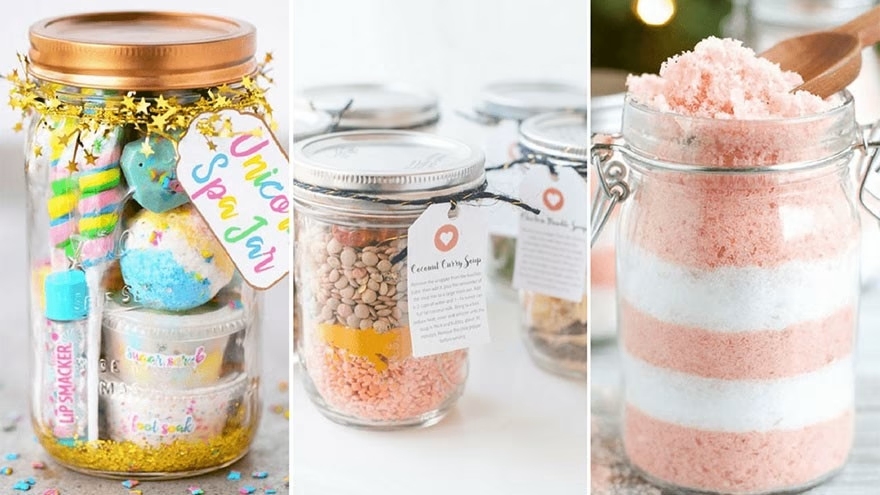
Why homemade kitchen gifts work — and when to start
Holiday gifts from the kitchen have a practical advantage that store-bought boxes rarely offer: most of them can be made weeks ahead. A batch of spice rub takes twenty minutes in October and sits in a sealed jar for months without losing a thing. Flavored vinegar needs three to four weeks just to develop its character, so early November is the right time to get the bottles on the shelf. This lead time turns what sounds like a generous gesture into a genuinely manageable project.
The other advantage is honesty. A handmade jar of strawberry jam or a tin of candied walnuts communicates something no gift card can — that someone spent an afternoon in a kitchen thinking about you. That signal lands differently than anything wrapped in tissue paper at a checkout counter.
The gifts covered here range from no-cook pantry staples (spice rubs, flavored salts) to simple preserves that require a little more attention. Each section includes storage timelines and any safety notes worth knowing, so you can give with confidence and recipients can use their gifts without guesswork.
Safety first — what to know before gifting homemade food
Most homemade food gifts are straightforward and safe. A few specific situations do require attention, and knowing the reasoning makes the precautions easier to follow rather than arbitrary.
The most important one: garlic submerged in oil at room temperature is a documented botulism risk. The National Center for Home Food Preservation states clearly that homemade garlic-in-oil stored at room temperature risks the development of Clostridium botulinum. The mechanism is straightforward — garlic is a low-acid food (pH above 4.6), and when it's submerged in oil, the oil blocks all oxygen. That anaerobic environment is exactly what C. botulinum spores need to germinate and produce toxin. Refrigeration slows but does not eliminate the risk; the NCHFP recommends using homemade garlic-in-oil within four days of preparation. If you're making herb-infused oils for gifts, leave the garlic out, use dried rather than fresh herbs, and include a note instructing the recipient to refrigerate and use within two weeks.
Homemade jams and preserves processed through water bath canning are safe — but only when made from a tested recipe with proper headspace and processing time. High-acid fruits (strawberries, figs with added lemon juice, raspberries) are suitable for water bath processing; low-acid vegetables are not. According to the NCHFP's jam storage guidelines, properly processed, full-sugar fruit jam should retain best quality for up to one year stored in a cool, dark place between 50–70°F. Once opened, it belongs in the refrigerator and is best used within a month.
For everything else in this list — spice rubs, dry cookie mixes, infused honey with dried botanicals, flavored vinegars — the safety profile is excellent when basic principles are followed: use dry ingredients where possible, keep moisture out of sealed jars, and label everything clearly with the date made and any storage instructions.
Flavored oils and vinegars — easy and impressive
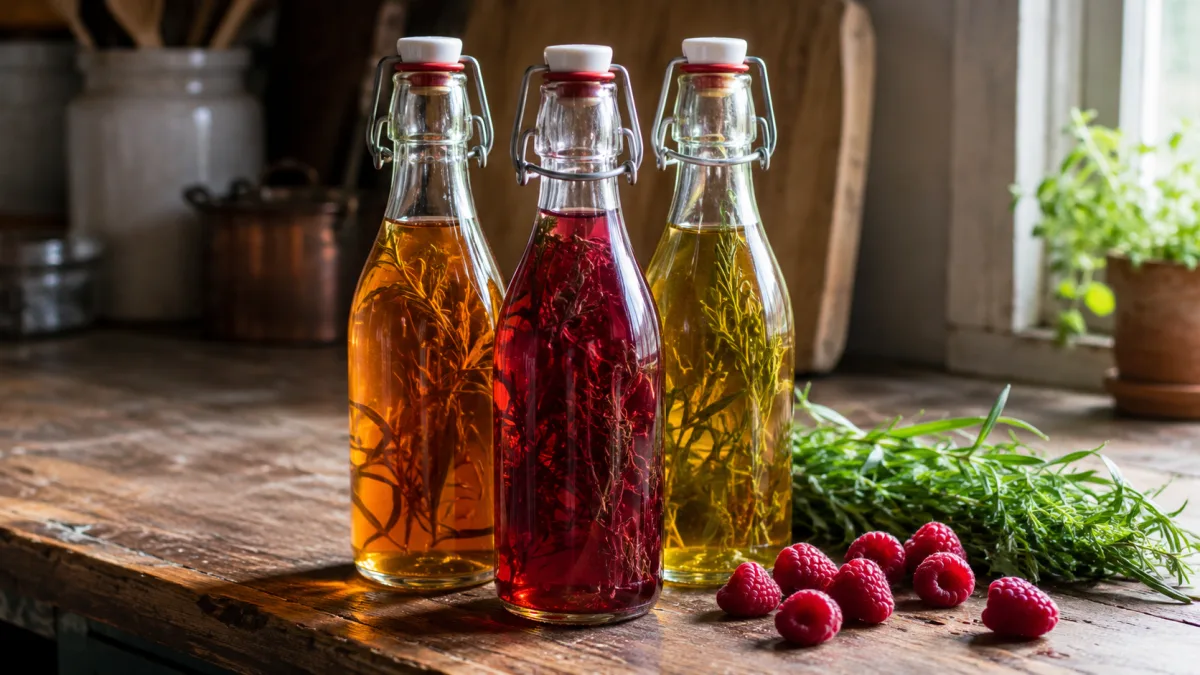
Flavored vinegars are among the safest and most forgiving of all kitchen gifts. The reason is chemistry: commercial vinegar is standardized to at least 5% acetic acid, putting its pH below 3.0. At that acidity, virtually no pathogens survive. Raspberry vinegar, tarragon vinegar, or a blend of mixed herbs in white wine vinegar will keep at room temperature for three to four months as the flavor develops, and longer refrigerated. Pour heated vinegar (just below boiling, around 190°F) over your flavoring ingredients, cap the bottle, and let it sit for three to four weeks before straining and decanting into a decorative bottle.
Herb-infused oils are a different story. Fresh herbs carry surface moisture, and that moisture trapped inside a sealed oil bottle — especially combined with a low-acid ingredient like garlic — can create exactly the wrong conditions. Stick to dried herbs for oil infusions meant as gifts. A good rosemary-chili oil made with dried rosemary and dried chili flakes is genuinely beautiful, keeps for two weeks refrigerated, and tastes far better than anything commercial. Label the bottle with a refrigeration note and a use-by date. That note is what separates a thoughtful gift from a health hazard, and recipients will appreciate the guidance rather than finding it alarming.
Spice rubs and seasoning blends
Spice rubs are the easiest kitchen gift to make and one of the most useful to receive. A classic mix for red meat — smoked paprika, brown sugar, black pepper, garlic powder, cumin, and a pinch of cayenne — can be batch-made in under ten minutes. Packed into a four-ounce glass jar with a label listing the ingredients and a suggested use (pork shoulder, grilled chicken, roasted sweet potatoes), it's immediately practical.
Dry spices and blended rubs keep best in airtight glass jars stored away from direct light and heat. Under those conditions, six to twelve months is a reasonable shelf life. The freshness test is simple: open the jar and smell. If there's no aroma, the spices have given up their volatile oils and should be replaced. For gifts, sourcing whole spices and grinding them yourself — even a basic coffee grinder reserved for spice use — produces a noticeably more aromatic result than pre-ground versions that have been sitting in a warehouse.
You can also make seasoning blends beyond the standard rub: an everything-bagel blend for eggs and avocado toast, an Italian herb salt for pasta water, or a za'atar-style mix of dried thyme, sumac, and sesame seeds. Each one is genuinely useful in a home kitchen and costs almost nothing to produce in a batch large enough for several gifts.
Cookie mix in a jar and layered baking gifts
The layered cookie mix jar is a well-established holiday gift for good reasons. It looks appealing, it's personal, and it's genuinely useful — the recipient adds butter, eggs, and vanilla, and has fresh cookies in under an hour. Layered properly in a wide-mouth mason jar, the visual effect of alternating flour, sugars, oats, chocolate chips, and dried cranberries is striking enough that no additional wrapping is really needed.
From a food safety standpoint, this gift is straightforward. The dry ingredients — flour, sugars, oats, chips — contain no significant moisture and no protein that can support bacterial growth. Sealed in an airtight jar and kept at room temperature away from heat and humidity, the mix will hold quality for six to twelve months. Chocolate chips or dried fruit are the components most likely to degrade first, through fat bloom or texture changes rather than safety concerns.
Include a recipe card tied to the jar with twine. List the wet ingredients the recipient needs to supply, the oven temperature, and the baking time. If you have a note about the recipe's origin — "this is the base my grandmother made every December" — write it on the back. That context is what turns a jar of dry ingredients into something worth keeping the card for.
For more ideas on presenting cookies beautifully, see our ultimate guide to cookie displays.
Infused honey, flavored salts, and pantry staples
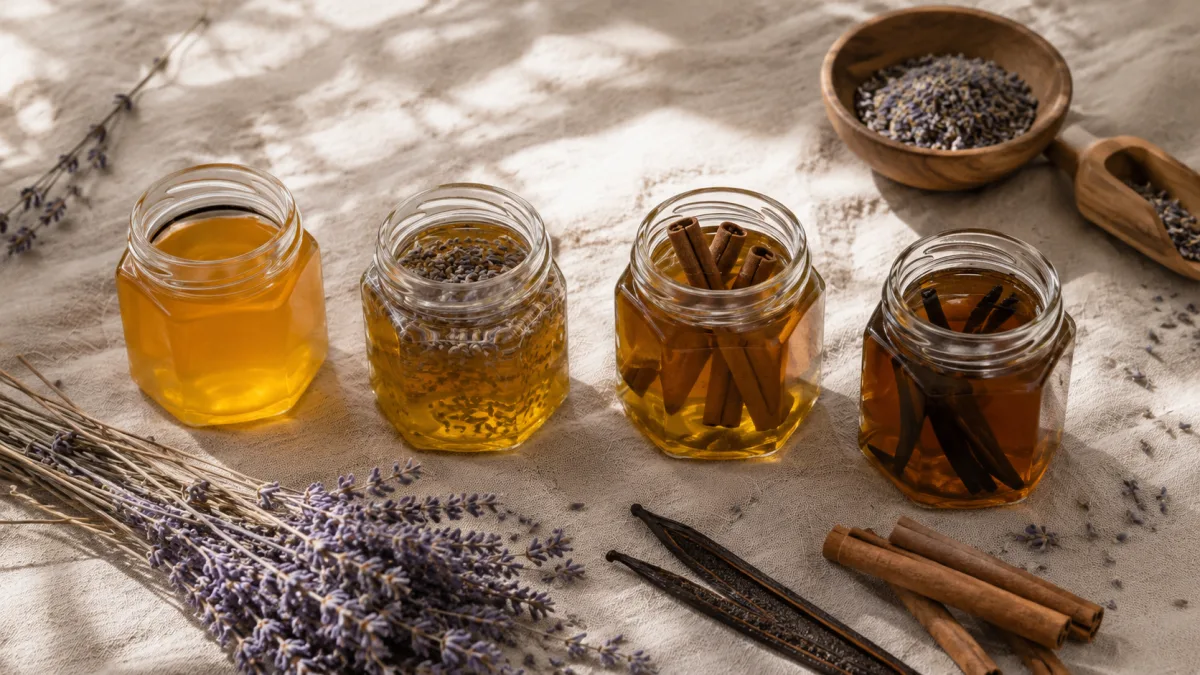
Honey is one of the most naturally shelf-stable foods that exists. Its combination of low water activity, low pH, and hydrogen peroxide production makes it inhospitable to most microorganisms. Infusing honey with dried botanicals — lavender buds, a split vanilla bean, cinnamon sticks, or dried citrus peel — produces a gift that's genuinely beautiful and keeps at room temperature for a year or more, provided the jar is kept dry and the botanicals are dry when added.
The critical word there is dried. Fresh herbs or fresh garlic added to honey introduce moisture that can reduce the honey's water activity enough to allow fermentation. For gift-giving, dried lavender, a whole dried vanilla bean, or whole cinnamon sticks are the right choices. Signs of fermentation — bubbling, a slightly sour or yeasty smell — mean the jar should be discarded. With proper dry ingredients and a clean jar, this is rarely an issue.
Flavored salts sit in the same low-effort, high-impact category. Smoked salt with dried rosemary, citrus zest salt (use dried zest only, thoroughly dry), or a chili-lime finishing salt all pack genuine flavor into a small jar. Use flaky sea salt as the base — fleur de sel or Maldon — because the texture itself communicates quality before anyone even tastes it. Sealed in a small glass jar with a label, these look like something from a specialty food shop.
Flavored hot chocolate mix — unsweetened cocoa powder, powdered sugar, a pinch of salt, and ground cinnamon or cayenne — follows the same logic. All dry ingredients, indefinite shelf stability, and deeply satisfying on a cold afternoon.
Candied nuts, biscotti, and ready-to-eat treats
Candied nuts require more active attention than most items on this list, but the result is one of the most reliably crowd-pleasing gifts you can make. The technique depends on understanding what's happening to the sugar. As a sugar syrup heats past 300°F, it reaches the hard crack stage — nearly all the water has evaporated and the sugar becomes a glass-like coating when it cools. At 320–360°F, actual caramelization begins, and the sugar takes on that characteristic amber color and bittersweet flavor.
For candied walnuts or pecans, the standard approach is to coat the nuts in a mixture of egg white, sugar, and spices (cinnamon, cayenne, a little salt), then roast at 300°F while stirring regularly. The egg white proteins set and help the sugar mixture adhere. The nuts must be spread in a single layer on a greased or parchment-lined sheet immediately when they come out of the oven — they clump together permanently if left in a pile. Once cooled, they keep in an airtight container for up to two weeks at room temperature, or considerably longer refrigerated.
Holiday biscotti is a natural companion gift. Twice-baked by design, biscotti has less moisture than most cookies, which is why it keeps for two to three weeks in an airtight tin without going stale. The long bake at low temperature after slicing drives off the residual moisture — this is the same principle that makes hardtack last for months. Dip one end in dark chocolate before packing and the presentation essentially does itself.
For ideas on sauces that round out a kitchen gift basket — a caramel sauce, for instance, or a chocolate drizzle — the sauce-making techniques in our stir-fry sauces guide cover the core principles of building flavor in a pan.
Packaging and presentation that makes the gift
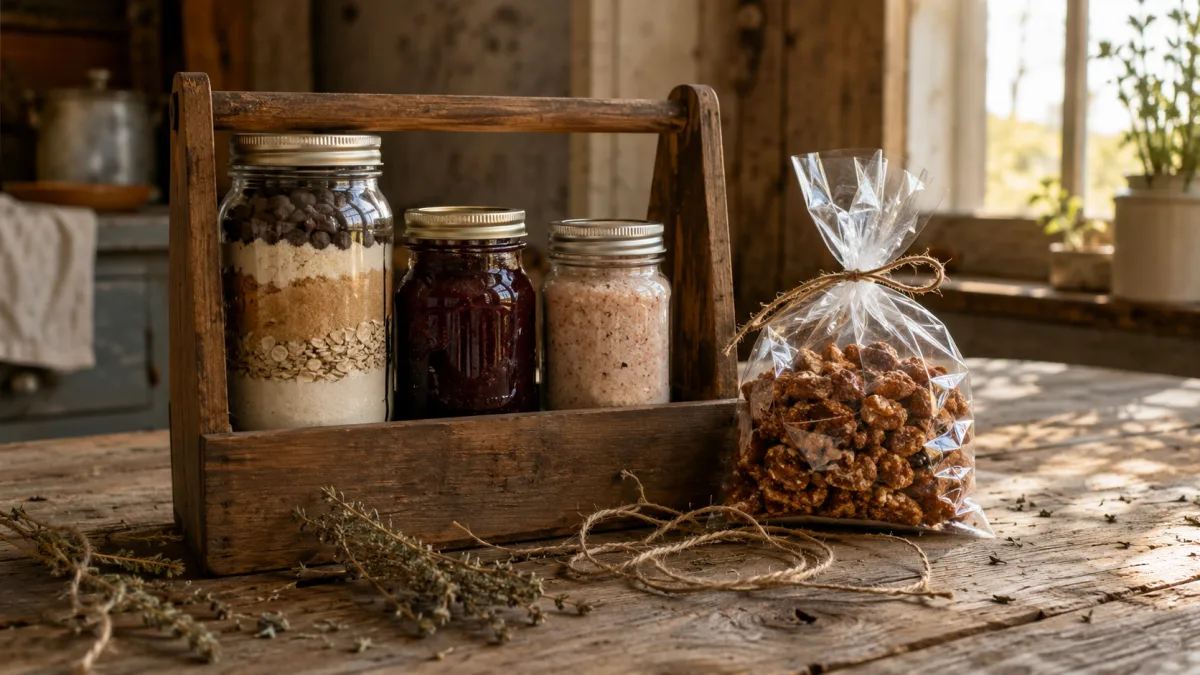
The container is part of the gift. A jar of excellent strawberry jam in a recycled pasta jar communicates something different than the same jam in a wide-mouth Ball jar with a fabric top and a hand-lettered label. The ingredients didn't change, but the message did.
Wide-mouth mason jars are the workhorses of homemade food gifts. They're inexpensive, seal reliably, look clean and intentional, and the recipient can reuse them. For liquids — flavored vinegars, infused oils — a swing-top bottle with a rubber gasket looks more refined and costs very little. Cellophane bags tied with twine work well for candied nuts, biscotti, or granola. Small kraft paper boxes with a cellophane window let the product speak for itself.
Labels matter more than most people expect. Printed labels from a standard template look sharp, but handwritten labels have a warmth that printed ones don't. Include at minimum: the name of the gift, the date it was made, key ingredients (especially useful for people with allergies), and any storage instructions. For infused oils, write "refrigerate — use within 2 weeks." For jams, write "store in a cool dark place — refrigerate after opening." These notes are genuinely useful, and they signal that the maker understood what they were producing.
Grouping a few items together elevates the whole — a small jar of flavored salt, a jar of infused honey, and a bag of spiced nuts arranged in a simple wooden crate or a cloth-lined basket reads as a curated collection rather than a collection of odds and ends. If you want to go further, a bottle of good olive oil from a specialty shop alongside your herb salt and a bag of dried pasta makes a complete Italian pantry gift that most home cooks would genuinely use.
For a celebration that calls for a full spread of homemade food, the ideas in our guide on throwing a memorable birthday party translate well to a holiday table setting.
Frequently Asked Questions
Is homemade garlic-in-oil safe to give as a gift?
Homemade garlic-in-oil is not safe to store at room temperature. The National Center for Home Food Preservation confirms that garlic submerged in oil without oxygen creates conditions that support botulism toxin production. If you want to give an infused oil, use only dried herbs (not fresh garlic or fresh herbs), label the bottle clearly with a refrigeration instruction, and note that it should be used within two weeks. For longer shelf life, commercially produced garlic-in-oil products are acidified or refrigerated for exactly this reason.
How long do homemade jams and jellies last?
Properly processed, full-sugar fruit jam — made using a tested recipe with correct headspace and water bath canning time — should retain best quality for up to one year when stored between 50–70°F in a cool, dark place. This is the NCHFP's recommendation. Once opened, the jar belongs in the refrigerator and is best used within a month. Jars that show any mold, cloudiness, or off odors should be discarded entirely.
Can I make a cookie mix jar months in advance?
Yes. Dry ingredients — flour, sugars, oats, chocolate chips, dried fruit — contain no significant moisture and store reliably. Sealed in an airtight jar and kept away from heat and humidity, a cookie mix jar holds quality for six to twelve months. The chocolate chips or dried fruit may show minor texture changes before the mix becomes unusable, but the product remains safe well beyond that point. Include a recipe card with the wet ingredients the recipient needs to add.
What can I add to honey for infused honey gifts?
Dried botanicals are the right choice: dried lavender buds, whole dried vanilla beans, cinnamon sticks, dried citrus peel, or star anise all work well. The key word is dried — moisture is honey's main vulnerability. Fresh herbs or fresh garlic introduce enough water to lower honey's water activity and allow fermentation. Using dried ingredients and a clean, bone-dry jar, infused honey keeps at room temperature for a year or more. Watch for bubbling or a sour smell, which would indicate fermentation and mean the jar should be discarded.
Do I need to label homemade food gifts with ingredients?
There's no legal requirement for labeling gifts to family and friends — FDA labeling rules apply to commercial food sales. That said, including a simple label with the product name, date made, key ingredients, and storage instructions is worth doing. Recipients with allergies or dietary restrictions will genuinely need the ingredient information, and storage instructions (particularly for anything with a refrigeration requirement) prevent waste and avoid any safety issues. It takes two minutes and removes all ambiguity about what someone is eating and how to store it.

Alyssa Curlin
Edits general health, nutrition and education explainers. Medical topics are educational and link to public-health guidance.




Leave a reply
Replying to