
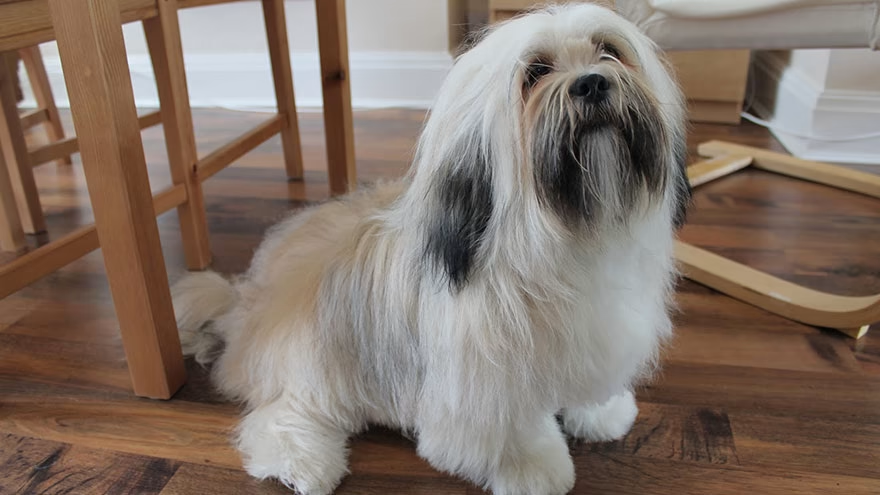
For roughly a thousand years, the Lhasa Apso stood guard inside Tibetan Buddhist monasteries — not as a lap dog warming a monk's robes, but as a working sentinel. Their Tibetan name, Apso Seng Kye, translates literally as "Bark Lion Sentinel Dog," and that job description shaped almost everything about how this breed thinks and acts today. The 13th Dalai Lama presented the first pair to reach American soil in 1933 as a diplomatic gift to C. Suydam Cutting of New Jersey — and the American Kennel Club granted the breed official recognition two years later, in 1935. Understanding that history makes the Lhasa far easier to live with.
1. What Are the Good and Bad Points of Owning a Lhasa Apso?
The Lhasa Apso is deeply devoted to the people it knows — a genuinely affectionate companion that tends to be playful, spirited, and quietly comical inside the home. Because monks bred these dogs over centuries to distinguish friend from foe in a monastery, they are sharp observers of human behavior and form intense bonds with their family. That same discernment makes them standoffish with strangers, which is a feature of the breed, not a flaw.
On the other side of the ledger: Lhasas are independent thinkers. They were never bred to follow orders; they were bred to make judgment calls. That means training takes patience and consistency, and the approach matters — physical corrections or raised voices produce stubbornness, not compliance. Reward-based methods using food or play work far better. Lhasas also do not tolerate rough handling well, which means households with very young children who haven't yet learned how to interact gently with a dog should think carefully before bringing one home. They can be wary and even snappy when they feel cornered or manhandled. Additionally, without early socialization — regular exposure to new people, sounds, and settings starting before 16 weeks — their natural wariness toward strangers can shade into something more anxious.
2. If I Buy a Lhasa Apso, Should I Have Him Registered?
Registration with the American Kennel Club is worth doing, but the decision should follow the purpose. You can purchase a purebred Lhasa Apso without AKC papers — the dog will be just as lovable — but papers carry practical value in specific situations. If you ever intend to breed or compete in AKC conformation shows, obedience trials, or agility events, registration is not optional.
For a pet-only dog, registration still tells you something important: it establishes that the puppy comes from a documented lineage. Reputable breeders routinely register their litters because they stand behind their breeding program. When a breeder cannot or will not provide registration papers, that absence deserves an explanation. It doesn't necessarily signal a problem, but it warrants asking why. Limited AKC registration — which allows a dog to compete in performance events but not pass on registered offspring — is a common and legitimate option that responsible breeders often use for pet-quality puppies.
3. Should I Buy My Lhasa Apso from the Local Pet Store?

The short answer is no. Most pet store puppies originate from commercial breeding operations — commonly called puppy mills — where dogs are housed in inadequate conditions and bred primarily for volume rather than health. The consequences show up in the puppy you bring home: behavioral issues rooted in poor socialization during the critical developmental window (roughly three to twelve weeks), and health problems that can surface weeks or months later.
The American Lhasa Apso Club maintains a breeder directory with members who abide by the club's code of ethics. A reputable breeder will health-test their breeding dogs for conditions known to affect Lhasas — particularly hereditary renal dysplasia and eye conditions — and will be willing to show you those test results. They will also want to meet you, ask you questions, and remain available after you take the puppy home. That relationship has real value, especially the first time you notice something unusual about your dog's health or behavior. For other small breeds the same logic applies — go directly to a committed breeder.
4. Should I Buy a Female or Male Lhasa Apso?
Both sexes make excellent companions, and the individual dog's temperament — shaped by genetics, early socialization, and training — matters far more than sex. That said, there are tendencies worth knowing. Male Lhasas are generally more outgoing and demonstrably affectionate, quicker to initiate play, and tend toward a more stable emotional baseline. They are also more likely to mark territory indoors if not neutered, which is worth factoring in for house-cleanliness reasons. Neutering largely eliminates this behavior when done at an appropriate age.
Female Lhasas are often described as more subtle in their affection — they accept petting on their own schedule rather than soliciting it constantly. They can be faster to pick up on training cues but are also more prone to mood shifts, particularly around hormonal cycles if left intact. Spaying removes those fluctuations. In practice, personality varies enough within each sex that the best approach is to describe your household — energy level, children, other pets, schedule — to your breeder and let them help match you to the right individual puppy, regardless of sex.
5. What Is the Best Way to Choose the Right Lhasa Apso Puppy?
Work directly with a qualified breeder and conduct two separate evaluations: one of the litter as a whole, and one of each individual puppy. The entire litter should strike you as energetic, curious, and physically healthy — bright eyes, clean coats, no discharge from nose or eyes, and confident movement. A litter that huddles in the corner or reacts with extreme fear to normal sounds is a warning sign about socialization quality.
When assessing individual puppies, look for one that notices you — makes eye contact, approaches willingly, engages. A puppy that participates in play with its littermates but is not the one constantly ambushing and pinning everyone else tends to adapt well to different home environments. Avoid the boldest bully and the most fearful hider; both extremes can present training challenges. Ask the breeder to describe the puppy's daily temperament observations — a breeder who spends real time with the litter will have specific, detailed answers. Good breeders often temperament-test at seven weeks to help match puppy to owner. Similar selection principles apply when choosing a Maltese or other companion breeds.
6. My Lhasa Apso Is Driving Me Crazy with Barking and Chewing — What Can I Do?
The barking makes sense the moment you recall what this breed was built to do. Inside a Himalayan monastery, a Lhasa that stayed quiet when strangers appeared was a useless sentinel. The sharp, persistent bark was the entire point. That instinct is now hardwired. You are not going to eliminate it, but you can manage it through two mechanisms: early training and sufficient mental stimulation.
Starting in puppyhood, teach a quiet cue — ask for silence, reward immediately when the dog complies, and build duration gradually. Consistency matters more than intensity; a calm "enough" followed by a treat when the dog stops is more effective than yelling, which Lhasas often interpret as you joining in. For chewing, the mechanism is different: puppies chew because their gums ache during teething, and adult dogs chew because they need to. Providing appropriate chew toys — rotated frequently to maintain novelty — redirects the behavior. Dogs left alone for long stretches without enrichment chew furniture not out of spite but out of boredom. Two short training sessions a day plus puzzle feeders address the root cause. For dogs that bark at outdoor triggers, repositioning furniture so they cannot see the street directly can reduce arousal significantly.
7. What Can I Do to Housebreak My Lhasa Apso?
Housebreaking a Lhasa Apso takes longer than it does with many other breeds, and the physiological reason is simple: small dogs have small bladders with proportionally faster turnover. A Lhasa puppy at eight to ten weeks may need to go out every 45 to 60 minutes during waking hours. Even by 16 weeks, hourly trips are not unusual. The bladder control that allows reliable indoor cleanliness develops fully around six months of age for most small breeds — so early "accidents" are largely a biology problem, not a stubbornness problem.
Crate training is the most effective framework. Dogs instinctively avoid soiling their sleeping area, and a properly sized crate — large enough to stand and turn, not large enough to designate a bathroom corner — uses that instinct productively. The routine is straightforward: out immediately when the puppy wakes, out after every meal (within 10-15 minutes), out after play sessions, and out before bed. Praise and a small treat the moment the puppy goes in the right spot reinforces the connection between location and reward. Never punish accidents that you didn't catch in progress; the dog cannot connect a correction to something that happened more than a few seconds ago. Patience and schedule adherence pay off faster than any shortcut. For stubborn cases, indoor training pads used in a consistent spot can bridge the gap during bad weather. Other breeds with reputations for difficult housebreaking benefit from the same systematic approach.
8. What Diet Should I Keep My Lhasa Apso On?
Protein quality is the first variable that matters. Choose a food — whether dry kibble, wet, or fresh — with a named animal protein (chicken, turkey, beef, fish, lamb) listed as the primary ingredient. Adult Lhasas need roughly 22-24% protein in their diet to maintain muscle mass and support their coat, which is metabolically demanding. Puppies need slightly more, around 24-26%, to fuel growth.
Lhasas are prone to skin and coat issues and food sensitivities — corn, soy, and certain grain proteins appear more frequently as culprits than others, though every individual varies. If your dog develops itchy skin, recurring ear infections, or digestive upset, an elimination diet trial guided by your veterinarian can identify the specific trigger. The broader question of grain-free versus grain-inclusive diets is nuanced: the FDA has investigated a potential link between certain grain-free diets and dilated cardiomyopathy in dogs, so grain-free is not automatically superior. Unless your vet identifies a confirmed intolerance, a quality food with digestible whole grains is a reasonable choice.
Fresh or lightly cooked food — cooked turkey, chicken, lean beef, combined with vegetables like sweet potato, green beans, or broccoli — can be excellent for Lhasas that respond poorly to commercial formulas, but must be nutritionally balanced. An unbalanced homemade diet creates deficiencies over time. Divide daily portions into two meals to keep blood sugar stable and reduce bloating risk, and provide fresh water at all times.
9. What Health Problems Are Common in Lhasa Apsos?

Hereditary renal dysplasia is the health concern most specific to this breed and the one that warrants the most careful attention when selecting a puppy. In affected dogs, the kidneys fail to develop normally — the urine-collecting tubules form improperly, leading to cysts that gradually replace functional kidney tissue. Symptoms typically appear between a few months and five years of age: excessive thirst, frequent urination, weight loss, and vomiting. There is no cure, only supportive management. Because the condition is hereditary, responsible breeders test their breeding stock and avoid producing affected lines. Asking a breeder directly whether their dogs have been screened for renal dysplasia is one of the most important questions a potential Lhasa owner can ask, according to the American Lhasa Apso Club.
Progressive retinal atrophy (PRA) is the other hereditary concern worth knowing. The disease causes photoreceptor cells in the retina to degenerate progressively — night blindness typically appears first, followed by a gradual narrowing of daytime vision, and eventually complete blindness. There is currently no treatment. Eye testing through OFA or a board-certified veterinary ophthalmologist can identify carriers before they produce affected offspring. Beyond these hereditary conditions, Lhasas are also prone to patellar luxation (the kneecap slipping out of position), cherry eye (prolapse of the third eyelid gland), and keratoconjunctivitis sicca (dry eye). The hair that grows around their eyes — part of their distinctive appearance — must be kept trimmed or tied back to prevent constant corneal irritation.
Despite this list, the Lhasa Apso is considered a generally healthy and long-lived breed. Compared to breeds prone to cardiac disease or hip dysplasia, a Lhasa from health-tested lines who receives good preventive care has an excellent prognosis for a long, comfortable life.
10. How Long Do Lhasa Apsos Live?

The Lhasa Apso is one of the longest-lived dog breeds in the world. Most individuals reach 12 to 15 years; a meaningful percentage live into their late teens. There are verified cases of Lhasas reaching 20 years — an extraordinary lifespan by any canine measure. By comparison, the average lifespan for a Golden Retriever is roughly 10 to 12 years, and many giant breeds average only 7 to 8. The Lhasa's longevity is one of its most compelling attributes for people seeking a long-term companion.
What drives that longevity? Several factors appear to contribute. Small body size correlates with longer lifespans across most mammalian species — less wear on cardiovascular systems and joints. The Lhasa's relative genetic diversity compared to breeds with very narrow founding populations also helps. And its original Himalayan environment, with extreme cold and altitude, may have selected for physiological robustness over centuries. Owners who want to maximize that lifespan should focus on keeping the dog lean (excess weight accelerates joint wear and metabolic stress), maintaining dental hygiene (dental disease is the silent life-shortener in small dogs), providing regular veterinary wellness exams, and catching hereditary conditions like renal dysplasia early through proactive screening. The breed's longevity also means committing to a potentially 15-year relationship — a detail worth thinking through before acquiring a puppy. Similar longevity considerations apply to the Maltese, another Tibetan-adjacent small breed with an impressive lifespan.
Frequently Asked Questions
Are Lhasa Apsos good for first-time dog owners?
Yes, with caveats. The Lhasa Apso's stubbornness and independent nature mean first-time owners need to be willing to invest in consistent, reward-based training from puppyhood. Those who expect an immediately obedient dog will be frustrated. First-timers who understand the breed's sentinel history — and accept that the Lhasa makes its own assessments rather than deferring automatically — tend to find the relationship deeply rewarding.
Do Lhasa Apsos get along with other pets?
Generally yes. Lhasas are not aggressive toward other dogs by default, though they will hold their ground and do not respond well to being harassed by larger, boisterous dogs. Early socialization — regular, positive exposure to other animals before 16 weeks — is the most reliable predictor of adult tolerance. Lhasas raised alongside cats typically coexist without issue.
How much exercise does a Lhasa Apso need?
Considerably less than most people expect. One or two walks around the block per day meets the physical exercise requirement, supplemented by indoor play sessions. Lhasas are not jogging partners — they score 1 out of 5 on jogging suitability according to VCA Animal Hospitals, largely because their compact build and brachycephalic facial structure make sustained aerobic exertion uncomfortable in warm weather. Mental stimulation through training games, puzzle feeders, and scent work matters as much as physical activity for this intelligent breed.
How difficult is Lhasa Apso grooming?
The full show coat — a heavy, straight, parted double coat that reaches the floor — requires brushing every other day to prevent mats and detangling sessions after bathing. Many owners opt for a "puppy cut," where the coat is trimmed to about 1-2 inches all over. This eliminates most of the intensive maintenance while preserving the breed's charm. Either way, the hair around the eyes must be kept clear of the corneas daily, and professional grooming every 6-8 weeks is practical for most pet owners. The Lhasa's coat sheds below average — an advantage in households concerned about pet hair.
Were Lhasa Apsos really considered sacred in Tibet?
They occupied a position of considerable spiritual reverence. Tibetan Buddhist belief held that the souls of deceased lamas could temporarily inhabit the bodies of Lhasa Apsos while awaiting reincarnation. Because of this belief, Lhasas in Tibet were never sold — they could only be given as gifts. That cultural protection helped preserve the breed's distinctive characteristics across many centuries before Western breeders encountered them in the early 20th century. Research published in Science in 2004 confirmed the Lhasa Apso is among the 14 most genetically ancient dog breeds recognized by the AKC, placing it closer to the ancestral wolf than most modern breeds.
The single most important thing to know before getting a Lhasa Apso: this is a thousand-year-old sentinel breed with an independent mind and a long memory. It will not give its loyalty to everyone in the room — it will choose its people deliberately and guard them with quiet tenacity. That selectivity, which can read as aloofness in a pet store window, becomes something genuinely rare in a companion once the dog has decided you belong to it.

Chiara Bradshaw
Covers education, culture and creative topics with an emphasis on readable explanations and verifiable references.

1 Comment
Join the discussion. Comments are moderated before appearing.