
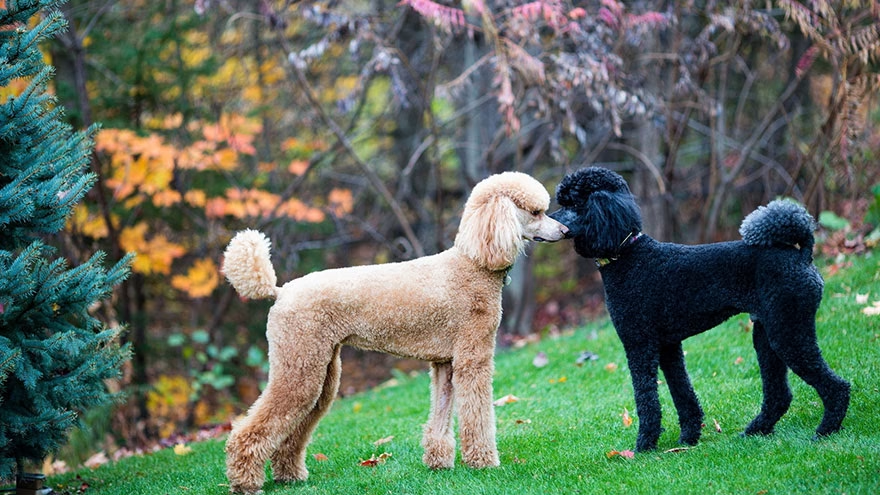
In Stanley Coren's landmark study The Intelligence of Dogs, published in 1994, the Poodle ranked second among all breeds — behind only the Border Collie. That ranking was not based on instinct or gut feeling. Coren surveyed 208 obedience trial judges across North America and found that Poodles could learn a new command in fewer than five repetitions and would obey a known command on the first request at least 95 percent of the time. For anyone starting poodle training, that statistic shapes everything: what works, what backfires, and what the most common mistake looks like.
Why Poodles Are Ranked Among the Most Trainable Dogs
Coren's framework measures what he calls working and obedience intelligence — the speed at which a dog learns a new behavior and the reliability with which it performs that behavior under varying conditions. Poodles score at the top of this scale, which means training sessions move faster than with most other breeds. A new cue, introduced clearly and rewarded consistently, can be reliable within a single afternoon.
But the same capacity that makes Poodles easy to train also makes them demanding partners. A dog that processes information this quickly does not tolerate boredom quietly. When the challenge disappears — when training becomes predictable, repetitive, or slow — the Poodle starts solving problems on its own. Those self-directed solutions are rarely what the owner had in mind: furniture corners get chewed, escape routes get tested, and household rules get creatively reinterpreted. Intelligence in a dog is not a passive trait. It requires active management.
Poodles also read emotional tone with unusual sensitivity. They pick up on the handler's frustration, impatience, or lack of confidence and respond by becoming tentative or disengaged. Calm, clear signals produce far better results than corrections delivered with irritation attached.
According to the American Kennel Club, Poodles sit firmly in the top tier of working intelligence — a classification that translates directly to how quickly and precisely they respond to structured training.
The Three Poodle Varieties — Size Differences and Temperament
All three Poodle varieties — Standard, Miniature, and Toy — share a single breed standard scaled proportionally by size. The AKC sets the measurements clearly: Standards stand over 15 inches at the shoulder, Miniatures measure between 10 and 15 inches, and Toys stand no more than 10 inches. The coat type, structure, and movement are the same across all three. What differs meaningfully is temperament, and that difference is worth understanding before starting any training program.
The Standard Poodle tends to be the most even-tempered of the three. It bonds strongly with its family but carries itself with a certain steadiness that makes it easier to keep focused in busy training environments. Standards are athletic — they were, after all, the original working dog — and they need physical exercise alongside mental challenge.
Miniature Poodles are more reactive than Standards. They can be wary around strangers and may take longer to settle in unfamiliar settings. That sensitivity means early and thorough socialization matters more with a Miniature than with a Standard. Once trust is established, though, they train with the same precision and enthusiasm as their larger relatives.
Toy Poodles bring the highest energy level and the most excitability. They tend to bark more frequently, can become clingy, and are most prone to separation anxiety. Their small size sometimes leads owners to skip structured training, which is a mistake — a bored, under-stimulated Toy Poodle in a small apartment generates a disproportionate amount of chaos. All three varieties need mental work, but the Toy may need it delivered in shorter, more varied bursts.
One thing all three share equally: the deep bond with their people. Poodles across all sizes form strong attachments and are sensitive to disruptions in the household's emotional tone. A stressed household produces a stressed Poodle.
For anyone considering a smaller breed companion with similar intelligence, the Maltese FAQ and Lhasa Apso FAQ on this site offer useful comparisons.
Poodle History — Water Dogs, Not Show Dogs

The image most people carry of the Poodle — dyed topknot, sculpted pom-poms, promenading at a dog show — is almost the opposite of where the breed came from. The name itself signals the origin: "Poodle" derives from the German "Pudel" or "Pudelhund," meaning to splash in water. These were working dogs, developed in Germany as waterfowl retrievers, bred to enter cold marshes, swim through reeds, and deliver ducks to hunters.
The AKC's history of the Poodle credits Germany and France as the primary sources of the breed's development, with the Standard emerging first as the working retriever and the Miniature and Toy varieties developed later, largely in France, as companion dogs for city dwellers and eventually for royalty. Claims of Egyptian or Roman origins that occasionally circulate are unverified — depictions of curly-coated dogs on Roman coins and Greek artifacts suggest some ancient ancestor, but the breed as we recognize it today was shaped in medieval Germany.
The distinctive clip that remains the Poodle's visual signature was not invented by show groomers. Hunters shaved the hindquarters, legs, and much of the tail to reduce drag and weight in water, but left hair intact over the chest, hip joints, and leg joints to protect vital organs from cold and from the sharp stems of reeds. The pompoms on the tail and the bands of hair at the joints were functional markers, not decoration. By the time the Poodle moved into French court society in the 18th century, those working trims had been elaborated into fashion statements — but the structure of the cut still traces back to the duck blind.
How to Start Training a Poodle Puppy
Training begins before the puppy arrives home. Responsible breeders start handling puppies from the first weeks, exposing them to different surfaces, sounds, and people. A Poodle that has had that early foundation is measurably easier to work with once it reaches its new home at eight weeks.
The first priorities are not commands. They are socialization, confidence, and a clear understanding of household rules. A puppy that has met a wide variety of people, dogs, surfaces, and environments by sixteen weeks will carry that confidence into every training session that follows. Socialization gaps are difficult to close later, particularly in Miniatures and Toys that may default to anxiety when faced with the unfamiliar.
Basic cues — sit, stay, come, and loose-leash walking — are appropriate to introduce early. Keep sessions short: five to ten minutes for a young puppy, with clear signals and immediate rewards. Poodles do not need dozens of repetitions to learn a new behavior, so long sessions are unnecessary. They can actually work against you, because a puppy that has already figured out what you want and performed it several times will start offering other behaviors just to find something more stimulating to do.
Name recognition, eye contact on cue, and a reliable recall are the most valuable foundations to build in the first weeks. Everything else — tricks, heel position, distance stays — layers on top of those core behaviors.
A professional trainer can be valuable even if you're experienced with dogs, simply because Poodles respond to small inconsistencies that owners often don't notice in themselves. A trainer watching from outside the session can catch patterns the handler can't see. The Miniature Schnauzer FAQ on this site covers similar ground on intelligent breed training fundamentals.
Positive Reinforcement and Clicker Training for Poodles
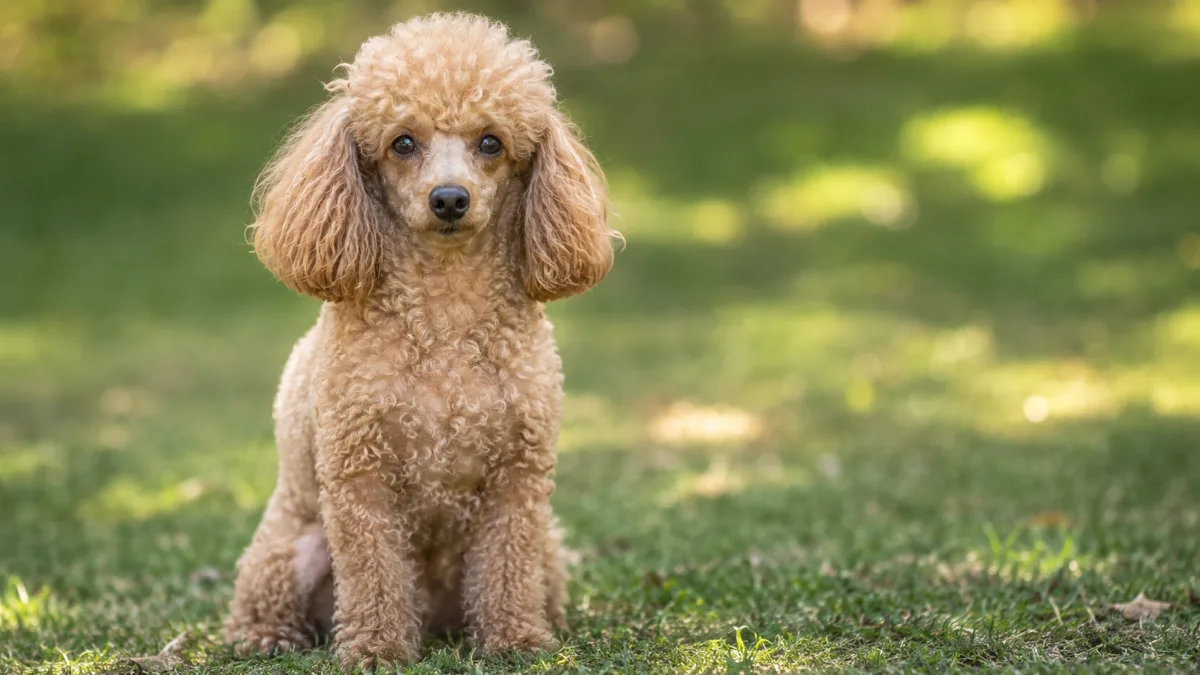
Positive reinforcement — rewarding a behavior immediately after it occurs to increase the likelihood it will repeat — is the scientific foundation of modern dog training. For Poodles specifically, it is not just the preferred approach; it is the most effective one by a significant margin. These are dogs that analyze patterns, that are sensitive to tone, and that shut down when faced with harsh corrections. Punishment-based methods produce exactly the kind of tentative, disengaged response that makes a Poodle difficult to work with.
Clicker training works particularly well with this breed for a mechanical reason: the click marks the precise moment the correct behavior occurs, before the reward arrives. That precision matters to a dog that is processing information quickly and drawing conclusions about cause and effect. Vague timing — rewarding two seconds after the behavior — leaves room for the dog to conclude it was being rewarded for something else. The click eliminates that ambiguity.
There are three main methods for introducing a new behavior: luring (using food or a toy to guide the dog into position), shaping (clicking and rewarding successive approximations toward the goal), and capturing (waiting for the dog to offer the behavior naturally and clicking at that moment). Poodles do well with all three, but shaping tends to produce the most engaged, enthusiastic response — it requires the dog to think, to experiment, to figure out what earns the click. That problem-solving element is exactly what keeps a Poodle's attention.
Vary the rewards. Food is effective for many behaviors, but Poodles can lose interest in a treat that appears every single time. Mixing in play, praise, and occasionally a favorite toy keeps the reward unpredictable and therefore more motivating. The technical term is a variable reinforcement schedule, and it produces behaviors that are more persistent and more resistant to extinction than fixed-ratio rewarding.
Advanced Training: Obedience, Agility, and Beyond
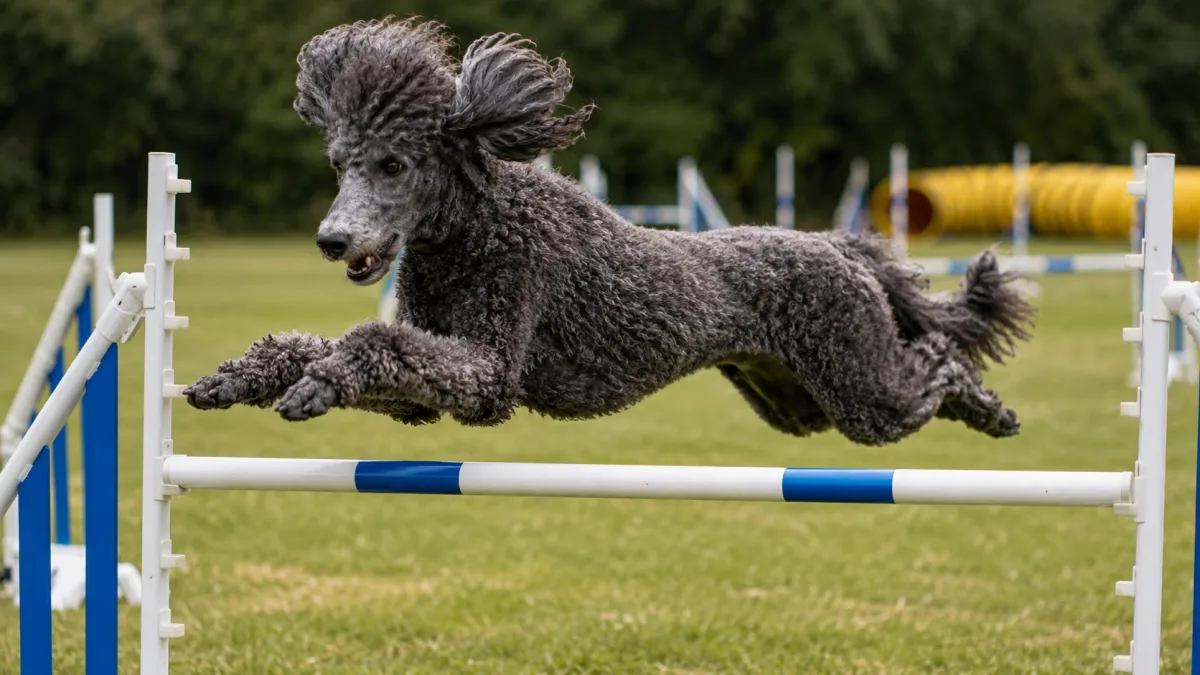
Once foundational behaviors are solid, the question is not whether a Poodle can handle advanced training — it is which direction to take first. The breed excels across a remarkable range of AKC sports and working titles.
In formal obedience, Poodles routinely compete at the highest levels, from Novice through Utility. The precision required — exact heel position, timed sits and downs, retrieve over high jump, signal exercises — suits a dog that learns quickly and enjoys the clarity of a well-defined task. AKC Rally offers a slightly more relaxed format, with handler and dog navigating a numbered course of stations together, which many Poodles find engaging precisely because each course is different.
Agility — timed obstacle courses of jumps, tunnels, weave poles, and contact equipment — plays to the Poodle's athleticism and responsiveness. The breed's ability to anticipate the handler's next signal, combined with its natural enthusiasm for physical activity, makes it a genuine competitor at the national level.
The Poodle Club of America lists hunt tests and tracking among the activities available to Poodles, a reminder of the working retriever underneath the show coat. Tracking tests, in which the dog follows a human scent trail across varied terrain, engage the breed's nose in a way that most Poodle owners never explore but that the dogs often find deeply satisfying. Canine freestyle — structured choreography set to music — is another discipline where Poodles compete, partly because of their showmanship and partly because learning a sequence of behaviors chained together over weeks of training is exactly the kind of sustained mental challenge they need.
For comparison with another highly capable breed in performance sports, see the German Shorthaired Pointer FAQ on this site.
Common Training Challenges with Poodles
The most consistent training challenge reported by Poodle owners is not stubbornness or distraction. It is boredom. These dogs learn so fast that the window between "new behavior being introduced" and "behavior fully learned and no longer interesting" is narrow. Once a Poodle has mastered a cue, repeating that cue twenty more times in the same session does not reinforce the learning — it undermines engagement. The dog has moved on mentally even if its body is still going through the motions.
This shows up most clearly as the dog switching off — going through behaviors mechanically, losing eye contact, slowing down, or starting to offer unrequested behaviors just to find something more stimulating to do. Owners sometimes interpret this as defiance or distraction. It is almost always boredom.
Inconsistency is a related problem that hits Poodles harder than it hits many other breeds, precisely because they are constantly analyzing patterns. A dog that is sometimes allowed on the furniture and sometimes corrected for it is not confused the way a less intelligent dog might be. It is running probability calculations. It has figured out that the rule depends on some variable — who is in the room, what time of day it is, whether the owner is paying attention — and it is testing that hypothesis. The result looks like disobedience but is actually pattern-finding applied in an unhelpful direction.
Separation anxiety is another genuine challenge across all three varieties. Poodles bond closely and do not handle solitude well, particularly if the transition to being alone was abrupt. Gradual alone-time training from puppyhood — short absences that increase incrementally — is far easier than addressing entrenched anxiety later.
Health Considerations That Affect Poodle Training
Training works best when the dog is comfortable. Several health conditions common to Poodles can affect movement, energy, or willingness to work, and knowing them helps owners recognize when a behavior change might have a physical cause.
Hip dysplasia affects Standards most commonly, causing pain in the hip joints that may show up as reluctance to jump, difficulty rising after rest, or a shortened stride. A dog that was previously enthusiastic about agility and begins stopping at jumps may be signaling joint pain, not disobedience. Standards that will compete in jumping sports benefit from hip evaluations before training begins at intensity.
Progressive retinal atrophy (PRA) affects all three varieties and causes gradual vision loss, beginning with night blindness. A dog losing its sight may appear disoriented in low light, hesitate at obstacles it once cleared confidently, or startle more easily. Catching PRA early allows training adjustments — more verbal cues, consistent environment layout, reduced reliance on hand signals — before vision loss becomes significant.
Bloat, or gastric dilatation-volvulus, is a life-threatening emergency that affects Standard Poodles as a deep-chested breed. Vigorous exercise immediately after a large meal significantly increases risk. Structuring training sessions and feeding schedules with an appropriate gap between them is a basic precaution.
Addison's disease — insufficient cortisol production from the adrenal glands — can produce lethargy, reduced appetite, and a general loss of the energy and engagement that makes Poodles easy to train. A dog that seems suddenly flat in training sessions, when it had previously been enthusiastic, warrants a veterinary evaluation. Addison's is manageable once diagnosed, and many dogs return to full training activity with appropriate treatment.
Frequently Asked Questions
At what age should I start training a Poodle?
Training can begin as soon as the puppy comes home, typically around eight weeks. At that age, sessions should focus on socialization, name recognition, and simple cues like sit and come. Formal obedience and sport training can start around four to six months, once the puppy has reliable attention and basic impulse control.
Are all three Poodle sizes equally easy to train?
All three varieties share the same underlying intelligence and trainability. In practice, Standards tend to be the most straightforward to train because they are less reactive and more settled in unfamiliar environments. Miniatures and Toys can be equally precise once trust and confidence are established, but they may require more careful socialization work early on.
Do Poodles need a professional trainer?
Not always, but a qualified trainer adds value even for experienced dog owners. Because Poodles pick up on handler inconsistencies quickly, a trainer watching the session from outside can catch patterns the handler cannot see. Group obedience classes also provide socialization alongside training, which suits Poodles well.
What is the single biggest training mistake Poodle owners make?
Repetition. Once a Poodle has learned a behavior, running through it twenty times in the same session does not strengthen the behavior — it teaches the dog that training is tedious. The smarter the dog, the faster boredom sets in, and a bored Poodle will start inventing its own agenda. Keep sessions short and varied: introduce new behaviors, mix known cues in different sequences, change locations, and reward unpredictably. The goal is a dog that finds training genuinely interesting, not one that tolerates it.
Can Poodles compete in hunt tests despite their reputation as show dogs?
Absolutely. The Poodle Club of America maintains an active hunt test program, and Standards in particular retain strong retrieving instincts. One Standard Poodle has earned a Master National Hunter title — the first of its breed to do so. Hunt tests, tracking events, and dock diving all engage the working drive that has always been part of the breed, even when it is hidden under a continental clip.

Chiara Bradshaw
Covers education, culture and creative topics with an emphasis on readable explanations and verifiable references.

Leave a reply
Replying to