
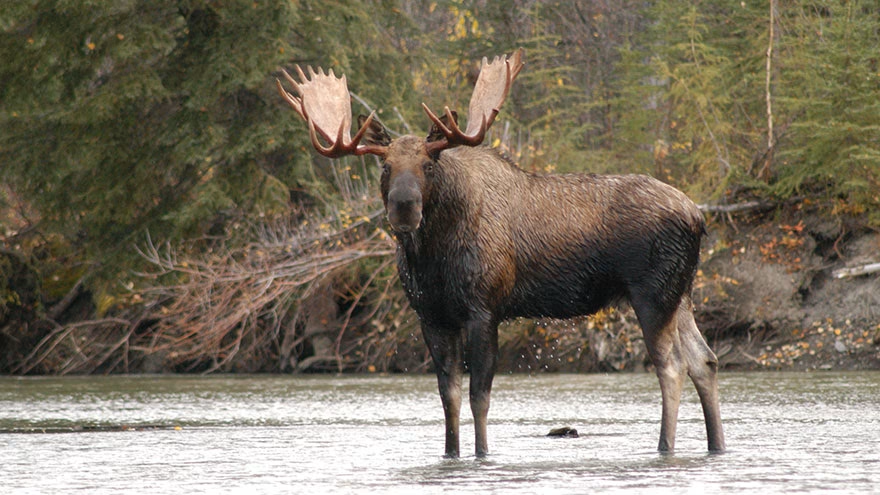
New Hampshire is home to an estimated 3,000 moose, down sharply from a peak of 7,000–8,000 in the late 1990s — a decline driven largely by winter tick infestations, with some individual animals hosting upward of 50,000 parasites at once. That context matters for anyone hoping to see moose in North Conway, New Hampshire: the animals are here, but the surest sightings come from knowing where and when to look. North Conway itself is a compact village, but it sits at the southern gateway to the White Mountain National Forest, with moose habitat spreading in every direction within a short drive.
Why North Conway is one of the best bases for moose watching in New England
The geography does a lot of the work. North Conway occupies the Mount Washington Valley at roughly 500 feet of elevation, hemmed in by forested ridgelines and threaded by the Saco River. Drive north on Route 16 and you're into the White Mountain National Forest inside fifteen minutes. Turn west on the Kancamagus Highway and you gain 2,800 feet before crossing the pass. Both corridors cut through the boreal forest edges, beaver ponds, and alder swamps that moose depend on.
The town is also small enough that moose occasionally wander its outer edges, particularly along the Saco River floodplain and the wetlands near Echo Lake State Park. Visitors staying in North Conway can attempt three or four different moose-watching approaches in a single day — a dawn paddle on the river, a mid-morning scenic railroad departure, a late-afternoon drive on the Kancamagus, and an evening guided bus tour — without logging more than forty miles behind the wheel.
When is the best time to see moose near North Conway?
Moose are crepuscular by nature, most active in the hour before and after sunrise and again from roughly an hour before sunset through full dark. The behavior is partly about thermoregulation: a bull moose can weigh 1,200 to 1,400 pounds and generates considerable body heat, so midday activity in summer is minimal. It also aligns with the low-light window when predator detection is harder.
Within the calendar year, late May through early July is particularly productive for moose watching near North Conway. Calves are born in May and June, and cows with calves spend considerable time in wetlands and along rivers feeding on aquatic plants. The sodium in aquatic vegetation — water lilies, pondweed, and similar plants — is essential: moose spend winter eating woody browse that is very low in sodium, and by late spring they have a deficit to replenish. That nutritional drive pulls them reliably to water, where they are easy to observe from a respectful distance.
September and October bring the rut, when bulls become visible and vocal as they compete for cows. Antlers reach their full size between April and September and are shed between November and January, so a September bull in full velvet-shed is one of the more striking wildlife sights in New England. Dawn and dusk sightings remain the rule, but rutting bulls occasionally move in daylight hours.
The Saco River — moose watching by canoe or kayak
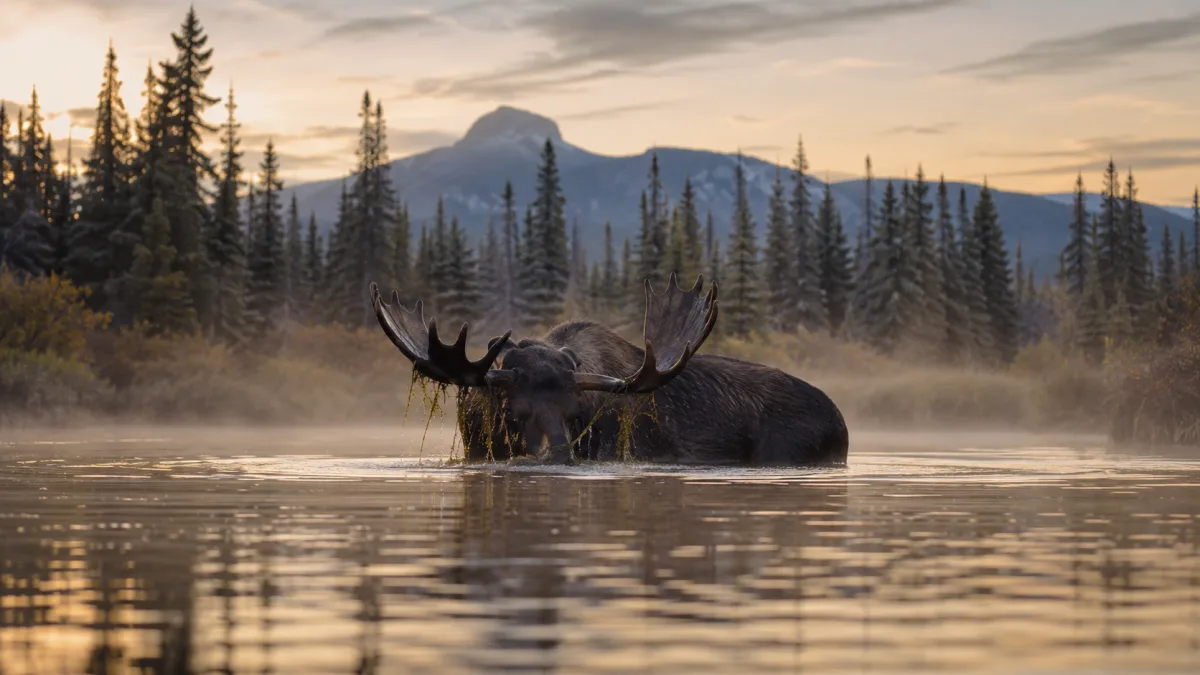
The Saco River runs along the western edge of North Conway before swinging south through farmland and forest. Early mornings on the upper Saco in June and July can produce moose wading knee-deep in the current, head submerged for stretches of up to a minute as they pull up roots and stems from the riverbed. They are not drinking — they are mining sodium, which aquatic plants contain at concentrations far higher than any terrestrial browse. The sight of a 1,000-pound animal standing chest-deep in a river is startling and entirely characteristic of the species.
Several outfitters in North Conway rent canoes and kayaks for self-guided runs on the Saco. The stretch between North Conway and Conway Village is gentle enough for beginners and passes through a mix of wooded banks and open meadow — both the kind of edge habitat moose prefer. Aim to be on the water at first light. A moose that has been feeding since before dawn may still be in the shallows at 7 a.m.; by 9 a.m. it will likely have retreated to forest cover for the day.
Be aware that moose are strong swimmers capable of sustaining six miles per hour in the water — faster than most paddlers manage against a light current. Give feeding animals a wide berth. The minimum safe viewing distance is generally cited as 75 to 100 feet; for a cow with a calf alongside, stay further back. Saco River Campground, located along this stretch, offers overnight stays in prime territory and has reported moose sightings at the water's edge in the early morning hours.
The Kancamagus Highway — a scenic drive through prime moose territory
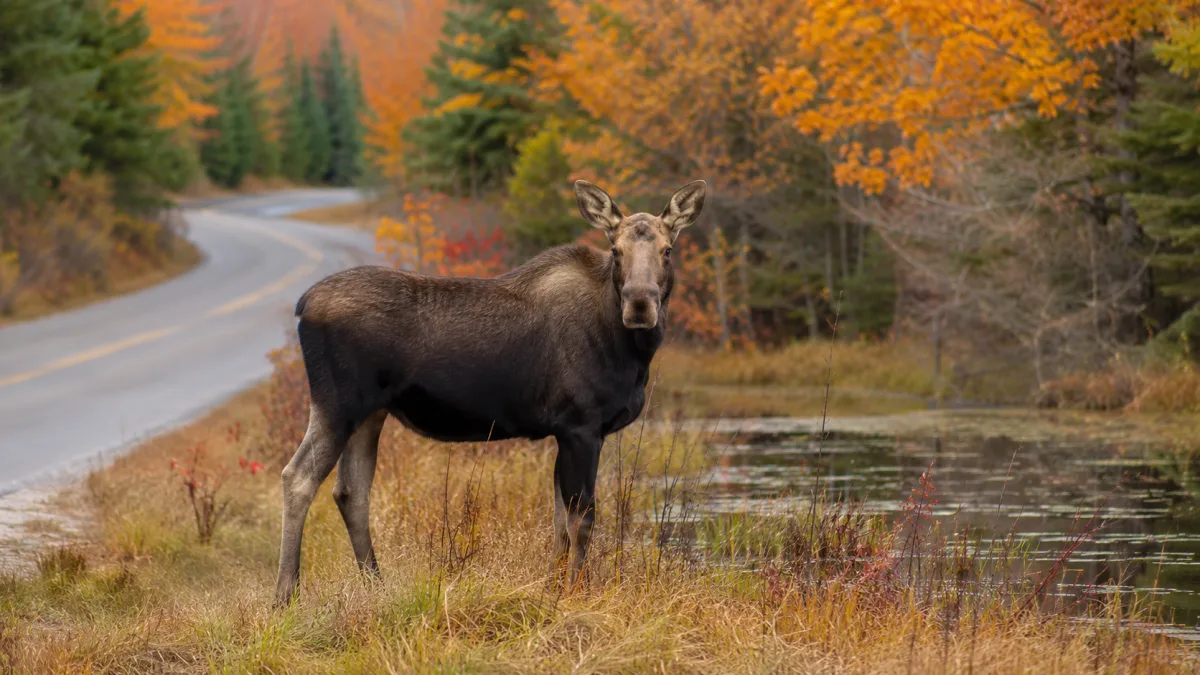
New Hampshire Route 112, the Kancamagus Highway, runs 34.5 miles from Conway west to Lincoln through the heart of the White Mountain National Forest — a federally designated scenic byway with no commercial development along its entire length. The western half of the route climbs to Kancamagus Pass at 2,855 feet and then drops toward Lincoln through some of the densest boreal forest in the region. Moose concentrate in the wetland corridors within about five miles on either side of the pass, as well as in the alder thickets along the Swift River on the eastern half.
The original article described a 90-mile loop, which warrants some clarification. A popular self-drive moose circuit from North Conway heads northwest on Route 302 past Crawford Notch, connects with Route 3 through the Twin Mountain area, then returns via the Kancamagus Highway from Lincoln. That loop is longer than the highway itself — closer to 90 miles round-trip — and passes through several distinct habitat types. Crawford Notch State Park and the Saco Lake area at the head of the Notch are both worth slowing for; Saco Lake itself is a reliable early-morning moose spot and is barely a roadside stop that many drivers pass without realizing it.
Along the Kancamagus, look for cars pulled onto the gravel shoulders with hazard lights on — that is almost always a sign that moose are visible nearby. The most consistent sightings come from the sections with moose-crossing signs, which are placed by NH Fish and Game based on documented activity patterns. Fall foliage season in late September and early October can make this corridor extraordinarily crowded, but it also corresponds to rut activity, which brings bulls out where they can be seen.
Conway Scenic Railroad — moose watching by train
The Conway Scenic Railroad, based at the Victorian-era North Conway station on Norcross Circle, has been running heritage train excursions through this valley since 1974. As of 2026 the railroad operates several distinct trips. The Valley Train is a one-hour, 11-mile round trip to Conway village along the Saco River — relaxed and family-friendly, with the river visible for much of the run. The flagship excursion is the Mountaineer, a 4- to 4.5-hour round trip to Crawford Notch that covers roughly 50 to 60 miles through forested mountain terrain; in recent years the railroad has also introduced a Crawford to North Conway and Return option for passengers who prefer to board at the notch end.
The Crawford Notch excursion passes through some genuinely productive moose country, particularly the wooded sections along the Saco and its upper tributaries and the wetland corridors approaching Saco Lake. Sightings are never guaranteed from a moving train, but the unhurried pace, elevated vantage, and near-complete absence of road noise make any wildlife encounter more likely than a car window would allow. The railroad also expanded winter operations in 2024, running regular excursions to Crawford Notch from late November — a period when moose have shed their antlers and their dark coats stand out sharply against snow-covered ground.
Check current schedules and book in advance at conwayscenic.com; the Crawford Notch excursions fill quickly in summer and fall. Departures from North Conway station.
Guided night moose tours from North Conway
If watching moose from a canoe or a slow-moving train feels too uncertain, a guided night tour shifts the odds dramatically. Several companies operate from North Conway and the surrounding valley, and the best of them maintain real-time knowledge of where moose have been spotted in the preceding 48 hours — guides are essentially running informal surveys throughout the week.
Mt. Washington Valley Moose Tours runs bus tours that depart from North Conway and travel north toward Crawford Notch and the White Mountain National Forest, illuminating moose at the roadside with spotlights. When conditions allow, passengers disembark to photograph the animals at close-ish range. North Conway Moose Safari operates a 3.5-hour tour from late May into October. Dan's Scenic Tours offers both evening group tours and private morning or evening options — the private format is worth considering for photographers who need more time with a specific animal. Gorham Moose Tours, based in Gorham about 45 minutes north on Route 16, runs from June through September with a claimed 94–99 percent sighting success rate and issues a voucher for a future tour if no moose are spotted.
Regardless of operator, book in advance during peak season. Tours typically depart at or just after sunset and run two to three hours.
Moose viewing safety — what you need to know
A moose looks passive right up until it isn't. An adult cow weighs 600 to 900 pounds; a bull in the 1,000–1,400-pound range is physically capable of killing a person with a single kick. NH Fish and Game is explicit on this point: a moose that has decided you've entered its personal space will knock you down and continue until the perceived threat stops moving. Cows with calves are the most reactive, and rutting bulls in September and October are unpredictable at any distance.
The standard guidance is to stay at least 75 to 100 feet away — farther if you can manage it. If a moose raises its hackles, pins its ears back, lowers its head, or starts swaying toward you, it is not posturing: create distance immediately. Never attempt to feed a moose or position yourself between a cow and her calf.
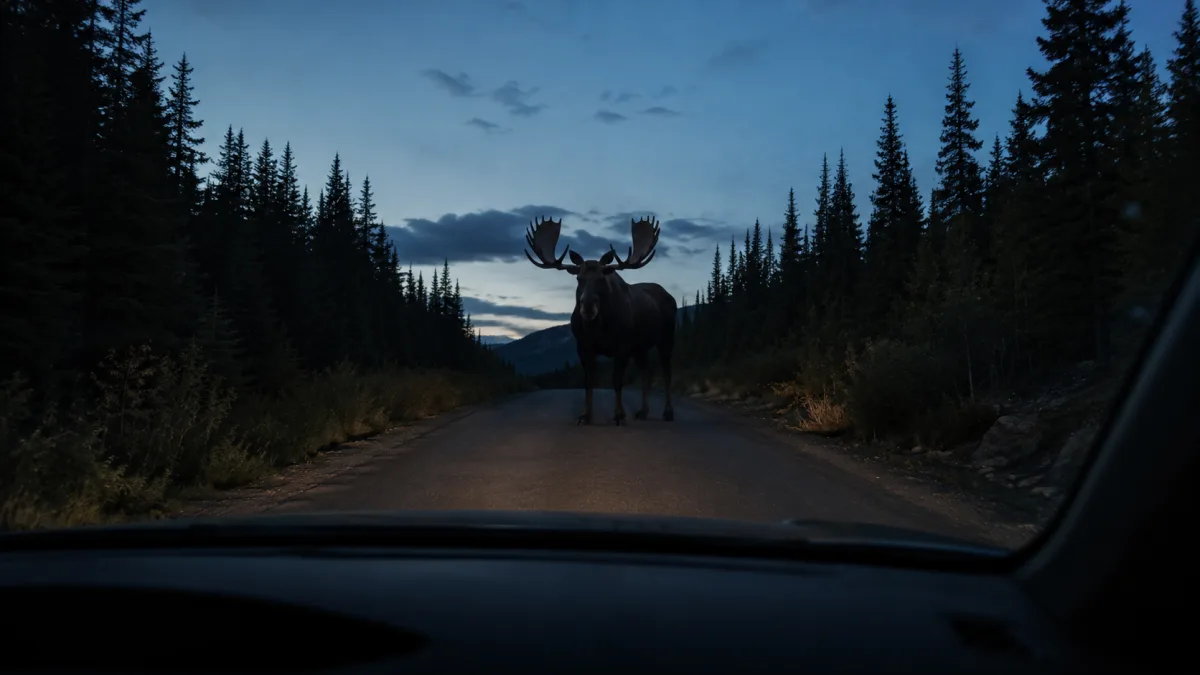
Moose-vehicle collisions deserve a separate note. A moose's center of gravity sits above the bumper line of most passenger vehicles, which means the animal's body rolls into the windshield and cabin on impact rather than over the hood. New Hampshire recorded roughly 300 moose-vehicle collisions per year at the population peak; even now, with a smaller herd, collisions remain common from April through November. Between dusk and dawn in the White Mountains, reduce speed, use high beams where safe, and scan both shoulders of the road. If a moose appears in your headlights, slow and stop — never assume you can pass around it. Moose legs are the same dark color as wet pavement and their eyes do not reflect headlights at the angle most vehicles illuminate them, making them genuinely hard to see at speed.
Best additional spots within an hour of North Conway
The area immediately around North Conway is productive, but two locations within an easy day trip raise the probability of a sighting considerably.
Thirteen Mile Woods on Route 16, running from Milan south toward Berlin along the Androscoggin River, is one of the most consistently reliable moose-watching corridors in New Hampshire. The road skirts the river through a long stretch of boreal wetland and alder swamp — exactly the kind of edge habitat moose favor — and the speed limit is low enough that wildlife has time to stand around. NH Fish and Game specifically lists Route 16 north of Milan as a road with active salt licks. This stretch is about 50 miles north of North Conway, making it an easy afternoon drive from the valley.
Pinkham Notch, 15 miles north of North Conway on Route 16, is closer and almost as reliable. The wetland areas around the Great Glen Trails Outdoor Center and the beaver ponds visible from the road in the lower notch produce consistent early-morning sightings in May, June, and September. The Androscoggin River corridor from Gorham northeast toward Errol (near Lake Umbagog National Wildlife Refuge) is another tier up in moose density — this is the New Hampshire North Country, where the population remains higher than in the White Mountains proper.
Crawford Notch State Park, accessible via Route 302 about 25 miles northwest of North Conway, offers Saco Lake at the head of the notch and several beaver pond pull-offs along the descent toward Bartlett. If you're making the scenic drive loop, an early arrival at Saco Lake — before 7 a.m. in June — gives a reasonable chance of seeing moose feeding in the shallows.
For more North Country wildlife destinations, see our guide to guided wildlife tours or explore the planning tips in How to Visit the Spiral Jetty on Utah's Great Salt Lake for another remote American landmark worth the drive. Our roundup of Top 5 Places to See in Petoskey, Michigan covers another region rich with wildlife and natural scenery.
Frequently Asked Questions
Are there moose in North Conway itself?
Moose are occasionally spotted at the edges of town, particularly along the Saco River floodplain and near wetlands on the outskirts of the village. More reliable sightings happen within 15–30 miles of North Conway in the White Mountain National Forest, along Route 16 toward Pinkham Notch, or on the Kancamagus Highway.
What time of day is best for seeing moose near North Conway?
Dawn and dusk are the most productive windows by a wide margin. Moose are crepuscular, meaning they concentrate their feeding and movement around the low-light periods at the start and end of the day. In summer, plan to be in position before 6 a.m. for the morning window, or at least an hour before sunset for the evening one. Midday sightings do happen but are much less common.
What month is best for moose watching in New Hampshire?
Late May through early July is excellent because cows with new calves spend extended time at wetlands and rivers feeding on aquatic plants rich in sodium. September through mid-October is the rut, when bulls are active and more visible. Both periods offer strong opportunities from North Conway. Avoid mid-July through August for peak-heat days when moose activity drops sharply at midday.
Is the Conway Scenic Railroad a good way to see moose?
It can be, particularly on the Mountaineer excursion to Crawford Notch, which passes through forested wetland corridors where moose are known to feed. Sightings are opportunistic rather than guaranteed, but the slow pace and quiet approach of a train can be an advantage. As of 2026, the railroad also runs winter excursions through Crawford Notch — a newer offering that puts visitors in moose country during a low-traffic season.
How close can you get to a moose?
NH Fish and Game recommends staying at least 75 to 100 feet away at minimum — and farther whenever possible. This is not a suggestion: moose have injured and killed people who approached too closely. Cows with calves and bulls during the rut are especially unpredictable. If you are on a guided tour, follow your guide's instructions about distance and whether to exit the vehicle.
Sources and verification
Check current details with these primary or subject-authority sources before acting on the information.

Olivia Prete
Edits culture and personal-development articles, distinguishing opinion and experience from verifiable claims.



Leave a reply
Replying to