

On your first morning at Air Force basic military training, reveille sounds at 4:45 a.m. Within minutes you are in formation outside your dormitory, a Military Training Instructor (MTI) walking the line checking that every button is fastened, every beret squared. No one calls an Air Force MTI a drill sergeant — that title belongs to the Army and Marine Corps. The distinction is deliberate: the Air Force built its training culture around technical competence and mission focus alongside discipline, so the instructors who run Air Force boot camp carry a different title that reflects a different philosophy.
That first morning captures the essence of what the next seven and a half weeks will be: structured, demanding, and entirely intentional in every detail. This guide covers what actually happens at Air Force boot camp today, using current information from official Air Force sources and verified reporting — not the outdated 2008-era descriptions that still circulate online.
What is Air Force boot camp and how long does it last?
Air Force boot camp is formally called Basic Military Training, abbreviated BMT. It is the entry point for every enlisted Airman, the program that transforms civilians into members of the United States Air Force. As of 2025, BMT runs 7.5 weeks — confirmed by the official Air Force BMT website at basictraining.af.mil. Most recruits arrive on the Tuesday of what the Air Force calls Zero Week, and graduation parade falls on the Thursday of the seventh week of training.
The duration has shifted several times. The program ran six weeks for many years, expanded to 8.5 weeks in 2008 in response to operational demands during the wars in Iraq and Afghanistan, then settled back to 7.5 weeks as the training model was revised. In October 2025 the Air Force launched an updated program sometimes called "BMT 2.0" that preserves the 7.5-week length while placing greater emphasis on physical conditioning and warfighting fundamentals.
Compared with Army basic combat training (ten weeks) or Marine Corps recruit training (thirteen weeks), Air Force BMT is shorter. The gap does not mean Air Force training is easier — it reflects a different design. The Air Force front-loads technical and academic instruction, knowing that Airmen will spend weeks or months in specialized technical school immediately after BMT, where career-specific skills are developed. The result is a program that balances physical hardening with classroom hours in a way no other branch matches.
Where does Air Force BMT take place?
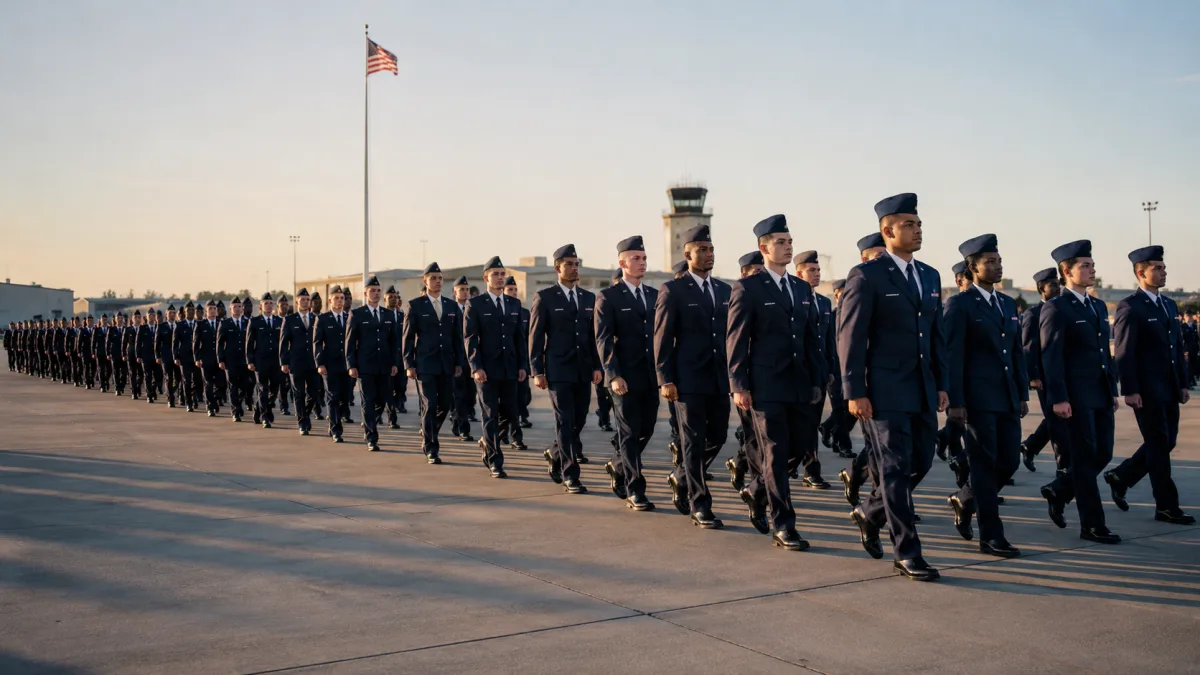
Every enlisted Air Force recruit trains at Joint Base San Antonio-Lackland in San Antonio, Texas — commonly referred to as Lackland AFB. It is the sole location for Air Force enlisted basic training, meaning all roughly 35,000 Airmen who graduate each year pass through the same gate in the same city.
San Antonio's climate shapes the training calendar. Summer temperatures regularly exceed 100 degrees Fahrenheit, so the physical training schedule shifts to early morning hours during those months. In winter, PT moves to mid-afternoon when temperatures are warmer. The base itself is large enough to contain dormitory complexes, weapons ranges, academic classrooms, a rappelling tower, the obstacle course, and the field training area used for the PACER FORGE exercise — all without recruits leaving the installation during the training weeks.
Families traveling to graduation should plan around San Antonio in advance. The Airman's Run and Coin Ceremony happen on the Wednesday of graduation week, with the formal Graduation Parade on Thursday morning at 9:00 a.m. Each trainee can sponsor up to six guests for base access through the Visitor Access Request List (VARL), submitted during Zero Week. DoD ID cardholders can enter without being on the VARL.
What happens at MEPS before basic training?
Before a recruit ever sees Lackland, they pass through a Military Entrance Processing Station (MEPS). These federal facilities handle the medical, legal, and administrative steps that determine whether an applicant is eligible to serve. MEPS processing typically spans two days: the first covers physical examination (vision, hearing, blood draw, urinalysis, orthopedic screening), and the second is for the Armed Services Vocational Aptitude Battery (ASVAB) if the applicant has not already taken it, along with career counseling and the enlistment oath.
The ASVAB score is consequential. It determines which Air Force Specialty Codes (AFSCs) — the career fields that define an Airman's job — a recruit is eligible to pursue. A higher composite score opens more technical options. Recruiters work with applicants to match ASVAB scores, physical qualifications, personal interests, and available training slots into an enlistment contract that specifies a guaranteed career field before the recruit ships to BMT.
The enlistment oath administered at MEPS — the same oath taken by every member of the U.S. military — is the legal moment of entry into service. From that point, the recruit is bound by the Uniform Code of Military Justice (UCMJ), even during the period between MEPS and the ship date to BMT, which can range from days to over a year depending on training availability.
Week-by-week overview of Air Force BMT
The 7.5-week program divides into distinct phases, each building on the last. Here is what the structure looks like from the inside.
Zero Week is processing week. Recruits arrive, receive haircuts (men are shaved to bare scalp; women with hair below the collar pin it up under their beret), are issued uniforms and equipment, receive immunizations, set up direct deposit for pay, and are assigned to a flight — the Air Force equivalent of a squad, typically 40 to 60 trainees — under an MTI. Sleep is short and the pace is disorienting by design. Early sleep deprivation at BMT is not an oversight; it is deliberate stress inoculation, testing whether recruits can follow instructions accurately when they are exhausted. The same principle governs the early weeks: cognitive load under fatigue is one of the most reliable predictors of how a person will perform under operational pressure.
Weeks 1 and 2 establish fundamentals: drill (marching in formation), reporting procedures, Air Force rank structure, saluting, dormitory standards, and the first physical training assessment. Recruits also receive their initial weapons familiarization — handling and basic maintenance of the M-4 carbine — and begin classroom instruction on the Law of Armed Conflict, human relations, and Air Force history.
Weeks 3 and 4 deepen the academic load. Service dress uniforms are issued in Week 3. Week 4 includes Chemical, Biological, Radiological, and Nuclear (CBRN) defense training — including the "gas chamber," where recruits wear protective masks in an enclosed space filled with a controlled chemical irritant (essentially tear gas), then briefly remove the masks to understand what happens without protection. Financial readiness, sexual assault prevention, and joint ethics briefings also fall in these weeks.
Weeks 5 and 6 shift toward warfighting skills: combat stress recovery, first aid, the Code of Conduct, joint operations, and combatives. Week 6 also includes the written end-of-course exam. PACER FORGE — the current field training exercise — takes place during the sixth week.
Week 7 is graduation week: final personnel appointments, orders pickup, technical training school briefing, the Airman's Run and Coin Ceremony on Wednesday, and the Graduation Parade on Thursday morning.
PACER FORGE — Air Force BMT's field training exercise
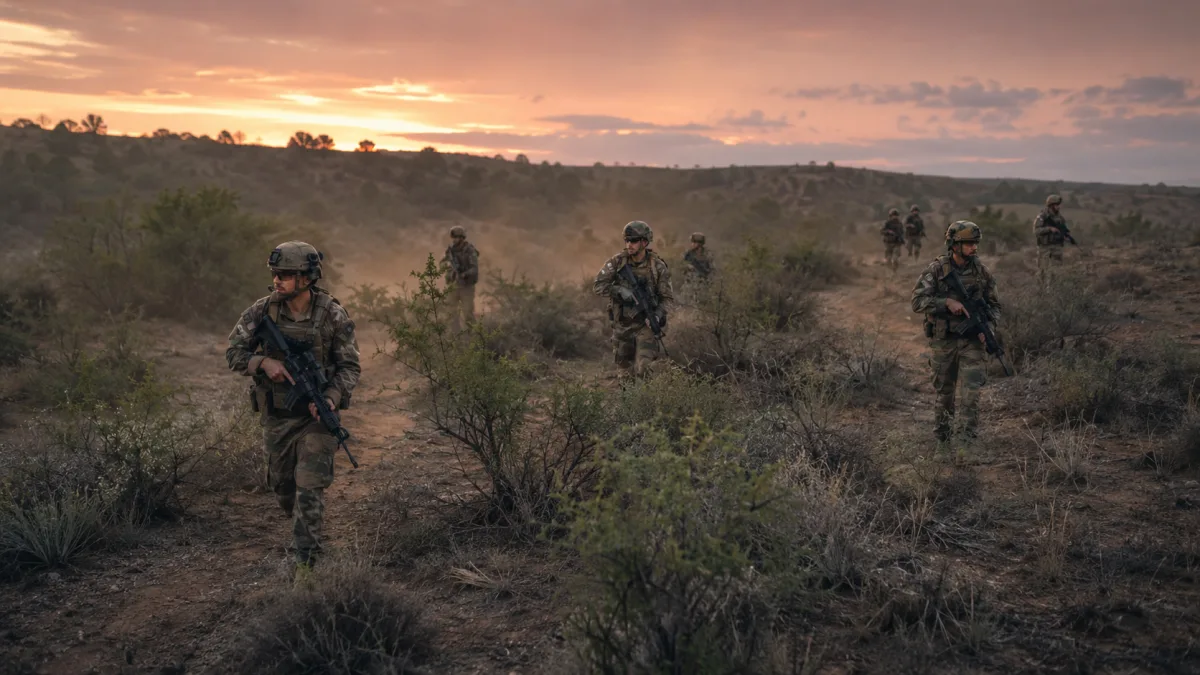
The field training exercise that most people associate with Air Force boot camp was for sixteen years called BEAST — Basic Expeditionary Airman Skills Training. In late 2022 the Air Force replaced BEAST with a redesigned exercise called PACER FORGE (Primary Agile Combat Employment Range, Forward Operations Readiness Generation Exercise). The change was not cosmetic.
BEAST ran four days and gathered large groups of trainees at a fixed location to practice responding to scenarios modeled on Middle East deployments: mortar attacks, car bombs, unexploded ordnance, sniper fire. PACER FORGE runs 36 hours and splits trainees into smaller, dispersed teams operating across the former BEAST site. The scenarios are designed to test flexibility, information-seeking, and decentralized decision-making. The reasoning behind the redesign is explicit in Air Force documentation: future conflicts with peer competitors like China or Russia will involve dispersed, isolated airmen operating without centralized command nearby, which is a fundamentally different environment than the large forward operating bases of Iraq and Afghanistan.
Preparation for PACER FORGE now begins before Week 6. Combat Arms Training and Maintenance (weapons qualification), Mask Confidence Training (the gas chamber), and Tactical Combat Casualty Care are delivered in earlier weeks so that PACER FORGE itself can focus entirely on the 36-hour scenario exercise. Trainees spend that time under simulated deployment conditions, making decisions as a team without constant MTI supervision — one of the few moments in BMT where independent judgment is explicitly required rather than strict compliance with orders.
Physical fitness requirements for Air Force basic training
The Air Force Physical Fitness Test at the end of BMT consists of three components: timed push-ups (one minute), timed sit-ups (one minute), and a 1.5-mile run. All scores are calculated by age and gender under DAFMAN 36-2905. Recruits must achieve a composite score above 75 while meeting minimum thresholds in each component.
To graduate, male recruits under 30 need to complete 27 push-ups, 42 sit-ups, and run 1.5 miles in 11:57 or better. Female recruits under 30 must manage 18 push-ups, 38 sit-ups, and the same distance in 14:26 or faster. Waist measurement is also assessed: 35 inches maximum for men, 31.5 inches for women (under 30). These are the graduation minimums — not the targets the Air Force encourages recruits to shoot for before they arrive.
The baseline standard upon arrival is considerably lower: men need only run 1.5 miles in under 18:30, women in under 21:35. The gap between entry and graduation standards reflects the 7.5 weeks of structured PT that fills the schedule six days a week. PT alternates between cardio and strength days. In summer months the runs happen early morning; in winter they shift to afternoon. Every day begins at 4:45 a.m., and lights go out at 9:00 p.m.
Fitness preparation before shipping matters more than most recruits expect. Trainees who arrive already capable of meeting or exceeding graduation standards have cognitive bandwidth for everything else — drilling, classroom exams, dormitory inspections — that a struggling recruit is spending on pure physical survival. The Air Force's official advice through the Delayed Entry Program is to follow a 14-week preparation schedule covering running, push-ups, and sit-ups before arriving.
For a practical fitness framework you can follow before shipping, the guidance at nutrition and physical fitness for law enforcement covers similar conditioning principles that apply directly to military preparation. If stress management is a concern going in, the article on reducing stress and anxiety during army basic training addresses techniques that work equally well for Air Force BMT.
What to pack and what to leave home
The official Air Force BMT packing list is published at airforce.com/training/military-training/bmt/preparation and updated periodically. The short version: bring almost nothing, because nearly everything is issued.
What you should bring includes a valid government-issued photo ID, Social Security card, birth certificate, high school or college transcripts if applicable, your enlistment contract, any prescribed eyeglasses (no contact lenses for the first several weeks), enough prescription medication to cover the early weeks, and enough cash or a debit card to cover minor initial purchases at the Base Exchange. Recruits receive a $400 prepaid card upon arrival for essentials, but it is deducted from the first paycheck.
What to leave behind: electronics (phones are collected and held by MTIs, returned only for authorized call periods), jewelry beyond a plain wedding band or watch, civilian clothing beyond what you wear the first day, anything that could be considered contraband, and any item not on the packing list. Packages from home are opened in front of an MTI, and food — no matter how well-intentioned the sender — is confiscated and discarded. The dormitory living space has minimal storage, and recruits are issued every item of clothing, hygiene product, and gear they need.
Phone access during BMT is limited and deliberate. Trainees receive a handful of approved calls across the 7.5 weeks. Additional calls can be earned through superior performance at an MTI's recommendation. All calls are voice only — no video, no FaceTime — except the one photo permitted upon arrival to send home the mailing address. Letters are delivered Monday through Friday and are a right, not a privilege; MTIs cannot withhold or delay mail as punishment.
Graduation and what comes after BMT
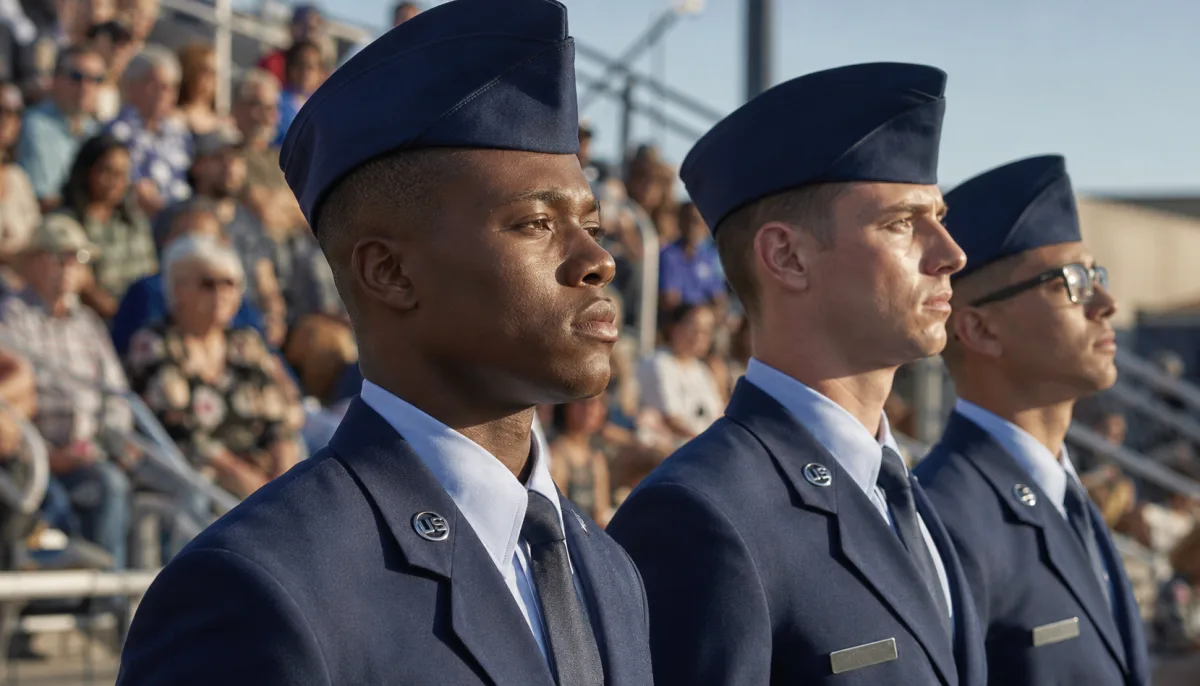
Graduation week is structured around two public events. Wednesday morning's Airman's Run brings the graduating flight past the flag pole at the Pfingston Reception Center at 7:30 a.m., followed by the Airman's Coin and Retreat Ceremony at 9:30 a.m. — the moment each trainee officially becomes an Airman. Thursday's Graduation Parade begins at 9:00 a.m. on the parade grounds and lasts approximately 30 minutes. After the parade, graduates are released for base liberty, then town pass — they can leave the installation but must return by curfew each evening.
Most Airmen ship to technical school the day after graduation. Technical school is where the career-specific training begins: the length varies from a few weeks to over a year depending on the Air Force Specialty Code. An Airman training as a Cyber Systems Operations specialist may spend a year at technical school; a Security Forces Airman might finish in nine weeks. Once at technical school, Airmen recover their phones and can communicate freely outside of class and duty hours.
Pay begins from the first day at BMT. The E-1 base pay rate for 2025 is approximately $1,733 per month. Recruits with verified dependents receive Basic Allowance for Housing (BAH) calculated against their home of record. The first paycheck is typically delayed 30 to 45 days and may be reduced by the initial $400 prepaid card advance. Military pay is deposited on the 1st and 15th of each month via direct deposit set up during Zero Week.
Recruits curious about military career paths beyond BMT can explore the range of civilian professional environments in the guide to receptionist and administrative assistant duties — a useful contrast for those weighing military versus civilian career tracks — or the overview of handling difficult workplace dynamics, which becomes relevant once Airmen enter their first duty station.
For comprehensive official information, the Air Force maintains two dedicated resources: airforce.com/training/military-training/bmt covers the full week-by-week training overview, and basictraining.af.mil handles graduation logistics, FAQ, and family information, updated regularly with current-as-of dates on each answer.
Frequently Asked Questions
How long is Air Force boot camp in 2025?
Air Force Basic Military Training is 7.5 weeks long. Most recruits arrive on the Tuesday of Zero Week and graduate on the Thursday of the seventh week of training. This is confirmed by the official Air Force BMT website and has not changed since the 8.5-week program was shortened. An updated program launched in October 2025 maintains the 7.5-week length.
What replaced BEAST Week in Air Force boot camp?
BEAST (Basic Expeditionary Airman Skills Training) was replaced in late 2022 by PACER FORGE — a 36-hour scenario-based field exercise conducted in the sixth week of BMT. Unlike BEAST's four-day large-group format, PACER FORGE uses smaller dispersed teams and trainee-led decision-making to mirror the Air Force's Agile Combat Employment doctrine for potential conflicts in contested environments.
Can recruits use their phones during Air Force basic training?
Phone access is limited. MTIs collect phones at arrival. Trainees receive a small number of authorized voice calls across the 7.5 weeks — the exact timing varies by flight. All calls are voice-only; no FaceTime or video. Additional calls can be earned for superior performance. Upon arrival, one photo is permitted to send home the mailing address. Full phone access returns when the Airman leaves for technical school after graduation.
How much do Air Force recruits get paid during BMT?
Recruits enter at E-1 (Airman Basic) and receive base pay of approximately $1,733 per month as of 2025. Those with dependents also receive BAH based on their home of record. Pay is deposited on the 1st and 15th, though the first paycheck typically arrives 30 to 45 days after arrival and is reduced by the $400 prepaid card advance issued at check-in.
What happens right after Air Force boot camp graduation?
Most Airmen ship to technical school the day after the Thursday graduation parade, with some departing late Thursday night. Technical school trains Airmen in their specific Air Force Specialty Code (AFSC) — their career field. Duration ranges from weeks to over a year. Once at tech school, Airmen have phone access and more freedom of movement than at BMT, though they are still under military rules and regulations.
How does Air Force boot camp differ from Army and Marine Corps basic training?
Air Force BMT is shorter (7.5 weeks versus 10 for Army and 13 for Marines) and places greater emphasis on academic and classroom instruction alongside physical training. The Air Force uses Military Training Instructors (MTIs), not drill sergeants. The physical standards are real but generally considered less severe than Marine Corps training in particular. Air Force BMT is also the only branch where all enlisted recruits train at a single location — Joint Base San Antonio-Lackland in Texas.

Alyssa Curlin
Edits general health, nutrition and education explainers. Medical topics are educational and link to public-health guidance.




Leave a reply
Replying to