
Marriage enrichment programs can reduce a couple's risk of divorce by up to 30 percent — yet most seminars squander that potential by running couples through back-to-back lectures with no hands-on practice. The research is unambiguous: couples retain skills when they do them, not when they hear about them. Adding fun interactive ideas to a marriage seminar is not window dressing. It is the delivery mechanism that makes the learning stick.
Dr. John Gottman's longitudinal studies tracked couples for nine years after observing just 15 minutes of conflict. His finding — that happy couples maintain at least five positive interactions for every one negative interaction — tells organizers something practical. Before any speaker steps to a podium, a room full of couples needs to bank positive moments together. Laughter, shared embarrassment, playful competition: these are not distractions from the seminar's purpose. They are the purpose, at least for the first hour.
Why Interactive Elements Make Marriage Seminars Work
Passive learning produces passive change. Psychologists distinguish between declarative knowledge (knowing that communication matters) and procedural knowledge (actually doing it under pressure). Marriage seminars that rely only on speakers deposit the first kind while leaving couples empty-handed when conflict erupts at 10 p.m. on a Tuesday.
A structured enrichment program reviewed in the Journal of Marital and Family Therapy found that couples who practiced skills in facilitated exercises during the seminar itself retained those skills at a six-month follow-up — while couples who attended lecture-only formats showed no measurable difference from controls. The implication for organizers is direct: every 90-minute content block should contain at least one activity where couples practice with each other, not just absorb from a stage.
Interactive activities also perform a second function: they surface the room's emotional temperature. A couple sitting rigid and silent during a lighthearted icebreaker is telling you something. A couple who cannot stop laughing at themselves during the Newlywed Game is probably going to be receptive to a harder conversation afterward. Smart pacing reads that temperature and adjusts accordingly.
The Newlywed Game: How to Run It So It Actually Works

The Newlywed Game's staying power across decades of marriage retreats is not accidental. Asking couples to predict each other's answers triggers what psychologists call perspective-taking — a core component of empathy. When a husband guesses wrong and his wife laughs, the audience laughs with her, not at him. That shared release lowers defensive walls before the seminar's harder content arrives.
Run it in the first 45 minutes or immediately after the first break. Three to four volunteer couples is the sweet spot — enough variety to sustain interest, few enough that the host can manage logistics. Seat spouses apart so they cannot see each other's answers. Give each person a small whiteboard or pre-printed answer card. When answers do not match, keep the host's reaction warm and curious rather than mocking. The goal is gentle revelation, not roast-level exposure.
Question design matters more than most facilitators realize. Avoid anything that touches finances, in-laws, or past relationships — these carry real charge and can open wounds the seminar is not equipped to close. Stick to low-stakes, memory-based questions that produce funny mismatches without triggering genuine hurt.
Sample questions that have worked well in group settings:
- "If your spouse had to describe your morning routine in one word, what would it be?"
- "What song would play as the soundtrack to your first date?"
- "Your spouse thinks your worst habit is — fill in the blank."
- "What meal do you cook that your spouse secretly throws away when you're not looking?"
- "On a road trip, who is more likely to refuse to stop for directions?"
Close the game with a 90-second debrief: "How many of you were surprised by an answer you got wrong?" That pivot from laughter to reflection plants the seed for the listening exercises that follow. For couples looking to extend this kind of playfulness into everyday life, romantic card games offer a low-pressure way to keep the habit going at home.
Stuck Like Glue: Touch, Oxytocin, and Why It Works

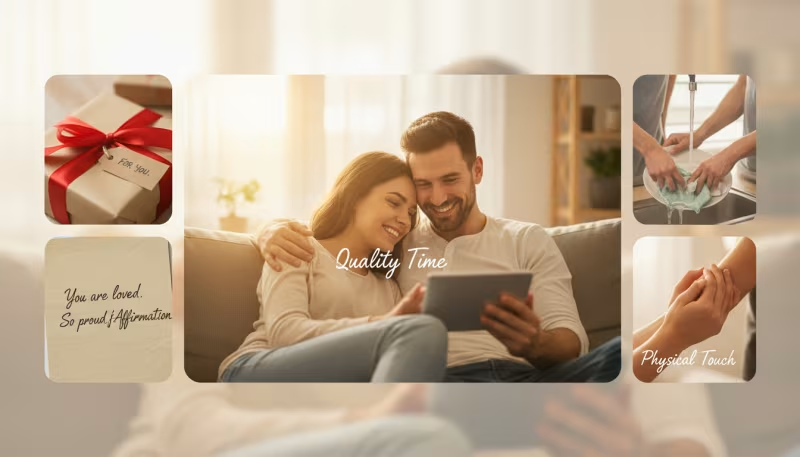
Physical contact is one of the most underused tools in any relationship workshop. Research on oxytocin — often called the bonding hormone — shows that sustained physical contact between partners raises baseline oxytocin levels in both people simultaneously. A hug lasting at least 20 seconds triggers the full cortisol-lowering, oxytocin-releasing effect; briefer contact does not reach the same threshold. Couples who maintain consistent physical affection outside sexual contexts show measurably higher oxytocin baseline levels than those whose touch is primarily confined to the bedroom.
The Stuck Like Glue activity puts that biology to work deliberately. During a designated break — lunch or a resource-table browsing period works best — challenge couples to maintain physical contact continuously. Holding hands, a hand on the small of the back, walking close enough that their sleeves brush: the rule is sustained contact, not performative embrace. The only exemption is restroom breaks.
Brief couples on the science beforehand. Explaining why you are asking them to do something unusual dramatically increases buy-in, particularly from participants who entered the seminar skeptically. "For the next 45 minutes, you are going to run a biology experiment on yourselves" lands differently than "please hold hands during lunch."
Debrief the activity with the full group when the break ends. Ask: Did anything feel awkward? Did anything feel surprisingly easy? The answers reveal each couple's current baseline of casual intimacy — and often prompt a quiet realization that contact has faded from their daily life. That realization, not a lecture, is the most persuasive argument for change.
Prophesy to Your Spouse: The Science of Verbal Affirmation
The word "prophesy" in its original usage meant to speak encouragement into someone's future — to call forward something they could not yet see in themselves. That is a precise description of what affirmation research shows verbal encouragement actually does neurologically. Positive verbal feedback activates reward circuitry and, over time, shapes how partners view each other within the relationship.
The 5-to-1 ratio identified by Gottman Institute researchers reminds us that it takes five positive interactions to counterbalance a single negative one during conflict. Yet most couples, when surveyed, dramatically underestimate how rarely they verbalize appreciation. They feel it. They do not say it. The Prophesy activity closes that gap with a structure simple enough to survive a busy week at home.
Each partner writes nine short phrases of genuine encouragement — one per index card. They should be specific rather than generic. "You're amazing" lands softly and fades quickly. "The way you stayed calm when the kids were falling apart last Tuesday — I noticed that and it made me proud" carries enough detail that it will be remembered. At the seminar, each person reads one card to their spouse before the first speaker begins. They read another card to their spouse before they leave for the day. The remaining seven go home: one read aloud per day for the following week.
The pacing is deliberate. A week of daily, specific, handwritten encouragement changes the chemistry of the household. Couples who try this consistently report noticing positive behaviors they had previously filtered out — a habit that, once formed, does not require the cards to maintain.
Pair this activity with small romantic gestures at home to reinforce the affirmation habit after the seminar ends.
Additional Activities That Expand the Seminar's Depth

Three activities will fill a morning, but a full-day seminar needs a broader toolkit. The following exercises address distinct relationship skills and can be sequenced to alternate between high-energy and reflective modes.
Values Card Sorting. Give each person a set of 30 printed cards, each listing a single value — adventure, security, loyalty, creativity, humor, faith, independence, and so on. Each partner ranks their top seven independently. Then couples compare lists and identify overlap. Most couples discover they share more core values than they consciously realized, which is genuinely reassuring. Where the lists diverge, the exercise opens a non-defensive conversation about why — much safer territory than most couples navigate during an argument.
Memory Map. Each partner gets a large sheet of paper and 10 minutes to draw or write their five most vivid positive memories from the relationship. No talking. When time is up, partners share their maps. The catch: the same memory rarely appears on both lists. One partner remembers a first trip abroad; the other remembers the rainy Saturday they spent doing nothing in particular. That asymmetry is not a problem — it is a discovery. It shows couples that they have more emotional resources than they have been drawing on.
Dream Mapping. Ask each partner to write answers to three prompts: "Something I want us to experience in the next two years," "Something I've always wanted to do that I've never mentioned," and "Something I hope we're still doing together at 80." The responses are then shared. This activity surfaces unspoken desires before they calcify into resentment. Consider pairing the follow-up to dream mapping with planning a meaningful anniversary celebration as a first concrete step toward a shared goal.
Guided Listening Pairs. Partner A speaks for three uninterrupted minutes on the topic "A time I felt closest to you." Partner B's only job is to listen — no responses, no nodding to redirect, no agreement sounds that steer the story. Then roles switch. Afterward, B summarizes what A said without interpretation. This is harder than it sounds. Most people listen to respond rather than to understand, and the silence required here is uncomfortable in a way that is immediately instructive. The discomfort is the lesson.
Pacing the Day: When to Use Humor vs. Reflection
Seminar schedules that front-load all the serious content and save activities for the afternoon are working against participants' cognitive rhythms. Energy and openness peak mid-morning, dip after lunch, then recover briefly before flagging late in the day. Activities sequenced to match this curve land better than the same activities delivered in the wrong slot.
Open with 20 to 30 minutes of humor-driven interaction — the Newlywed Game fits here perfectly. Move into the first content block while the room is warmed and attentive. Use a reflective dyadic activity (Guided Listening or Values Sorting) before lunch, when couples are still energized but have enough information to work with. Reserve physical activities like Stuck Like Glue for the lunch break itself, where the social setting normalizes touch without drawing self-conscious attention. Schedule Dream Mapping for mid-afternoon — it is low-energy to execute but emotionally generative, so it compensates for the post-lunch slump without demanding physical or cognitive exertion. Close the day with the Prophesy card exchange: participants leave on an emotional high, with a task that extends the seminar's effect for another seven days.
Handling Resistant Participants
Every seminar room contains at least one partner who was brought under duress. They sit with crossed arms, answer questions in monosyllables, and treat every activity as evidence that they were right to resist coming. Managing resistance poorly — singling them out, pushing harder, or letting their energy infect the room — wastes everyone's time.
The most effective approach is low-stakes entry. Offer every activity with an opt-out that is not embarrassing. "If you'd rather observe the first round, that's completely fine — you can jump in anytime." Resistant participants almost always start participating by the second activity, not because they were persuaded, but because the room's energy made non-participation feel more conspicuous than joining. Keep the facilitator's language outcome-focused rather than compliance-focused: "By the end of today, most couples walk away with two or three things they genuinely did not know about each other" invites curiosity rather than defensiveness.
For couples attending because they are in active conflict, touch activities and affirmation exchanges can feel forced. Acknowledge this directly rather than pretending it away: "If this feels awkward because things have been difficult lately, that's okay — awkward is actually a productive place to start."
Frequently Asked Questions
How long should interactive activities last at a marriage seminar?
Individual activities work best at 15 to 25 minutes each, including setup and debrief. Activities shorter than 10 minutes rarely reach the emotional depth needed to produce change. Activities longer than 30 minutes lose the attention of resistant participants before the payoff arrives. Build 5 minutes of buffer after each activity for spontaneous conversation — that unstructured time is often where the real breakthroughs happen.
What activities work for couples who are in crisis?
Couples in acute distress need lower-intensity entry points. Values card sorting and Memory Map work well because they are reflective and low-conflict. Avoid activities that require sustained physical contact or public performance early in the day — these can feel exposing for couples already feeling fragile. The Prophesy affirmation cards are almost universally well-received even by struggling couples, because writing specific encouragement bypasses defensiveness in a way that verbal dialogue often cannot.
How many couples can participate in Newlywed Game activities at once?
Three to five couples is the optimal range for the on-stage version. With more than five, logistical complexity outweighs the entertainment value. For larger groups, run a parallel version where every couple in the room fills out answer cards simultaneously, then shares results with their nearest neighbors — this retains the energy without creating a bottleneck at the front of the room.
Should marriage seminar activities be different for newlyweds versus long-married couples?
The activities themselves can remain the same; the facilitation framing shifts. Newlyweds doing Dream Mapping are building toward something unknown. Long-married couples often discover gaps between what they once planned and where they landed — a different but equally valuable conversation. For Memory Map exercises, couples with 20-plus years of shared history tend to need a longer time window (15 minutes rather than 10) because the material they are sifting through is richer and harder to narrow down.
How do you handle couples where one partner participates enthusiastically and the other does not?
Asymmetric engagement is normal and usually resolves within the first hour. The facilitator's role is to avoid amplifying the imbalance — calling attention to the reluctant partner by name, or praising the enthusiastic one in ways that implicitly shame their spouse, makes the gap worse. Design activities so that quiet, low-participation responses are still valid responses. In Values Sorting, a partner who hands over their cards without discussion has still completed the exercise and given their spouse real information.
What is the right ratio of activities to speaker content at a full-day seminar?
A rough guideline: no more than 50 minutes of passive speaker content before an activity break. The most effective full-day formats alternate 40-minute content blocks with 20-minute activity windows throughout, rather than clustering all activities into the afternoon. Research on adult learning consistently shows that retention drops sharply after 45 minutes of uninterrupted lecture, regardless of how skilled the speaker is.
Can these activities work for pre-marital couples, not just married ones?
Yes — Dream Mapping, Values Sorting, and the Prophesy affirmation exchange work particularly well for engaged couples who have not yet established entrenched patterns. Research reviewed by the AAMFT Family Therapy Magazine confirms that skills-based pre-marital interventions produce lasting effects, with couples showing significantly stronger satisfaction scores at the two-year mark compared to those who first encountered these skills after conflict had accumulated.
The single most actionable takeaway for seminar organizers: build the day's schedule around the activities first, then fit the speaker content around them — not the reverse. The talks give couples language; the activities give couples practice. Practice is what changes behavior at home on an ordinary Wednesday, and that is the only outcome that actually matters.

Cashie Evans
Covers parenting and practical household topics with clear steps, safety notes and links to current guidance.


Leave a reply
Replying to