
Stand at the edge of any busy cruise terminal — Miami's Dodge Island, Southampton's Ocean Terminal, Barcelona's Moll Adossat — and you'll notice something before you read a single name on any hull. The funnels tell you everything. That red slash with black bands: Cunard, without question. The dramatic swept wings in red, white, and blue: Carnival, no debate. The giant Greek letter rising above the stern: Celebrity. Funnel identification is one of the oldest maritime skills, and for cruise passengers and port-side spectators alike, learning to identify cruise lines by their smoke stacks turns any harbor into a living field guide.
Why do cruise lines use distinctive funnel designs?
The simplest answer is that ships needed to be recognized from a distance long before radio, GPS, or AIS tracking existed. When a vessel appeared on the horizon, the funnel's color and shape told port workers, pilots, and competing ships exactly who was coming in. That mattered enormously for practical reasons: different companies had different berthing arrangements, different cargo handling crews, different customs agreements. Recognizing the funnel saved time and prevented costly confusion.
Beyond navigation, there was commercial logic too. In the mid-19th century, when ship hulls were painted a near-universal black to hide coal grime and superstructures were kept white to reflect heat, the funnel was the one element shipowners could dress up. Companies quickly realized that a striking funnel became a form of trademark — one visible from miles away, reproducible on printed timetables and posters, and memorable to passengers choosing between competing lines. As Wikipedia's entry on ship funnels notes, some companies became so closely identified with their funnel color that the color itself became the company's colloquial name. The Blue Funnel Line is the clearest example: the legal name was Alfred Holt & Company, but nobody called it that.
Modern cruise ships are diesel-electric powered, and their actual exhaust needs are modest compared to the coal-fired boilers of the steamship era. Many contemporary funnels are partly or entirely decorative — what naval architects call dummy funnels. Disney Cruise Line's forward funnel on its Magic-class ships contains a teen lounge, not exhaust machinery. Carnival's "whale tail" wings are engineered to direct diesel fumes away from passengers rather than to vent steam. The functional role has changed, but the branding role is more important than ever.
A brief history of cruise ship funnel colors
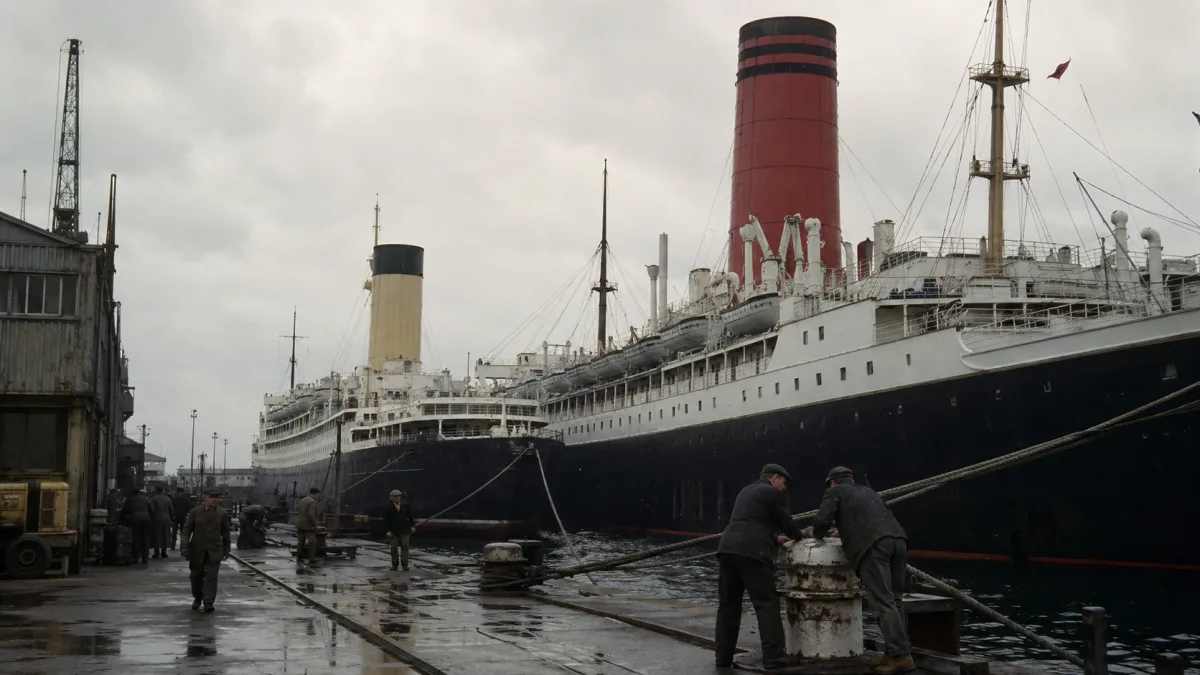
The tradition started with the first commercial steamship lines of the 1830s and 1840s. When Samuel Cunard's company launched its inaugural quartet of ships — Britannia, Caledonia, Acadia, and Columbia — Scottish engineer Robert Napier chose a red funnel color that had already appeared on his yard's private steam yachts. That combination of red with narrow black bands and a black top became Cunard's house color, and it has remained essentially unchanged for nearly 185 years.
Other lines followed the logic. The Peninsular and Oriental Steam Navigation Company settled on buff (a yellowish tan) with a broad black top band, which P&O Cruises still references in its livery today. The Blue Funnel Line's plain cobalt stack reportedly originated from a batch of leftover blue paint during a period of national mourning, and the color stuck. Each combination was, in effect, a registered trademark enforced by maritime tradition rather than law — if you painted your funnel Cunard red, you would face the industry's version of a cease-and-desist.
The practice carried straight into the 20th century and the cruise era. Shipping families, particularly in the Mediterranean, added their initials or family crests. The Chandris family of Greece put their surname's initial on every funnel; the Costa family did the same. By the time purpose-built cruise ships arrived in the 1960s and 1970s, the funnel had become a marketing canvas as much as a mechanical component, with designers hired specifically to create icons that would photograph well from shore and from other ships' decks.
How to identify the major cruise lines by their funnels
A few principles help before going line by line. First, look at color before anything else — it narrows the field immediately. Then look at shape: most funnels are cylinders, but a handful break that rule dramatically. Finally, look for logos or emblems. Once you have absorbed the patterns below, you will find yourself making identifications in seconds, even from a hotel balcony above a distant port.
It also helps to know that transferred ships sometimes keep their old funnels temporarily or permanently. Carnival acquired three former Costa ships — Venezia, Firenze, and Luminosa — and those vessels kept their straight Costa-style funnels rather than receiving the signature Carnival wings. On-water identification is usually reliable, but fleet transfers mean occasional exceptions.
Carnival Cruise Line — the whale tail funnel
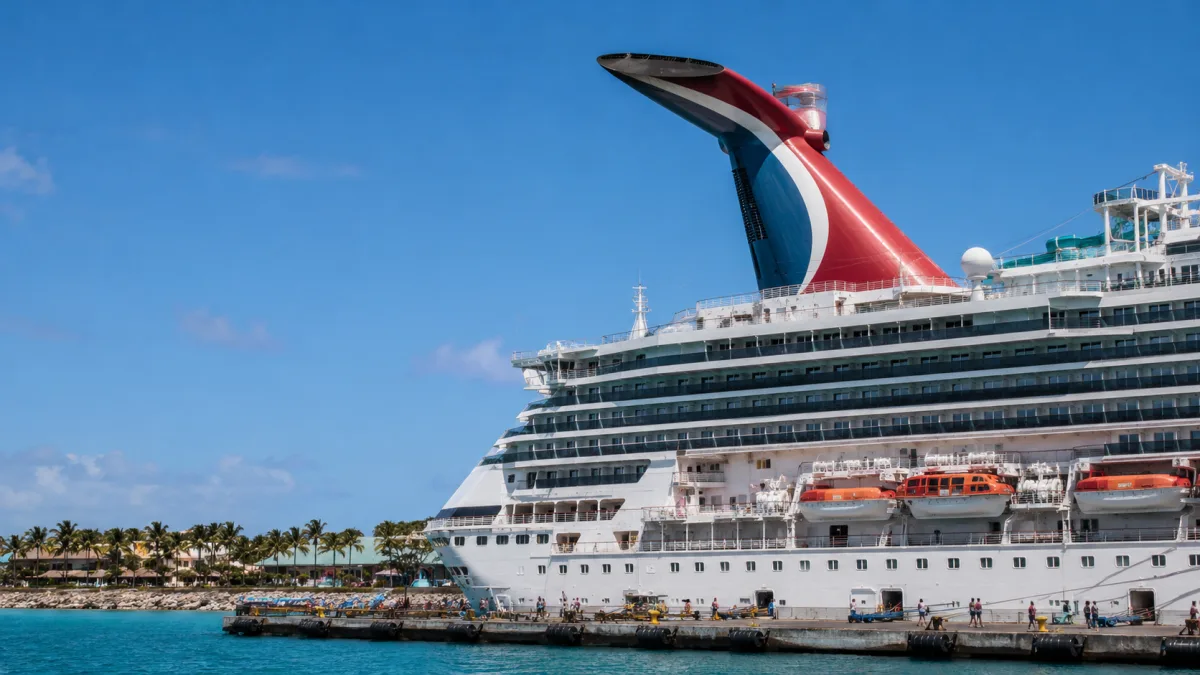
Carnival's funnel is the most structurally distinctive in the cruise industry. Rather than a simple cylinder or box, it sports a pair of swept-back wings extending outward from the central exhaust column — a shape the company calls the whale tail, and which designer Joseph Farcus introduced on the Tropicale in 1982. The color scheme is the red, white, and blue of the Carnival Corporation flag, and the wings themselves serve a real aerodynamic purpose: made from fiberglass composite, they direct diesel exhaust gases up and over the aft decks, keeping the outdoor areas directly behind the funnel cleaner and more comfortable for passengers.
At sea, the whale tail is visible from an enormous distance because of its height and unusual profile. In port, you can often see the red glass panel at the funnel's base through which some ships' atria look directly up into the structure. One current caveat: the Carnival Freedom lost her original whale tail in a 2022 fire and its replacement in a 2024 fire, so she was sailing as of early 2026 with a modified non-standard funnel until a scheduled 2026 drydock. The three former Costa ships in the fleet also lack the wing design. For all other Carnival vessels, the whale tail remains unchanged since Farcus first drew it.
Royal Caribbean, Celebrity, and Norwegian funnel designs
Royal Caribbean's funnel is a white cylindrical stack bearing the Crown & Anchor emblem — a stylized white anchor topped with a crown, set within a navy blue rectangle. In late 2024 the company refreshed its visual identity, deepening the navy blue and removing "International" from the wordmark, though the Crown & Anchor symbol itself was only subtly refined. On newer ships the funnel is sometimes integrated into a larger superstructure block, but the blue-and-white coloring with the anchor logo remains the identifying mark.
Celebrity Cruises carries one of the most visually arresting funnels afloat: an oversized X, executed not merely as a painted emblem but as a three-dimensional shape on newer Edge-class vessels. That X is the Greek letter chi, standing for Chandris — the Greek shipping family who founded Celebrity in 1988 as a premium offshoot of Chandris Lines. It is traditional in Greek maritime families to place the family initial on the funnel, much as the Costa family placed a C on theirs. Celebrity was acquired by Royal Caribbean Group in 1997, but the chi has remained, a piece of corporate genealogy visible from the dock. The original version was a white X on a dark blue funnel; on the latest ships, the funnel is architecturally sculpted into the X shape itself.
Norwegian Cruise Line takes a different approach. NCL funnels vary by ship class and era, and the line invests far more branding energy into dramatic hull art — elaborate murals commissioned from internationally known artists — than into a standardized funnel shape. The funnels tend to be white or off-white with the NCL name or logo, but a Norwegian ship is more reliably spotted by its painted hull than by any single funnel design.
Disney, Princess, and Holland America funnels
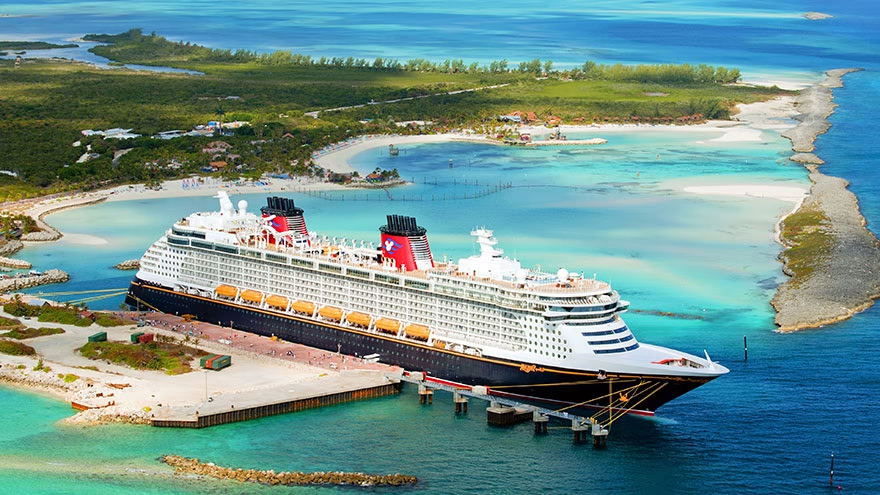
Disney Cruise Line ships carry two funnels, which is unusual in the modern cruise world where most vessels need only one. Disney's designers made an explicit choice to evoke the great ocean liners of the early 20th century, where multiple funnels signaled grandeur and power. Both funnels on Disney ships share the same livery: a red base with three horizontal blue wave stripes and the iconic white silhouette of Mickey Mouse's head. Only the rear funnel actually functions as an exhaust system; the forward funnel on Magic-class ships houses the teen club. On newer Dream-class and Wish-class ships the non-functional funnel still carries the full visual design. In a busy port, the Mickey silhouette is identifiable at surprising distances.
Princess Cruises marks its funnels with the Sea Witch, a stylized female face drawn in flowing lines that has been the company's logo since 1968. The design is rendered in blue-and-white on the funnel face, typically against a blue background with a wave pattern. Princess has also been expanding the Sea Witch to the bows of its ships as large hull art, so a Princess vessel often carries the emblem at both ends. The Sea Witch design is subtler than Carnival's wings or Disney's Mickey, but recognizable once you know what to look for — particularly the sweeping hair that doubles as a wave motif.
Holland America Line funnels are white, tall, and relatively clean in design, marked with the company's HAL logo against the white background. The current design reflects a corporate rebrand that moved from an orange-based palette (used until around the early 2000s) to a blue, white, and blue triband scheme. Historically, HAL funnels went through several iterations — yellow with green and white bands in the 1960s, orange with a wave emblem in the 1970s — but the current ships present a consistent white funnel that reads as understated compared to the more theatrical designs of Carnival or Disney.
Cunard, MSC, and Costa funnel designs
Cunard's funnel is the one with the longest uninterrupted history in commercial passenger shipping. The original design — vermilion red with two or three narrow black bands and a black top — was established by Robert Napier when the first four Cunard ships were commissioned in the 1840s. It has survived two world wars, corporate restructurings, mergers (including the famous Cunard-White Star merger of 1934), and multiple ownership changes. The current Queen Mary 2, Queen Victoria, and Queen Elizabeth all carry the same red-and-black livery their predecessors carried in the Victorian era.
This point deserves emphasis because it is commonly confused: Cunard's red funnel has nothing to do with the Titanic. The Titanic was built and operated by the White Star Line — Cunard's principal rival in the North Atlantic. White Star Line ships used a buff or yellowish-tan funnel with a black top, a completely different color scheme. The two lines merged in 1934, but Cunard's red was eventually reinstated as the surviving identity after World War II. Anyone who says that Cunard mirrors Titanic colors by painting its funnels red has the history backwards: it was the White Star Line that had the unusual buff funnels, and Cunard's red predates the Titanic by more than 70 years.
MSC Cruises — the world's largest cruise line by fleet capacity as of 2025 — operates a white funnel bearing the MSC logo in the line's navy blue and gold colors. The design is cleaner and more corporate than those of older lines, reflecting MSC's relatively recent move from cargo shipping into passenger cruising (the first MSC cruise ship entered service in 1995). The funnel changed from an earlier blue star emblem to the current white-with-MSC-letters design around that same period.
Costa Cruises has one of the most recognizable funnels in European cruise ports: a bright yellow stack with a large, bold blue "C" and black-tipped top. The yellow-and-blue combination has been in use since the 1940s, making it one of the older continuous funnel liveries in the industry. Costa ships travel frequently in Mediterranean and Caribbean waters, and the yellow funnel is particularly vivid against blue sky and water. Like the Chandris chi and the Cunard red, the Costa C represents the founding family's initial — a naming convention that goes back to the days when ships were personal property of merchant dynasties and the funnel was literally their flag.
Best ports for watching and identifying cruise ships
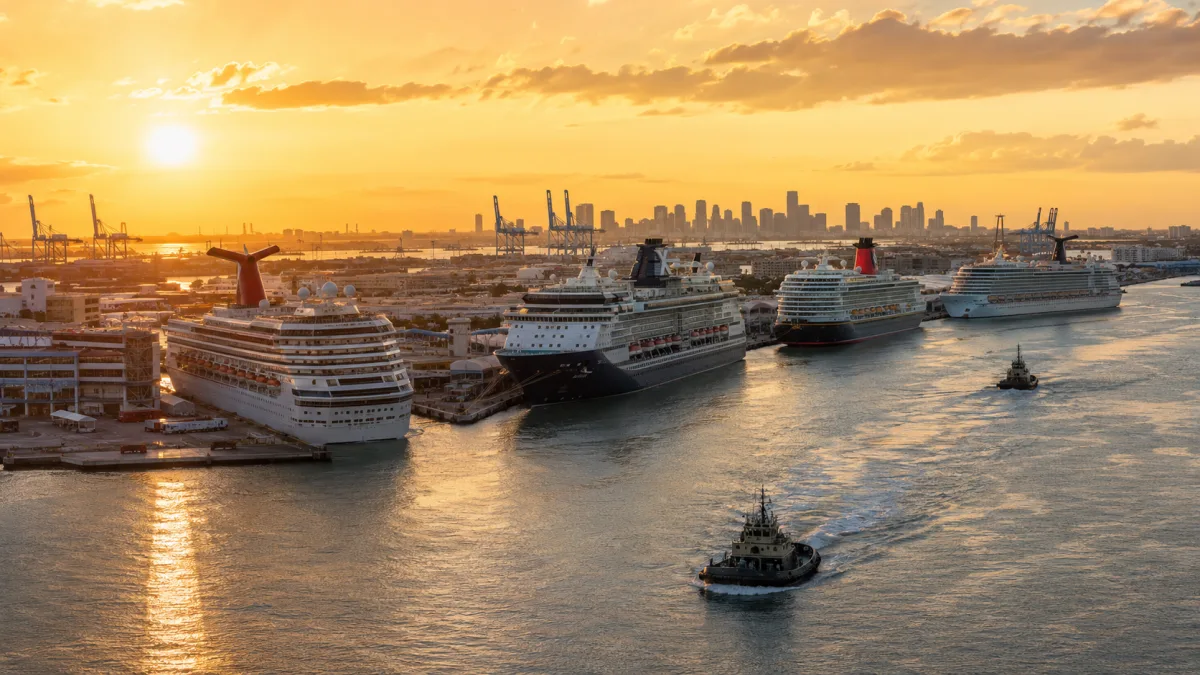
Cruise ship funnels are most rewarding to study in busy homeports rather than ports of call, for the simple reason that homeports see multiple lines simultaneously. Great Lakes towns like Petoskey get river and lake boat traffic, but for ocean cruise lines the action concentrates in a handful of mega-ports.
Port Miami holds the title of the world's busiest cruise port by passenger volume, and it delivers accordingly for funnel spotters. The causeway approaching Dodge Island offers unobstructed sightlines to multiple berths simultaneously, and on busy Saturdays — when Caribbean cruises typically turn around — you can count six or eight ships from a single vantage point, representing nearly every major line. A live webcam at PortMiamiWebcam.com streams 24 hours a day if you cannot be there in person.
Port Everglades in Fort Lauderdale runs Miami close for total traffic. Florida's cruise infrastructure extends to wildlife encounters nearby — manatee tours in Fort Myers make an easy add-on for anyone spending a pre-cruise night on the Gulf Coast. The port itself benefits from excellent waterfront access, and ships entering and leaving must navigate a relatively narrow channel that brings them within comfortable viewing distance of the shore.
For European spotters, Southampton on England's south coast processes the largest volume of cruise calls in the United Kingdom. Cunard's Queen Mary 2 berths here regularly, as do ships from P&O, MSC, and Celebrity. The Western Docks viewing area and the Town Quay park offer accessible shore-side positions. Barcelona's Moll Adossat handles an enormous Mediterranean cruise flow from spring through autumn, with ships from Costa, MSC, Celebrity, Royal Caribbean, and Norwegian all appearing regularly.
Landlocked destinations have their own spectacles, but for cruise funnel spotting, Nassau in the Bahamas stands out as a port of call worth mentioning. The Prince George Wharf handles so many Caribbean sailings that at any given time on a busy day, three or four ships from different lines are visible simultaneously — a compact and colorful introduction to funnel identification in the field. Ship-watching there shares the same patient attentiveness as wildlife spotting, much like watching for moose in New Hampshire's White Mountains: the reward comes to those who know where to look and when.
One practical note wherever you choose to watch: working cruise terminals are active industrial spaces with tugboats, line handlers, fuel trucks, and gangway equipment moving quickly. Stay behind any fencing or marked viewing areas, especially when a ship is actively docking or departing. The funnels are tall enough to be clearly visible from well outside the restricted zones.
Frequently Asked Questions
What is the difference between a funnel and a smokestack on a cruise ship?
The terms are used interchangeably in everyday speech, and maritime tradition accepts both. "Funnel" is the British English term; "smokestack" is more common in American English. On modern cruise ships, neither term is perfectly accurate because the vessels run on diesel-electric systems rather than coal or steam boilers, so what comes out is engine exhaust rather than coal smoke or steam. The structure remains, however — both for exhaust management and for the branding purpose it has served since the 1840s.
Do all ships in a cruise line's fleet have the same funnel design?
In most cases yes, but fleet transfers and acquisitions create exceptions. Carnival's three former Costa ships retain their straight Costa-style funnels rather than the Carnival whale tail. Royal Caribbean ships built in different eras show subtle variations in how the Crown & Anchor is rendered. Lines that have undergone major rebrands — like Holland America's shift from orange to blue — may have ships in the fleet that predate the change and show the older design.
Are any modern cruise ship funnels purely decorative?
Yes. Disney Cruise Line's forward funnel on Magic-class ships contains the teen club and performs no exhaust function. The Titanic famously had one dummy funnel — added for aesthetic symmetry and perceived power. The practice of adding non-functional funnels dates to the late 19th century, when passengers equated the number of funnels with a ship's speed and reliability. On modern ships, a single functional funnel may look visually unbalanced on a large hull, so designers sometimes add a second structure for proportion.
Did Cunard copy the Titanic's funnel colors?
No — and this is a common misconception worth correcting directly. Cunard has used red funnels with black bands since the 1840s, when Robert Napier selected the color for the line's first four ships. The Titanic was operated by the White Star Line, Cunard's rival, which used a buff or yellowish-tan funnel with a black top — a completely different color scheme. The two companies merged in 1934, with White Star eventually absorbed into Cunard's identity. Cunard's red predates the Titanic by more than 70 years; if anything, White Star was the latecomer doing things differently.
What are the best tips for identifying a cruise ship's line from a distance?
Start with color, since it is visible before any logo or emblem becomes legible. Red narrows you to Cunard; yellow points to Costa; the whale-tail wing shape means Carnival regardless of distance. From medium range, look for logo shapes: the X for Celebrity, the Mickey silhouette for Disney, the Crown & Anchor for Royal Caribbean. If you have binoculars, you can read the ship's name from the bow or stern while still in open water. Cruise industry resources like Cruise Critic also explain funnel types in detail, and AIS tracking apps such as CruiseMapper allow you to identify any vessel by position in real time — useful when a funnel design is obscured or the ship is too far away for visual confirmation.

Tory Stearns
Edits practical household, travel and lifestyle explainers. Claims that can change are linked to current primary or subject-authority sources.



Leave a reply
Replying to