
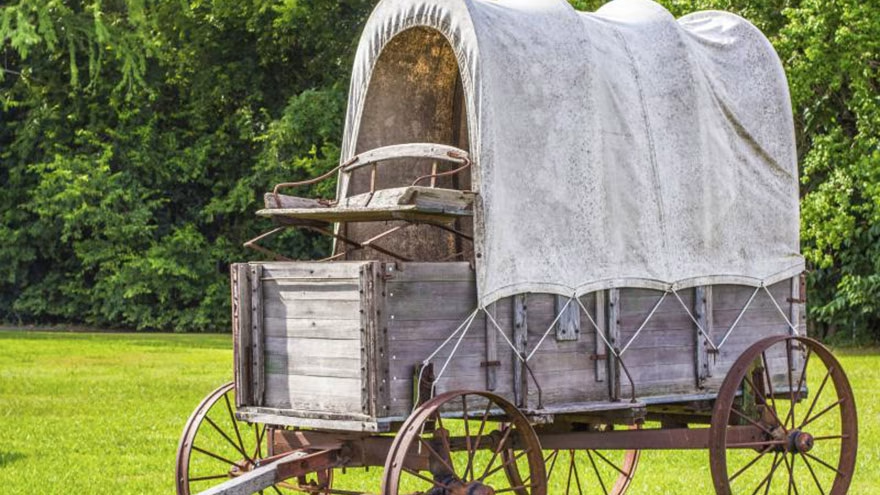
What makes a pioneer party different from a generic Western party?
Picture this: somewhere between 1843 and the mid-1860s, an estimated 400,000 people set off from Independence, Missouri, bound for Oregon City along a 2,000-mile trail of dust, river crossings, and mountain passes. Families packed everything they owned into canvas-covered prairie schooners pulled by oxen. Children — some as young as three — walked beside those wagons for months, hauling water, gathering firewood, and still finding time to play. That is the world a pioneer-themed children's party brings to life.
A generic Western party tends to lean on cowboy hats, sheriff badges, and saloon-style props. A pioneer party is something richer: it centres on the real homesteaders who crossed the Oregon Trail and built lives from scratch. Think butter churned by hand, corn husk dolls, dried apple snacks, and parlour games played in candlelight. The frontier spirit of making-do and making-fun-anyway is exactly what kids respond to — and it gives every activity a genuine story behind it.
Pioneer party invitations and dress code
Set the mood before the party even starts. Cut invitation cards into the shape of a covered wagon or roll them up like a trail map and tie them with a short length of jute twine. Hand-write (or print in a serif font that looks hand-pressed) the party details as if they were frontier-era notices: "Calling all settlers! Join us on the trail at [address] on [date]." A wax seal pressed with a star stamp adds a satisfying finishing touch.
For the dress code, keep the request simple and achievable. Ask guests to come in pioneer attire: flannel shirts, denim, suspenders, simple cotton dresses, bonnets, or wide-brimmed hats. Avoid requesting anything elaborate — many pioneer families owned very little, and that modesty is actually part of the charm. Let parents know that a bandana around the neck or a straw hat from a dollar store is completely in the spirit. You can also keep a small costume box at the door for anyone who arrives without a costume.
Setting the scene — pioneer party decorations
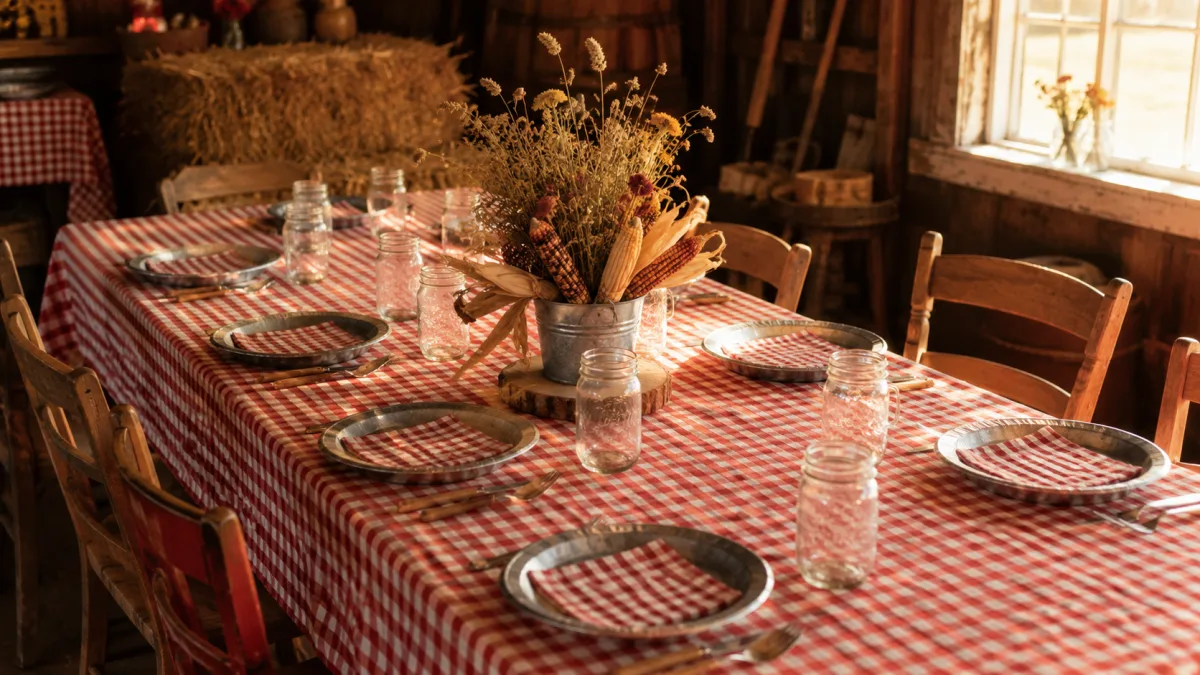
The best pioneer decorations double as props for activities, so nothing feels wasted. Start at the front door with a lantern — battery-operated ones work perfectly — and a bundle of corn stalks tied with twine. Inside, swap the usual tablecloth for red gingham or burlap. Mason jars make excellent drinking glasses, and pie tins work beautifully as plates, giving the table an immediate homestead feel without any fuss.
Hay bales work brilliantly as seating if you have outdoor space, or you can suggest them as photo-op props. Drape bandanas over lamps to soften the light. Fill a wooden crate with dried ears of corn, a few simple wildflowers in a tin cup, and a scatter of dried apple slices near the snack station. String a short clothesline across one wall and peg miniature fabric squares to it — these can double as decoration before the party and as a craft material during it. The overall look should feel warm and a little rough around the edges, not slick: mismatched tins, rough wood, simple textiles.
Pioneer party food and drinks
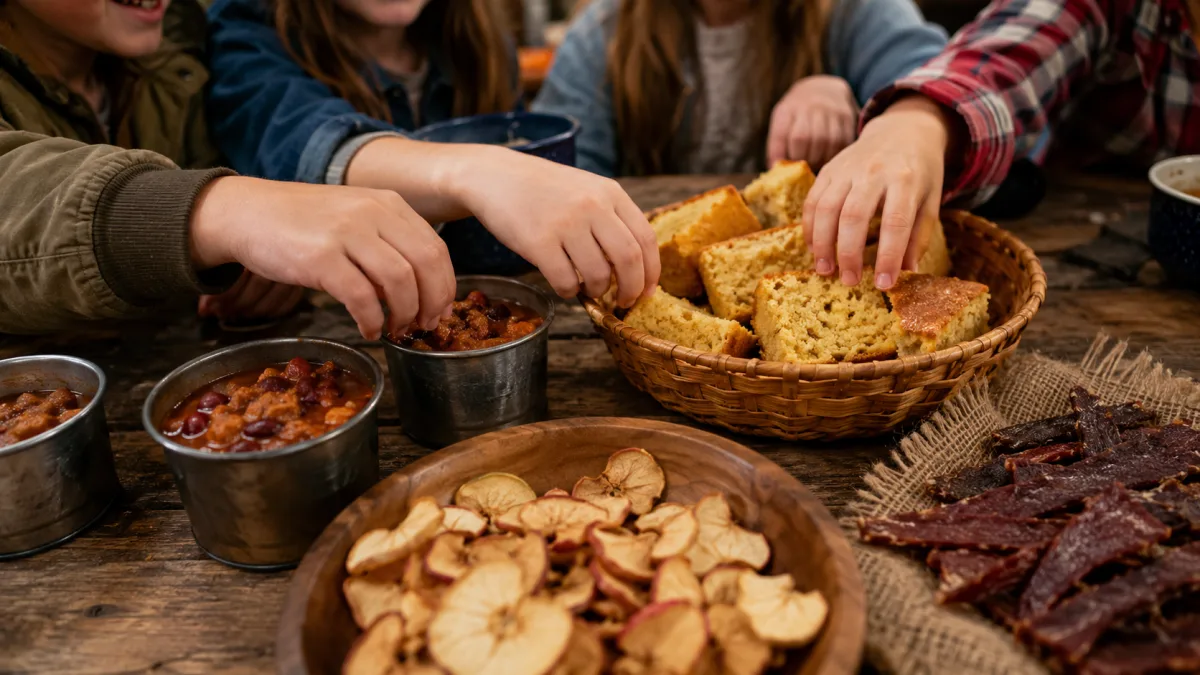
Trail food was practical and filling, and a surprising amount of it translates well to a children's party table. Pioneers on the Oregon Trail relied on hardtack, salt pork, beans, dried apples, and cornmeal — simple staples that travelled well and kept families going across the Rockies. You do not have to serve actual hardtack (though adventurous older kids will appreciate trying a piece), but the spirit of simple, honest food is easy to carry through the menu.
For the main, a slow-cooker pot of chili with beans is ideal — serve it in small tin cups or bowls. If your crowd skews younger, label chicken nuggets on a skewer as "trail chunks" and serve them with honey for dipping. Either way, cornbread or biscuits baked in a cast-iron skillet are the perfect side — they look the part and taste great. Stack them in a cloth-lined basket for extra effect.
The snack table is where the theme really shines. Fill small tin cups or wooden bowls with dried apple slices, beef jerky torn into strips, blueberries (which real pioneers called "trail berries"), and wedges of watermelon. For drinks, serve lemonade in a glass jug with a ladle — call it "switchel" if you want to use the actual name pioneers gave their lemon-and-ginger trail drink. A cake decorated with a miniature pioneer clothesline — tiny sugar fondant shirts and dresses pegged to a thin wire between two wooden skewers — makes a memorable centrepiece. If you want something simpler, a round "prairie cake" frosted in chocolate with a crushed graham cracker "dirt" top works just as well. For more ideas on building a showstopping dessert display, take a look at the ultimate guide to cookie displays — many of the presentation tricks transfer perfectly to a frontier dessert table.
Hands-on pioneer activities for kids
This is where a pioneer-themed children's party separates itself from every other theme going. Real pioneer children had real chores — and those chores, translated into party activities, are genuinely fascinating for kids between about five and ten years old. The key is framing each one as something the children on the actual Oregon Trail would have done.
Churn your own butter. This is the standout activity of the whole party. Fill a clean mason jar about one-third full with heavy whipping cream and seal the lid tightly. Pass the jar around the group and have each child shake it hard for one to two minutes before handing it on. What is happening inside is pure food science: as the fat globules in the cream are agitated, their membranes break and the fat molecules bond together, separating from the buttermilk liquid. After ten to fifteen minutes of collective shaking, you will have a pale yellow lump of real butter. Drain the buttermilk, sprinkle in a pinch of salt, and spread it on the cornbread you baked earlier. Kids are consistently astonished that this works. Room-temperature cream speeds the process up to as little as ten minutes, so pull it from the fridge about an hour before you start. The Science Buddies butter-shaking activity explains the chemistry beautifully if you want talking points to share with curious kids.
Corn husk dolls. Pioneer children adopted this craft from the Northeastern Native American tribes who had been making corn husk dolls for more than a thousand years. According to Haudenosaunee (Iroquois) tradition, the dolls have no face — a choice tied to a legend in which a doll was punished for vanity by having her reflection, and then her face, removed by the Creator. Sharing this story while the children work adds something real and thought-provoking to what is otherwise a simple craft. Soak dried corn husks in warm water until pliable (about ten minutes), then show children how to fold and tie them into a simple doll shape using strips of husk or twine. The faceless result looks exactly right.
Husking corn and egg basket gathering. Set up a station with a few ears of fresh corn for children to husk — the satisfying pull-and-peel action delights younger kids. Alongside it, hide small plastic eggs around the yard or a designated room and give each child a basket to collect them. Pioneer children gathered eggs every morning as one of their first chores, often making ten or fifteen trips between the henhouse and the kitchen.
Gold panning. Fill a shallow plastic tub with sand and scatter gold-coloured craft glitter or small gold-painted stones through it. Give each child a pie tin and a cup of water. The gold rush era overlapped with the Oregon Trail peak years, and this activity brings that connection to life. Kids pan slowly, swirling the water in the tin until the heavier "gold" settles at the bottom.
If you enjoy building hands-on food projects into events, how to freeze fresh vegetables has useful detail on working with corn and other garden produce that pairs well with the homestead theme.
Pioneer party games
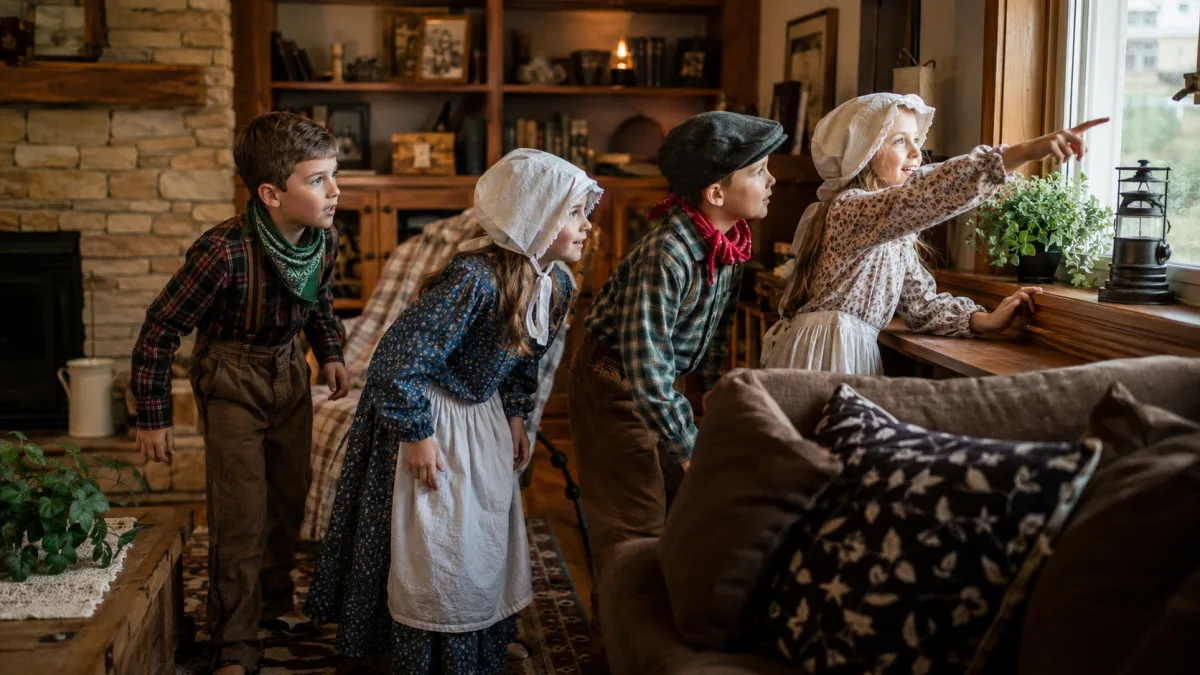
Pioneer children played versions of games that would be recognisable today, using whatever was available: a thimble, a potato sack, a button. The California Trail Interpretive Center documents many of these games, noting that families on the California and Oregon Trails played them both while walking and at camp in the evenings. Three work especially well at a party.
Hunt the Thimble. One child (the hider) takes the thimble — or any small object — and places it somewhere in the room in plain sight, without hiding it inside anything or under anything. The other players come back in and search. No hot-and-cold clues are given; players simply call out "I spy!" the moment they spot it. The last child to find it becomes the hider for the next round. This game, documented in William Wells Newell's 1883 Games and Songs of American Children and reportedly played by Laura Ingalls Wilder and her sister Mary during long winters, works best in a room with plenty of shelves, mantelpieces, and windowsills — surfaces where a small object can sit in full view but still be overlooked.
Button Button. Children sit in a semi-circle with their palms pressed together. One child walks along the row, sliding their pressed palms between each pair of hands — but only leaving the button secretly in one child's palms. After completing the circuit, they say: "Button, button, who has the button?" Each seated child guesses in turn. This Victorian-era parlour game made its way into frontier communities and is simple enough for five-year-olds yet surprisingly gripping.
Pioneer relay race. Divide the children into two teams. At one end of the yard, place a box of dress-up props for each team: a hat, a bandana, an apron, a pair of (adult-sized) boots. At the signal, the first player from each team runs to the box, puts on all the items, runs back, and takes them off so the next player can go. The first team to get every player through the full rotation wins. The scramble to pull on oversized boots while wearing a flapping apron tends to be the funniest moment of the whole party.
Pioneer party favors and loot bag ideas
Favours work best when they feel like something a real pioneer child might have valued. Small muslin drawstring bags (often called "trail pouches") make excellent loot containers and cost very little in bulk. Fill each one with a selection of trail provisions: a strip of beef jerky, a handful of dried apple pieces, a small packet of sunflower seeds, and one or two small toys that fit the era.
Good toy additions include a bandana (practical, re-usable, and immediately wearable), a small spinning top, a marble or two, a length of string for cat's cradle, or a wooden coin stamped with the party date — a nod to the wooden nickels sometimes used in frontier trade. If the children made corn husk dolls during the craft session, those go home in the bag too. Keep the overall feel simple and tactile: the point is that a pioneer child's treasures were small, handmade, and genuinely useful. For children who attended a memorial or milestone birthday version of this party, ideas for memorial birthdays has thoughtful guidance on making keepsakes feel personal.
Party planning timeline and age considerations
A pioneer party is best suited to children aged five to ten. Below five, the craft activities require too much fine motor patience; above ten, some of the games may feel too familiar to hold interest — though the butter churning tends to impress at any age. Budget for two to two-and-a-half hours of actual party time, with a loose structure: arrivals and costume settling (fifteen minutes), a craft activity (twenty to thirty minutes), games (thirty minutes), food (twenty-five minutes), cake and butter-on-cornbread ceremony (fifteen minutes), and favours and farewells (fifteen minutes).
For planning, send invitations two to three weeks ahead so parents have time to pull together a simple costume. Buy corn husks from a Latin grocery store or well-stocked supermarket a week before and soak and dry a batch the day before to check they work well. Make the cornbread the morning of the party — it improves slightly as it cools. Set out the butter-churning station and chilling cream the day before. Decorations can go up the evening before; they are simple enough that it takes less than an hour.
If you are planning other food-focused celebrations around the same time, how to throw a Hi-5 birthday party has useful structural ideas for keeping a group of young children engaged across multiple activities.
Frequently Asked Questions
What age is a pioneer party best suited to?
Ages five to ten work best. The activities — churning butter, making corn husk dolls, husking corn, playing Hunt the Thimble — require just enough concentration to feel satisfying without being frustrating. Younger children can join in with supervision; older children often enjoy the role of "experienced settler" helping the younger ones.
Do I need a big outdoor space for a pioneer party?
Not necessarily. The craft activities and parlour games all work indoors around a table or in a living room. The relay race and egg-gathering activity benefit from outdoor space, but both can be adapted — the relay can run up and down a hallway, and the egg hunt can be done in any room with enough furniture to create hiding spots. Pioneer families made do with small spaces, and your party can too.
How do I make the butter-churning activity work smoothly at a party?
Use heavy whipping cream (not single cream or half-and-half — it needs the fat content). Pull it from the fridge about an hour before the activity so it is closer to room temperature, which shortens churning time. Fill the mason jar only one-third full — overfilling slows things down. Have two or three jars going simultaneously so no child waits too long for a turn. The whole group can count out shakes together to keep energy high.
Are there any pioneer party ideas that work for larger groups?
Yes. The relay race and Button Button scale well to any number. For crafts with a large group, set up two or three simultaneous stations: corn husk dolls at one table, gold panning at a tub, and a drawing-your-own-trail-map station at another. Rotate children through in small groups every fifteen minutes. This approach also means no single activity creates a bottleneck.
What is the single most memorable activity to include?
Churning butter in a mason jar and spreading it on fresh-baked cornbread. Children who do this at a party remember it for years — the tactile shaking, the visible change from cream to butter, and the pay-off of eating something they made with their own hands. It is the one activity that turns a themed party into a genuine experience.

Tory Stearns
Edits practical household, travel and lifestyle explainers. Claims that can change are linked to current primary or subject-authority sources.
Leave a reply
Replying to