
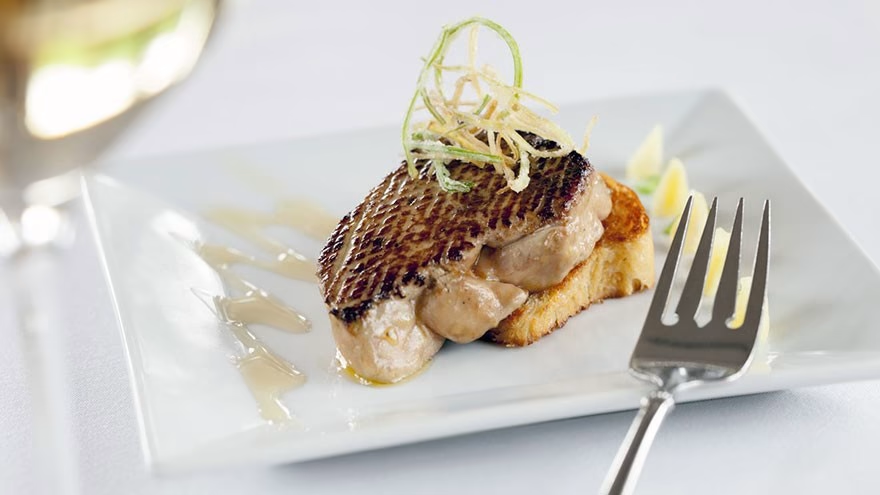
Foie gras begins as a biological peculiarity. Before long migrations, waterfowl gorge compulsively, and their livers respond by storing fat at a rate that would kill most mammals — the organ can swell to seven or ten times its normal size, reaching a fat content of 50 to 60 percent. This hepatic steatosis is a natural, reversible adaptation; the liver returns to normal size once the bird resumes a regular diet. French farmers understood this capacity at least as far back as ancient Egypt, and the practice of gavage — controlled feeding to replicate the pre-migration gorge — has driven foie gras production ever since. The result is an ingredient unlike anything else in a kitchen: dense, unctuous, and so laden with fat that it begins to melt the moment it touches heat. That single fact governs every decision you make when buying, cooking, or serving foie gras.
What is foie gras and where does it come from?
Foie gras is French for "fatty liver," specifically the liver of a duck or goose fattened through gavage, a process in which birds are fed measured amounts of corn over a brief finishing period — typically two to four weeks — causing the liver to accumulate fat rapidly through lipogenesis. The resulting liver is pale, cream-colored, and extraordinarily rich, with a flavor that sits somewhere between butter and roasted nuts, with none of the sharpness associated with ordinary chicken or beef liver.
France remains the cultural and regulatory center of foie gras production, with the Périgord and Gascony regions holding geographic indication status. Hungary and Bulgaria also produce significant quantities, while in the United States, Hudson Valley Foie Gras in Ferndale, New York — the country's largest domestic producer — has raised Moulard ducks on its farm since the 1980s. For American cooks who can legally buy fresh foie gras, Hudson Valley is the standard reference point for quality and freshness.
The ingredient carries genuine culinary history. It appears in the records of ancient Egyptian granaries, was documented in Roman kitchens, and became formalized as a French delicacy by the 17th century. The question of its ethics — addressed below — has generated significant legal activity in recent decades, but its culinary status has never been seriously disputed among serious cooks.
Duck foie gras vs. goose foie gras — which should you buy?
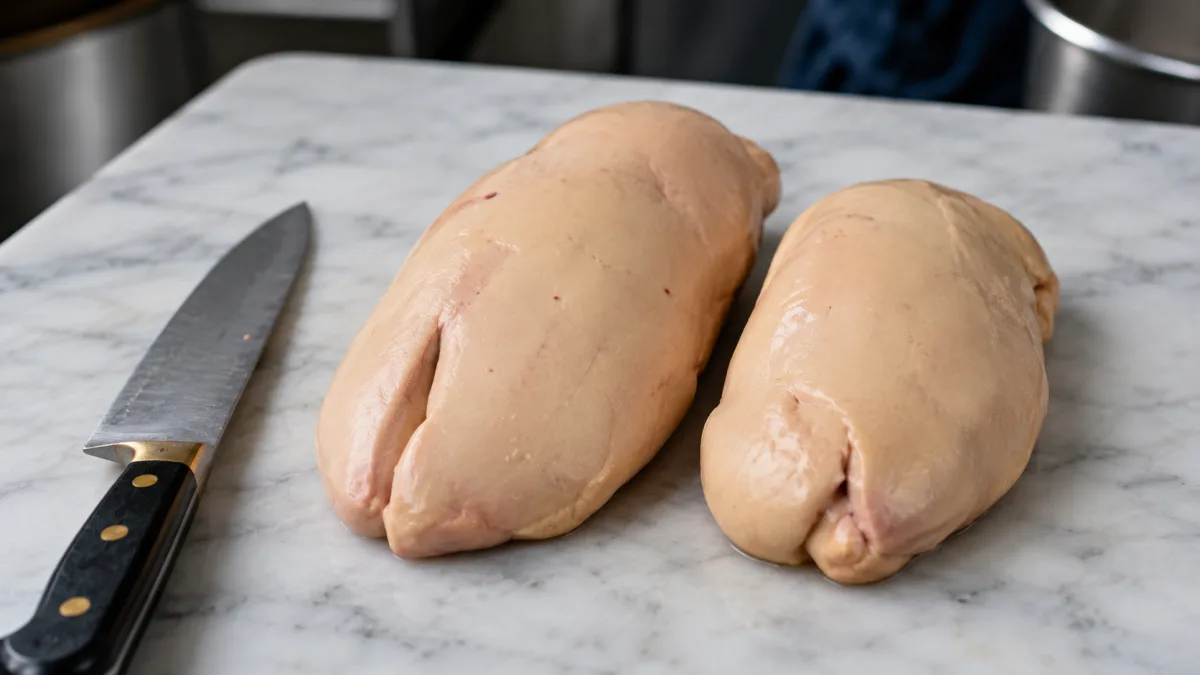
Duck foie gras, almost always from the Moulard breed — a sterile hybrid of Muscovy and Pekin ducks — dominates the American market by a wide margin. Duck accounts for roughly 90 percent of foie gras sold in the United States, and for good reason: the Moulard liver is large, robust in flavor, and takes well to high-heat cooking. Its taste is assertive, with an earthiness and depth that holds up alongside acidic fruit reductions, Madeira sauces, and bold wine pairings. Grade A Moulard livers can weigh between 1.5 and 2 pounds, making them practical for portioning.
Goose foie gras is rarer in America and commands a premium. The liver is milder, silkier, and more delicate than duck — the texture in a well-made terrine is almost ethereal, the flavor closer to cream than to meat. It is the traditional choice in Alsace and the default in much of France's classic gastronomy, though even there, duck has gained significant ground. For home cooks encountering foie gras for the first time, duck is the easier introduction — more forgiving during searing and more widely available. For those building a terrine or a torchon where texture is everything, good goose foie gras, if you can source it, produces a noticeably different result.
If you want to explore cooking with goose more broadly, the bird itself offers a similar richness that gives some context for why the goose liver is prized.
How to buy foie gras — grades, forms, and quality markers
Fresh foie gras sold in the United States is graded by size, appearance, and structural integrity. Grade A is the top classification: the liver should be large (1.5 pounds or more for duck), firm to the touch with a slight give when pressed, pale cream to light beige in color, smooth-surfaced with minimal visible veins or blood spots, and sweet-smelling. This is the grade for searing or any preparation where the whole liver is the centerpiece — its fat content and firmness mean it will hold its shape under high heat long enough to develop a crust before the interior melts. Grade B livers are smaller (roughly half a pound to 1.5 pounds), softer, slightly darker, with more prominent veins. They are perfectly good for terrines, mousses, and sauces, where visual imperfections disappear during cooking. Grade C is small, veined, and used commercially to enrich and thicken sauces.
When buying from a jar or tin, the labels matter. The quality hierarchy runs as follows, from best to least refined:
- Foie gras entier — the entire lobe, or two lobes from the same liver, cleaned, deveined, seasoned, and cooked. The purest expression of the ingredient.
- Foie gras (with pieces) — reassembled lobe pieces, at least 30 percent of which are intact chunks, bound together. Solid and flavorful, but not whole.
- Bloc de foie gras — mechanically reconstructed from trimmings of multiple livers, compressed into a uniform block. Consistent in texture, but lacks the character of entier.
- Parfait de foie gras — minimum 75 percent foie gras, extended with lean duck or goose liver.
- Mousse de foie gras — minimum 30 percent foie gras, emulsified with fat and air into a spreadable consistency. Pleasant, but a different product category altogether.
When buying a jar, hold it to the light: high-quality foie gras entier will be uniform in color with no gray patches or separating fat pools. For fresh liver, press gently — the liver should yield slightly and spring back. A spongy texture indicates insufficient fat content, and a liver that feels greasy and yields without resistance will render out almost entirely during cooking.
For the best foie gras preparation ideas at home, some of the same principles that apply to other rich ingredients — like buying and preparing delicate proteins like frog legs — carry over: freshness, sourcing, and handling temperature are everything.
How to sear foie gras — the classic French technique
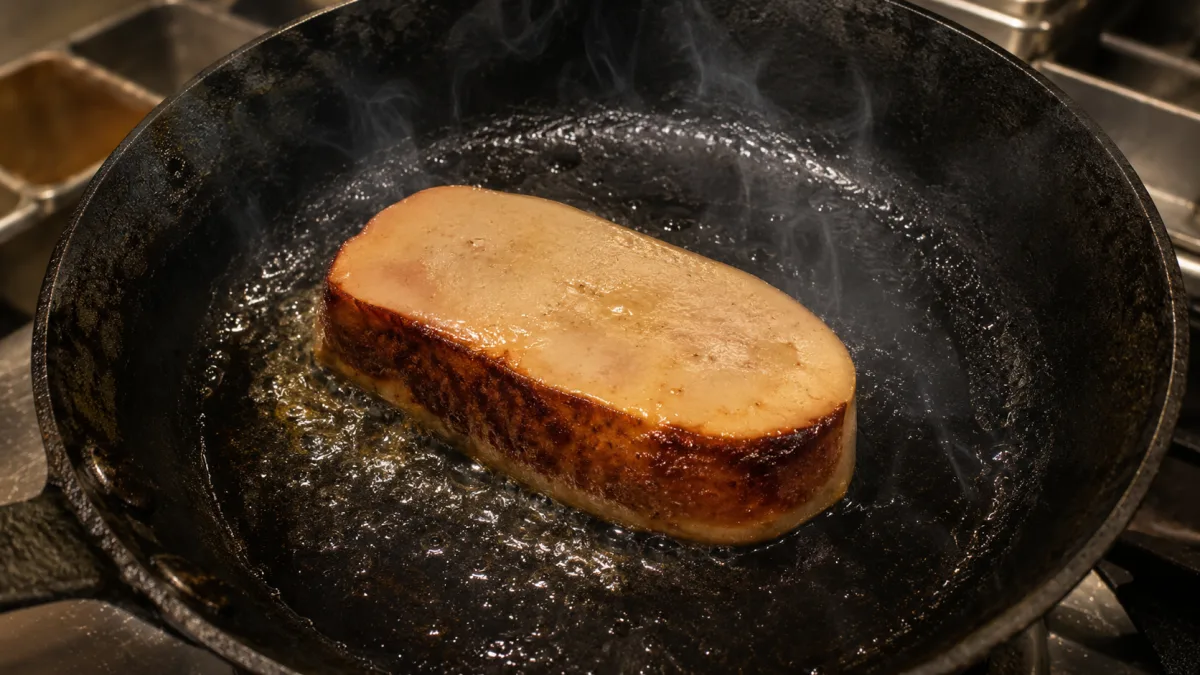
Searing foie gras is the technique that separates confident cooks from anxious ones, and the stakes feel high because the ingredient is expensive and unforgiving. The entire method rests on one mechanical fact: foie gras is 50 to 60 percent fat by weight. Given any prolonged contact with heat, it will simply melt away. The solution is not to cook it gently — it is to cook it violently fast.
Slice the lobe into escalopes about three-quarters of an inch thick. Pat them completely dry. Season both sides with flaky sea salt and cracked pepper no more than a minute before cooking — salt draws moisture, and moisture is the enemy of crust formation. Heat a cast-iron or heavy stainless-steel pan bone-dry over the highest flame your stove produces until the surface temperature approaches 400°F — a drop of water should evaporate on contact instantly. No oil, no butter. Foie gras renders its own fat within seconds.
Place the slices in the pan without crowding and do not move them. Sear 30 to 45 seconds on the first side until a deep mahogany crust forms, then flip and sear 20 to 30 seconds on the second side. The center should remain slightly soft — press gently and it should feel like a just-set custard. Remove immediately and serve within 60 seconds; the residual heat will keep cooking the interior. The rendered duck fat left in the pan is excellent for sautéing potatoes or finishing vegetables.
That high initial heat accomplishes two things simultaneously: it drives the Maillard reaction on the exterior, building the brown crust that provides textural contrast to the creamy center, while the brevity of the cook means the interior never reaches the temperature at which the fat liquefies completely. Get either variable wrong — too low heat, or too long — and you will watch the slice collapse into a pool of fat.
Other ways to cook and serve foie gras
Beyond the sear, foie gras adapts to several other preparations, each suited to different occasions and skill levels.
Torchon is a cold preparation in which raw foie gras is cleaned, seasoned, and rolled tightly in a cloth (torchon is French for dish towel), then poached briefly in water, stock, or wine at a low temperature — around 140 to 150°F — and pressed under refrigeration for 24 hours. The result is a dense, cylindrical terrine that slices cleanly and serves cold, typically on brioche with a pinch of fleur de sel. It requires no high-heat skill and can be made a day or two ahead.
Mi-cuit, or semi-cooked foie gras, is cooked below 70°C and preserved in its own rendered fat, producing a texture between raw and fully cooked — richer and more unctuous than a fully cooked terrine. It has a shorter shelf life than fully cooked versions but a more pronounced flavor.
Foie gras entier from a jar needs nothing more than time and cold temperature. Refrigerate the jar for at least four hours before opening — never place it directly on ice, which can cause condensation to dilute the surface. Slice thinly with a warm knife, serve on lightly toasted brioche or pain de campagne, and resist the urge to over-garnish. The liver's own richness is the point.
Foie gras also works sliced and layered into a warm salad, or used to enrich a pan sauce by whisking in a small piece off-heat at the end. It pairs well with ingredients that offer acidity, sweetness, or textural contrast: caramelized figs, roasted stone fruit, pickled cherries, a drizzle of aged balsamic, or a Madeira reduction. For a broader sense of how rich proteins work in composed dishes, the techniques behind grilling whole duck share some of the same fat-management principles.
What to serve with foie gras — wine pairings and accompaniments
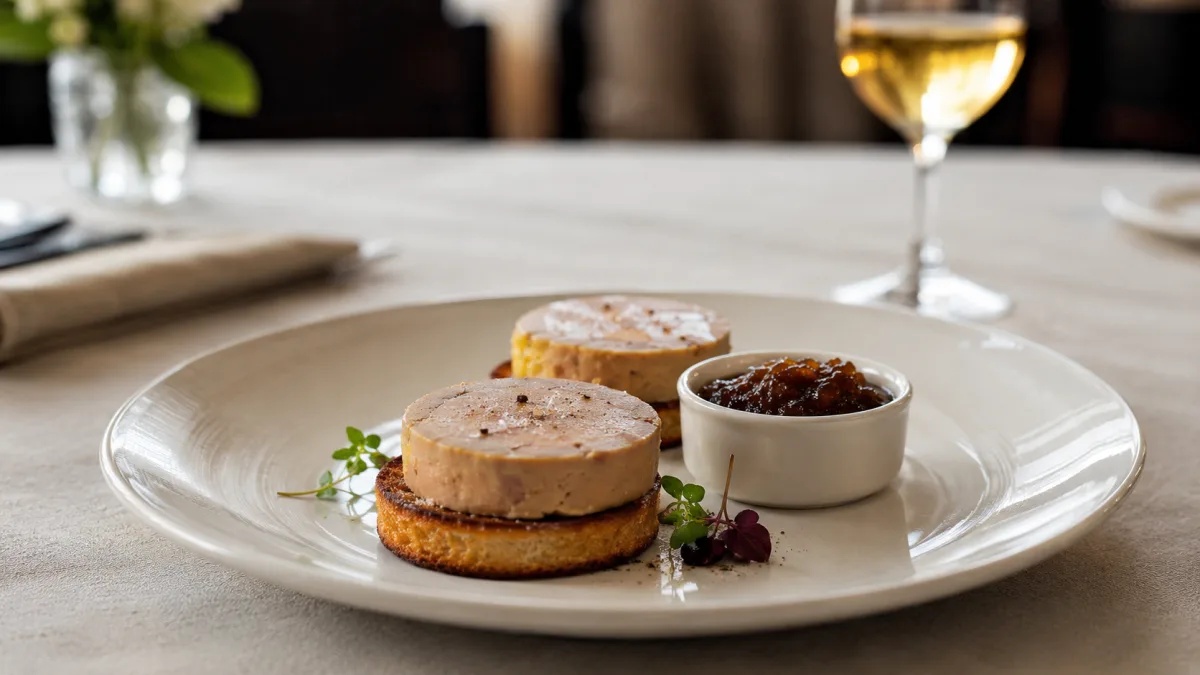
The classic pairing of Sauternes with foie gras is not arbitrary sentimentality. Sauternes — the botrytized sweet wines of Bordeaux, with Château d'Yquem as the benchmark — brings two elements that the dish needs: high residual sugar to contrast the savory richness of the liver, and sufficient acidity to cut through the fat and reset the palate between bites. Without that acid, even a moderate portion of foie gras becomes overwhelming. The sweetness creates contrast; the acidity creates clarity.
Tokaji Aszú from Hungary operates on identical principles — honeyed stone fruit and citrus notes with a spine of acidity, and a full body that does not get lost against the liver's weight. Alsatian Gewurztraminer, especially a Vendange Tardive, works for similar reasons, with the addition of lychee and rose aromas that echo well against fruit-based accompaniments. If you prefer a drier approach, a late-harvest Riesling or even a well-structured Champagne — its effervescence cuts fat mechanically, the acidity does the rest — are sound alternatives.
On the plate: toasted brioche or pain brié for the base; a small spoonful of fig jam, quince paste, or a Madeira-and-shallot reduction alongside; fleur de sel scattered at the last moment. Microgreens add color without competing. The accompaniments should provide contrast — sweetness, acidity, crunch — not crowd the liver off its own plate.
Is foie gras legal in the United States?
The production and sale of foie gras occupy legally complicated territory in the US. California's ban, originally passed in 2004 with a delayed implementation, has had a turbulent history: it went into effect in 2012, was briefly overturned by a federal district court in 2015 on the grounds that California law conflicted with the federal Poultry Products Inspection Act, and was reinstated in 2017 when a three-judge appeals panel reversed that ruling. In January 2019, the US Supreme Court declined to hear the industry's challenge, leaving the California ban in permanent effect. Foie gras cannot legally be sold in California.
Outside California, foie gras remains legal at the federal level. New York, where Hudson Valley Foie Gras operates, sells and ships freely to most other states. A handful of cities and municipalities have passed their own restrictions, but in the vast majority of the country, purchasing, cooking, and serving foie gras is entirely unrestricted. If you are buying fresh liver online, check that the retailer ships to your state — most reputable suppliers flag California automatically.
The ethics of gavage production are contested, and the debate is ongoing in animal welfare and agricultural policy circles. The argument in foie gras's defense — that Moulard ducks lack the gag reflex of mammals, and that the migratory hepatic steatosis the process mimics is a natural biological function — is accepted by some veterinary scientists and rejected by others. That conversation belongs in policy arenas and is not resolved here.
Frequently Asked Questions
What does foie gras taste like?
Foie gras has a rich, buttery flavor with a faint sweetness and none of the mineral sharpness of ordinary liver. Duck foie gras is bolder and earthier; goose is milder and creamier. Seared foie gras adds a layer of caramelized depth from the crust, while cold preparations like torchon or entier from a jar taste purer and more delicate.
How do you store fresh foie gras?
Fresh foie gras is highly perishable. Refrigerate immediately upon receipt and use within three to five days, or freeze for up to several months. If freezing, wrap tightly to prevent freezer burn; thaw in the refrigerator overnight before use and cook within one to two days of thawing. Prepared foie gras in sealed jars or tins can be kept refrigerated until the use-by date and should be consumed within three to five days of opening.
Why does foie gras melt so quickly when cooked?
The fat content of foie gras — 50 to 60 percent by weight in a Grade A liver — is unusually high for a solid protein. At temperatures above approximately 104°F, the fat begins to render out of the liver cells rapidly. This is why searing technique matters so much: the only way to build a crust and retain an interior is to work at extremely high heat for an extremely short time, creating the exterior crust before the interior reaches liquefaction temperature.
Can you substitute pâté or mousse for whole foie gras in a recipe?
Not directly. Pâté, mousse, and bloc de foie gras are processed products with added ingredients including water, fat, and sometimes other livers; they will not sear, hold a terrine shape, or deliver the same flavor concentration as whole foie gras entier. They serve as spreads and flavor enhancers, not stand-ins for fresh liver in cooking applications. That said, a high-quality mousse on toasted brioche is a legitimate and accessible way to experience foie gras flavor without the cost of a whole lobe.
What is the best bread to serve with foie gras?
Brioche is traditional and ideal — its slight sweetness and soft crumb complement the liver without competing. Lightly toasted pain de campagne (country sourdough) is a good alternative when you want more texture and a mild acidity. Avoid heavily seeded or flavored breads, which can overwhelm the liver. The bread is a vehicle; it should not dominate.
Is foie gras safe to eat?
Properly prepared foie gras — whether fully cooked (entier from a jar or terrine), mi-cuit, or seared to an appropriate internal temperature — is safe to eat. The USDA recommends that poultry liver reach an internal temperature of 160°F for food safety, which a proper sear achieves. Raw or undercooked foie gras carries the same food safety considerations as any raw poultry liver and should be handled accordingly.
Sources and verification
Check current details with these primary or subject-authority sources before acting on the information.

Cashie Evans
Covers parenting and practical household topics with clear steps, safety notes and links to current guidance.




Leave a reply
Replying to