
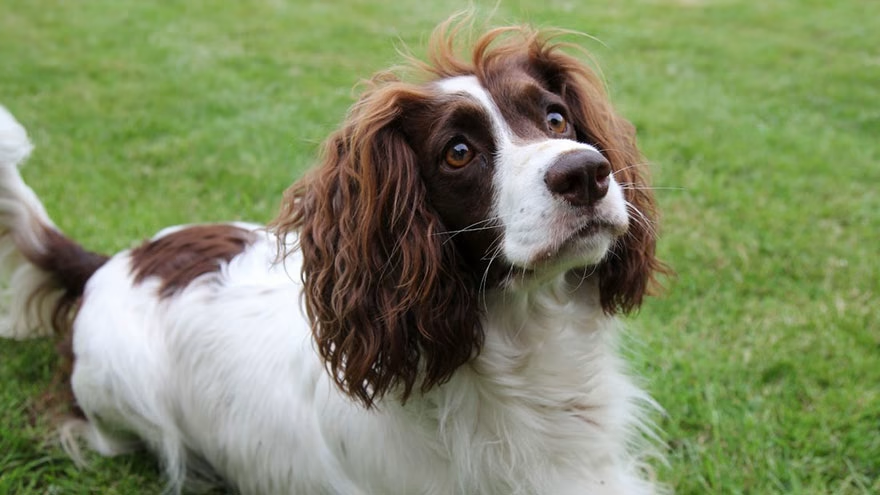
How trainable is the Brittany Spaniel?
Stanley Coren's landmark study The Intelligence of Dogs ranks the Brittany 19th overall in working and obedience intelligence — the highest placement of any spaniel-type breed on the list. That ranking translates into something concrete: a Brittany can learn a new command in fewer than five repetitions and will obey a known command on the first attempt roughly 85 percent of the time. For context, the average dog needs 25 to 40 repetitions and complies only about half the time.
The name itself holds a clue to this breed's dual nature. The AKC recognized the Brittany Spaniel in 1934, but in April 1982, the word "Spaniel" was officially dropped from the American name. The reason: Brittanys point in the field rather than flush, putting their working style firmly in the pointer category. They are, in essence, a compact versatile gun dog wearing a spaniel's face — and that versatility extends directly into training. A dog bred to read cover, honor a point, and respond to a handler at 300 yards develops an attentiveness that makes Brittany Spaniel training unusually efficient in the right hands.
The AKC describes the breed as "bright and eager," and the field record supports that assessment. Brittanys consistently appear alongside English Pointers, English Setters, and German Shorthaired Pointers in NSTRA and AKC field trial competitions — a roster that does not accommodate slow learners.
Why gentle, consistent training matters more with Brittanys than most breeds

Here is the paradox at the heart of this breed: the dog most desperate to please is also the one most damaged by harsh correction. Brittanys carry an emotional sensitivity that has no parallel in tougher working breeds like the Rottweiler or the Labrador. Raise your voice sharply during a training session and the Brittany does not simply ignore it — the dog shuts down, losing the forward momentum that makes the breed so rewarding to work with.
The science explains why. When a dog experiences an aversive correction — a sharp verbal reprimand, a leash jerk, physical punishment — the hypothalamic-pituitary-adrenal axis triggers a spike in cortisol. Research published in peer-reviewed veterinary science journals confirms that punishment-based training methods produce measurably elevated glucocorticoid levels in dogs, a sustained stress state that suppresses learning. In sensitive breeds, repeated exposure to aversive methods produces something worse than a stressed dog: it produces a dog that has learned not to try. Behavioral scientists call this learned helplessness — a state in which the dog stops offering behaviors because prior attempts were met with unpredictable punishment. For a breed wired to seek human approval, learned helplessness is both easy to create and difficult to reverse.
Positive reinforcement sidesteps this entirely. When a Brittany succeeds and is marked with a treat or clear verbal praise, dopaminergic reward pathways reinforce the behavior without activating the stress response. The dog leaves the session in the same emotional state it arrived — or better. That is the foundation every subsequent training session builds on. See also how other sensitive breeds benefit from consistent handling in our guide to Maltese training.
Basic obedience training for a Brittany Spaniel
The critical socialization window for dogs runs from roughly 8 to 16 weeks. Within that period, the Brittany's brain is forming the neural connections that will govern how the dog relates to people, other animals, sounds, and environments for the rest of its life. Starting basic obedience at 8 to 10 weeks is not rushing things — it is timing things correctly.
The foundational sequence runs: sit, stay, come, heel, off. Each command should be taught with a consistent verbal cue and, initially, a hand signal. Brittanys pick up visual signals quickly; the dual-channel approach (word plus gesture) accelerates generalization — the ability to respond correctly in new environments, not just in the kitchen where training began.
Keep sessions short: 5 to 10 minutes for a puppy, 15 minutes for a dog older than six months. The Brittany's attention is sharp but burns quickly when sessions become repetitive. End every session on a successful repetition. If the dog is struggling with a new command, step back to something it knows confidently, mark that success with a reward, and close there. The dog's last emotional memory of a training session shapes its willingness to engage at the next one.
Clicker training suits this breed well. The marker's precise timing — click happens the instant the correct behavior occurs, not a half-second later — matches the Brittany's quick processing speed. Replace the clicker with a verbal marker ("yes") once the dog understands the game, since you will not always have a clicker available in the field.
For a comparison of obedience approaches across different intelligent breeds, our breakdown of the German Shorthaired Pointer's most common training questions covers similar territory from a pointing-breed perspective.
Housebreaking and crate training a Brittany
The Brittany's human-bond orientation — the same trait that makes it an outstanding companion — also makes it prone to separation anxiety when that bond is not carefully managed from puppyhood. Crate training addresses both housebreaking and separation anxiety at once, provided it is introduced correctly.
A crate works because dogs retain a denning instinct: a correctly sized enclosure (large enough to stand and turn, not large enough to use one end as a bathroom) feels like a safe, bounded space rather than a prison. Introduce the crate before the puppy ever needs to be confined. Place treats and the puppy's meals inside with the door open for several days. Let the dog choose to enter. Once the puppy is sleeping in the crate voluntarily, begin short, closed-door sessions — three minutes, then five, then fifteen — always returning before the puppy shows distress.
Housebreaking follows from the crate's confinement function. A puppy in a correctly sized crate will hold its bladder because soiling the sleeping area is instinctively aversive. Take the puppy directly outside immediately after waking from every nap, after every meal, and after every play session. Use the same outdoor spot each time; the residual scent cues the dog to eliminate there. The instant the puppy finishes outdoors, mark and reward. Accidents indoors are training failures, not dog failures — they mean supervision lapsed.
Brittanys that are crated for too many consecutive hours, or introduced to the crate through force, often develop a negative crate association that amplifies, rather than reduces, separation anxiety. The goal is a dog that enters the crate willingly because it has learned that the crate is where good things happen.
Sound conditioning for hunting — a step-by-step approach
Gun shyness is almost always a training problem, not a genetics problem. When a young dog is exposed to sudden, loud gunfire without prior conditioning, the noise becomes a traumatic stimulus paired with nothing positive. The dog's sympathetic nervous system fires, cortisol spikes, and a conditioned fear response forms. Undoing that response later is exponentially harder than preventing it.
Sound conditioning is applied classical counter-conditioning: the goal is to repeatedly pair a mildly aversive stimulus (gunshot sound) with a highly appetitive one (food, birds, play) until the dog's emotional response to the sound shifts from fear or uncertainty to anticipation. The protocol works in stages:
- Weeks 1-2 — household noise exposure: While your 8-week-old Brittany puppy is eating, drop a metal pan in the adjacent room. Watch the reaction. A healthy response is a brief startle followed by a quick return to eating. Do not repeat during the same session. One exposure per mealtime, daily, for a week, then move the pan into the same room.
- Weeks 2-4 — cap pistol at distance: Have a helper fire a cap pistol 50 yards away while the puppy engages with a wing or feathered dummy. The puppy should lift its head, check in with you, then return to the bird. If it shows no concern, close the gap by 10 yards every few sessions. Let the dog's body language, not a calendar, dictate the pace.
- Weeks 4-6 — small caliber at working distance: Move to a .22 blank pistol at 75 to 100 yards. Always fire while the dog is actively engaged with birds or retrieving — never while it is idle. The emotional peak of bird contact masks the sound's novelty and keeps the association strongly positive. Close the distance over multiple sessions until you can fire at 50 yards without a stress response.
- Transition to field conditions: Once the dog accepts pistol fire at close range without concern, introduce shotgun sound in the same graduated way — distant first, then progressively closer as the dog's field drive strengthens.
Expect this full arc to take two to six weeks depending on the individual dog. Never fire a gun — even a cap pistol — when the puppy is idle, startled, or already in a heightened state. The conditioning works only when the positive stimulus (food or birds) is present and dominant at the moment of the sound.
Field training and hunting preparation
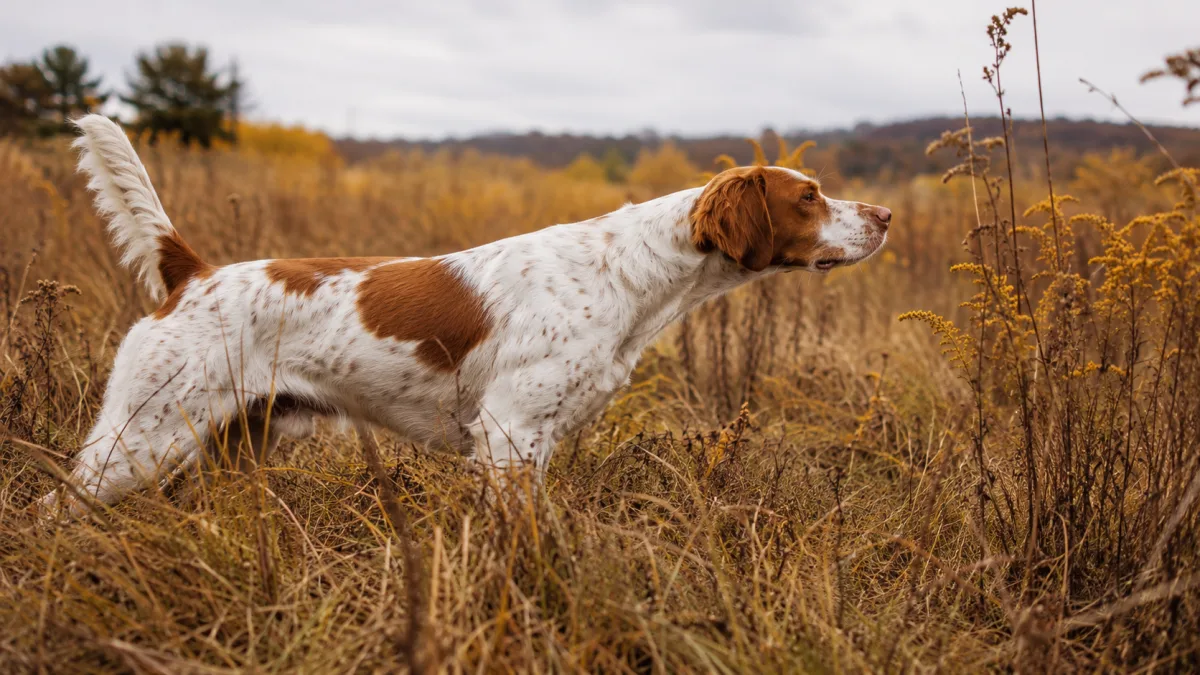
The Brittany is a versatile pointing bird dog, historically used on partridge in the Breton countryside and today primarily deployed for pheasant, quail, and woodcock in North America. The breed's compact build lets it work dense cover that would slow a larger pointer, while its natural birdiness — the bred-in desire to locate and honor birds — reduces the mechanical training burden considerably compared to breeds with weaker hunting instinct.
Introduce your Brittany to live birds as early as six to eight weeks. Even brief exposure to a wing, a pen-raised quail, or a pigeon in a controlled setting activates the genetic drive and creates an emotional association between birds and excitement that underpins all subsequent field work. A puppy that is bird-crazy at ten weeks is easier to train at twelve months.
Recall reliability in the field is the single most consequential skill a hunting Brittany can have — and the one most commonly neglected. Brittanys range naturally, sometimes covering ground 100 yards or more from the handler. That instinct is an asset when controlled and a liability when recall is weak. Build a reliable recall in controlled environments long before the dog encounters open ground and bird scent simultaneously: the combination of hunting drive and open space will override a shaky recall every time. Many field trainers introduce an e-collar after the recall command is solid on a long line — using the collar to reinforce a command the dog already understands, not to teach a new behavior.
AKC Hunt Tests and NSTRA field trials are accessible entry points for Brittany owners who want to test their dog's field development in a structured setting. The American Brittany Club (theamericanbrittanyclub.org) maintains a calendar of sanctioned events and breed-specific resources for field training.
Agility, rally, and sport training for the active Brittany
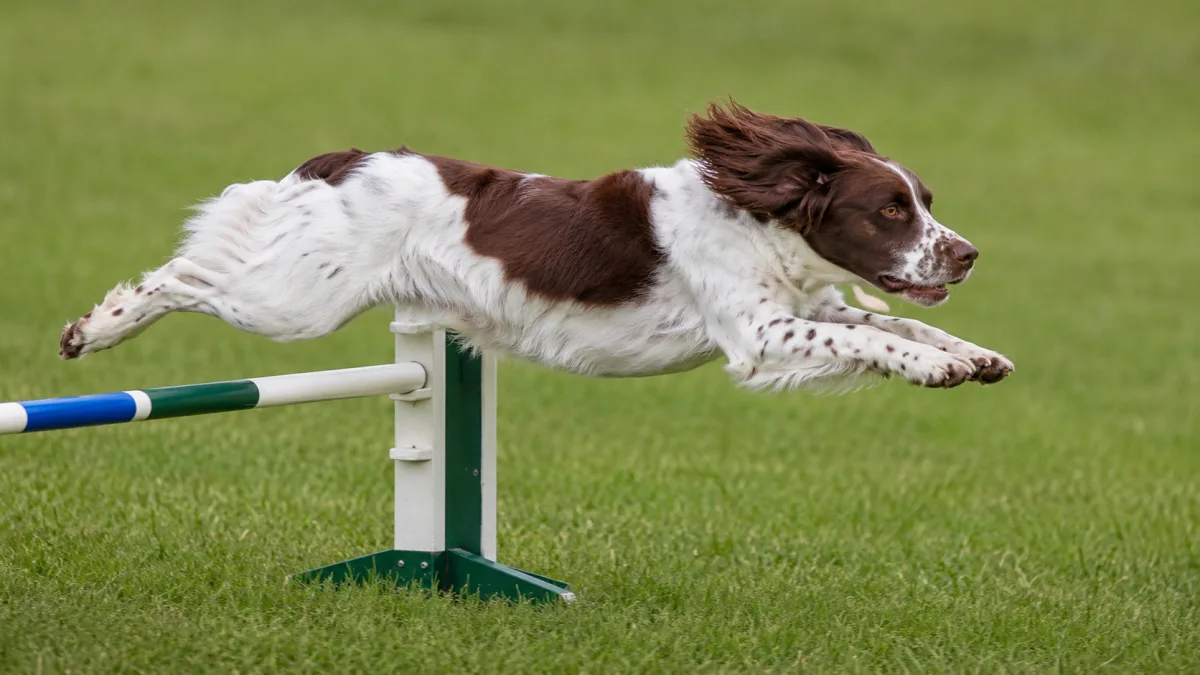
Not every Brittany owner hunts, but every Brittany needs a job. The breed requires at least one hour of vigorous exercise daily — many do better with 90 minutes — and mental stimulation is as important as physical output. A Brittany with unspent energy is not a misbehaving dog; it is a dog whose needs are unmet.
Agility suits this breed closely. The obstacle course demands the same handler-attentiveness the Brittany already carries from its field genetics, and the speed of competition matches the dog's natural pace. AKC Agility and AKC Rally Obedience both have classes structured for dogs at every experience level, from Novice through Master. Rally, with its handler-dog teamwork format and verbal cues, translates naturally from the obedience foundation you build in early puppyhood.
Tracking and nose work are also strong fits. A breed with the olfactory drive to locate upland birds in dense cover can redirect that instinct productively into structured scent exercises. Even brief daily nose work sessions — hiding treats or a scent article around the house or yard — provide the mental exhaustion that quiets an otherwise restless Brittany far more effectively than an extra lap around the block.
For a broader look at how athletic breeds channel energy into sport, see our overview of the Brittany Spaniel breed and breeder recommendations.
Common training mistakes Brittany owners make
The first mistake is treating the Brittany's sensitivity as a defect rather than a feature. Owners who come from experience with tougher breeds — Labradors, German Shepherds, working terriers — sometimes escalate corrections when a command is not followed. With a Brittany, escalation produces the opposite of the desired result. The dog does not become more compliant; it becomes more tentative, shutting down the trial-and-error behavior that drives learning.
The second mistake is inconsistency. Brittanys learn patterns rapidly, which means they also learn inconsistent patterns. If "come" sometimes means something good happens and sometimes means the end of play, the command loses reliability. Every person in the household must use the same cues, the same criteria, and the same rewards. A dog trained by one consistent handler and then ignored by everyone else in the family will not generalize its obedience.
The third mistake is under-exercising before training. A Brittany with two hours of suppressed energy cannot concentrate in a 10-minute obedience session. A 20-minute run or a retrieving session before structured training produces a dog that is stimulated but not frantic — the attentive state in which learning happens most efficiently.
The fourth mistake in hunting contexts is introducing gunfire before the dog has a strong bird drive established. Gun noise fired near a puppy that has no bird interest yet registers as a pure negative — a loud, painful sound with nothing rewarding attached. Build the bird drive first, then introduce sound while the dog is in full bird contact. The sequence matters more than the timeline.
Frequently Asked Questions
At what age should I start training a Brittany Spaniel puppy?
Basic obedience — sit, stay, come, name recognition — can begin at 8 weeks. The critical socialization window closes around 16 weeks, making early positive exposure to people, dogs, sounds, and environments essential during that period. Formal field training with live birds can start as soon as the puppy shows bird interest, often as early as 8 to 10 weeks with a simple wing or feathered dummy.
Are Brittany Spaniels easy to train compared to other breeds?
Yes, by most measures. Stanley Coren's obedience intelligence research ranks the Brittany 19th overall, the highest of any spaniel-type. The breed learns new commands quickly and shows high compliance rates. The caveat is that this intelligence is paired with emotional sensitivity — the dog learns fast in positive environments and deteriorates quickly under harsh handling.
How do I stop my Brittany Spaniel from ranging too far off-leash?
Build a reliable recall before the dog ever runs free in open ground. Start on a 30-foot long line, reward every check-in lavishly, and practice changing direction randomly so the dog learns to watch you rather than assume you will follow. Once the recall is solid on the long line in low-distraction environments, proof it with increasing levels of distraction before removing the line. Many field hunters then transition to an e-collar to reinforce the known command at distance — the e-collar extends your reach to 300-plus yards, which is where hunting Brittanys often work.
My Brittany Spaniel seems afraid of loud noises. Can I still use it for hunting?
In most cases, yes, with patient counter-conditioning. The key is to never pair gunfire with an idle or mildly stressed dog. Reintroduce sound at the lowest possible intensity — clapping hands, a cap pistol at 100 yards — while the dog is eating or actively engaged with birds. Pair every sound repetition with something the dog values highly. Progress is measured in weeks, not days. If the fear is severe, a professional gun dog trainer is worth consulting before the dog's fear response becomes deeply entrenched.
Does the Brittany Spaniel suffer from separation anxiety?
It can, particularly when the dog's bond with a specific person is strong and crate training or alone-time has not been introduced gradually. Prevent separation anxiety by building positive crate associations from puppyhood and practicing brief, calm departures and returns starting at 8 to 10 weeks. Do not make arrivals or departures emotionally charged. A Brittany that learns early that solitude is temporary and safe will handle alone time far better than one for whom solitude is always associated with distress.
What is the single most important training priority for a Brittany Spaniel?
Recall. A Brittany with a reliable recall is safe off-leash, manageable in the field, and able to participate in the sports and activities this breed genuinely needs. Without it, the Brittany's natural instinct to range and hunt independently becomes a liability. Every other training goal is easier to achieve when the dog has learned that coming back to you is the most rewarding thing it can do.

Chiara Bradshaw
Covers education, culture and creative topics with an emphasis on readable explanations and verifiable references.


Leave a reply
Replying to