
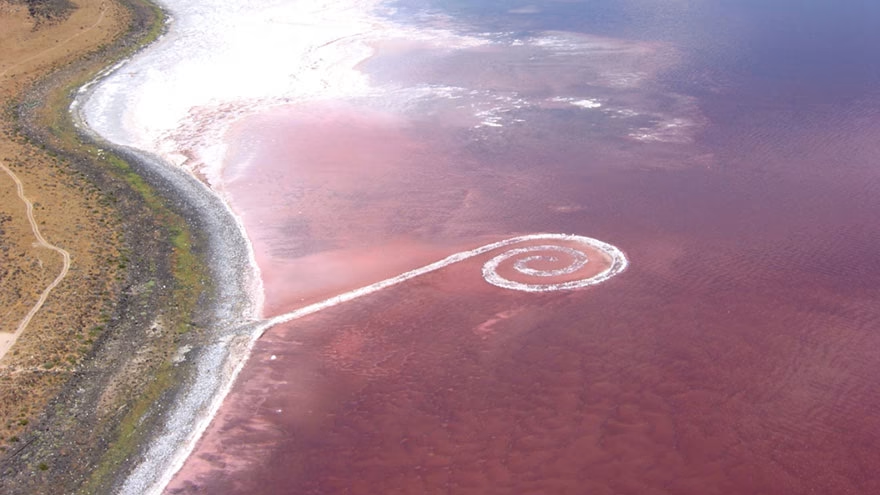
The first thing you notice at Rozel Point is the silence — then the smell. A briny, mineral exhalation rises from the lake's north arm as you step out of the car and look down at the black basalt coil curling counterclockwise into shimmering pink water. This is the Spiral Jetty, Robert Smithson's 1970 earthwork and one of the most astonishing pieces of art anywhere in North America. It takes a long drive on unpaved roads through scrubland to reach it, and every mile is worth it.
What is the Spiral Jetty and who made it?
The Spiral Jetty is an earthwork sculpture built directly into the northeastern shore of Utah's Great Salt Lake, at a remote peninsula called Rozel Point. Completed in April 1970, it consists of a counterclockwise coil approximately 1,500 feet long and 15 feet wide, constructed from roughly 6,650 tons of black basalt boulders and earth that Smithson and a crew of workers displaced from the surrounding lakeshore using dump trucks, a tractor, and a front loader. The basalt boulders were chosen deliberately — they are remnants of extinct volcanoes that once dotted the area, their dark surfaces now coated in salt crystals that crunch underfoot when you walk the coil's length.
What makes the Spiral Jetty unlike almost any other artwork is that it exists entirely outdoors, without fencing, admission booths, or security guards. Dia Art Foundation — which acquired the work in 1999 through the generosity of the Estate of Robert Smithson and the artist Nancy Holt — is the current owner and steward, but the site remains open to anyone who makes the drive. You can walk directly onto the sculpture, follow the spiral inward to its center, and stand where Smithson himself once stood, looking outward at the lake and the mountain ridgeline beyond. In 2024, the Spiral Jetty was listed on the National Register of Historic Places, formal recognition of what visitors have understood for decades: this is an irreplaceable landmark.
Robert Smithson and the land art movement
Robert Smithson was born in Passaic, New Jersey, in 1938, largely self-taught, and by the late 1960s had positioned himself at the center of a new movement that rejected the gallery as the primary site of art. Land art — or earthworks — took sculpture out of the museum and placed it directly in the landscape, often at a scale that dwarfed anything a gallery could contain. Smithson was its most articulate theorist as well as its most ambitious practitioner, publishing essays such as "Entropy and the New Monuments" (1966) and "A Sedimentation of the Mind: Earth Projects" (1968) that laid out his thinking on entropy: the idea, drawn from thermodynamics, that all systems tend toward disorder, and that this tendency was not something to resist but something to embrace as the subject of art itself.
His concept of the "non-site" captured this dialectic precisely. Smithson would collect rocks, sand, or gravel from an outdoor site and display them in a gallery alongside maps and photographs — the raw material severed from its origin, existing simultaneously in two locations. The Spiral Jetty inverted this: instead of bringing the landscape indoors, he built the artwork into the landscape itself, creating a site of maximum entropy, subject to flooding, salt accumulation, and the slow work of geological time. He described the fractured terrain around Rozel Point as looking like "prehistory" — an end of the world rather than a beginning.
Smithson died on July 20, 1973, at age 35, when the small plane he was flying in to survey a new earthwork in West Texas — a piece that would have been called Amarillo Ramp — crashed near the site. He never saw the Spiral Jetty from the air after it was built. His wife, the sculptor Nancy Holt, completed Amarillo Ramp in his memory and went on to create her own major earthwork, Sun Tunnels, in the Utah-Nevada desert.
What does the Spiral Jetty look like today?
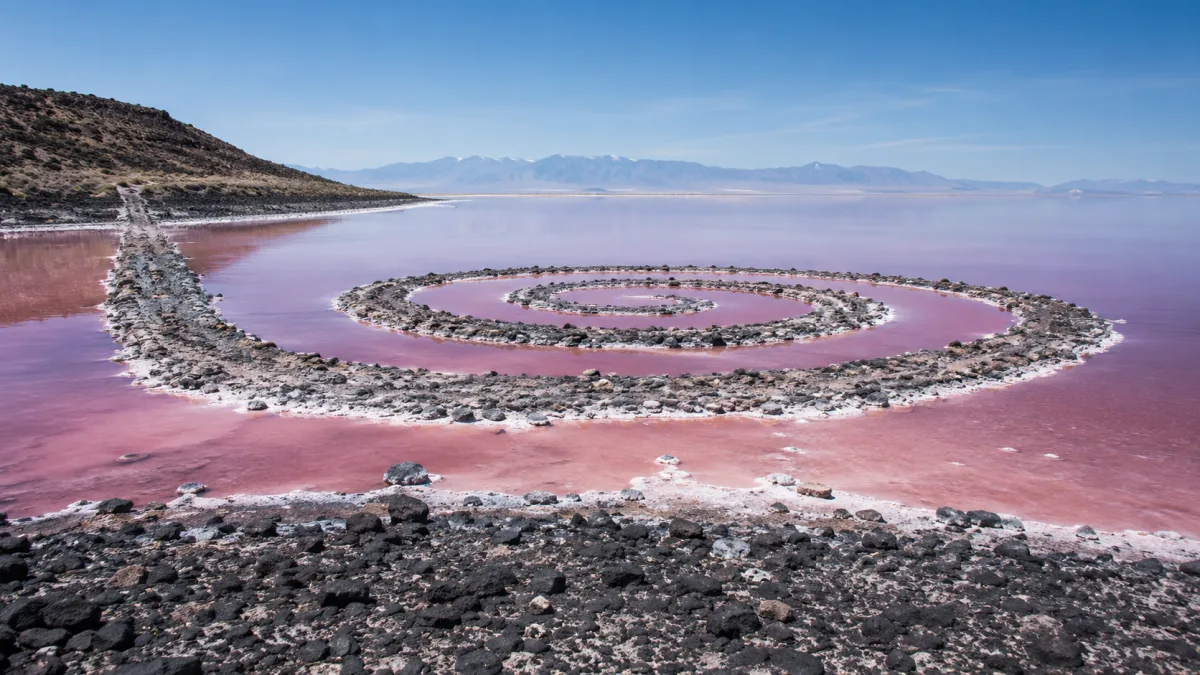
The short answer: extraordinary. The Spiral Jetty has been continuously visible since 2002, when drought caused the Great Salt Lake to recede enough to expose it after roughly three decades of submersion. (The work was completed in spring 1970; rising lake levels swallowed it in 1972 and did not give it back for thirty years.) Since its re-emergence, the lake has continued to shrink — dramatically so. By 2022, the Great Salt Lake had contracted from roughly 3,300 square miles at its historic high to under 1,000 square miles, one of the most severe lake-level declines ever documented in the American West. Dia Art Foundation notes that the lake, which once covered the Spiral Jetty entirely, is now almost a full mile from the sculpture's outer edge. That distance will register physically when you arrive: the jetty sits at the edge of an exposed lakebed that extends far into what was once open water.
Walking the coil itself, you move across rough black basalt over a crust of salt crystals that have grown directly onto the rocks in white, geometric formations. The rocks are wet near the water's edge, slicked with the briny residue of the lake. At the spiral's center you are surrounded by pink water on three sides — a saturated magenta that looks digitally enhanced but is entirely natural. Bring waterproof boots; the inner sections of the coil may be shallow-flooded depending on recent conditions.
Why is the water around the Spiral Jetty pink?
The answer begins with a railroad. In the 1950s, the Southern Pacific Railroad replaced its old wooden trestle bridge across the Great Salt Lake with a solid rock-and-dirt causeway, effectively splitting the lake into two arms with almost no water exchange between them. The south arm, which receives freshwater input from rivers, stays at a relatively moderate salinity of 12–15% — enough to support green and blue-green algae. The north arm, cut off from that freshwater, has grown progressively saltier, reaching average salinities of 26–30%.
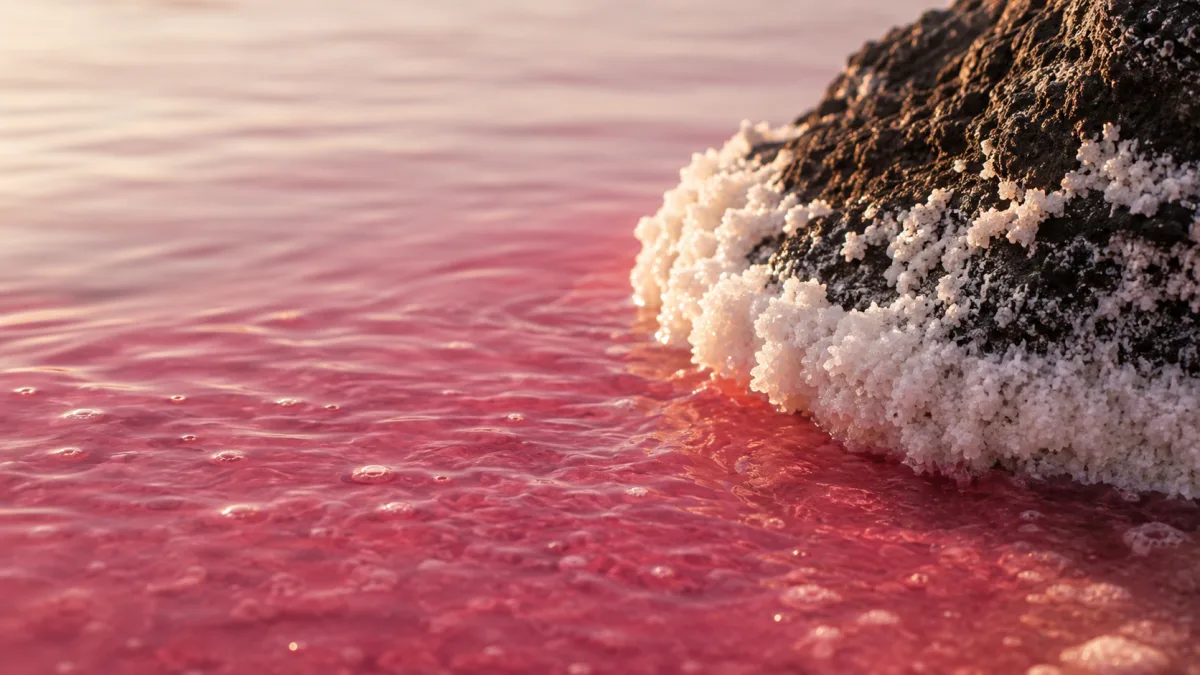
At those concentrations, only extreme specialists survive. Dunaliella salina — a single-celled green algae — produces red-orange carotenoid pigments to protect its chlorophyll from oxidative stress, staining the water pink to orange. Alongside it, halophilic (salt-loving) bacteria including Halobacterium species use a protein called bacteriorhodopsin — which is naturally violet-pink in color — to convert sunlight directly into energy. The combined effect of these microorganisms in their billions turns the north arm's water a vivid magenta, most intense in summer when temperatures climb and evaporation concentrates the brine further. The Spiral Jetty sits in the north arm, which is why the color surrounding it looks nothing like any other lake you have ever visited.
There is also a smell: a deep, fermented mineral odor from the brine flies that hatch in enormous numbers along the shoreline. They do not bite, but they swarm. Accept them as part of the landscape.
How to get to the Spiral Jetty — directions and road conditions
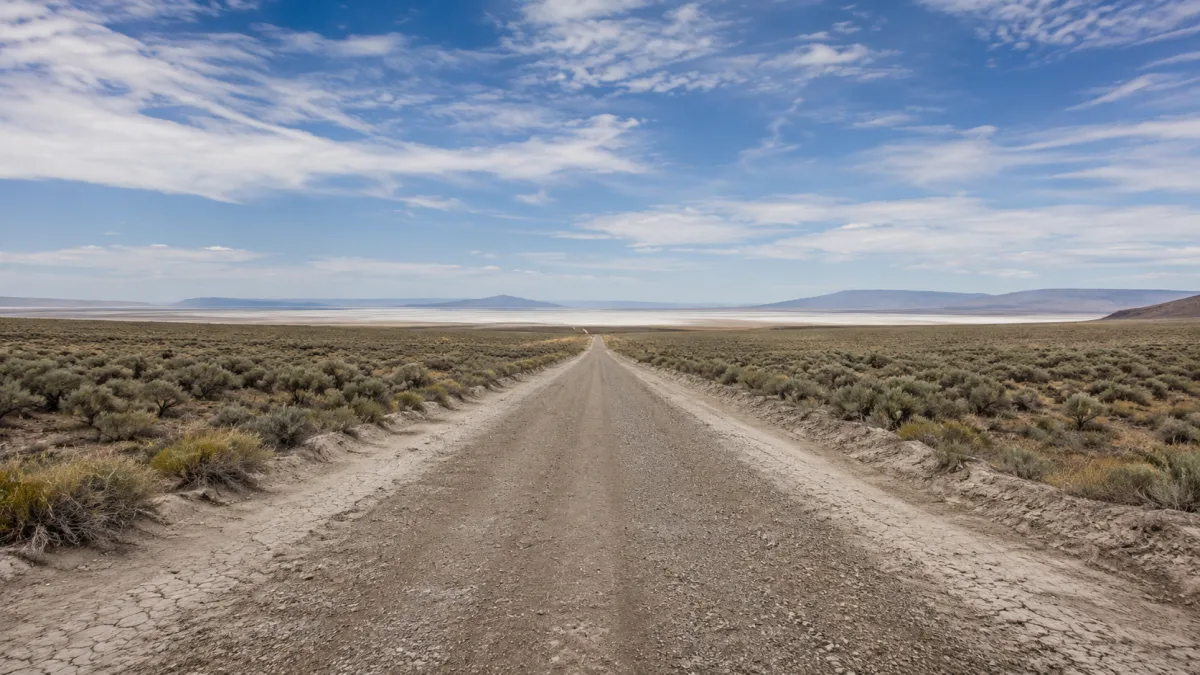
Plan for a full day. The Spiral Jetty is approximately 2.5 hours from Salt Lake City, and the final stretch of the drive is on unpaved roads that require care, particularly after rain. Here are the official directions from Dia Art Foundation:
- From Salt Lake City, take I-15 north for 65 miles.
- Take Exit 365 and turn right onto UT Route 13 toward Corinne. Fill your gas tank here — Corinne is the last fuel stop before the site, roughly 40 miles away.
- Continue west for 18 miles (UT Route 13 becomes Highway 83). Follow signs toward the Golden Spike National Historic Site (GSNHS) Visitor Center.
- Turn left onto Golden Spike Road and drive 7.7 miles to the GSNHS Visitor Center. This is the last point with bathrooms and cell phone service. Stock up on water here.
- From the visitor center, drive 5.6 miles west on the main gravel road (N Golden Spike Loop). At the fork, bear left (west) following the Spiral Jetty signs.
- Drive 1.4 miles to a second fork; turn right (southwest).
- Continue approximately 9 miles as the road curves north around Rozel Point. It ends at a cul-de-sac parking lot directly above the Spiral Jetty.
The GPS coordinates are approximately 41.4373° N, 112.6659° W. The gravel road is generally passable by standard passenger cars when dry, but high-clearance vehicles are strongly recommended, and after any rain a four-wheel-drive vehicle becomes essential. Do not attempt the road in wet conditions without 4WD — the clay surface becomes extremely slippery. There is no cell service past the Golden Spike visitor center, so download offline maps before you leave and do not rely on real-time navigation for the final stretch.
What to bring and what to expect on the ground
There is nothing at the site — no bathrooms, no food, no drinking water, no fuel, no shade structures. The terrain is open high desert, exposed to wind and sun, and temperatures in summer can exceed 100°F by midday. Pack accordingly:
- At least two liters of water per person — more in summer.
- Waterproof boots or shoes you do not mind getting wet and encrusted with salt. The coil's inner sections may hold standing brine.
- Sun protection: hat, sunscreen, sunglasses. The reflective salt flats intensify UV exposure significantly.
- Food. A picnic at the water's edge, with the pink lake in front of you and the Wasatch Range behind, is one of the stranger and more memorable lunches available in Utah.
- A camera. The light here in the late afternoon turns the basalt almost purple against the pink water — this is when the Spiral Jetty photographs best.
The walk from the parking lot down to the Spiral Jetty is short and gentle, but the terrain on and around the coil is uneven. The rocks are rough and can be slippery where wet. Walk slowly, particularly near the water's edge. There are no fences and no lifeguards; the lake's brine is too hypersaline to swim in comfortably, but the real hazard is simply a twisted ankle on the basalt.
One serious note for context: the exposed lakebed surrounding the Great Salt Lake contains arsenic, mercury, and other heavy metals that were safely locked under water for generations. As the lake has retreated, that lakebed has dried out and become a source of toxic dust when winds blow. Utah's legislature has enacted emergency conservation measures in response, and significant federal and state funding has been directed at water conservation. The situation at Rozel Point is not acutely dangerous for a day visitor, but the broader Great Salt Lake crisis is very real — the place you are visiting is an ecosystem under severe pressure.
Best time of year to visit
Spring and early summer — roughly April through June — offer the best combination of conditions. Temperatures are manageable, the lake water tends to be at its most vividly colored as warming temperatures intensify microbial activity, and the surrounding desert landscape shows spring color. The road is most reliably passable when it has had a few dry days. Summer visits are entirely feasible but require serious heat preparation; the exposed lakebed radiates heat aggressively, and there is no shade anywhere on the walk to or along the Spiral Jetty. Autumn offers similar advantages to spring, with slightly reduced crowds and lower temperatures than summer. Winter visits are possible but inadvisable unless you have 4WD and winter-rated tires — the road can become impassable after snow, and the short daylight hours reduce your time at the site. The Spiral Jetty is currently fully visible and has been so continuously since 2002; there is no bad season in terms of whether the artwork can be seen, only in terms of visitor comfort and road conditions.
The site is open at all hours, every day of the year, free of charge. Sunrise and sunset visits, when the low-angle light turns the water from pink to deep red, are particularly striking — but if you are arriving before or after daylight, be sure you know the road well or have driven it previously, as navigation is difficult in the dark.
Other land art and sites to visit nearby
The Golden Spike National Historic Site — where the transcontinental railroad was completed in 1869 — is directly on your route to the Spiral Jetty and worth a stop. The visitor center is excellent, and the site maintains working replicas of the two locomotives that met at Promontory Summit.
For visitors with a deeper interest in land art, Nancy Holt's Sun Tunnels (1973–76) is the obvious companion piece to the Spiral Jetty. Holt — Smithson's widow and a major land artist in her own right — installed four massive concrete cylinders in an X-shaped configuration in the Great Basin Desert of northwestern Utah, aligned to frame the rising and setting sun during the summer and winter solstices. Each cylinder is perforated with holes corresponding to four constellations, so that starlight falls in patterns on the interior surfaces at night. Sun Tunnels is located near the Utah-Nevada border, roughly two hours west of the Spiral Jetty, and is reachable as a second stop on a longer road trip. Like the Spiral Jetty, it is free, open at all hours, and isolated. Both works reward the effort required to reach them in ways that no museum piece ever quite can.
For those interested in further outdoor adventure in Utah's northern reaches, the area around the Great Salt Lake offers other experiences worth exploring. You might consider meteorite hunting in the Nevada desert on your way back west, or pair the trip with a stop at the kind of overlooked desert destinations you find around Laughlin, Nevada. If your trip extends south through Utah and into Kentucky, the Waverly Hills Sanitarium in Louisville offers a completely different kind of immersive historical site. Closer to home, hikers heading to the Wasatch Range might find it useful to know how to properly adjust walking sticks before taking on the rocky terrain in the region.
Frequently Asked Questions
Is the Spiral Jetty currently visible?
Yes. As of 2025, the Spiral Jetty is fully visible. It has been continuously exposed since 2002, when drought caused the Great Salt Lake to recede. The lake has continued to shrink significantly since then — Dia Art Foundation notes the lake is now nearly a mile from the sculpture's outer edge — so the work is not at risk of submersion in the near term, though long-term lake management remains uncertain.
Do you need a four-wheel-drive vehicle to reach the Spiral Jetty?
Not always, but it is strongly recommended. When dry, the gravel and dirt road to Rozel Point is generally passable by a standard passenger car with decent ground clearance. After rain, the clay surface becomes treacherous and a high-clearance 4WD vehicle is essentially required. Check weather forecasts before you go, and never attempt the road in wet conditions with a low-clearance sedan.
Is there an admission fee?
No. The Spiral Jetty is free to visit and open 24 hours a day, every day of the year. Dia Art Foundation stewards the site and asks only that visitors leave no trace: carry out all waste, do not remove rocks from the artwork, and do not build fires.
How long should I plan to spend at the Spiral Jetty?
Allow at least an hour at the site itself — time to walk down from the parking area, traverse the full coil to its center, linger, and walk back. Many visitors spend two hours or more. Factor in the 2.5-hour drive each way from Salt Lake City plus stops at Golden Spike, and you are looking at a full-day commitment. It is worth it.
What is the single most important thing to bring?
Water. The site has none. The nearest source is the Golden Spike visitor center, roughly 25 miles from the parking area. In summer, dehydration can become serious quickly in the desert heat and reflective salt environment. Bring more water than you think you need — the standard advice of two liters per person is a minimum, not a generous estimate.

Timothy Davidson
Edits step-by-step general-interest guides for clarity, realistic limits and source verification.



1 Comment
Join the discussion. Comments are moderated before appearing.