
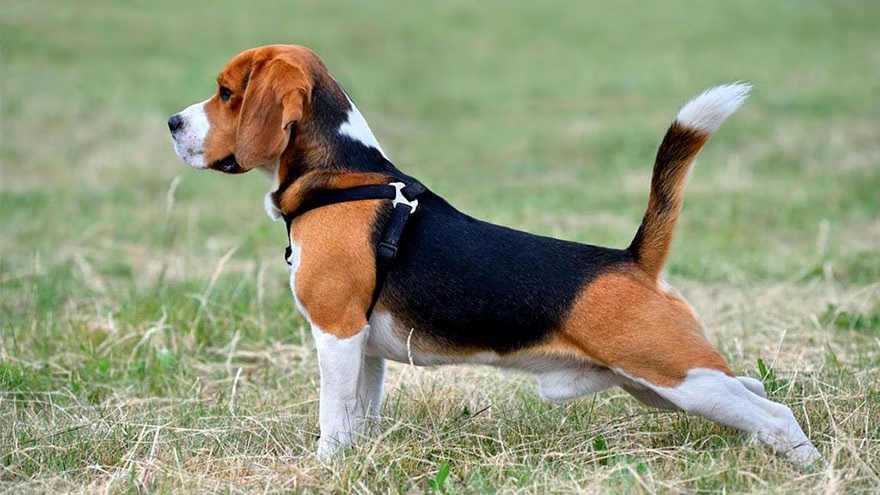
Normal Beagle height and weight is easy to misunderstand because Beagles are measured by height variety, not by a single perfect number on a scale. In the American show standard, there are two varieties: Beagles not exceeding 13 inches at the shoulder and Beagles over 13 inches but not exceeding 15 inches. Weight then follows build, muscle, sex, and body condition. A short, heavy Beagle and a taller, lean Beagle can both be normal for different reasons.
The better question is not "How much should my Beagle weigh?" It is "Can I feel the ribs, see a waist, and confirm that this dog's height and frame match the weight?" Beagles love food, and a few extra pounds on a short hound can matter.
The Two AKC Beagle Height Varieties
The National Beagle Club of America standard states that the 13-inch variety is for hounds not exceeding 13 inches in height, while the 15-inch variety is for hounds over 13 but not exceeding 15 inches. It also states that a hound measuring more than 15 inches is disqualified in that standard.
The American Kennel Club lists the same two height varieties and describes the breed as happy-go-lucky, funny, and bred to hunt in packs. That pack-hound background helps explain why Beagles often enjoy food, company, sniffing, and movement.
Height is measured at the withers, the highest point over the shoulder blades, not the top of the head. A Beagle that stretches, crouches, or wiggles can be hard to measure accurately at home. Use height as a rough guide unless you are involved in showing or breeding.
If you are comparing Beagles to larger breeds, a guide to the biggest dog breeds can make the Beagle's scale clearer: this is a compact hound, not a toy dog and not a large dog.
Typical Adult Beagle Weight
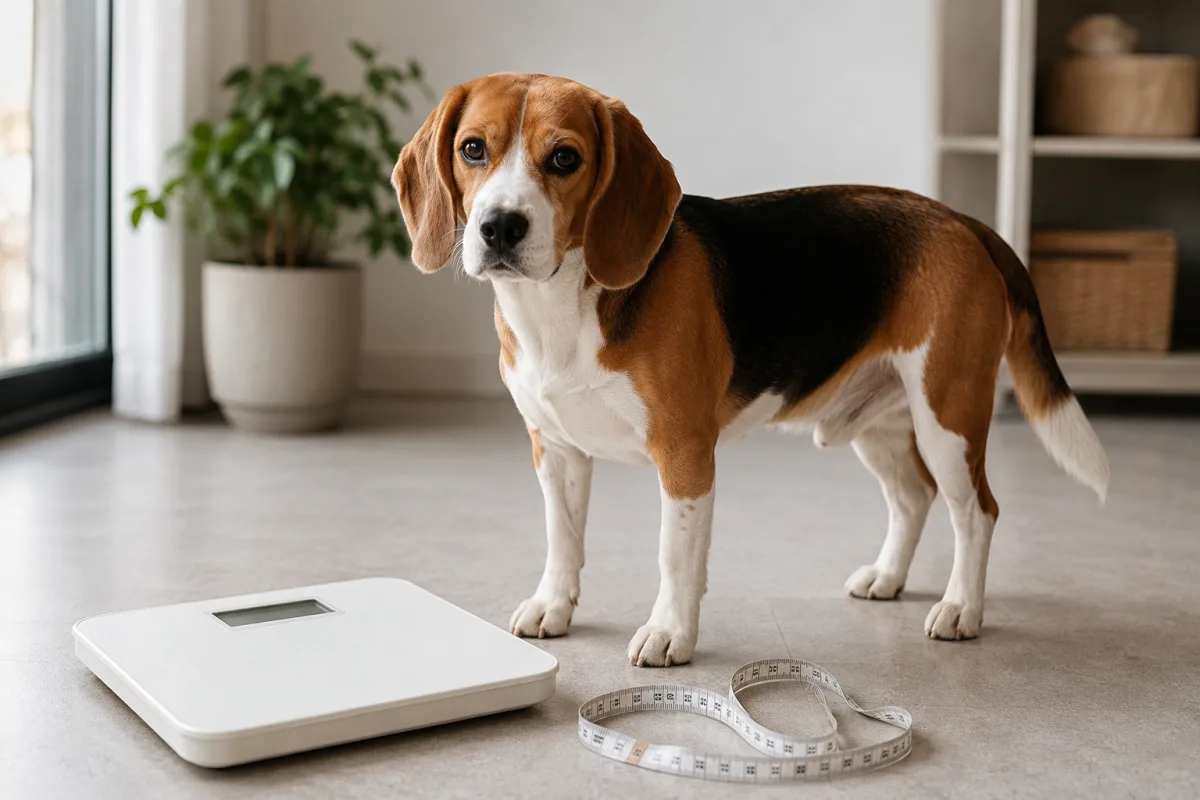
AKC public breed summaries commonly place the smaller variety under about 20 pounds and the 13-to-15-inch variety around 20 to 30 pounds. Those numbers are useful, but they are not a substitute for body condition. A muscular hunting Beagle may sit differently on the scale than a couch-loving companion of the same height.
Male and female Beagles can overlap in size. Some males are lighter than some females. Neuter status, activity, diet, age, and genetics all influence weight. Do not chase a low number if the dog is bony, and do not excuse extra fat because the breed is "supposed to be sturdy."
VCA Animal Hospitals notes that Beagles love to eat and have a tendency to become obese, recommending balanced feeding and calorie restriction if weight gain starts. Their Beagle breed page is blunt because this is one of the breed's most practical health issues.
Small-dog comparisons can help, but do not borrow another breed's target. A Miniature Schnauzer and a Beagle may overlap on a scale while carrying weight very differently.
The number on the scale is also affected by muscle. A Beagle that hikes, tracks scents, or trains for field work can carry firmer weight through the shoulders and thighs than a same-height dog that mostly naps. Fat feels softer and spreads over the ribs, spine, and tail base; muscle has shape and resistance. That is why a veterinarian will usually combine weight, body condition, and a hands-on exam instead of judging the dog from pounds alone.
How To Check Body Condition At Home
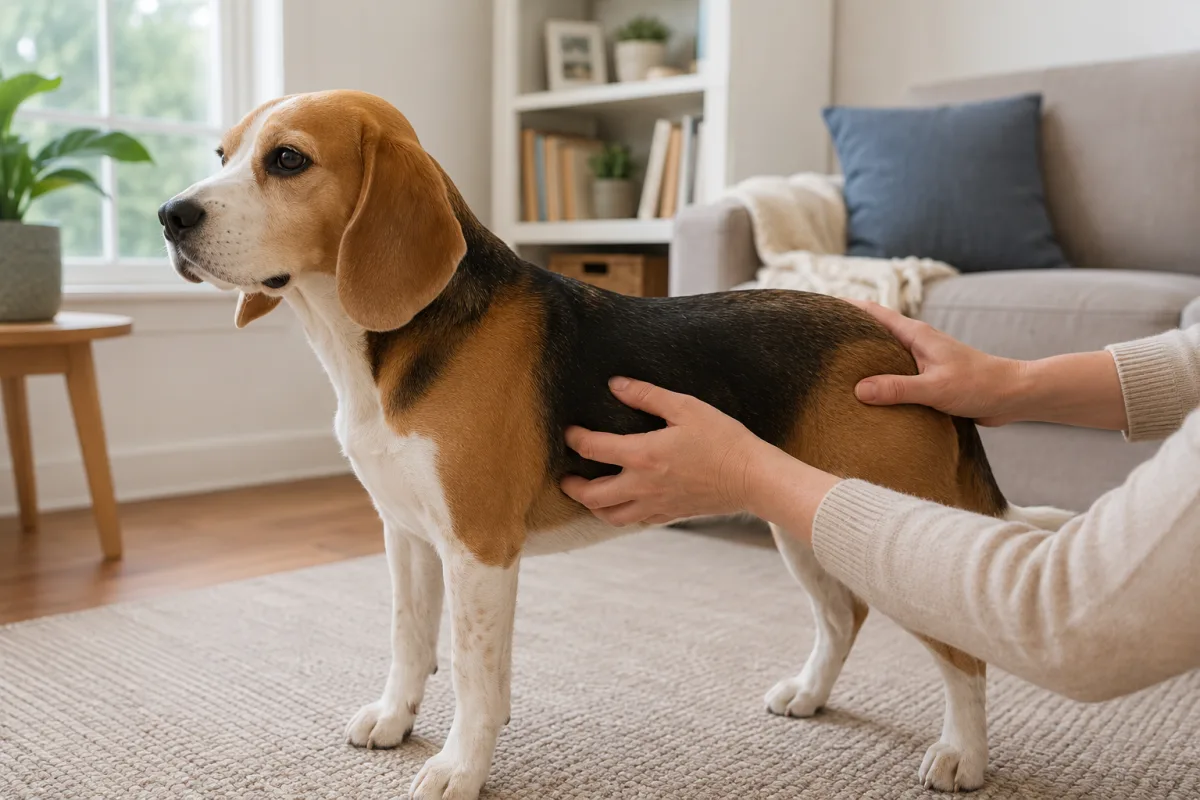
Use your hands. You should be able to feel the ribs with light pressure, not digging. Looking from above, the waist should narrow behind the ribs. From the side, the abdomen should tuck up slightly rather than hanging in a straight line. A thick Beagle may still look cute, but cute does not protect joints, back, or breathing.
Do the check with the dog standing, not curled on the sofa. Part the coat with your hands if needed, although Beagles have short coats. If the ribs feel sharp and the hip bones show, the dog may be too thin. If the ribs disappear under padding and the waist is gone, the dog is likely too heavy.
Weigh your Beagle regularly, but do not weigh daily. Every two to four weeks is enough for most home tracking unless your veterinarian gives different instructions. Use the same scale when possible. Bring the record to appointments if weight is changing.
Body checks matter in other hound-shaped dogs too. Reading Basset Hound questions shows the same issue from a different angle: long-backed, food-loving dogs need weight watched before mobility suffers.
Treats are usually the quiet source of weight gain. A biscuit after breakfast, a bite of cheese during cooking, and a few training rewards may look tiny, but a 22-pound Beagle does not have much calorie room. Break treats into pea-size pieces, use part of the measured meal for training, and ask every person in the house to follow the same rule. One generous family member can erase a week of careful feeding.
If the waist check is hard to judge, take a side and top photo every month. Photos expose slow changes that daily eyes miss.
Puppy Growth And When Size Settles

Beagle puppies grow quickly in the first months and usually approach adult height before they fully mature in body. A young Beagle may look lanky, then fill out. That does not mean every puppy should be pushed to gain weight. Growth should be steady, not forced.
Ask the breeder or rescue about the parents' size and the puppy's growth pattern. A puppy from 13-inch lines may mature differently than one from larger lines. If you adopted a mixed or unknown-history Beagle, use body condition and veterinary guidance rather than breed charts alone.
Do not free-feed a Beagle puppy unless your veterinarian specifically recommends it. Measured meals, training treats counted into the day, and regular activity build better habits. Beagles are clever enough to train the whole household into feeding them twice.
Growth charts are most useful as a pattern, not a verdict. A puppy that suddenly drops off its usual curve, looks pot-bellied, has chronic diarrhea, or eats well but fails to gain deserves a veterinary check. A puppy that is simply smaller than a littermate may be normal if energy, stool, coat, and body condition look good.
When Weight Needs A Vet Check
Call your veterinarian if your Beagle gains weight rapidly, loses weight without trying, seems hungry all the time with weight loss, becomes lethargic, drinks or urinates much more, limps, or develops a pot-bellied look. Weight is sometimes a diet issue, but it can also reflect endocrine disease, pain, parasites, dental trouble, or other medical concerns.
Never crash-diet a dog. Your vet can set a target weight, daily calories, safe treat plan, and recheck schedule. For many Beagles, the biggest changes are boring but effective: measure food, reduce table scraps, use part of the meal for training, add walks, and keep food out of reach.
Grooming is easy compared with long-coated breeds, but weekly brushing and ear checks still help. If you are used to a coat-intensive routine such as longhair Dachshund grooming, Beagle coat care will feel simple; the harder job is often food management.
Frequently Asked Questions
How tall is a normal Beagle?
In the AKC standard, Beagles come in two varieties: not exceeding 13 inches and over 13 inches but not exceeding 15 inches at the shoulder.
How much should a Beagle weigh?
Many adult Beagles fall under 20 pounds for the smaller variety and around 20 to 30 pounds for the taller variety, but body condition matters most.
Are male Beagles bigger than females?
Sometimes, but the overlap is large. Height variety, frame, activity, and body condition are more useful than sex alone.
How do I know if my Beagle is overweight?
You should feel ribs with light pressure, see a waist from above, and see a slight tummy tuck from the side. If not, ask your vet for a body condition check.
When does a Beagle stop growing?
Many Beagles reach most of their height before full physical maturity, then fill out gradually. Your veterinarian can judge whether growth and weight are on track.
Normal Beagle height and weight is not one number. Measure the height variety, watch the body condition, and remember that this cheerful hound's appetite often needs more management than its coat.

Timothy Davidson
Edits step-by-step general-interest guides for clarity, realistic limits and source verification.


Leave a reply
Replying to