
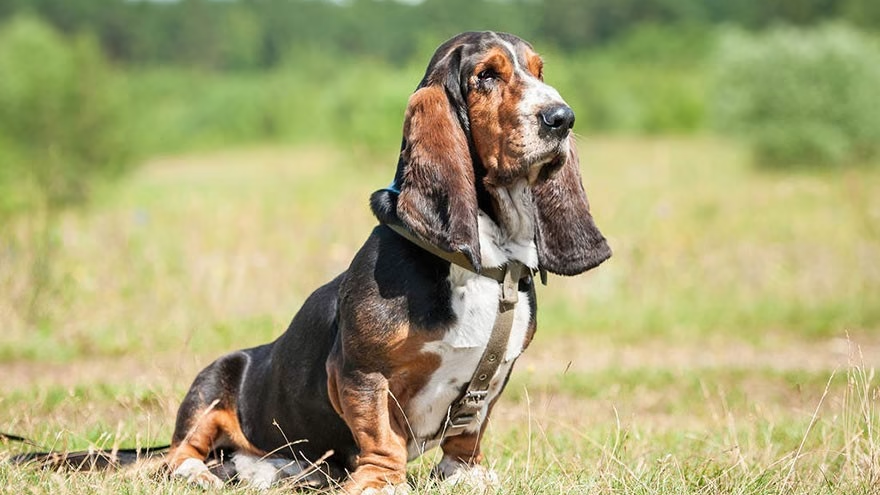
The Basset Hound traces its lineage directly to the St. Hubert's Hound, developed at the Abbey of St. Hubert in the Ardennes region of France around 700 CE. That deep history gives the breed its extraordinary nose — 220 million olfactory receptors, second only to the Bloodhound — and a temperament shaped by centuries of cooperative hunting with humans on foot. The AKC registered its first Basset Hounds in 1885, but a misconception about their bones has been circulating almost as long. They do not have more bones than other breeds. What they do have is proportionally more bone mass per pound of body weight than any other breed, a consequence of achondroplasia (genetic dwarfism) that produces a heavy, wide skeleton on dramatically shortened limbs. That distinction matters, because it changes how you think about their care, their movement, and their health risks.
1. Why Is It Important to Keep the Basset Hound from Jumping?
The short answer: their skeleton works against them whenever impact forces arrive at angles their joints were not designed to absorb. Basset Hounds are an achondroplastic breed — the same genetic mechanism that produces their short, bowed legs creates bones that are disproportionately heavy and dense relative to limb length. The AKC breed standard explicitly notes they carry more bone mass per pound than any other recognized breed. That mass, combined with a long, low spine, means that a jump from a sofa or the back seat of a car generates significant compressive force on the vertebral discs and forelimb joints on landing.
The specific risk is intervertebral disc disease (IVDD), which is common across all elongated-back breeds including the Dachshund. Repeated impact can accelerate disc degeneration, eventually causing pain, difficulty walking, or hind-limb weakness. This does not mean Bassets are fragile dogs — it means ramps and low furniture access points are a practical investment, not an indulgence. Puppies are particularly vulnerable while their growth plates are still open, so limiting jumping in the first 12 to 18 months of life is especially important.
2. Is the Basset Hound a Healthy Breed and How Long Will It Live?
Generally, yes — with the right owner who understands breed-specific vulnerabilities. The Basset Hound's typical lifespan is 12 to 13 years, which is solid for a dog of its bone density and build. Several health conditions appear with enough frequency that prospective owners should know them before they commit.
Thrombopathia is the most breed-specific of these: a hereditary platelet disorder that impairs clotting. A dog with thrombopathia can bleed excessively from minor wounds, experience spontaneous nosebleeds, or bruise unusually easily. Genetic testing is available, and reputable breeders screen for it. Entropion and ectropion are the correct terms for the eyelid conditions common in the breed — entropion causes the eyelid to roll inward (lashes rubbing the eye surface), while ectropion causes the lid to sag outward, exposing the conjunctiva. Both can cause chronic irritation and corneal damage if left untreated. IVDD, bloat (GDV), hip dysplasia, seborrhea, and chronic ear infections round out the list of conditions owners should discuss with a veterinarian from the start. Weight management is critical across all of these, since excess pounds compound joint stress and increase bloat risk.
3. How Many Puppies Does the Basset Hound Usually Have?
The typical Basset Hound litter runs six to eight puppies, which aligns with documented averages for the breed. The figure of 13, 14, or 15 puppies that sometimes gets cited is not impossible — very large litters do occur in hound breeds — but it represents an extreme outlier, not a typical outcome. Litter size is influenced by the dam's age, her overall health and nutrition, and the timing of breeding relative to ovulation.
Large litters in Basset Hounds bring a particular challenge: the breed's low body-to-ground clearance makes whelping supervision essential, as the dam can inadvertently trap or lie on a puppy. Responsible breeders stay present during whelping and for the first several weeks. Puppies should not be placed in new homes before eight weeks, and many breed-experienced owners recommend waiting until 10 to 12 weeks so puppies benefit fully from the social learning that happens within the litter.
4. Is the Basset Hound a Good Watchdog?
That depends on what you mean by watchdog. A Basset will alert you — their bay is loud, low, and carries farther than most people expect the first time they hear it. They notice strangers approaching the property and will voice that opinion clearly. As an alarm dog, they perform reasonably well. As a deterrent or protection dog, they do not. Their temperament is fundamentally social: affectionate with people, calm in the house, and rarely aggressive. A stranger who ignores the barking and walks past the gate is more likely to get sniffed than confronted.
If your primary concern is territorial aggression or physical deterrence, a Basset is the wrong breed. If you want a dog that will reliably notify you when someone arrives — while remaining safe around children, guests, and neighbors — they suit that role well. Their bay alone is often enough to make a would-be intruder think twice, which may be all most households actually need from a watchdog.
5. What AKC Events Does the Basset Hound Compete In?
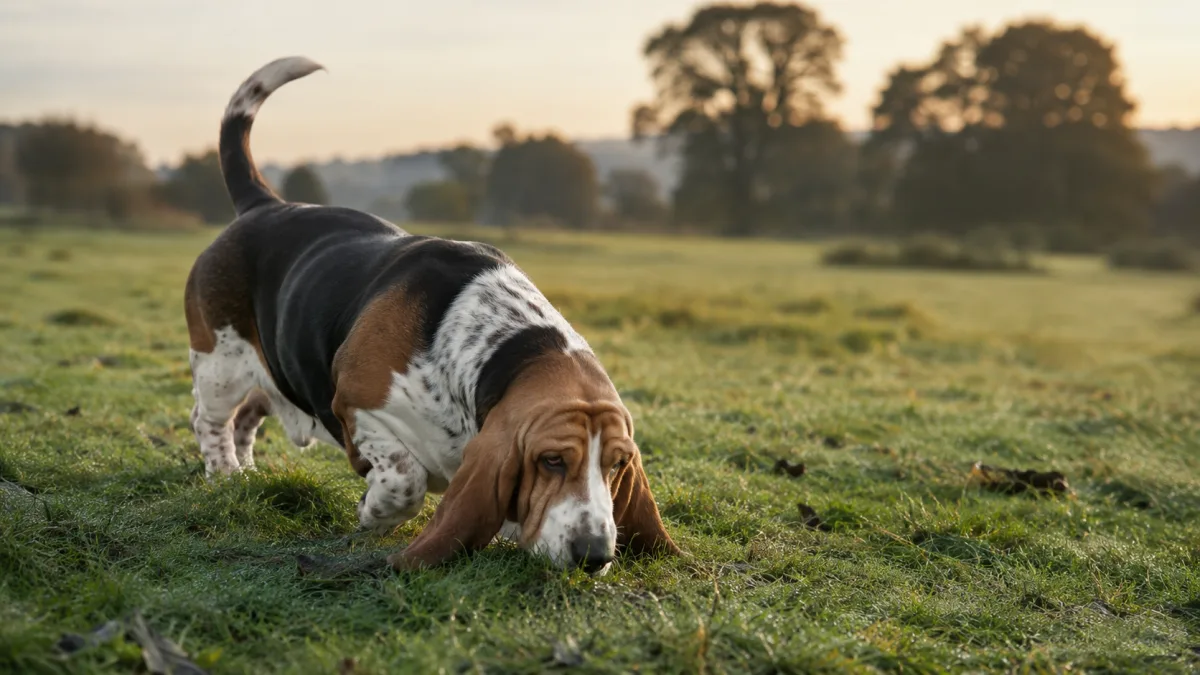
The Basset Hound's competition record is broader than its leisurely reputation suggests. The AKC Scent Work program is a natural fit: those 220 million olfactory receptors that made this breed invaluable to French hunters translate directly into elite performance in odor detection trials. Field Trials, a Basset Hound specialty event within the AKC, test the dog's ability to track rabbits or hares over varied terrain — an activity that mirrors the breed's original purpose so closely that a well-conditioned field trial Basset barely resembles the couch-dwelling companion version in terms of stamina.
Beyond scent-based events, Bassets compete in AKC Obedience, Rally, Tracking, and Agility. Agility may raise eyebrows given their build, but the AKC offers a Preferred division with lower jump heights that accommodates the breed's proportions safely. Conformation showing is perhaps the most natural arena of all — Bassets consistently place well because the breed standard rewards exactly the physical traits they carry: massive bone, pendulous ears set low on the skull, a deep chest, and a deliberate, effortless gait. If your interest is in dog sport rather than the show ring, tracking and scent work give a Basset Hound both physical exercise and the mental engagement the breed genuinely craves.
6. Where Does the Name 'Basset' Come From?
The name derives from the French adjective bas, meaning low or short-statured. Applied to a hound, it described a dog that stood close to the ground, distinguishing it from the taller, faster hounds bred for mounted hunting. That distinction was deliberate and functional: French hunters on foot needed a dog slow enough to follow at walking pace while still possessing a nose capable of holding a cold scent trail through dense brush and varying terrain.
The breed's ancestors were first documented at the Abbey of St. Hubert in the Ardennes around 700 CE, and for centuries the dogs were refined by French nobility and clergy. By the 16th century, the type was established well enough to appear in French hunting literature. The Comte de Couteulx de Canteleu, whose kennel produced many of the dogs that eventually arrived in England and America, is often cited as the most influential breeder in shaping the modern Basset. The English Kennel Club recognized the breed in 1880; the AKC followed in 1885. For more on breeds that share a similar low-slung hunting lineage, see our guide on grooming the Longhair Dachshund.
7. Are Basset Hounds Good for Conformation Showing?
They are among the most competitive conformation dogs in the Hound Group. The AKC breed standard for the Basset Hound is unusually detailed and specific — it describes the exact angle of ear set, the degree of dewlap, the shape of the sternum, and the precise movement pattern expected in the ring. A Basset that meets the standard closely is a striking dog to watch in motion: low, purposeful, with straight tracking and well-bent hocks.
Grooming for the conformation ring is genuinely straightforward compared to most group competitors. The hard, smooth, short coat requires a bath, a once-over with a rubber grooming mitt or soft bristle brush, and a wipe of the wrinkles and ear flap undersides. Nails should be kept short — the breed standard addresses this specifically, since long nails alter foot posture and gait. No coat trimming, no styling product, no breed-specific equipment beyond basic tools. For owners interested in other show breeds, our coverage of the Maltese and the Miniature Schnauzer illustrates how different grooming demands can be across ring competitors.
8. Do Basset Hounds Shed a Lot?
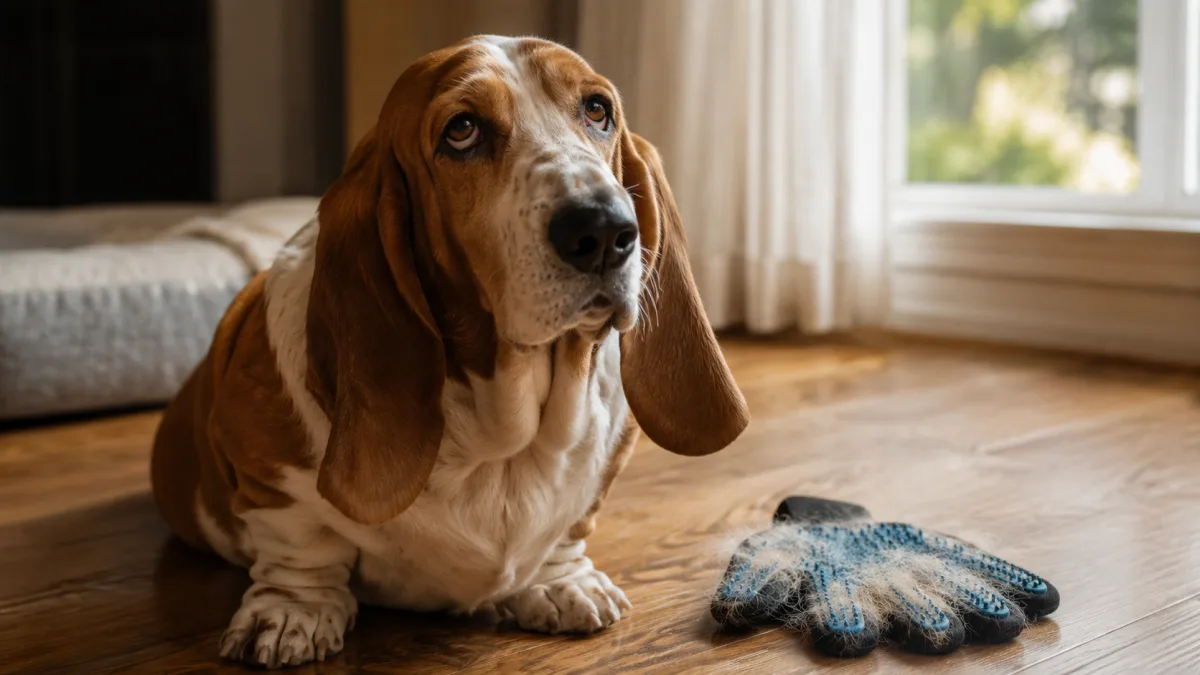
Yes — and this is one of the breed's most persistent myths. The short, smooth coat creates an expectation of low shedding, but Basset Hounds shed heavily year-round, with notable increases during seasonal coat changes in spring and autumn. The individual hairs are short but they embed themselves in fabric with remarkable efficiency. Upholstery, clothing, and car interiors accumulate a visible layer within days of contact with an unbrushed Basset.
Daily brushing with a rubber grooming glove or a bristle brush is the most effective management strategy. It removes loose hair before it migrates to furniture and distributes skin oils along the coat, which keeps the short hair lying flat and reduces the characteristic hound odor that can concentrate in an unbrushed dog. Bathing every four to six weeks helps, but brushing frequency matters more than bath frequency for shedding control. If minimal shedding is a firm requirement, the Basset is not the right match regardless of what the short coat implies at first glance. See our article on the Lhasa Apso, a breed that sheds far less but requires considerably more coat maintenance.
9. Can a Basset Hound Be a Walking or Jogging Partner?
Walking, yes — with some nuance. Jogging, no. The biomechanics of a Basset's build make sustained running inadvisable: the elongated spine and foreshortened legs create a gait designed for endurance at a slow pace, not for the repeated concussive load of jogging. Sustained running places the same compressive forces on vertebral discs that jumping does, increasing IVDD risk over time. A Basset that appears to jog willingly is not a signal that the activity is safe for their joints; they will often push past discomfort.
Daily walks, however, are both beneficial and genuinely enjoyed. A Basset on a scent trail will keep pace and sustain interest for 30 to 45 minutes without difficulty. The caveat is recall: once the nose goes down and a trail registers, the ears effectively go offline. A secure leash is not optional near traffic or open spaces. A long-line in a fenced area lets the dog follow scent freely while remaining safe. For a contrasting look at high-energy sporting breeds, our article on the German Shorthaired Pointer covers what genuine jogging-partner energy looks like in a dog breed.
10. Are Basset Hounds Actually Lazy?
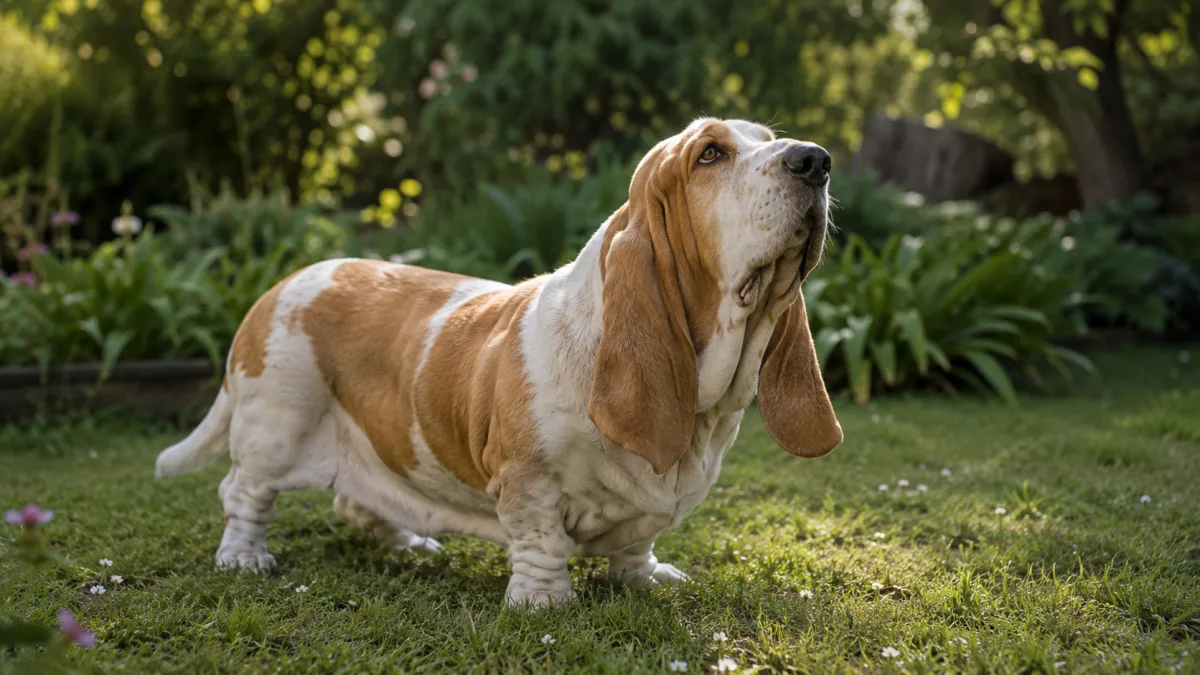
The lazy reputation is inaccurate but not entirely unfounded. A Basset Hound in a quiet house with no stimulation will sleep most of the day — that much is true. But give the same dog a scent trail, a yard to investigate, or a slow walk through a neighborhood full of interesting odors, and you will see a completely different animal: focused, determined, and willing to work for a long time without losing interest. The breed was developed for sustained, independent scent work over hours of hunting. That drive did not disappear with domestication.
What Bassets genuinely lack is the explosive, persistent energy of sporting or working breeds. They do not need two hours of vigorous daily exercise. They are not anxious or destructive when resting. Their pace is deliberate — the same quality that made them useful to hunters on foot. A healthy adult Basset benefits from at least one 30-minute walk per day and appreciates interactive play or nose work sessions that engage the scenting instinct. Owners who mistake "calm" for "lazy" often under-exercise their dogs, which contributes to obesity — one of the most significant and preventable health risks this breed faces. A fit, appropriately exercised Basset is a very different dog from an overweight, sedentary one, both in health outcomes and in personality.
Frequently Asked Questions
Are Basset Hounds good with children?
Yes. The Basset Hound's patient, even-keeled temperament makes them reliably gentle with children of all ages. They tolerate handling well and rarely snap. The main supervision concern runs the other direction — young children should be taught not to climb on a Basset or encourage it into jumping positions that stress the spine.
Why do Basset Hounds get so many ear infections?
The anatomy is the cause. Those long, pendulous ear flaps fold down over the ear canal, blocking air circulation and trapping warmth and moisture inside. Bacteria and yeast thrive in warm, damp, dark environments. Debris that the dog picks up low to the ground — grass, soil, standing water — also collects in the canal. Weekly ear inspection and cleaning with a veterinarian-approved solution is a basic maintenance requirement for this breed, not optional. Chronic infections left untreated can lead to permanent hearing damage.
How difficult is Basset Hound training?
More challenging than average, but not because Bassets are unintelligent. The challenge is motivational: a dog with 220 million scent receptors and an evolutionary history of following trails independently does not naturally prioritize human commands over olfactory input. Short sessions of 10 to 15 minutes, high-value food rewards, and consistent repetition work better than lengthy drilling. Recall in open, unfenced areas is the hardest skill to establish and should never be fully trusted without a leash or a physical boundary.
Do Basset Hounds do well in apartments?
They can adapt to apartment living if exercise needs are consistently met. Their noise output is the primary concern — the Basset's bay is designed to carry over long distances and through dense cover. In a dense building, that vocalization during the owner's absence can become a neighbor issue quickly. Owners who work long hours away from home should plan for that reality.
What should I look for in a Basset Hound breeder?
Health testing is the primary filter. A responsible breeder conducts genetic screening for thrombopathia, tests hips and elbows, and has veterinary documentation for their breeding dogs. The Basset Hound Club of America maintains a breeder referral network and publishes breed health guidelines. Avoid breeders who cannot provide health clearances or who place puppies before eight weeks of age.
Sources and verification
Check current details with these primary or subject-authority sources before acting on the information.

Tory Stearns
Edits practical household, travel and lifestyle explainers. Claims that can change are linked to current primary or subject-authority sources.

Leave a reply
Replying to