
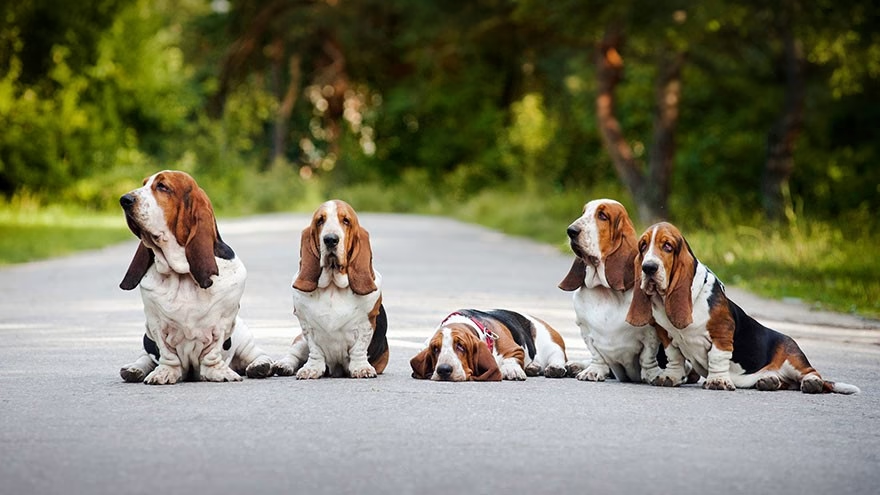
What makes Basset Hound training different from other breeds?
Stanley Coren ranked the Basset Hound 71st out of 80 breeds in his widely cited obedience intelligence list. That number gets quoted so often in breed guides that it has calcified into a reputation: slow, dim, nearly untrainable. The problem is that Coren's methodology measured one specific thing — how reliably a dog obeyed a handler's verbal commands in a formal obedience context. It did not measure problem-solving ability, environmental awareness, or the kind of sustained independent judgment that allowed Basset Hounds to trail quarry for hours through dense terrain without a hunter directing every step.
Basset hound training is genuinely different from training a Labrador or a Border Collie — but not because the dog lacks intelligence. It is different because the Basset carries 400-plus years of selective pressure toward autonomous decision-making. When that nose locks onto a scent, the dog is doing exactly what generations of breeders refined it to do. Understanding this distinction is the foundation of any effective training plan.
Patience is not optional here. Neither is a clear-eyed acceptance that certain behaviors — such as reliable off-leash recall mid-track — sit at the far edge of what any Basset will give you. Knowing the limits is as important as knowing the techniques. The reward, for owners who adapt their expectations and methods accordingly, is a dog that is affectionate, funny, and surprisingly capable once motivation aligns with the task.
Understanding how the Basset Hound's nose controls behavior
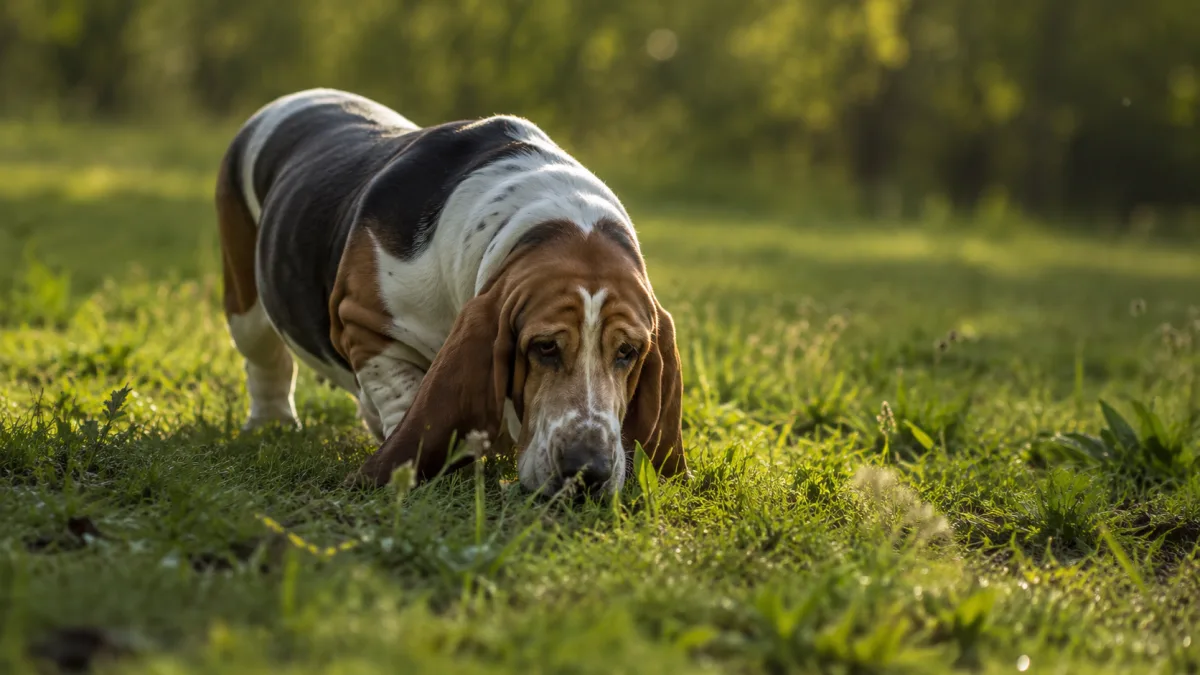
The Basset Hound carries approximately 220 million scent receptors — compared to roughly 5 million in a human nose. By olfactory receptor count alone, the breed ranks second only to the Bloodhound among AKC-recognized hounds. Those receptors connect to an olfactory cortex that, in dogs broadly, is proportionally far larger than in humans. Where human brains dedicate the majority of cortical real estate to visual processing, the canine brain is organized around smell.
What this means in practice: when a Basset drops its nose to the ground and locks onto a scent trail, the olfactory system is not merely active — it is dominant. Neural resources shift toward processing the cascade of chemical information rising from the ground. The dog's long, pendulous ears — called leathers in breed terminology — drag along the surface as the animal walks, physically disturbing particles and funneling scent upward toward the nostrils. The loose folds of skin beneath the chin, known as the dewlap, trap and concentrate scent molecules. Every anatomical feature reinforces the nose's primacy.
This is why calling a Basset mid-track is so rarely effective. It is not selective hearing. The olfactory cortex is, in that moment, consuming cognitive bandwidth that would otherwise be available for processing your voice and deciding to comply with a recall cue. Scent hounds were bred to work independently of constant human instruction — that independence is the feature, not a flaw. Training that tries to override the nose head-on will lose. Training that works around it, or channels it, will succeed.
The long ears also create a secondary concern: because the ear flaps hang low and rarely allow air circulation, Basset Hounds are prone to chronic ear infections. Regular cleaning is part of basic maintenance, and an infected ear is a distracted, uncomfortable dog — one even less likely to engage with training.
Basset Hound history and what it was bred to do
The name comes from the French word bas, meaning low. France in the 16th century had numerous strains of hunting hounds, and what would become the Basset Hound was developed to fill a specific ecological niche: pursuing rabbit and hare through dense undergrowth at a pace slow enough for hunters on foot to follow. Horses were not required. Speed was not the goal. The goal was a dog that could work a complex scent trail methodically, in a pack, for extended periods — without losing the line and without needing directional commands from above.
The modern breed took clearer shape through the 18th and 19th centuries, with Bloodhound crosses cementing the characteristic long ears, heavy bone structure, and mournful expression. The Basset arrived in England in the late 1800s and drew considerable interest from aristocratic hunters. The Basset Hound Club of America was founded in 1935 — the national parent club — and the AKC had formally recognized the breed earlier, in 1885.
Under the AKC breed standard, a Basset Hound stands no more than 14 inches at the highest point of the shoulder blade — a disqualifying height beyond 15 inches. Males typically weigh between 50 and 65 pounds; females between 45 and 60 pounds. That combination of low height and substantial bone mass makes the Basset the heaviest breed for its height in the entire Hound Group. The body is built for endurance and ground-level scenting, not speed or agility.
Knowing this history reframes training. You are not trying to rehabilitate a dog with a behavioral problem. You are working with an animal whose entire physical and psychological architecture was engineered for independent nose-work — and you are asking it to also perform commands in contexts that feel irrelevant to that purpose. That requires a different kind of currency: usually food.
Starting training — age, approach, and session length
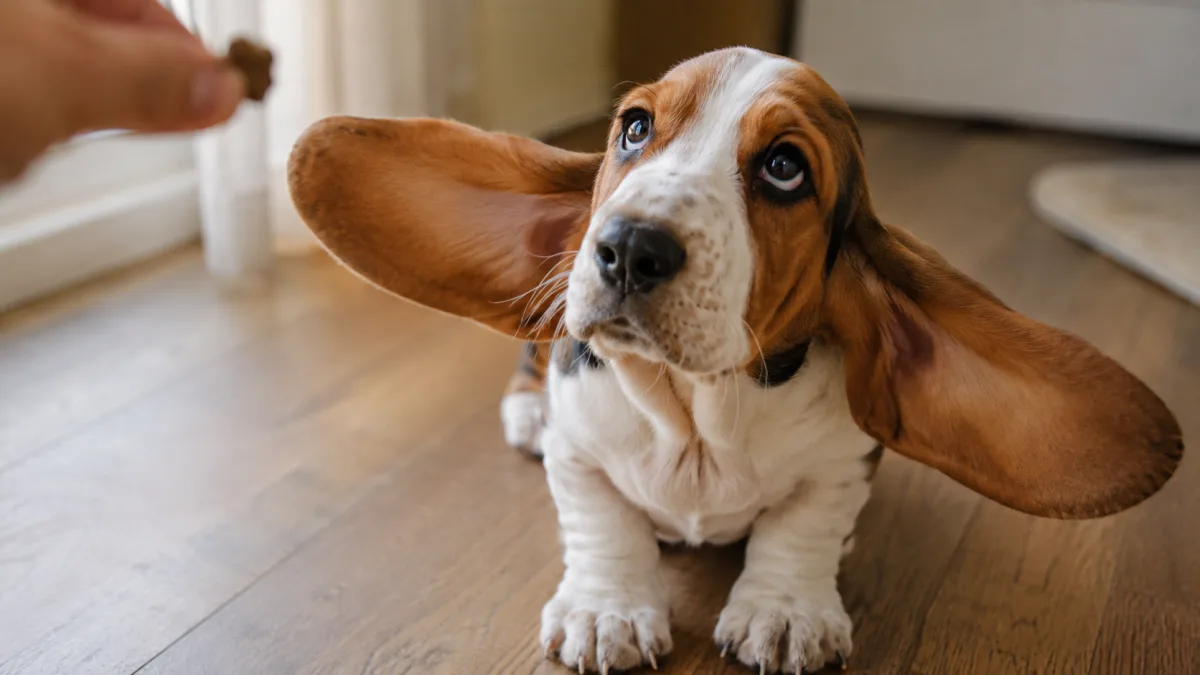
The window between eight and sixteen weeks is the most important socialization period in any dog's development, and Basset Hounds are no exception. Early exposure to different environments, sounds, people, and other animals shapes the adult dog's baseline anxiety level and reactivity. A Basset that misses this window can become timid or reactive in ways that complicate every future training session.
Formal obedience work can begin the day a puppy arrives home — not in long, structured sessions, but in short, repeated interactions throughout the day. The rule of thumb that applies specifically well to Bassets is five to ten minutes maximum per session. These dogs are not built for sustained attention on tasks that compete with environmental scent information. A ten-minute session done three times across a day will produce better results than a single thirty-minute session that ends in frustration for both handler and dog.
The luring technique works well with this breed. Hold a high-value treat near the dog's nose, then move it slowly to guide the dog's body into the target position — nose-up and back-down for a sit, for instance. The food keeps the nose engaged on something the handler controls rather than on the floor. Verbal praise alone is typically insufficient as a primary reward for Bassets; the smell of a treat is a more compelling signal than a spoken word.
Crate training should start early as well. A crate gives the dog a predictable, safe space and reduces the destructive behavior that often accompanies separation anxiety. Bassets are deeply social animals — they were bred to work and rest in packs — and time alone is not natural for them. A crate does not solve separation anxiety on its own, but it limits the damage while systematic desensitization (gradually extending alone time from seconds to minutes to hours) addresses the underlying stress.
For an introduction to foundational Basset training, the Basset Hound 10 most common questions covers the breed queries new owners encounter most often.
Core obedience commands for Basset Hounds
The five commands that form the practical foundation for any dog's household behavior are sit, stay, come, down, and leave it. Each presents its own challenge with a Basset, and each responds best to the same toolkit: food reward, short sessions, and consistency in the cue used.
Sit is typically the easiest starting point. Lure the nose upward while the treat moves back over the head — the hindquarters lower naturally. Mark the moment the dog's backside touches the floor with a verbal marker ("yes") and deliver the treat immediately. Timing matters; a late reward marks the wrong behavior.
Stay requires building duration in small increments — one second, then three, then ten. Bassets will break early if the distraction value of the environment exceeds the value of holding the position. Keep the stay duration short until the dog understands the command, then gradually extend it, always ending the stay with a release cue before the dog decides to leave on its own.
Down follows a similar luring approach: from a sit, move the treat from the dog's nose straight down to the floor between the front paws. Most Bassets will follow the treat into a down position. Their low center of gravity actually helps here — the transition from sit to down is physically easier for them than for taller breeds.
Leave it is arguably the most practically important command for a Basset, given that a nose this powerful finds potential hazards everywhere. Build it progressively: treat in a closed fist, reward when the dog stops sniffing and pulls away; treat on the floor covered by a hand, reward when the dog backs off; treat on the floor uncovered, reward when the dog ignores it on cue. The goal is a dog that looks up at the handler on the cue, not merely backs away from the object.
Come (recall) deserves its own section.
Other dog breeds with independent minds face similar training considerations — the Staffordshire Bull Terrier health and behavior overview and the Rottweiler's most common training questions both address working with strong-willed breeds whose instincts sometimes override handler cues.
Leash manners and recall — the hardest skills
Recall is the single command that most Basset owners describe as perpetually unreliable, and the anatomy of the problem is predictable: the dog has its nose on the ground, olfactory processing is in full swing, and a human voice becomes background noise. The Basset is not ignoring you out of spite. The cognitive resource that would process and act on the recall cue is occupied elsewhere.
The practical implication is simple and non-negotiable: keep a Basset Hound on a leash or within a securely fenced area whenever it is outdoors. Off-leash access in an open or unfenced environment creates genuine safety risk. A dog following a scent trail has no awareness of roads, other dogs, or how far it has traveled. The breed's methodical pace is deceptive — they cover ground consistently and can disappear around a corner before a handler realizes they are gone.
Recall training should still happen, but it belongs in a low-distraction environment first: indoors, then a fenced yard, then graduated outdoor settings. Make the recall command the most rewarding thing in the dog's vocabulary — use a unique cue reserved only for recall, and only ever deliver the best food rewards (real meat, cheese) when the dog arrives at your feet. Never call the dog to you for something unpleasant, and never end recall practice sessions with anything the dog dislikes. You need the word "come" to trigger an anticipatory response, not anxiety.
Leash manners present a related problem. Bassets pull toward scent sources, often with surprising determination given their relatively slow pace. A front-clip harness is preferable to a neck collar for this breed — it reduces pressure on the trachea when the dog hits the end of the lead, and the front clip redirects the dog's body toward the handler rather than allowing forward momentum to build. Standard flat collars, particularly with a dog prone to pulling, create tracheal stress over time.
Heeling — the formal command to walk at the handler's left side with attention up — is one of the harder skills to achieve with a Basset. The breed's natural gait is nose-down. Expect to spend considerably more time on heel work than you would with a retrieving or herding breed, and accept that a Basset that walks on a loose lead without constant pulling is a genuine achievement, even if formal heeling remains imperfect.
If you are working with multiple scent-driven breeds, the parallel challenges around German Shorthaired Pointer training and recall offer useful comparison — a hunting breed with a similarly strong nose-first orientation but far more handler focus than the Basset typically provides.
Scent work and nose work — training that plays to the breed's strengths
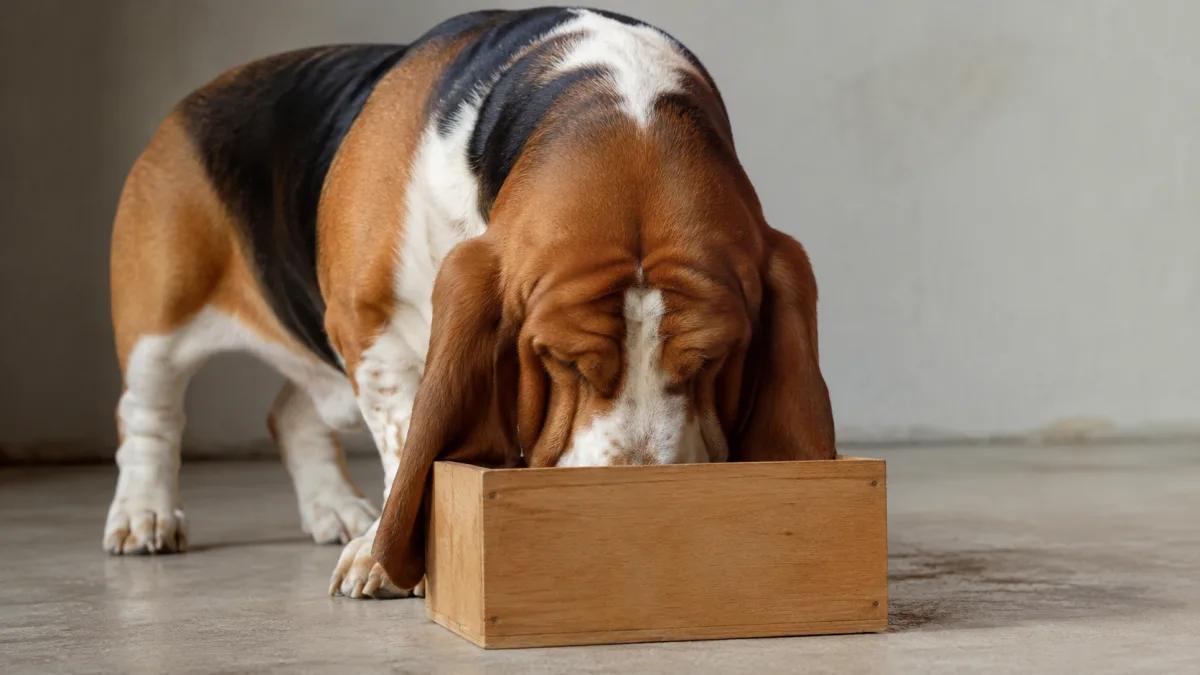
AKC Scent Work is the competitive sport that most closely mirrors what a Basset Hound was built to do. Dogs search for cotton swabs saturated with specific essential oils — birch, anise, clove, and cypress — hidden in containers, interior spaces, exterior environments, and buried locations. The dog alerts the handler when it locates the target odor. There are four levels of difficulty in each division (Novice, Advanced, Excellent, and Master), plus a Detective Class that presents an integrated search environment with an unknown number of hides.
For a Basset Hound, this activity is not merely enjoyable — it is neurologically fulfilling in a way that sit-stay drills can never be. The dog is doing what its brain is optimized to do, in a structured context with clear rules and rewards. Owners who begin scent work often report a measurable improvement in overall trainability: a dog that has an appropriate outlet for its primary drive is calmer, more focused, and more responsive during other training activities.
The entry point is low. K9 Nose Work classes — the civilian precursor to AKC Scent Work — are available through trainers across the country and require no prior obedience training. The dog begins by simply searching boxes for food rewards, then graduates to searching for a specific odor. Most Bassets take to the activity immediately, since it asks them to do what they already want to do, on purpose, with someone watching approvingly.
AKC Tracking is another avenue. Tracking events ask dogs to follow a human scent trail across varying terrain, identifying articles left along the path. The Basset's slow, methodical tracking style — the same pace that made it useful for foot hunters centuries ago — is an asset in this context. Tracking titles (TD, TDX, VST) are available through the AKC and represent a legitimate competitive goal for dedicated owners.
If you want to understand what a Basset brings to scenting activities compared to other hound-type breeds, the overview of owning a Brittany Spaniel illustrates how bird dogs with a different scenting style approach field work — a useful contrast for understanding what makes the Basset's ground-tracking specialty so distinct.
Health considerations that affect training
Intervertebral Disc Disease (IVDD) is the most significant health risk specific to the Basset Hound's body type. The combination of a long back, short legs, and heavy bone mass places chronic mechanical stress on the intervertebral discs that cushion the spine. Chondrodystrophic breeds — those with disproportionately short legs relative to body length, including Dachshunds, Corgis, and Basset Hounds — carry a structural predisposition to disc herniation that can cause pain, nerve damage, or paralysis.
For training, this has direct practical implications. High-impact activities — jumping from heights, climbing repeatedly over obstacles, sustained stair use — increase spinal load and should be minimized. Training sessions should take place on non-slip surfaces; a dog that scrambles on hard floors is putting asymmetric stress on its back with every movement. If a Basset begins reluctantly approaching training sessions, shows pain responses when touched along the spine, or moves with unusual stiffness, veterinary evaluation takes priority over any training schedule.
Obesity compounds IVDD risk significantly. Basset Hounds are food-motivated to a degree that works in the trainer's favor — but that same drive means they will overeat consistently if allowed. Every treat used in training is a calorie that should be accounted for in daily food intake. Keeping the dog lean is, in many respects, the most important long-term training-related health decision an owner makes. An overweight Basset carries excess load on a spine already under structural stress.
Ear infections, mentioned earlier in relation to the ear anatomy, also affect training quality indirectly. A dog in ear pain is distracted and irritable. Weekly ear checks and cleaning with a veterinarian-recommended solution should be part of the routine, not a response to visible symptoms.
Bloat (gastric dilatation-volvulus, GDV) is a risk for deep-chested breeds, though it is more commonly associated with large and giant breeds than with Bassets specifically. The precaution most often recommended is avoiding vigorous exercise for at least an hour before and after meals — a simple rule that slots naturally into a structured training schedule.
Frequently Asked Questions
Are Basset Hounds really as difficult to train as people say?
Not exactly. They are more difficult than breeds that were developed to work in close obedience with a handler — retrievers, shepherds, sporting dogs. But "difficult" conflates two different things: intelligence and trainability. Basset Hounds are problem-solvers with strong environmental awareness; what they lack is the reflexive handler-focus that makes some breeds appear brilliantly compliant. Adjust your expectations and your methods — shorter sessions, higher-value food rewards, more patience — and most Bassets will learn the behaviors you need.
At what age should Basset Hound training begin?
As early as possible, ideally from the first day the puppy arrives home. The socialization window between eight and sixteen weeks is critical. Formal command training can begin in this same period — sit, name recognition, and basic leash exposure are all appropriate for a young puppy. Short sessions (three to five minutes for very young puppies, up to ten for dogs over four months) keep the experience positive and prevent fatigue.
Why does my Basset Hound ignore me when outside?
Almost certainly because it has found something to smell. When a Basset is in active tracking mode, its olfactory system genuinely crowds out other sensory processing. This is not stubbornness — it is the breed's primary cognitive mode. Build recall cues in low-distraction indoor environments first, make those cues consistently predict the best food rewards you can offer, and never rely on off-leash recall in an unfenced outdoor space regardless of how solid the indoor response seems.
How long should training sessions be for a Basset Hound?
Five to ten minutes is the standard recommendation, and it holds up well in practice. Multiple short sessions distributed through the day produce better retention than a single long session. End each session before the dog loses interest — stopping while the dog is still engaged leaves it wanting more, which makes the next session easier to start.
What is the best activity for a Basset Hound's mental health?
Scent work, without question. AKC Scent Work and K9 Nose Work both give the dog a structured context in which to do what its brain was built to do. A Basset that receives regular scent-work sessions is a noticeably calmer, more cooperative animal in all other respects. Tracking is a close second, particularly for owners interested in AKC competition titles. Both activities are accessible to beginners and require no advanced obedience foundation to begin.

Timothy Davidson
Edits step-by-step general-interest guides for clarity, realistic limits and source verification.
Leave a reply
Replying to