
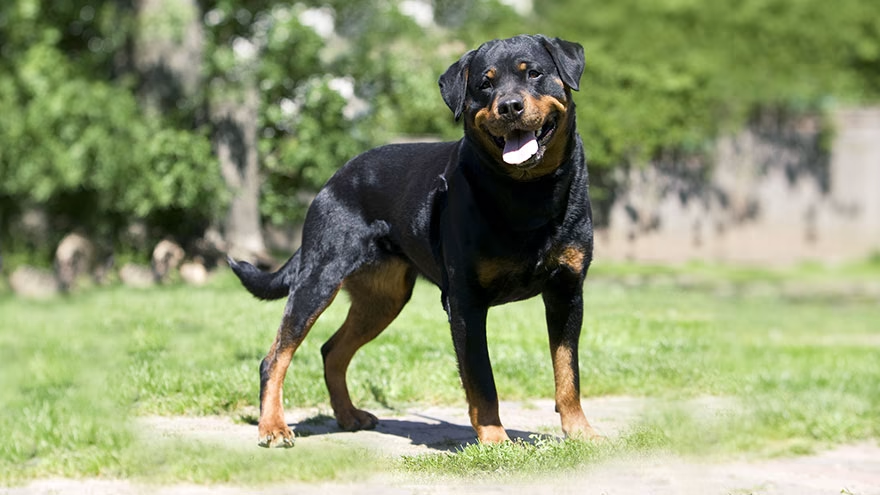
The Rottweiler carries more than two millennia of working history. Roman legions marching north through the Alps brought mastiff-type droving dogs with them — dogs bred to shoulder straying cattle back into line, guard the camp at night, and pull carts loaded with meat to market. By the time those dogs settled in what is now Rottweil, Germany, they had earned a nickname that stuck: the Rottweiler Metzgerhund, the Butcher's Dog of Rottweil. Today that same breed — calm, confident, fiercely loyal — is one of the most recognizable working dogs in the world. It is also one of the most misunderstood. These are the ten questions prospective owners ask most often.
1. How Can I Assess a Rottweiler Puppy's Temperament Before Buying?
Temperament is not a lottery ticket, but it does have a genetic component that runs significantly through the dam. Research suggests roughly 40 percent of a puppy's behavioral disposition traces back to the mother, which makes meeting her in person one of the most useful things you can do before committing. Watch how she interacts with the breeder, with you as a stranger, and with her own puppies. A dam that snarls, cowers, or guards obsessively is a warning signal regardless of how well the puppies are socializing on their own.
The father contributes less to individual puppy temperament in direct contact, but his lineage still matters for long-term traits. Ask the breeder for titles or working evaluations on both parents — Rottweilers compete in Schutzhund (now called IGP) and obedience trials, and a dog with titled parents has had its drives and stability objectively assessed. The American Rottweiler Club's breed standard describes the ideal temperament as calm, confident, and self-assured — not reactive, not anxious. Any puppy that is chronically fearful at 8 weeks should be treated as a red flag, even if the rest of the litter appears steady.
2. Are Rottweilers Unpredictable?
The reputation for unpredictability comes largely from how the breed was misused, not from the breed itself. Because Rottweilers are large, physically powerful, and protective by nature, they attracted interest from people who wanted intimidating dogs — sometimes through deliberate provocation and poor socialization. The result was a population of poorly bred, unsocialized animals whose behavior reflected their handling, not the breed's inherent character.
The AKC breed standard describes the Rottweiler as possessing a "wait-and-see" attitude toward strangers — watchful and reserved rather than explosive. That is a stable profile, not an unpredictable one. A well-bred Rottweiler raised by a knowledgeable owner who started socialization before twelve weeks — exposing the puppy to traffic, strangers, children, and other animals — settles into a dog that is affectionate inside the family and composed outside it. The same dog left in isolation, chained in a yard, or raised without structure can become genuinely dangerous, but that outcome is a failure of environment and management, not a breed defect.
3. What Is the History of the Rottweiler?

The story begins with the Roman legions. As Roman armies pushed into northern Europe roughly 2,000 years ago, they brought molosser-type dogs to herd the cattle that served as a moving food supply. These dogs were working partners, not pets — they drove straying animals back into formation and guarded provisions overnight. When the Romans established a settlement at what would become Rottweil in southwestern Germany, some of those dogs remained.
For centuries the dogs were central to Rottweil's cattle trade. Butchers and drovers relied on them to move livestock through market towns and to haul carts of goods home after a sale. Merchants tied the day's earnings in a purse around the dog's neck — a Rottweiler walking beside you was a more effective deterrent than a locked strongbox. The breed took its formal German name, Rottweiler Metzgerhund, from this role.
The industrial revolution nearly ended the breed. When railways replaced overland cattle drives in the mid-nineteenth century, the Rottweiler's primary job disappeared almost overnight. By 1882, a dog show in Heilbronn recorded exactly one Rottweiler in attendance. Breed enthusiasts organized, and by 1901 the first Rottweiler breed club had formed in Germany. The breed found new roles in police and military work during the early twentieth century, and the American Kennel Club formally recognized it in 1931. Today the Rottweiler consistently ranks among the top ten most popular breeds in the United States.
image_prompt_1
4. How Much Does a Rottweiler Puppy Cost?
The original price range of $500 to $1,000 is decades out of date. From a health-tested, reputable breeder in the United States, expect to pay between $1,500 and $3,500, with $2,000 to $2,500 being most common. Puppies from imported German bloodlines or titled parents can reach $4,000 to $7,000.
The price reflects real costs. A responsible breeder tests both parents for hip and elbow dysplasia through OFA, performs a cardiac evaluation via echocardiogram, runs CAER eye exams, and DNA tests for JLPP — that battery of screenings runs $500 to $1,000 per breeding dog before a single puppy is born. Add veterinary prenatal care, whelping supplies, early neurological stimulation programs, and the first round of vaccines and deworming, and the economics of a bargain-priced Rottweiler puppy become clear: someone skipped something. Puppies offered for $600 on classified sites typically come from parents with no health documentation, which transfers the financial risk — and the heartbreak — to the buyer.
5. Are Rottweilers Prone to Hip Dysplasia?
Hip dysplasia is a developmental condition in which the femoral head and the hip socket do not fit together cleanly. In a normal joint, the two surfaces move smoothly through a full range of motion. When the fit is loose or malformed, the bones grind rather than glide — cartilage erodes, the surrounding tissue becomes inflamed, and the body responds by laying down irregular bone around the joint. That remodeling causes pain, stiffness, and over time a measurable reduction in mobility.
Rottweilers are among the breeds with elevated hip dysplasia rates in the OFA database. The condition is polygenic — multiple genes contribute — and is also influenced by rapid growth, excessive high-impact exercise in puppyhood, and diet. The OFA recommends that Rottweilers used for breeding have both hips and elbows X-rayed and evaluated at 24 months or older, with results filed publicly. Asking a breeder for OFA hip and elbow clearances on both parents is non-negotiable due diligence. A diagnosis of hip dysplasia does not automatically mean surgery; mild to moderate cases are often managed with anti-inflammatory medication, controlled exercise, and weight management. Severe cases may require femoral head osteotomy or total hip replacement. You can also browse related large-breed orthopedic concerns in our overview of the top 10 biggest dog breeds.
6. What Other Health Tests Should a Rottweiler Breeder Provide?
The American Rottweiler Club mandates a specific set of health clearances for member breeders under the CHIC (Canine Health Information Center) program. Hip OFA and elbow OFA at 24 months form the foundation. Beyond those, the mandatory list includes a cardiac evaluation — strongly recommended to be performed by a board-certified cardiologist via echocardiogram — and a CAER eye exam within three years of breeding. DNA testing for JLPP (Juvenile Laryngeal Paralysis and Polyneuropathy) is also required.
The cardiac test screens for Subaortic Stenosis, or SAS — the full term is subvalvular aortic stenosis. SAS is a congenital defect in which a fibromuscular ridge or ring of tissue forms just below the aortic valve, narrowing the left ventricular outflow tract. The left ventricle must then work against that obstruction every time it contracts, generating abnormally high pressure and turbulent blood flow. That pressure overload triggers concentric hypertrophy — the ventricular wall thickens to compensate. In severe cases, the thickened wall outgrows its own blood supply, and the resulting myocardial ischemia creates the conditions for fatal arrhythmia, particularly during exercise. This is why affected dogs can die without warning at a young age. A murmur at puppyhood does not always indicate SAS — but any Rottweiler puppy with a murmur should be evaluated by a cardiologist before purchase. Check out how other breeds handle hereditary health screening, including the Staffordshire Bull Terrier health problems guide.
7. What Is JLPP and Why Does It Matter?

Juvenile Laryngeal Paralysis and Polyneuropathy is a fatal neurological disease caused by a mutation in the RAB3GAP1 gene. It is inherited in an autosomal recessive pattern, meaning a puppy must inherit a defective copy from both parents to be affected. Two carrier parents — each outwardly healthy — have a 25 percent chance of producing an affected puppy with every breeding.
The disease targets the peripheral nervous system, starting with the longest nerves in the body. The first sign, typically appearing between 11 and 13 weeks of age, is labored, noisy breathing caused by paralysis of the muscles that hold the larynx open during inhalation. The airway narrows and the puppy struggles to pull in enough air, especially during activity or excitement. Swallowing becomes difficult, raising the risk of aspiration pneumonia. As weeks pass, the paralysis moves outward — hind-limb weakness and stumbling follow, then front-limb involvement. There is no treatment. Affected puppies rarely survive past six months and most are humanely euthanized once the severity of their decline becomes clear.
A simple DNA cheek swab, processed through the OFA's laboratory at the University of Missouri, identifies each dog as clear, carrier, or affected. Two clear dogs can be bred together with no risk of producing affected offspring. Two carriers can also be bred if the breeder ensures no affected puppies are produced — but the safest and most responsible practice is to breed only clear-to-clear or clear-to-carrier, never carrier-to-carrier. Asking for OFA JLPP results on both parents before purchasing a puppy is a straightforward ask that no ethical breeder will refuse.
image_prompt_2
8. Are Rottweilers Difficult to Train?
Training a Rottweiler is less about difficulty and more about consistency and respect. The breed is genuinely intelligent — Rottweilers have long competed in Schutzhund/IGP trials that test tracking, obedience, and protection work to a high standard, and the dogs that excel at those sports demonstrate an ability to process complex tasks and work through frustration without shutting down. That working drive makes them very trainable in the right hands.
What trips up first-time owners is the breed's confidence. A Rottweiler that spots an inconsistency in the rules — a command enforced Monday but ignored Wednesday — will quietly test the boundary. This is not stubbornness in the way people sometimes mean it; it is a rational animal probing what the arrangement actually is. Clear, consistent rules enforced the same way every time produce a dog that is a pleasure to work with. Positive reinforcement is the most effective approach: food rewards, play, and verbal praise all work well. Harsh corrections applied by someone who does not know the breed tend to produce either a shut-down dog or one that learns to distrust its handler. Begin obedience training at eight weeks, expose the puppy to new environments several times a week through twelve to sixteen weeks, and enroll in a structured puppy class. For comparison, the Miniature Schnauzer is another breed that rewards consistent early training and shows similar working intelligence.
9. How Much Exercise Does a Rottweiler Need?
Adult Rottweilers need between 60 and 90 minutes of genuine physical activity each day — not just a slow loop around the block, but purposeful exercise that raises the heart rate and engages the dog mentally. Long walks, swimming, fetch sessions, and structured play all count. The breed's working history means it does best with some variety rather than the same 30-minute route repeated indefinitely. Rottweilers that do not get enough exercise tend to redirect their energy into behaviors owners find less charming: pacing, destructive chewing, or excessive barking.
Puppies are a different calculation. Growth plates in Rottweilers do not fully close until 18 to 24 months, and repetitive high-impact exercise — long runs on pavement, forced swimming sessions — before that point can damage developing cartilage and compound the risk of orthopedic problems. Short, frequent play sessions of 10 to 15 minutes work better than a single long outing during the puppy months. Once the dog is past two years, it can handle more sustained activity including jogging. Senior dogs, typically around seven years and older, benefit from reduced intensity — 30 to 45 minutes of lower-impact walking keeps them mobile without overstressing aging joints. Managing weight is the constant across all life stages; an obese Rottweiler puts enormous pressure on hips, elbows, and the heart. The average lifespan is 9 to 10 years, and dogs that stay lean and active consistently reach the upper end of that range.
10. Are Rottweilers Good With Children?
A well-bred, properly socialized Rottweiler can be a devoted companion to children in its own household. The breed's instinct to watch over the family is genuine — Rottweilers have historically been described as self-appointed guardians, and that protectiveness extends naturally to the children they are raised with. Stories of Rottweilers gently herding toddlers away from hazards are not fiction; the droving instinct is real and it tends to surface around small, fast-moving humans.
The nuances matter, though. An adult Rottweiler weighing 100 pounds can knock a three-year-old off their feet without meaning any harm, and the breed's protective instincts mean it may not immediately read an unfamiliar child as friendly rather than threatening. Supervision between young children and any large dog is essential, and that goes double for a dog as physically powerful as the Rottweiler. Introductions to children outside the immediate family should be calm and controlled, not chaotic. Families with older children who understand how to read dog body language and approach dogs calmly tend to have smoother experiences than families with toddlers and multiple simultaneous visitors. With that context in place, a Rottweiler that has been well-socialized from puppyhood is a stable, affectionate family dog — not a liability. For contrast, read about how another medium-to-large breed handles family life in our German Shorthaired Pointer Q&A.
Bonus: What Does Rottweiler Coat Care Involve?
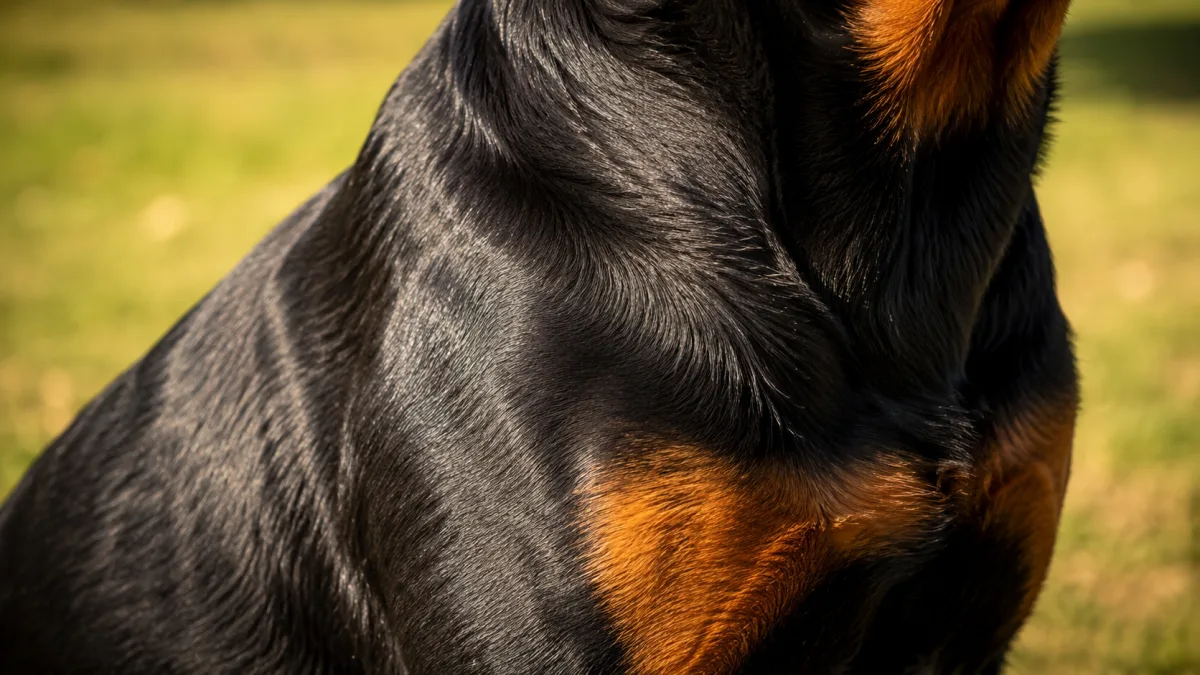
The Rottweiler's coat is one of the breed's lower-maintenance features. The outer coat is straight, coarse, and medium in length; a dense undercoat lies beneath, heavier in cold climates and during winter months. The color is always black with clearly defined mahogany or rust markings above the eyes, on the cheeks, muzzle, chest, and legs — any deviation from this pattern is considered a fault under the AKC breed standard.
Weekly brushing with a firm bristle brush removes loose hair and distributes natural skin oils. The undercoat sheds twice a year in heavier seasonal blows, and during those periods — typically spring and autumn — daily brushing prevents mats and reduces the volume of hair that ends up on furniture. Bathing every six to eight weeks is sufficient for most dogs; bathing too frequently strips the coat's natural oils. Ears should be checked and wiped clean weekly, nails trimmed every three to four weeks depending on how much pavement the dog covers, and teeth brushed several times a week. The overall grooming commitment is modest compared to long-coated breeds. For grooming contrast see our guide to grooming a Longhair Dachshund.
image_prompt_3
Frequently Asked Questions
How long do Rottweilers live?
The average Rottweiler lifespan is 9 to 10 years. Dogs that are kept lean, receive adequate exercise, and come from health-tested lines tend to reach the upper end of that range. Obesity and orthopedic disease are the two factors most likely to shorten a Rottweiler's life.
How big do Rottweilers get?
According to the AKC breed standard, males stand 24 to 27 inches at the shoulder; females measure 22 to 25 inches. Weight ranges from 80 to 135 pounds depending on sex and build, with males typically heavier. The breed is described as medium-large, robust, and powerful — not a giant breed, but close in many individuals.
Do Rottweilers get along with other dogs?
With proper early socialization, most Rottweilers coexist fine with other dogs, particularly those they have been raised alongside. Same-sex pairs can sometimes show dominance tension as both dogs mature. Introducing an adult Rottweiler to a resident dog should be done on neutral ground, on leash, with calm energy — not by opening a door and letting them sort it out. Their confident, assertive nature means they tend to set the terms of social interaction rather than defer to other dogs.
When should a Rottweiler puppy start training?
The moment the puppy arrives home — typically at eight weeks. Puppies at that age are already absorbing information about what behaviors earn rewards, what the household rules are, and whether their environment is safe and predictable. Waiting until six months to start training forfeits the most neurologically plastic window in the dog's development. Basic sit, down, come, and leash manners can all be introduced in short sessions of three to five minutes starting in the first week.
Is the Rottweiler a good choice for a first-time dog owner?
Honestly, the Rottweiler is better suited to someone with prior experience owning a large, confident breed. The dog's intelligence and physical strength mean that gaps in the owner's knowledge and consistency become apparent quickly. That said, a first-time owner who does serious research, commits to professional obedience training from the start, and works with a mentor or knowledgeable breeder can succeed. The most important thing for a first-time Rottweiler owner is this: start structured training before the puppy is twelve weeks old and never stop. A Rottweiler that has been trained and socialized consistently is one of the most rewarding dogs you will ever own. One that has not is a very large problem.

Chiara Bradshaw
Covers education, culture and creative topics with an emphasis on readable explanations and verifiable references.

Leave a reply
Replying to