
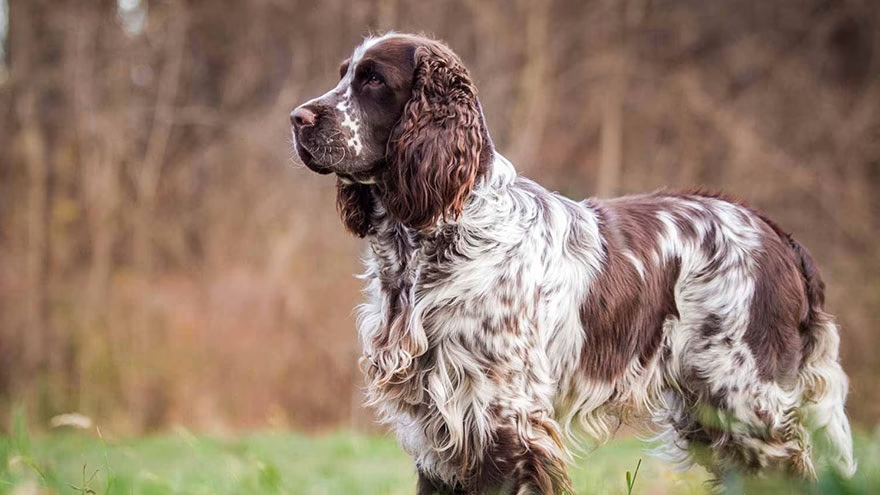
Every time an English Springer Spaniel plunges into dense cover and explodes a pheasant skyward in a burst of wings and feathers, it is doing exactly what it was bred to do — spring game. That single motion, the dramatic flushing leap that sent birds up for falcons or into nets centuries before firearms existed, gave the breed its name and shaped every instinct it carries today. Understanding that origin helps explain why these dogs need so much exercise, why they bond so tightly to their people, and why they thrive on having a job to do.
English Springer Spaniel history and origin
The word "Spaniel" is thought to derive from "Espagnol" — Spanish — suggesting an origin on the Iberian Peninsula, though the dogs were established in Britain long enough ago that ancient Welsh law mentioned them by name around 300 A.D. By the 1500s, written records describe land spaniels performing the springing work that defines the breed. One influential 19th-century strain was the Norfolk Spaniel, developed by the Duke of Norfolk, whose dogs shaped what the larger land spaniels became.
For centuries, springers and cockers were not separate breeds — they were the same litter sorted by size. Dogs large enough to spring pheasant and partridge were called springers; smaller littermates that specialized in flushing woodcock became cockers. The American Spaniel Club, formed in 1880, began formalizing the size distinction, and the Kennel Club in England officially recognized the English Springer Spaniel as its own breed in 1902. The American Kennel Club followed with its first registration in 1910, and the English Springer Spaniel Field Trial Association (ESSFTA) was established in 1924 as the breed's national parent club in the United States.
Springers have won Best in Show at the Westminster Kennel Club dog show six times, first in 1963 and most recently in 2007. Both Presidents Bush owned them: Millie belonged to George H.W. Bush, and her daughter, Spot Fetcher, accompanied George W. Bush into the Oval Office daily — the only presidential pet to have lived in the White House under two administrations.
What does an English Springer Spaniel look like?
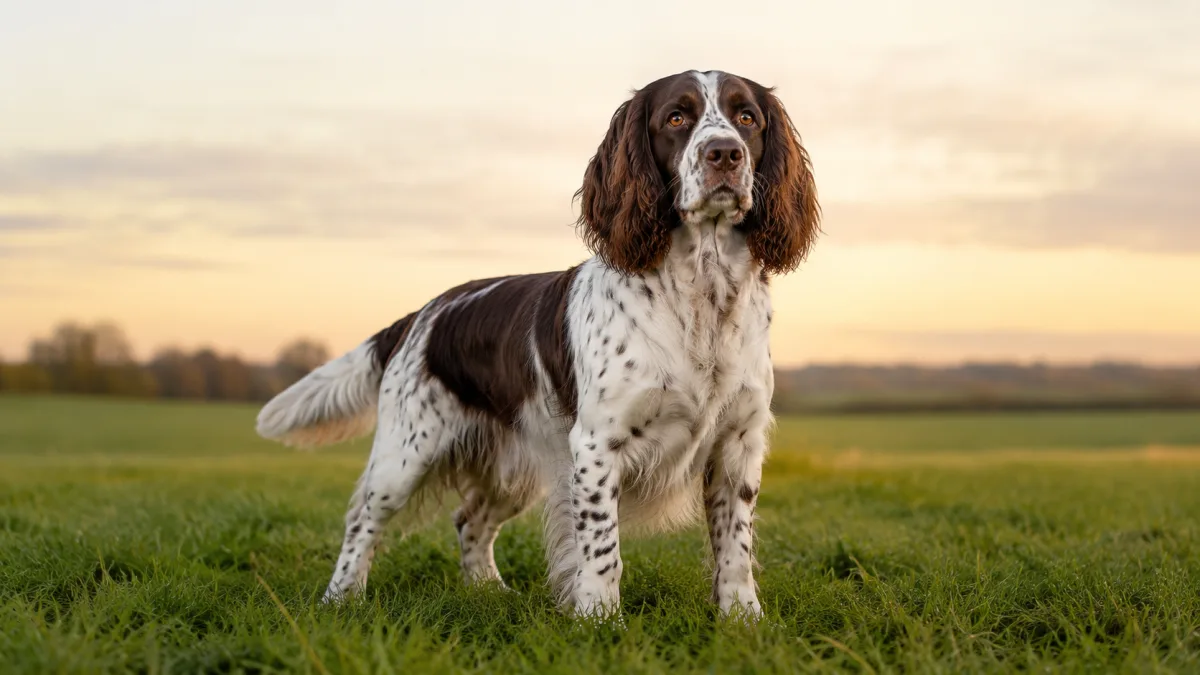
The breed standard describes a compact, medium-sized dog built for a full day in the field. Males stand 20 inches at the shoulder and weigh approximately 50 pounds; females are 19 inches and around 40 pounds. The difference matters because the AKC standard ties weight directly to height — a heavier dog at either height is considered out of condition rather than simply larger.
The coat is the breed's most striking visual feature. A dense outer coat of medium length, either flat or with a soft wave, covers a short, soft undercoat that insulates against cold water and brushy terrain. Long, silky feathering grows on the ears, chest, belly, legs, and tail. Accepted colors include liver-and-white, black-and-white, or tricolor — black or liver and white with tan markings on the eyebrows, cheeks, inside of the ears, and under the tail. Blue roan and liver roan patterns also appear. Off-colors such as lemon, red, or orange are not placed in the show ring.
The expression is described in the breed standard as "kindly and trusting" — a combination of the slightly oval, medium-sized eyes and the long, lush ears that frame the face. The tail, traditionally docked to about one-third of its natural length in the United States, is carried in constant motion when the dog is working. Tail docking is increasingly controversial and has been banned outright in many European countries and parts of Australia.
English Springer Spaniel temperament and personality
Ask any longtime Springer owner to describe the breed and the word "grin" comes up quickly. The broad, loose-lipped smile that spreads across a Springer's face when it greets someone familiar is so consistent that enthusiasts simply call it the "Springer Spaniel grin." Behind that expression is a dog that was bred to work within yards of a hunter all day — which means it is fundamentally oriented toward its people in a way that many sporting breeds are not.
Springers are quick to learn and genuinely eager to please, which makes them straightforward to train with reward-based methods. They are outgoing with strangers rather than aloof, patient with children, and generally compatible with other dogs. When raised alongside cats from puppyhood, most adjust without conflict. Puppies can be mouthy — a working-line holdover from retrieving instinct — and all Springers can be excitable during training sessions if sessions run too long or the handler's energy spikes. Short, upbeat training windows of ten to fifteen minutes outperform marathon drills.
Without adequate exercise or mental engagement, this is a breed that will entertain itself in ways owners find destructive. Boredom shows up as chewing, barking, or compulsive digging — not spite, but a brain that was built to solve problems and has nothing to solve.
Show vs. field lines — the two types of English Springer Spaniel
By the 1940s, breeders began selecting show-line dogs primarily for conformation and field-line dogs primarily for hunting performance. Eighty-plus years of divergent selection produced what are effectively two distinct animals wearing the same name and registration papers.
Show-bred Springers, sometimes called bench or conformation dogs, tend to be heavier-boned with longer ear leather and a more abundant coat. They are typically calmer as household pets and well-suited to families who want a manageable, affectionate companion. Field-bred Springers are smaller and faster, with shorter coats and higher prey drive. They are built to range ahead of a hunter at a ground-covering trot, quarter the terrain systematically, and switch from full working intensity to calm household behavior the moment hunting ends — a trait field breeders specifically select for and call "biddability off the whistle."
The critical thing a prospective owner must understand before buying is which line the puppy comes from. A field-bred Springer placed in a suburban apartment with two forty-minute walks a day will not thrive. A show-bred Springer given to a hunter who needs a dog to work a full day of pheasant cover may lack the drive and stamina for the job. Neither line is superior — they are different tools optimized for different purposes. Ask the breeder directly, and look at what the parents are doing.
For more on related sporting spaniels, see what to expect when owning a Brittany Spaniel, another versatile flushing breed with similar energy demands.
Exercise needs and activity
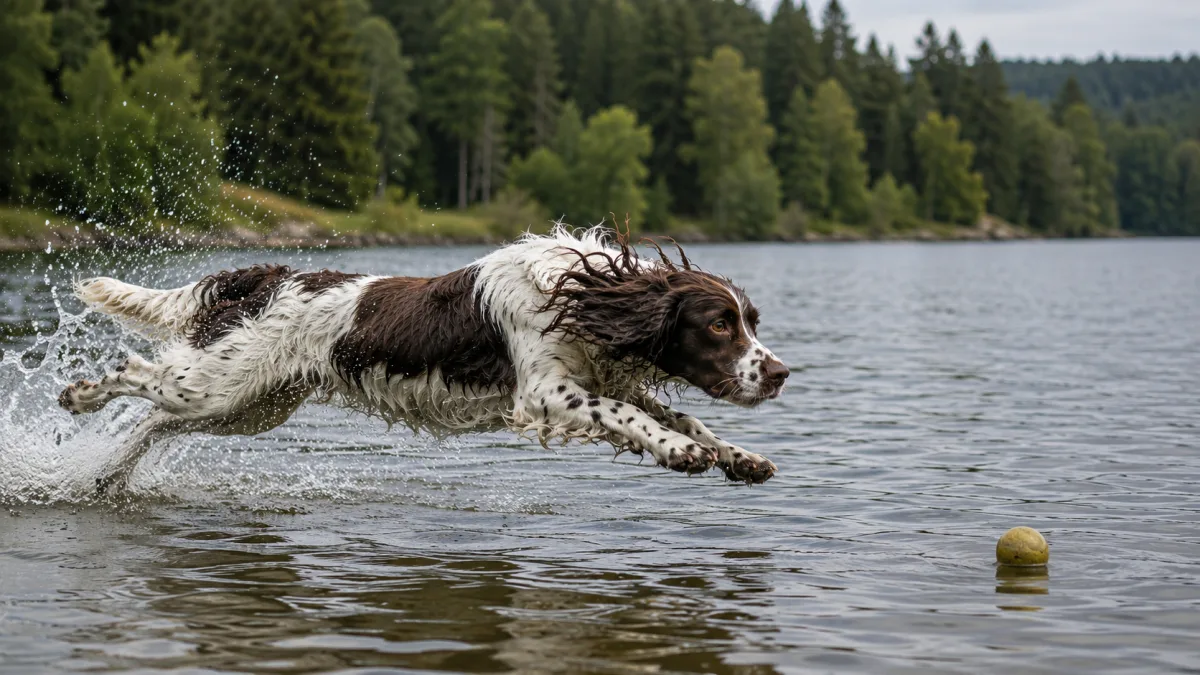
The AKC places the English Springer Spaniel in the Sporting Group, and the breed's exercise requirements reflect that classification precisely. Show-line adults need a minimum of 60 minutes of genuine physical activity daily — not a slow neighborhood stroll, but brisk walking, off-leash running in a secure area, or active fetch sessions. Field-bred dogs require closer to 90 minutes to two hours, and a portion of that time should involve scent work or retrieving games that engage the nose and decision-making circuits, not just the legs.
Swimming is an instinctive preference for most Springers — the water-resistant outer coat and the webbing between the toes are not accidents. Organized AKC activities where Springers excel include Hunt Tests, Field Trials, Agility, Obedience, Rally, and Tracking. Agility, in particular, has become one of the fastest-growing competitive outlets for the breed, as it channels the same combination of speed, body awareness, and handler focus that field work demands. According to the ESSFTA's activities page, some dogs earn titles across multiple disciplines — a designation the club recognizes with a Versatile Springer Award.
A Springer that gets adequate exercise each day is a calm, adaptable housedog. The same dog under-exercised is a different animal entirely. If your schedule reliably allows for less than an hour of vigorous activity per day, this is not the breed for you. For comparison with other high-drive sporting breeds, the German Shorthaired Pointer's exercise profile presents many of the same considerations.
Grooming requirements

The feathering that makes a Springer so handsome is also the source of its heaviest maintenance demand. Fine, silky feathering traps debris — burrs, mud, seeds, and leaf fragments — far more efficiently than the shorter body coat, and the fine texture means tangles tighten quickly if left unaddressed. The areas behind the ears, under the armpits, and on the hindquarters are the first places mats form.
A practical grooming schedule for a pet-kept Springer involves brushing two to three times per week with a slicker brush for surface tangles, followed by a wide-tooth comb worked through the feathering to catch anything the slicker missed. An undercoat rake removes loose undercoat during seasonal shedding. Professional trimming every eight to twelve weeks keeps the coat at a manageable length and tidies the feet, ears, and skull.
Ear care deserves special attention. The long, pendulous ear leathers trap moisture and restrict airflow, creating warm, humid conditions ideal for bacterial and yeast infections. Weekly ear inspections and cleaning with a veterinarian-approved solution are non-negotiable, and ears should be dried thoroughly after every swim or bath. Show-preparation for conformation competition is considerably more involved — extensive coat conditioning, chalking, and sculpting that transforms weekly maintenance into a substantial pre-show project.
For technique guidance applicable to long-coated sporting breeds, the long-coat grooming guide covers brushing and detangling principles that transfer directly to Springer feathering.
Health issues in English Springer Spaniels
The English Springer Spaniel is generally a hardy breed with a lifespan of 10 to 14 years, but several inherited conditions warrant attention before purchase.
Hip dysplasia is the most common orthopedic concern. The hip joint develops improperly, leading to cartilage wear and progressive arthritis. Responsible breeders screen breeding stock using OFA (Orthopedic Foundation for Animals) evaluations or PennHIP radiographs, and buyers should ask to see the parents' clearances as a matter of course.
Phosphofructokinase (PFK) deficiency is a metabolic disorder unique to English Springer Spaniels and American Cocker Spaniels. The enzyme PFK converts glucose into usable energy in red blood cells and muscle tissue. Dogs lacking it cannot sustain energy production under exertion, leading to anemia, exercise intolerance, muscle weakness, and fever — symptoms that can appear anywhere from two months of age through early adulthood. A DNA test identifies carriers, and responsible breeders DNA-test before breeding.
Springer Spaniel Rage Syndrome, more accurately called idiopathic aggression, is a documented but uncommon condition seen primarily in show-line dogs. It differs from normal dog aggression in a key way: there is no readable warning. Dogs affected may be completely calm and affectionate, then attack without any of the body language signals — growling, stiffening, hard eye contact — that precede ordinary canine aggression. Episodes end as abruptly as they begin. The condition is thought to have a genetic basis and appears to be neurological rather than behavioral. It is not trainable out of an affected dog, and management options are limited. Any Springer displaying sudden, context-free aggression requires immediate veterinary evaluation, not a training plan.
Progressive retinal atrophy (PRA), ear infections (as a structural consequence of the ear shape rather than neglect), and skin allergies round out the breed's common health concerns. VCA Animal Hospitals' breed profile also notes that Springers have a tendency to gain weight if fed ad libitum — their enthusiasm for food matches their enthusiasm for everything else.
For a broader look at how inherited conditions affect medium-sized breeds, the Staffordshire Bull Terrier health overview covers similar screening approaches for prospective owners.
Is the English Springer Spaniel right for you?
The Springer fits a narrow but enthusiastic profile. It does well with active families who have secure outdoor space, who can commit to daily exercise that genuinely taxes a sporting dog, and who enjoy having a dog that participates in everything — walks, hiking, swimming, training sessions, and quiet evenings on the couch. The breed is patient with children, adapts to other pets when properly introduced, and travels well.
It is a poor fit for households where the dog will be alone for long stretches most days, where exercise will be limited to two short walks, or where the owner expects an independent dog content to nap while the family goes about its week. These dogs were developed to work alongside humans; isolation and inactivity create stress that expresses itself as problem behavior.
The choice between show and field lines is not cosmetic — it is a fundamental temperament and energy question. Field-bred Springers from working parents require more than most suburban households provide. Show-bred dogs from carefully health-tested parents are more forgiving of a moderately active lifestyle while still needing consistent daily exercise.
Prospective owners curious about how the Springer compares to other compact sporting breeds might also consider reading the Brittany Spaniel breeder guide or the Basset Hound FAQ for contrast between high-drive and low-drive sporting dogs.
Frequently Asked Questions
How much exercise does an English Springer Spaniel need daily?
Show-bred adults need at least 60 minutes of vigorous activity per day. Field-bred dogs from working lines typically need 90 minutes to two hours, with a portion of that time involving scent work or retrieving rather than pure running. Puppies under 12 months should have their exercise managed carefully to protect developing joints — shorter, more frequent sessions rather than long forced runs.
What is Springer Spaniel Rage Syndrome?
Rage Syndrome, also called idiopathic aggression, is a neurological condition seen primarily in show-line English Springer Spaniels. Affected dogs attack suddenly and without the warning signals normal dogs display — no growling, stiffening, or hard stare. The episode ends quickly, and the dog may appear confused or return to normal behavior immediately. It is not the same as fear aggression or redirected aggression, and it is not a training problem. Any dog displaying unprovoked, context-free aggression should be evaluated by a veterinary neurologist.
What is the difference between show-line and field-line Springer Spaniels?
Show-line (bench) Springers have been bred since roughly the 1940s for conformation, with heavier bone, longer ear leather, and more coat. They are typically calmer as pets. Field-line dogs are smaller, faster, and higher-strung, with shorter coats and greater hunting drive. Both are registered as English Springer Spaniels, but their day-to-day energy levels and exercise needs differ significantly. Ask any breeder which line their dogs come from and what the parents' working or show history includes.
Are English Springer Spaniels good with children?
Yes, generally. The breed was developed to work closely with people and is patient and outgoing by nature. Springers tend to enjoy the activity and noise that children generate. As with any dog, children should be taught to interact respectfully, and very young children should be supervised. Puppies can be exuberant and mouthy during play, which calls for consistent early training rather than concern about temperament.
How often do English Springer Spaniels need grooming?
The coat needs brushing two to three times a week at a minimum, with daily attention during heavy shedding periods. Professional trimming every eight to twelve weeks keeps the feathering manageable. Ears should be inspected and cleaned weekly — the pendulous ear flap restricts airflow and creates conditions where bacteria and yeast infections develop easily, particularly after swimming or bathing.
What health tests should I ask a Springer breeder about?
At minimum, ask for OFA or PennHIP hip evaluation results for both parents, a DNA test for phosphofructokinase (PFK) deficiency, and eye clearances for progressive retinal atrophy (PRA). The AKC breed health information page lists recommended health tests for the breed, and the ESSFTA health and genetics page provides additional detail on what responsible breeders should screen for before producing a litter.

Chiara Bradshaw
Covers education, culture and creative topics with an emphasis on readable explanations and verifiable references.

Leave a reply
Replying to