

Sandtray Techniques belong mainly in trained therapy settings. A sand tray can help some clients show feelings, memories, conflicts, and stories without relying only on words.
This is general mental-health education for readers, not a training manual. Sandtray work with trauma, children, dissociation, abuse, or severe symptoms should be led by a qualified clinician.
What Sandtray Means
Sandtray therapy uses a tray of sand and small figures to build scenes, patterns, or worlds. The scene can become a safer way to talk about material that is hard to describe directly.
Psychology Today describes sandplay therapy as a nonverbal therapeutic intervention using a sandbox and figures to create miniature worlds: sandplay therapy overview.
Non-Directive Work
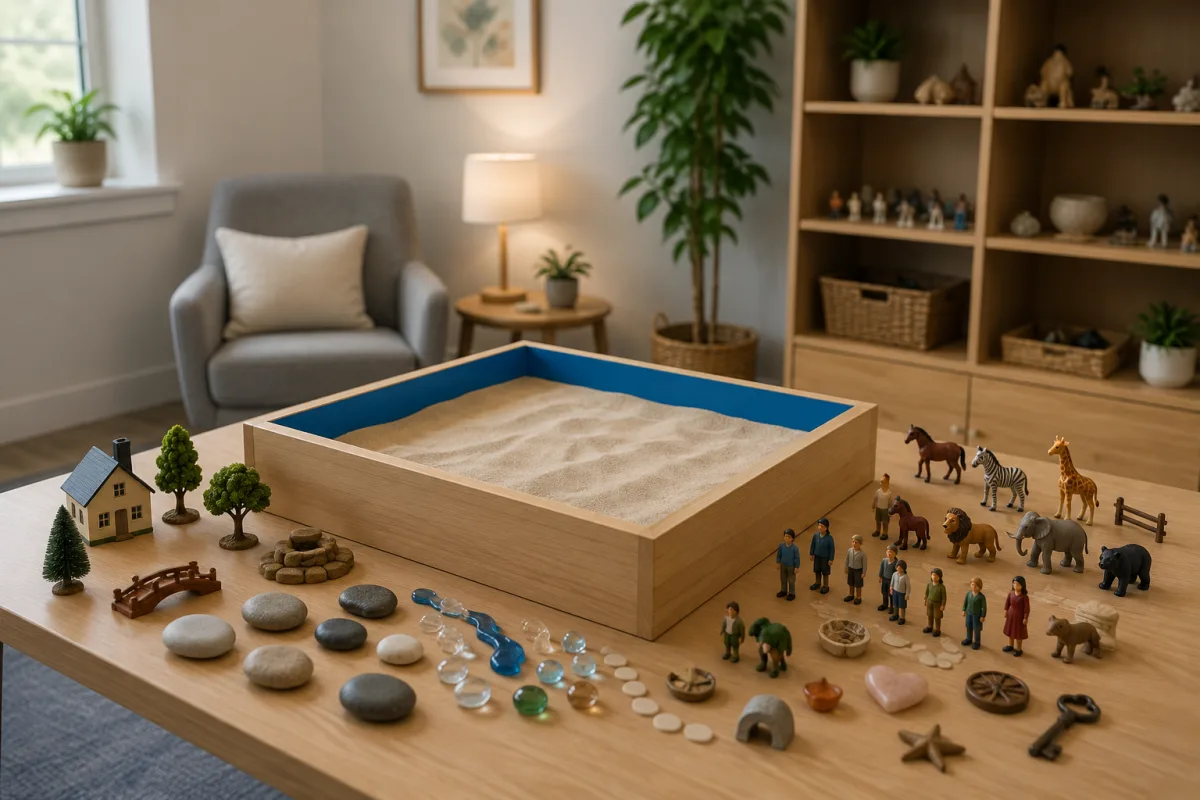
In non-directive work, the therapist offers the tray and figures without assigning a specific scene. The client chooses what to place and where.
The therapist watches, stays curious, and avoids rushing to interpret every object. Meaning belongs first to the client.
Directive Prompts
A directive prompt gives a frame: build a safe place, show a conflict, create a support team, or show what stress feels like. This can help clients who feel lost with too much choice.
Directive prompts should still leave room for refusal, change, and client control.
Miniature Selection

Figures may include people, animals, buildings, vehicles, fences, bridges, symbols, nature objects, and ordinary household items. A varied set helps clients show more than one kind of story.
The set should not push one culture, religion, body type, or family structure as normal.
Boundaries And Consent
The client should know what will happen, whether photos are taken, how records are kept, and that they can stop. Consent is part of safety.
This matters with children too. A caregiver may consent to therapy, but the child still needs respectful choice inside the session.
Trauma-Informed Pace
SAMHSA emphasizes trauma-informed approaches that attend to safety and avoid retraumatization. See SAMHSA's trauma-informed care page.
A sandtray scene can bring up strong feelings. The therapist should pace the work, ground the client, and avoid forcing disclosure.
Reflection Questions
Useful questions are gentle: What title would you give this scene? What do you notice? Where would you stand in it? What might happen next?
Avoid leading questions such as this means you are angry at your father. Interpretation can shut people down.
Closing The Tray

Closing matters. The therapist may invite the client to look at the tray, describe what they want to remember, take a photo if appropriate, or dismantle it with care.
Clients should not be rushed out while activated. Grounding, water, breathing, or a clear next step can help.
Children And Speech
Sandtray can be helpful when children do not have words for what they feel. It should not be used to pressure a child into a specific story.
Livecub's selective mutism article is a related example of why silence deserves skilled support, not force.
Anxiety And Performance
Some adults use sandtray to externalize performance fear, conflict, or stuck choices. Livecub's stage fright guide and sports tryout nerves article are related anxiety topics.
A sandtray scene can make the pattern visible, but treatment still depends on the client's goals and clinical plan.
Training And Ethics
The Association for Play Therapy is a professional society for play therapy training and credentialing. See its professional organization page.
Sandplay Therapists of America also promotes education, training, and research in sandplay therapy.
Home Use Limits
At home, sand play can be calming or creative, but it should not be presented as therapy unless a trained therapist is providing therapy.
If a child or adult reveals abuse, self-harm thoughts, violence, or severe distress during play, respond with safety and professional help.
Sand And Water
Some clinicians use dry sand only; others may use water to shape the scene. Water can intensify sensory and emotional experience, so it should be introduced thoughtfully.
The client should be able to decline water, gloves, touch, or any object that feels uncomfortable.
Documentation
Therapists may photograph the tray with permission, write process notes, or avoid photos depending on setting and consent. Documentation should protect privacy.
Images of trays can contain sensitive meaning even when no person is visible.
Online Limits
Sandtray work is harder online because the therapist cannot control materials, privacy, safety, or post-session support in the same way.
If online expressive work is used, it needs clear limits and a plan for grounding if the client becomes distressed.
Cultural Symbols
Miniatures carry cultural and personal meanings. A figure that seems threatening to one client may feel protective to another.
The therapist should ask, not assume.
Figure Placement
Distance, barriers, height, grouping, and empty space can all matter in a tray, but the therapist should not assume meaning too quickly.
A wall might mean protection, separation, play, or nothing symbolic at all. Ask the client what it means to them.
Resourcing Scenes
A resourcing scene invites the client to build a place, team, or image of support. This can help before deeper trauma work or after a difficult session.
Resources might be people, animals, nature, spiritual symbols, tools, or abstract objects. The client decides.
Conflict Scenes
A conflict scene can show distance between parts, people, choices, or feelings. Seeing the conflict outside the body may make it easier to discuss.
The therapist should pace carefully and avoid pushing the client to solve everything in one session.
Parts Work
Some therapists use sandtray to represent parts of self: protector, critic, child, planner, avoider, or grieving part. This should be done within the therapist's training and model.
Parts language can be helpful, but it should not create fear that the client is broken or divided beyond help.
Group Or Family Work
Sandtray can be used in family or group settings, but privacy and boundaries become more complex. Each person needs a way to participate without being exposed unfairly.
A therapist may set rules about touching figures, speaking for one's own choices, and respecting another person's scene.
Cleaning And Safety
Sand and figures need cleaning routines, safe storage, and materials appropriate for the client's age and setting. Small objects can be choking hazards for young children.
Safety is not a minor detail. A therapy room should support expression without creating avoidable risk.
Therapist Stance
The therapist's stance should be steady, curious, and nonjudgmental. A client may reveal more through arrangement than speech, and silence can be part of the work.
The therapist should not fill silence just because it feels uncomfortable.
Client Choice
Clients should choose whether to speak during the building, after the scene is complete, or not at all. Some sessions are more about witnessing than explaining.
Choice helps protect the client from feeling examined or pushed.
Age Adaptation
Younger children may build quickly and move figures often. Teens or adults may be slower, more symbolic, or more self-conscious.
The technique should match development and comfort rather than forcing one style.
Aftercare
After a strong session, the therapist may suggest grounding, a transition ritual, or a plan for the rest of the day. Emotional material can linger after leaving the room.
Clients should know whom to contact if distress rises later.
Scope Of Practice
A clinician should use sandtray within their license, training, supervision, and setting. A workshop alone does not make someone ready for complex trauma work.
Ethical limits protect both client and therapist.
Respect The Scene
The completed tray should be treated as meaningful even if it looks simple. A single figure in an empty corner can carry as much weight as a crowded scene.
Respect also means asking before moving figures, photographing the tray, or interpreting a symbol out loud.
Training Notes
Therapists learning this method need supervision, personal reflection, and clear consent language. The tools may look playful, but the material can be serious.
Good technique protects the client's pace and keeps the session from becoming a guessing game.
Frequently Asked Questions
What are sandtray techniques?
They are therapy methods using sand, miniatures, scenes, and reflection to help clients express and process experience.
Can anyone do sandtray therapy?
Only qualified clinicians should provide therapy, especially with trauma, children, or severe symptoms.
Is sandtray only for children?
No. It can be used with adults too, depending on training, goals, and client fit.
Should the therapist interpret every object?
No. Meaning should be explored with the client, not imposed by the therapist.
Can I use a sand tray at home?
You can use sand play creatively, but do not treat home sand play as therapy for serious concerns.
Sandtray techniques are powerful only when safety, consent, pacing, and training are respected. The tray should help expression, not force disclosure.

Chiara Bradshaw
Covers education, culture and creative topics with an emphasis on readable explanations and verifiable references.




Leave a reply
Replying to