

What Is Travel Accident Insurance? Travel accident insurance is a narrow benefit that pays after certain accidental deaths or serious accidental injuries during a trip. It is not the same as trip cancellation, travel medical insurance, or ordinary life insurance.
Read the benefit schedule before buying. The policy decides which accidents count, who gets paid, what losses qualify, and whether coverage applies only on a common carrier such as a plane.
Basic Definition
Travel accident insurance often works like accidental death and dismemberment coverage for a trip.
NAIC describes accidental death and dismemberment as coverage that pays beneficiaries if a traveler dies in an accident on the trip or pays the traveler for certain losses such as limb or eyesight loss: NAIC travel insurance consumer guide.
Not Trip Cancellation
Trip cancellation pays for certain prepaid trip costs when a covered reason prevents travel.
Travel accident insurance pays because a covered accident causes death or a listed injury, not because the trip is canceled.
Not Travel Medical
Travel medical insurance may help pay for treatment after illness or injury while traveling.
Travel accident insurance may pay a fixed benefit after a covered accidental death or dismemberment, even if medical bills are separate.
Common Carrier Coverage
Some policies cover only accidents on a common carrier such as a scheduled airline, cruise ship, train, or bus.
Others may offer broader 24-hour travel accident coverage during the trip. The difference is large.
Flight Accident Coverage
Flight accident coverage is narrower than all-trip accident coverage.
NAIC notes that some accidental death and dismemberment plans apply only to an accident that occurs on an aircraft: NAIC travel insurance questions.
Benefit Schedule
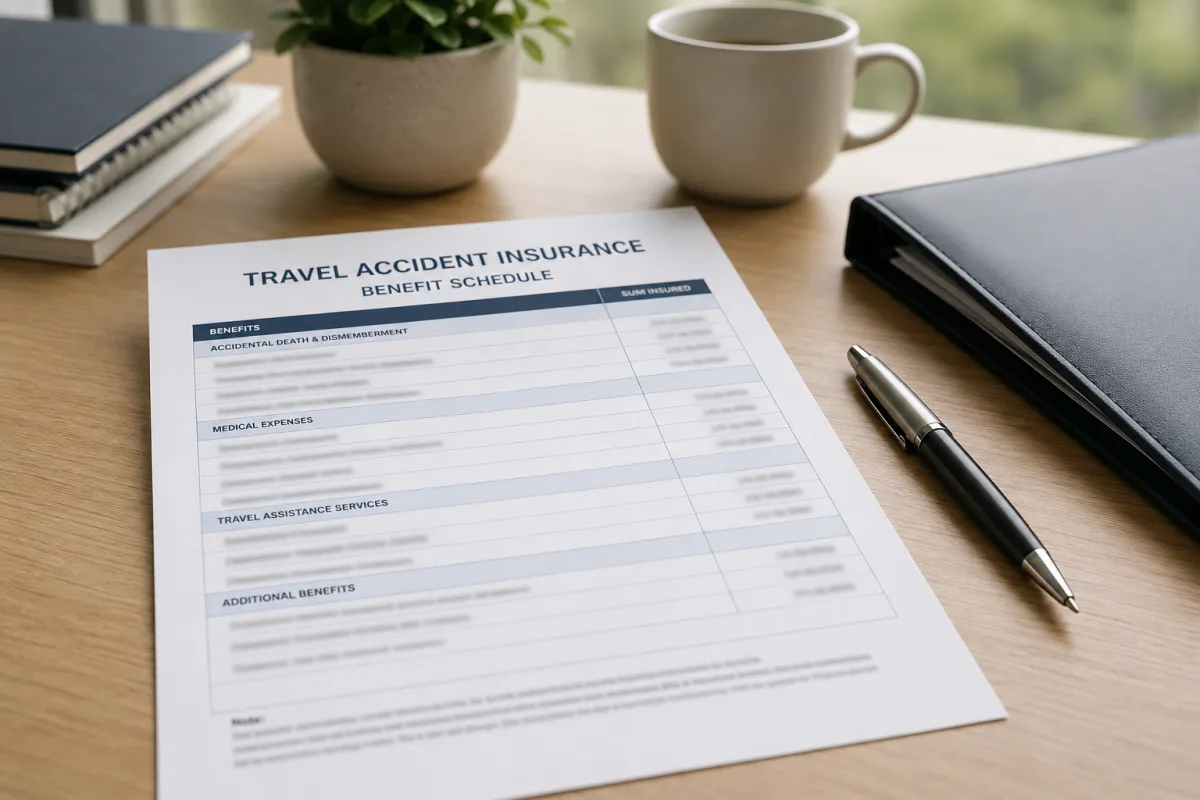
The benefit schedule says how much is paid for death, loss of sight, loss of a limb, or other listed injuries.
Do not assume every serious injury receives the full amount. Many schedules pay different percentages.
Beneficiary Names
If the policy pays a death benefit, the beneficiary designation matters.
Review names, spelling, relationship, backups, and whether the policy follows estate rules if no beneficiary is listed.
Exclusions
Common exclusions may include illness, natural death, suicide, intoxication, illegal acts, war, certain adventure sports, or travel against advice.
The exclusion list can be more important than the headline benefit.
Adventure Travel
If the trip includes scuba, climbing, backcountry skiing, racing, or other high-risk activity, read the activity exclusions closely.
A policy bought for a beach vacation may not fit an expedition trip.
Credit Card Benefits
Some credit cards include travel accident coverage when the fare is paid with the card.
Read the card benefit guide. Coverage may apply only to common carriers and may have claim deadlines.
Employer Travel
Business travelers may have employer-provided accident coverage, but personal side trips may be treated differently.
Ask HR or the benefit provider before assuming a work policy follows you everywhere.
Compare With Life Insurance
Travel accident insurance is not a replacement for life insurance because it covers only certain accidental events.
Life insurance planning should look at family income needs, debt, dependents, and long-term obligations.
Compare With Medical Coverage
A large accident benefit does not mean the hospital will be paid directly.
For international travel, compare emergency medical, evacuation, and accident benefits separately.
Trip Cost Is Different
Travel accident insurance is usually not about recovering trip deposits.
Trip deposits, cancellation rules, and accident benefits should be reviewed as separate policy questions.
Cruise Travelers
Cruise travelers should not rely on accident coverage alone because medical care, evacuation, missed connections, and interruption may be bigger practical risks.
Cruise-specific coverage should include medical, evacuation, missed connection, and interruption questions.
Household Planning
A travel accident benefit may help a family after a tragedy, but it is one small piece of financial planning.
Livecub's money teaching guide can help families build broader money conversations.
Savings Are Not Coverage
Savings can help with immediate costs, but savings do not create an insurance claim.
Livecub's saving bonds value guide covers asset value, which is separate from accidental benefit coverage.
Policy Terms Are Separate
A traveler may also own annuities, bonds, or other financial products, but those do not define an accident claim.
Livecub's annuity comparison guide shows why similar-sounding financial terms should be read separately.
What To Ask
Ask whether the policy is common-carrier-only or 24-hour, what injuries qualify, what exclusions apply, and who receives payment.
Also ask how long after the accident the loss must occur to qualify.
Claims Documents

Claims may require police reports, carrier reports, death certificates, medical records, beneficiary forms, and proof of travel payment.
Keep policy documents and emergency contacts accessible during travel.
When It May Make Sense
It may make sense for travelers who want a small accidental death or dismemberment benefit during a high-cost or frequent travel period.
It makes less sense if the traveler thinks it replaces medical, evacuation, life, or cancellation coverage.
Read Before Adding It
Accident coverage is often sold as an add-on because it sounds simple.
Read it anyway. Simple benefits can still have narrow definitions.
Death Benefit Timing
Some policies require the death or listed loss to happen within a set period after the accident.
That time limit can decide whether a claim qualifies, so read it before relying on the benefit.
Dismemberment Definitions
Dismemberment does not always mean the same thing across policies.
A policy may define loss of hand, foot, eyesight, speech, or hearing in exact medical or legal terms.
Seat Belt Or Carrier Rules
Some accident benefits include extra rules or extra benefits tied to seat belts, air bags, or common carrier travel.
Read these sections slowly because they can change the payout.
Business And Personal Travel
A card or employer plan may cover business travel differently from personal travel.
If a trip mixes work and vacation, ask how the policy treats the personal days.
Who Files The Claim
For a death claim, the beneficiary or estate representative may need to file.
For a dismemberment claim, the traveler may need medical documentation and claim forms.
Estate Issues
If no beneficiary is named, the benefit may pass according to policy rules or estate rules.
That can delay payment, especially if probate is required.
Children And Dependents
Family travel plans may have different benefit amounts for adults and children.
Do not assume every covered traveler has the same payout limit.
High Risk Activities
Motorcycle touring, aviation outside scheduled airlines, racing, diving, climbing, or other activities may be excluded or need a special plan.
Match the policy to the actual itinerary, not the peaceful part of the trip.
Alcohol And Illegal Acts
Accident policies often exclude losses connected to intoxication or illegal acts.
That can matter during vacations where people may take risks they would avoid at home.
Coordination With Other Policies
Travel accident benefits may be paid in addition to other insurance, but the policy wording controls.
Compare it with life insurance, employer benefits, health insurance, and travel medical coverage.
Keep The Benefit In Scale
A small travel accident benefit may not be enough to support a family after a death.
Treat it as a limited travel benefit, not a full financial plan.
Ask Before A Big Trip
For a costly or risky trip, ask the insurer what is covered from door to door, at the airport, on the ship, and during excursions.
The answer may reveal that the benefit is narrower than the traveler expected.
Decide With The Full Picture
Buy or skip travel accident insurance after looking at existing life insurance, medical coverage, evacuation coverage, and the trip itself.
A narrow benefit can be useful, but only when the traveler understands exactly what it does and does not do.
Frequently Asked Questions
What does travel accident insurance cover?
It may pay after covered accidental death or listed accidental injuries during travel, depending on the policy schedule.
Is it the same as travel medical insurance?
No. Travel medical coverage may pay treatment costs, while travel accident insurance often pays a fixed benefit after specific losses.
Does it cover illness?
Usually no. Accident insurance is generally for covered accidents, not illness, natural death, or ordinary medical conditions.
What is common carrier coverage?
It is coverage tied to accidents on scheduled transportation such as a plane, cruise ship, train, or bus, depending on the policy.
Do I need it if I have life insurance?
Maybe not. Travel accident insurance is narrow and should be compared with life, medical, evacuation, and trip cancellation coverage.
Travel accident insurance is narrow. It can pay after certain covered accidents, but it should not be confused with trip cancellation, medical, evacuation, or life insurance.

Tory Stearns
Edits practical household, travel and lifestyle explainers. Claims that can change are linked to current primary or subject-authority sources.




Leave a reply
Replying to