
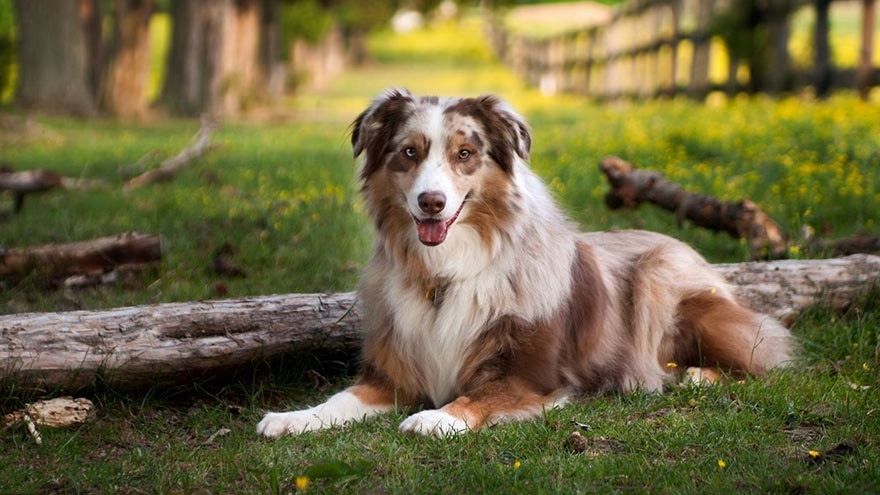
The Australian Shepherd dominates agility competition worldwide — and the breed that wins those titles was built entirely in the American West, not Australia. That paradox captures the Aussie perfectly: a dog full of surprises that rewards owners who take the time to understand it. Australian Shepherd training works best when it starts with knowing what this breed was actually designed to do and why those instincts show up in everything from fetch sessions to early-morning zoomies.
Is the Australian Shepherd really from Australia?
No. The breed developed in the American West — California, Colorado, Wyoming, Idaho — during the 19th century, shaped by the demands of wide-open rangelands and enormous sheep flocks. According to the American Kennel Club's breed history, the Aussie's earliest ancestors were British herding dogs brought east to west, merging with loose herding types already present on the range. The "Australian" name is a matter of association, not geography. When Merino sheep arrived from Australia in the late 1800s — already accompanied by merle-coated dogs that Americans observed doing the herding — observant ranchers labelled every similar dog an "Australian Shepherd." No one in Australia ever called them that.
A 2017 genomic study published in Cell Reports confirmed that the Aussie belongs to the UK Rural clade, alongside the Collie, Border Collie, and Shetland Sheepdog. Basque sheepherders, who came through California during the Gold Rush, likely contributed to the breed's development as well, though their precise genetic input remains debated. The AKC formally recognized the Australian Shepherd in 1991 and placed it in the Herding Group, where it remains one of the most athletically versatile members.
How trainable is the Australian Shepherd?
Stanley Coren's famous intelligence rankings place the Aussie 42nd out of 138 breeds in working and obedience intelligence — solidly above average, but not top ten. That number is worth examining. Coren's scale measures how quickly a dog responds to a command from a stranger in a controlled setting, which is only one slice of intelligence. Where Aussies truly stand out is instinctive and adaptive intelligence: the ability to size up a fluid situation, make an independent decision, and execute it without being told twice. A working Aussie reading a flock of sheep is solving a moving problem in real time. That's the same cognitive hardware that makes pet Aussies both brilliantly responsive and, at times, stubbornly creative about finding loopholes in your rules.
The practical upshot for training is that this breed picks up new behaviors fast and gets bored even faster. A command drilled forty times in a single session will lose the dog's interest by repetition thirty. Keep training sessions short — 10 to 15 minutes — and rotate through skills to maintain engagement. An Aussie that has checked out mentally will start offering unrequested behaviors, spinning, or simply walking away. These aren't defiance signals; they're a boredom report.
What does an Australian Shepherd need to stay mentally engaged?
Adult Australian Shepherds need at least 60 to 90 minutes of physical activity per day, but exercise volume alone doesn't resolve the equation. An Aussie that has sprinted three miles may still shred a couch cushion an hour later because the mind hasn't been touched. The breed was selected over generations for sustained cognitive focus — herding requires tracking multiple animals, anticipating movement, and adjusting pressure in split-second increments. That hyperfocus doesn't switch off at the end of a run.
Nose work, puzzle feeders, obedience drills, trick training, and structured off-leash sessions in a securely fenced yard all count as mental exercise. AKC Scent Work is a particularly effective outlet: it channels the dog's natural olfactory drive into a low-impact, high-engagement activity that works well on recovery days when joint stress is a concern. For owners who want to go further, the Australian Shepherd Club of America (ASCA) offers breed-specific performance programs ranging from obedience and agility to stockdog trials. Giving the Aussie a legitimate job — even a recreational one — is the single most effective management strategy available.
Basic obedience training for an Australian Shepherd
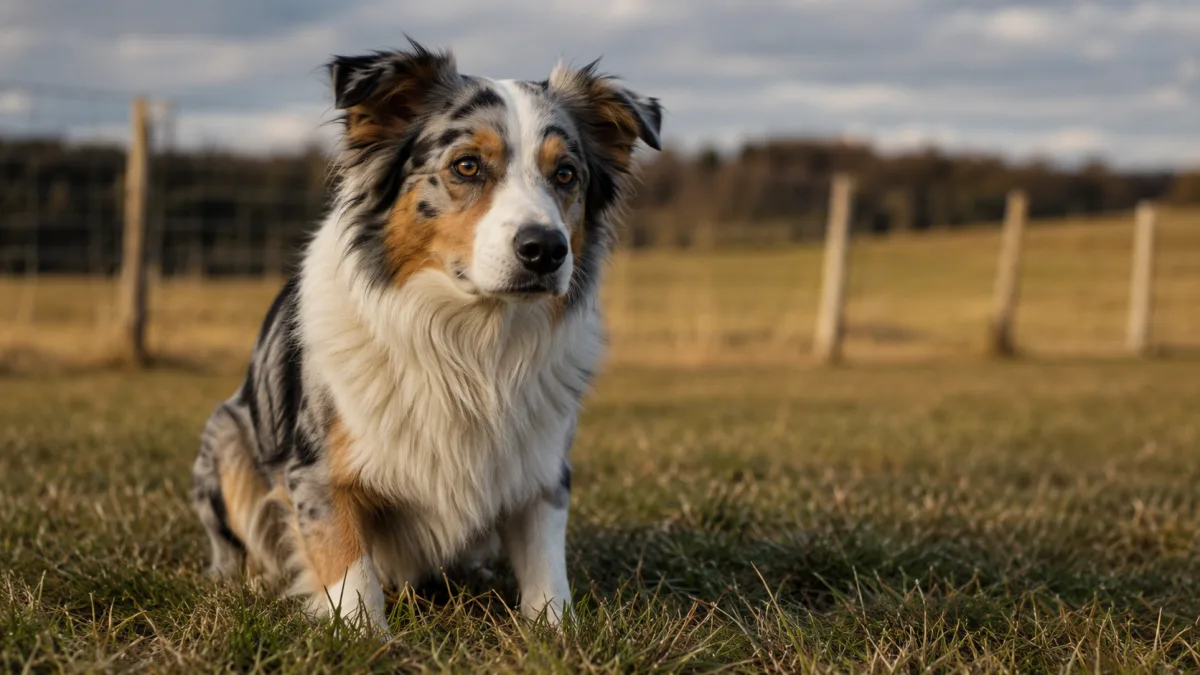
Positive reinforcement is not just the kindest approach for this breed — it's the most effective one, and the science explains why. In operant conditioning, the brain forms an association between a behavior and its consequence only within a narrow time window. Research on reward timing indicates that a delay of even one or two seconds between the behavior and the reward can cause the dog to associate the treat with whatever it happened to be doing at that moment — sniffing the floor, glancing sideways — rather than the sit you just asked for. A clicker bridges this gap precisely. The click marks the exact millisecond of the correct behavior; the treat can follow a beat later. When a click reliably predicts a reward, the brain releases dopamine in anticipation, which accelerates learning and sustains focus across sessions.
Work on one command at a time and proof it fully before introducing another. Aussies are quick enough that owners sometimes rush, layering new cues before the previous one is solid under distraction. The result is a dog that performs beautifully in the living room and falls apart at the park. Once a command is reliable in three different locations with three different levels of distraction, it's genuinely learned. At that point, you can begin chaining behaviors — asking for a sit, then a down, then a stay — which also provides the kind of mental challenge this breed thrives on. If the dog responds with the wrong behavior, simply reset and start the sequence again. Frustration in the handler is contagious and counterproductive; the Aussie will read your energy before it reads your cue.
Herding instinct — how to manage it at home
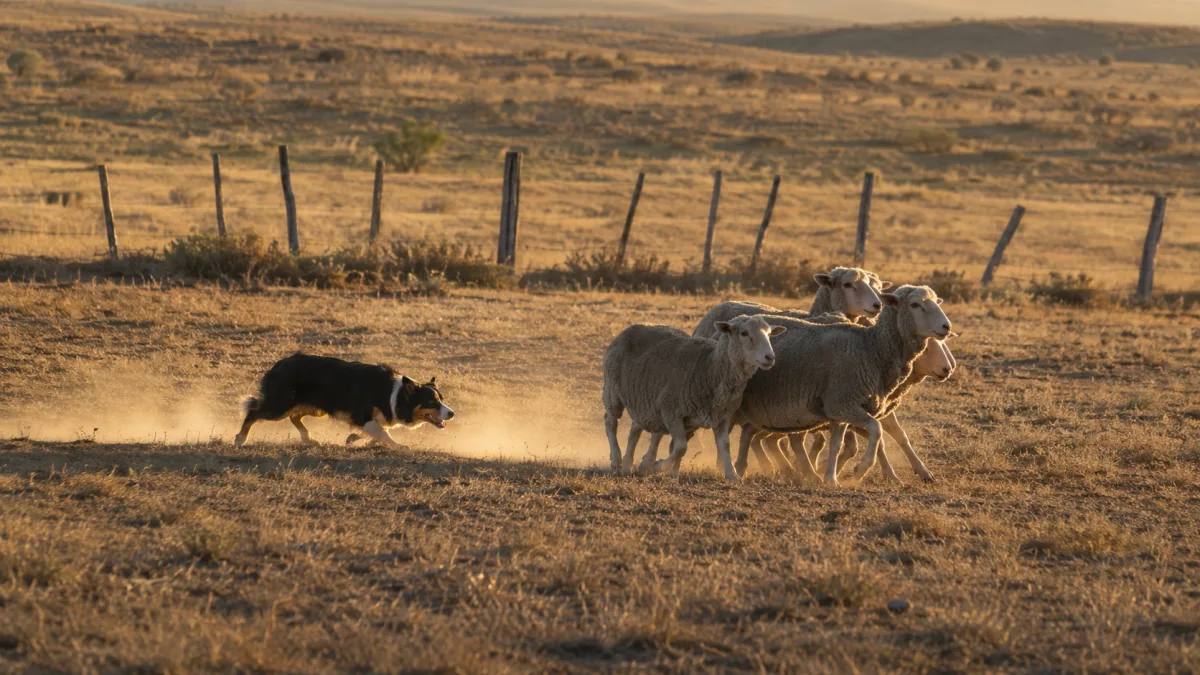
If your Aussie nips at the heels of running children, circles the family dog at the park, or tries to corner the cat in the kitchen, that's not a behavior problem — it's a centuries-old genetic program running exactly as written. Herding dogs were bred to move livestock by applying pressure, cutting off escape routes, and using heel nips to speed up slow-moving animals. Strip away the sheep and you get the same instinct applied to whatever is moving nearby.
The management approach is two-pronged. Short-term, teach a solid "leave it" cue and interrupt herding behavior before it escalates, redirecting the dog to a ball, tug toy, or structured activity. Long-term, give the herding drive a legitimate outlet. Treibball — a sport in which dogs push large exercise balls into a goal using herding techniques — was designed precisely for this purpose. The AKC Herding Instinct Test is also available to Australian Shepherds; dogs six months and older can enter a pen with livestock to demonstrate natural herding aptitude, and passing the test opens the door to full herding titles. Owners of other high-drive breeds will recognize the same principle: a breed instinct channeled into a sanctioned outlet shrinks dramatically as a household problem.
Supervision matters most when children are running and the dog is overexcited. Place yourself between the dog and the moving target, interrupt with a calm verbal marker, and redirect. Over time, consistent management combined with adequate daily outlets reduces the intensity of the impulse considerably.
Agility, disc dog, and sport training for Aussies
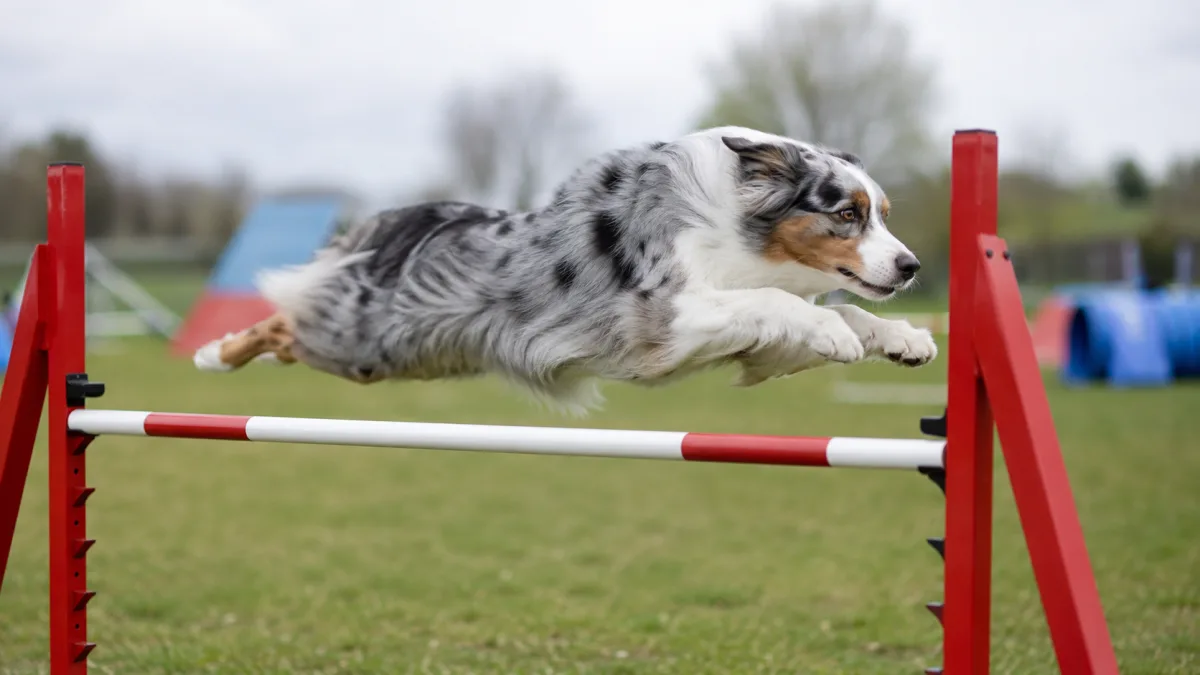
The Australian Shepherd's dominance in competitive dog sports isn't accidental. The same attributes that made the breed exceptional on the ranch — athleticism, trainability, tight handler focus, and an almost compulsive desire to work — translate directly to the agility course, the disc dog field, and the obedience ring. Aussies consistently place among the top dogs at AKC National Agility Championships, and in disc dog (Frisbee) competition the breed is nearly synonymous with the sport's upper echelons.
Agility training should begin on the ground — literally. Foundation skills like targeting, rear-end awareness, and directional cues are taught without equipment first, then transferred to low-set jumps and tunnels once the dog's growth plates have closed, typically around 12 to 18 months depending on the individual. Rushing equipment before physical maturity risks cartilage damage that can derail a working career permanently. For disc dog, Aussies generally take to the sport naturally, but building a solid retrieve and drop command before introducing distance throws prevents the common problem of a dog that catches brilliantly but won't release the disc. ASCA also runs stockdog trials for owners who want to test traditional herding instincts; even dogs with no prior livestock exposure often show strong instinct at their first introduction.
For those looking to compare training approaches across similar working breeds, the Maltese training guide offers a useful contrast — a toy breed that also excels at obedience sports but through an entirely different motivational profile.
Separation anxiety and crate training
Australian Shepherds bond intensely with their people, which is part of their appeal and one of their most significant management challenges. The breed's working history required dogs to stay tuned to a single handler across long workdays. That loyalty, applied to modern home life, can tip into separation anxiety with surprising speed — especially in dogs that were not gradually acclimated to alone time as puppies.
Crate training addresses this directly by giving the dog a defined den space associated with calm and reward rather than isolation and distress. Introduce the crate while you're home, feeding meals inside it and placing high-value chews there. Build duration slowly — five minutes, then fifteen, then an hour — always ending the crate session before the dog shows any sign of anxiety. The goal is a dog that enters the crate voluntarily and settles, not one that tolerates the crate because there's no alternative. Once that foundation is in place, absences can be extended incrementally. Puzzle feeders loaded with frozen food extend engagement and give anxious dogs something to do in the first critical minutes after you leave, which is when anxiety spikes highest.
Dogs that have already developed established separation anxiety may need a formal desensitization protocol — leaving for thirty seconds, returning before any distress, and building from there. A certified professional dog trainer or veterinary behaviorist can design a structured plan; the process takes weeks but prevents the escalating destruction and self-injury that untreated anxiety produces. Owners exploring crate training for the first time can also read about how other working breeds handle similar challenges in the German Shorthaired Pointer FAQ.
Health considerations that affect training
Two health factors can directly influence how your Aussie responds to training and what veterinary choices surround the breed.
Hip dysplasia and elbow dysplasia are inherited joint conditions that occur with enough frequency in Australian Shepherds that the ASCA recommends OFA (Orthopedic Foundation for Animals) hip and elbow evaluations for all breeding dogs. Joint pain changes a dog's training behavior in ways that are easy to misread as stubbornness or declining motivation. An Aussie that was previously eager and is now hesitant to jump, reluctant to sit on command, or slower to recover between sessions may be hurting rather than regressing. If training performance drops without an obvious cause, a veterinary exam should precede any change in protocol. Low-impact work like nose work, swimming, and loose leash walking keeps the mind engaged during recovery periods without stressing affected joints.
The MDR1 (ABCB1) gene mutation is the other major consideration. Approximately 50% of tested Australian Shepherds carry at least one copy of this mutation, which disrupts p-glycoprotein — the pump that clears certain drugs from the blood-brain barrier. Affected dogs can experience severe neurological reactions to medications that are routine in other breeds: ivermectin at high doses (used to treat demodectic mange), loperamide (the active ingredient in Imodium), some sedatives and opioids, and several chemotherapy drugs. According to VCA Animal Hospitals, dogs with two mutated copies are at greatest risk, while those with one copy show milder effects. A simple cheek swab test, available through commercial veterinary genetics labs and Embark Vet, identifies your dog's status. Sharing that result with every vet, groomer, and boarding facility your dog encounters is a practical step that can prevent a medical emergency — and that information is most useful before, not after, a procedure requires anesthesia or parasite treatment.
Owners of double merle Aussies — dogs produced by merle-to-merle breeding — should also be aware that this color combination raises the probability of congenital deafness and vision impairment. Deaf Aussies respond well to hand signals and vibration-based cues; training them follows the same positive reinforcement principles, adapted to visual rather than verbal markers.
Frequently Asked Questions
At what age should I start training my Australian Shepherd?
Socialization and very basic obedience — sit, name recognition, leash introduction — can begin the day your puppy comes home, typically around eight weeks. Puppies have a critical socialization window that closes around 12 to 16 weeks; exposing them to different people, surfaces, sounds, and animals during this period produces lasting behavioral benefits. Formal training classes are appropriate from about eight weeks as long as the puppy has had initial vaccines. Structured sport training, particularly anything involving jumping or contact equipment, should wait until 12 to 18 months to protect developing joints.
How much exercise does an Australian Shepherd need each day?
Most sources, including breed-specific guides and veterinary recommendations, put the minimum at 60 to 90 minutes of physical activity per day for an adult Aussie. That figure assumes a mix of aerobic exercise — running, fetch, swimming — and structured mental engagement. A dog that gets two hours of off-leash fetch but no training or enrichment may still exhibit restless or destructive behavior indoors. The mix matters as much as the total.
Is punishment-based training safe to use with Australian Shepherds?
Punishment-based methods carry real risks with any dog breed, and Aussies are particularly sensitive to harsh handling given their strong bond with handlers and their high situational awareness. Punishing an incorrect response creates ambiguity — the dog learns what not to do but doesn't learn what you're actually asking for — and can introduce avoidance and anxiety into training sessions. Reward-based training, by contrast, builds a clear behavior history: the dog knows exactly which action produced the good outcome. The science on this is consistent: positive reinforcement produces faster acquisition, better retention under distraction, and fewer behavioral side effects than punishment-based protocols.
My Aussie keeps herding my kids. What should I do?
Manage the environment first by supervising all interactions when children are running, and interrupt herding attempts early — before the dog makes contact. Redirect to a toy or structured activity immediately after the interruption. Parallel to management, provide a proper outlet for the herding drive: treibball, agility, or even regular fetch with directional commands satisfies the same neurological itch. Over several months of consistent redirection plus adequate daily exercise, most Aussies reduce the intensity of this behavior substantially. If it persists or escalates, a trainer with herding breed experience is the appropriate next step. You can also read more about managing working breed instincts in the Staffordshire Bull Terrier health article for comparison with another high-drive breed.
What is the MDR1 mutation and why does my vet need to know?
The MDR1 (ABCB1) mutation disrupts a protein called p-glycoprotein that normally pumps certain drugs out of the brain before they reach toxic concentrations. About 50% of Australian Shepherds carry at least one copy of the mutation. Affected dogs can suffer neurological crises — seizures, ataxia, coma — from doses of ivermectin, loperamide, and certain anesthetics that would be safe in other breeds. A cheek swab DNA test identifies your dog's status. Share those results with every veterinarian, emergency clinic, and boarding facility your dog encounters. At standard heartworm-prevention doses, ivermectin-based products are generally considered safe even for MDR1-positive dogs, but high-dose ivermectin treatments should be discussed with your vet and alternatives considered.
Can Australian Shepherds be trained for off-leash reliability?
Yes, and many Aussies achieve excellent off-leash reliability because their handler focus is so strong. The critical ingredient is a solid recall that has been proofed in high-distraction environments over many months. Begin recall training on a long line (15 to 30 feet) before removing the leash, and practice in successively busier environments. Never punish a dog that returns to you slowly — doing so makes coming back to you a less attractive option. An emergency recall word, trained separately from the everyday "come" and always rewarded with the highest-value treat in your arsenal, gives you a backup cue for genuine safety situations. E-collar training can be effective for off-leash work when applied by an experienced trainer using low-level stimulation as communication, not as punishment, though positive-reinforcement-based long-line methods achieve the same result for most Aussies without the associated risks.

Tory Stearns
Edits practical household, travel and lifestyle explainers. Claims that can change are linked to current primary or subject-authority sources.
Leave a reply
Replying to