
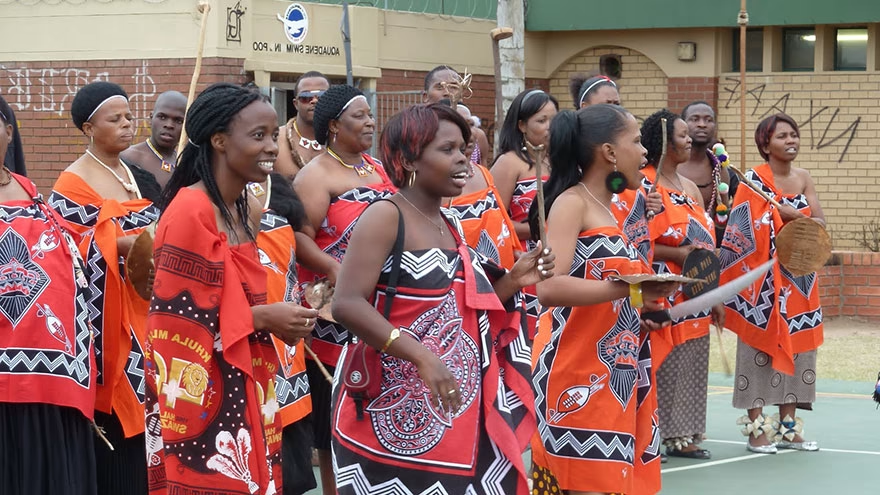
Culture Facts Are About Patterns, Not Stereotypes
Culture facts are useful only when they help you notice patterns without flattening people into cartoons. Culture includes learned behavior, shared meanings, language, symbols, values, food, etiquette, art, family habits, and daily routines. It is not a fixed script that every person follows the same way.
OpenStax's elements of culture chapter explains culture through values, beliefs, norms, symbols, and language. That framework is better than memorizing a list of national stereotypes.
Good cultural knowledge makes you more careful, not more certain.
Culture Is Learned
People are not born knowing which foods feel normal at breakfast, how close to stand in conversation, how to greet elders, what counts as polite silence, or when a celebration should happen. Those habits are learned through family, school, religion, media, peers, work, and place.
Learning culture does not mean copying one official rulebook. Families differ. Rural and urban communities differ. Generations differ. A traveler who understands that will ask better questions and make fewer assumptions.
For travel planning around place and context, Livecub's Petoskey travel guide is a useful internal reminder that destinations are shaped by local rhythm, not only attractions.
Culture is practiced before it is explained.
Language Carries More Than Vocabulary
Language carries humor, politeness, distance, emotion, hierarchy, and belonging. The same literal sentence can feel warm in one setting and blunt in another. Tone, pauses, greetings, honorifics, and indirect wording all matter.
OpenStax's what is culture section discusses how unwritten rules and shared meanings shape daily life. For travelers, that means translation is not only word-for-word language.
If you do not understand a phrase, ask gently. People usually prefer curiosity to confident misreading.
Symbols Carry Shared Meaning
Symbols can be flags, colors, clothing, gestures, songs, buildings, religious objects, sports teams, flowers, or even a style of handwriting. The object itself may be simple. The meaning around it can be deep.
Travelers should be careful with symbols because they may touch grief, pride, faith, politics, or family history. A color that feels decorative to you may have a role in mourning, celebration, or protest somewhere else.
Symbols are small only until you learn what they carry.
Norms Are the Unwritten Rules
Norms are the everyday expectations that tell people how to behave. Some are formal, like laws. Others are informal, like how loudly to speak on a train, whether to remove shoes indoors, or how to queue.
Norms can be invisible until someone breaks them. Travelers often learn this quickly: a gesture, tip, greeting, or clothing choice may carry meaning that was not obvious from home.
For a travel example where local rules and access shape the visit, Livecub's Spiral Jetty guide shows why place-specific details matter.
Unwritten does not mean unimportant.
Food Is Culture in Daily Form
Food carries memory, season, religion, class, migration, family identity, agriculture, trade, and celebration. A dish is rarely just ingredients. It can mark a holiday, a region, a childhood, a grief ritual, or hospitality.
Be careful with food judgments while traveling. Calling unfamiliar food strange says more about your starting point than the food. Ask what the dish means, when people eat it, and what variations exist.
For another place-based travel comparison, Livecub's Laughlin travel ideas shows how regional activities and food stops become part of a trip's local feel.
Etiquette Is Culture in Motion
Etiquette is not only which fork to use. It includes greetings, gift giving, eye contact, silence, punctuality, hospitality, shoes indoors, tipping, personal space, and how directly people disagree.
Etiquette can change by setting. A behavior that is fine among close friends may be wrong at a religious site, family table, workplace, or memorial. Travelers who watch the setting before acting usually make fewer mistakes.
Politeness depends on the room.
Material Culture and Nonmaterial Culture Work Together
Material culture includes objects: clothing, tools, houses, temples, phones, art, roads, and furniture. Nonmaterial culture includes meanings, beliefs, values, language, and rules. The two are linked.
A wedding ring is material. The promise, status, family expectation, and emotion around it are nonmaterial. A public square is material. The way people gather, protest, flirt, sell food, or celebrate there is cultural practice.
Objects become cultural when people give them meaning.
Culture Changes
Culture is not frozen in a museum case. Migration, technology, trade, intermarriage, law, climate, work, music, war, education, and media all change how people live. Sometimes the change is slow. Sometimes one invention changes daily routines in a decade.
The Smithsonian National Museum of Natural History's anthropology department describes anthropology as the study of humans and their societies across past and present. That time span matters because culture is always being made and remade.
Do not treat an old guidebook, movie, or childhood memory as the final version of a place.
Migration Blends and Preserves Culture
Migration does not simply erase old habits or copy new ones. People carry recipes, languages, holidays, faith practices, music, names, jokes, and family expectations into new places. Some practices fade. Others become stronger because they help people stay connected.
That is why cities often contain many cultural layers at once. A neighborhood bakery, grocery store, festival, or place of worship can tell a story about movement, adaptation, and memory.
Do not assume blended culture is less authentic. Culture has always traveled with people.
Individuals Do Not Equal the Whole Culture
One person can teach you something, but one person cannot represent everyone. Age, region, religion, language, education, class, gender, profession, family, and personality all affect how someone lives within a culture.
If three people from the same place give three different answers, that is not a failure of culture. It is culture being lived by real people. Patterns exist, but variation is normal.
For another destination-focused internal link, Livecub's Waverly Hills tour guide shows how a place can carry many meanings depending on history, visitors, and local storytelling.
Culture Shock Is a Signal
Culture shock is not only dramatic homesickness. It can be irritation at small things: meal timing, noise, paperwork, directness, service speed, personal space, or public behavior. That irritation often reveals an expectation you did not know you had.
When that happens, pause before judging. Ask what local logic might be at work. The goal is not to agree with everything. The goal is to understand before reacting.
Discomfort can be information.
Cultural Appreciation Needs Context
Appreciating culture means learning context, crediting sources, respecting sacred or private practices, and avoiding costume-like use of identity. Buying food from a local restaurant and asking about a festival are different from wearing a religious item as a party prop.
If someone from that culture says a practice is sensitive, listen before defending your intention. Good intentions do not erase impact. Curiosity works best when paired with humility.
Respect is more useful than performance.
How Travelers Can Use Culture Facts Well
Use culture facts as preparation, not as a script. Learn greetings, basic etiquette, religious or holiday timing, tipping norms, clothing expectations, food customs, and photography rules. Then stay observant once you arrive.
Watch what locals do in public places. Ask hotel staff, guides, hosts, or friends when you are unsure. Apologize quickly if you make a mistake. Most cultural learning happens in small corrections.
For an outdoor travel comparison, Livecub's Skyline Drive waterfalls article shows the same planning principle: conditions on the ground matter more than a generic checklist.
Better Questions to Ask
Instead of asking, "What is your culture like?" ask smaller questions. "When do families usually gather?" "What foods mark this holiday?" "Is there a polite way to greet elders?" "Are photos okay here?" Smaller questions get better answers.
Do not make one person your unpaid teacher for every question. Use museums, books, local guides, official visitor information, and respectful observation too. Then keep revising what you think you know over time with care.
Frequently Asked Questions
What is culture in simple terms?
Culture is the learned and shared way people make meaning, behave, communicate, celebrate, organize life, and pass habits to others.
What are examples of culture?
Examples include language, food, holidays, clothing, family roles, music, religious practice, manners, laws, values, and everyday routines.
Is culture the same as nationality?
No. Nationality can influence culture, but culture also varies by region, family, religion, language, generation, class, and community.
Why does culture change?
Culture changes through migration, technology, trade, education, media, law, environment, conflict, creativity, and everyday human choices.

Cashie Evans
Covers parenting and practical household topics with clear steps, safety notes and links to current guidance.



Leave a reply
Replying to