
Saint Bernard history — alpine rescuers and the Barry legend
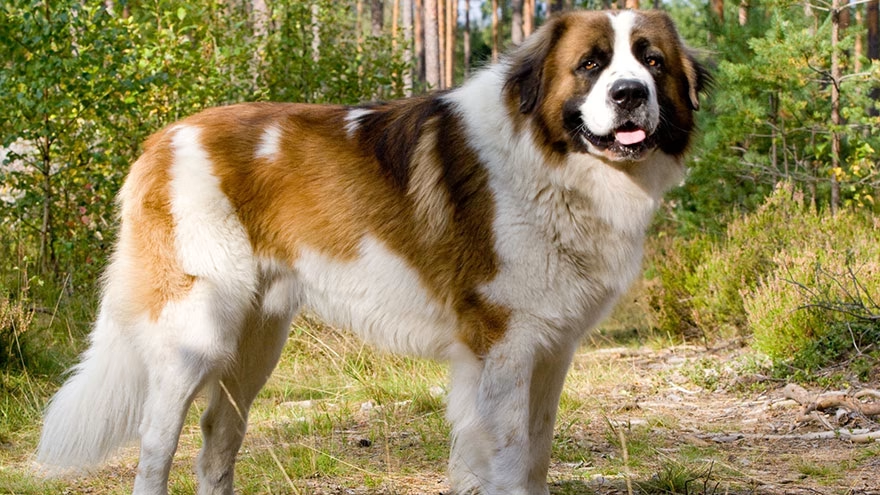
High in the Western Alps, at an elevation of 2,469 metres on the Great St. Bernard Pass between Switzerland and Italy, a monk named Bernard de Menthon founded a hospice around 1050 to shelter pilgrims and traders crossing one of the most treacherous mountain routes in Europe. Sometime between 1660 and 1670, the monks acquired large, mastiff-descended dogs — first as watchdogs, then as companions on search-and-rescue missions into the blizzards that regularly swallowed travellers whole. What began as an assignment to accompany the monks became something remarkable: the dogs learned to find buried survivors faster than any human could. They would dig through the packed snow, lie across the injured person to transfer body heat, and send a partner back to the hospice to alert the monks. By the time the AKC documented the breed's history, the Hospice dogs were credited with saving more than 2,000 lives over two centuries.
The most celebrated of these dogs was Barry der Menschenretter — Barry the rescuer of people. Born in 1800 at the Hospice itself, Barry worked the pass for twelve years and is credited with more than forty rescues before his death in 1814. His preserved body has been on display at the Natural History Museum in Berne since 1815. What Barry never carried was a brandy barrel around his neck. That detail was invented in 1820 by a young British painter named Edwin Landseer, who added a small cask to the collar of one dog in a painting called Alpine Mastiffs Reanimating a Distressed Traveller — a whimsical flourish that caught the public imagination and became the breed's defining myth. The barrel was Landseer's invention; the rescue work was real.
The American Kennel Club recognised the Saint Bernard in 1885, placing it in the Working Group — an acknowledgment of that alpine heritage that still shapes how we understand this dog today. Males stand 28 to 30 inches at the shoulder and typically weigh between 140 and 180 pounds, with some individuals exceeding 200 pounds. Females are slightly smaller, generally 26 to 28 inches and 120 to 140 pounds. Life expectancy is 8 to 10 years, the compressed lifespan that comes with extreme size.
Why training a Saint Bernard must start early

A Saint Bernard puppy at eight weeks weighs somewhere between 10 and 15 pounds. That same dog at eighteen months may weigh 140 pounds. The window between those two points is when Saint Bernard training matters most — not because young dogs are especially impressionable in some vague sense, but because the physics of the situation change completely. Teaching a 12-pound puppy not to jump on guests involves redirecting a minor inconvenience. Addressing the same habit in a 160-pound dog means managing an animal that can knock a grown adult off their feet without trying.
The neurological argument for early training is equally clear. Puppies between roughly 8 and 16 weeks are in a critical socialisation period when the brain is actively cataloguing what is normal and non-threatening. Experiences missed during this window — different surfaces underfoot, strangers in hats, children on bicycles, other dogs of varying sizes — are far harder to introduce later without triggering anxiety or reactive behaviour. A fearful Saint Bernard at 160 pounds presents challenges that a fearful small dog simply does not. Size amplifies every gap in early training.
Saint Bernards also mature slowly compared to medium-sized breeds, both mentally and physically. They can remain puppy-like in judgement well into their second year, which means the commitment to consistent Saint Bernard training cannot be front-loaded and then abandoned at six months. The breed tends to be willing and good-natured, but it can be stubborn — not aggressively so, but with the particular stubbornness of a large animal that has decided the effort is not worth its while. Short sessions of 10 to 15 minutes, kept engaging and free from repetitive drilling, work better than long ones that drag into tedium.
The gentle giant's temperament — what training works with
The AKC describes the Saint Bernard as watchful, patient, and careful with children, and VCA Animal Hospitals echoes this: calm, sweet, with an easygoing nature that makes them genuinely pleasant to live with once trained. These are not hyperactive dogs. An adult Saint does not require the high-energy outlet of a Border Collie or a Vizsla. What they need is consistent structure and moderate daily movement — and that natural calm is one of the best tools a trainer has.
The temperament also comes with some notable quirks. Drool is not a grooming issue so much as a permanent feature of the household. After drinking or eating, a Saint Bernard shakes its head and the result ends up on walls, windows, and clothing. This is relevant to training because high-value food rewards — the primary currency of positive reinforcement — need to be accounted for in the dog's daily caloric intake. Saint Bernards can gain weight easily given their size-to-metabolism ratio, and overweight dogs face compounded joint problems. Small, high-value treats used precisely and counted against daily food rations keep the dog lean and the training effective.
Variety in reward types helps too. Toy play, enthusiastic verbal praise, brief play breaks — alternating these with food keeps the dog engaged without over-relying on treats. The core principle remains the same: positive reinforcement is the only training approach that makes sense for this breed. Aversive methods risk producing a dog that is anxious or shutdown rather than cooperative, and an anxious Saint Bernard at full size is a serious management problem.
Core commands every Saint Bernard needs
The foundation commands — sit, stay, down, come, and leave it — apply to every breed, but they carry particular weight for a giant dog. Sit is arguably the single most important behaviour a Saint Bernard owner can teach, and not just because it demonstrates control. A sitting dog cannot simultaneously be jumping on a visitor. Sit becomes the default greeting behaviour, the interrupt for anything unwanted, the anchor around which all other manners are built.
Timing determines how quickly any command becomes reliable. When a dog performs a desired behaviour, the brain's associative learning machinery is running a short clock — the window in which a reward meaningfully strengthens that specific behaviour is roughly one to two seconds. A treat delivered five seconds after the sit gets associated with whatever the dog is doing at the five-second mark, which may be nothing useful. This is why marker training with a clicker or a consistent verbal marker like "yes" is so effective: the marker bridges the gap between the behaviour and the treat, preserving the association even if the treat takes a few extra seconds to deliver. The click tells the brain "that exact thing you just did." The treat confirms it.
Leave it takes on special importance for a dog whose head is roughly at counter height and whose reach is considerable. Teaching a reliable leave it — beginning with food covered by a hand, progressing to objects on the floor, eventually working up to food dropped in the kitchen — protects both the dog and the household from the casual destruction a curious giant can accomplish. Come, or recall, should be trained with the most valuable rewards available and never associated with punishment. A Saint that does not come reliably when called is a much larger problem off-lead than a toy breed in the same situation.
Early socialisation runs parallel to command training rather than after it. Puppy classes serve both goals simultaneously — basic commands in a structured environment while exposing the dog to unfamiliar dogs, people, and surfaces. For a breed whose size places it among the largest dog breeds in the world, that exposure is insurance against the reactive behaviour that can emerge from under-socialised giant dogs.
Leash manners and managing size
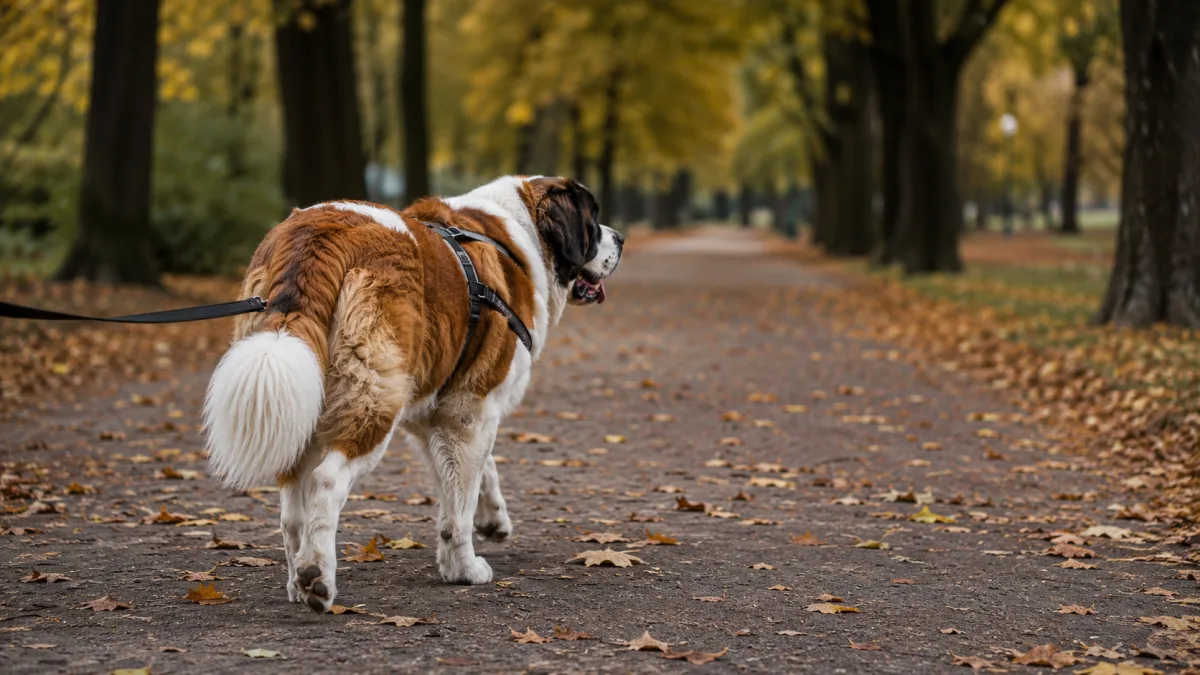
A Saint Bernard that pulls on the lead is not being aggressive or defiant — it is simply going where it wants to go, and at 160 pounds it can do so regardless of what the person on the other end of the leash intends. This is the mechanical problem that makes leash manners a non-negotiable priority from the first weeks of ownership.
A standard flat collar is inadequate for a pulling giant breed. The two most effective tools for managing leash pressure before manners are fully trained are the front-clip harness and the Gentle Leader headcollar. The front-clip harness redirects the dog's body toward the handler when tension is applied, making it physically harder to sustain a pull. The headcollar works on the same principle as a horse halter — control the head, and the body follows. Neither is a substitute for training, but both make training sessions safer and more productive while the dog learns that loose-leash walking is what makes the walk continue.
"Four on the floor" is the shorthand rule most Saint Bernard owners eventually adopt for greetings: all four paws must remain on the ground for interaction to happen. Combined with a reliable sit, this rule addresses the jumping problem at the source. Guests are instructed to turn away and remove attention the moment a paw leaves the ground, returning only when the dog settles. Consistency from every person who enters the house is what makes it work — a dog that gets rewarded for jumping by even one visitor every few weeks will keep trying.
Exercise and growth plate protection in giant breeds
Giant breeds have a different skeletal timeline than medium-sized dogs. Growth plates — the cartilaginous zones at the ends of long bones where new bone tissue is produced — close at different ages depending on breed size. In medium breeds this typically happens around 12 to 14 months. In Saint Bernards and other giant breeds, growth plates may remain open until 18 to 24 months. Until those plates close, high-impact activities place stress on tissue that has not yet converted to solid bone, increasing the risk of lasting damage to developing joints.
The practical restrictions are specific: avoid sustained running on hard surfaces, jumping from heights, and excessive stair climbing during the growth phase. This is not a blanket ban on exercise — a Saint Bernard puppy still needs daily movement and mental engagement. Controlled walks on grass or soft ground, brief play sessions, and swimming (an excellent zero-impact exercise at any age) are all appropriate. What to avoid is repetitive impact on concrete or pavement, forced runs that exceed the puppy's natural pace, and any jumping that lands weight on developing joints.
Adults, once the growth period has passed, do well with 30 to 45 minutes of moderate exercise daily. Swimming remains excellent. Mountain hiking is appropriate for a conditioned adult dog, but heat tolerance is limited — the Saint Bernard's thick double coat and considerable mass make overheating a real risk in warm weather. Morning or evening outings in summer, with constant access to water, are safer than midday activity. This also connects to grooming: regular coat maintenance during moulting seasons keeps the coat functioning as insulation rather than a heat trap, and handling a dog calmly for grooming is itself a training exercise — the dog that accepts being brushed, ears examined, and paws handled is far easier to manage at a vet visit.
Saint Bernard health issues and how they affect training
Several health conditions are notably prevalent in the breed, and awareness of them changes how an owner should approach training and exercise decisions.
Hip and elbow dysplasia are the most common orthopaedic concerns. Both involve malformation of the respective joints, leading to arthritis and chronic pain that worsens with age and inappropriate exercise in youth. A dog with untreated hip dysplasia that has also spent its first year running on concrete may arrive at middle age with significant mobility limitations. Screening parent dogs for hip and elbow clearances before purchase is the single most effective prevention, but owners of affected dogs also need to adjust training environments — hard floors and stairs should be minimised, and training sessions that require repeated sits and downs should be conducted on padded surfaces.
Bloat, or gastric dilatation-volvulus (GDV), is a life-threatening emergency in which the stomach fills with gas and rotates on itself. Saint Bernards, as a deep-chested breed, face elevated risk. Avoiding vigorous exercise in the hour before and after meals, feeding from a raised bowl, and knowing the warning signs — unproductive retching, a distended abdomen, sudden weakness — are essential for every Saint Bernard owner. GDV can kill within hours without veterinary intervention.
Dilated cardiomyopathy (DCM), a condition in which the heart muscle weakens and the chambers enlarge, is also more prevalent in large and giant breeds. Wobbler syndrome, a cervical spinal condition causing neck pain and a characteristic unsteady gait, appears in Saint Bernards as well. Both conditions affect training capacity: a dog with DCM or spinal compression has reduced exercise tolerance and may need veterinary clearance before any structured activity. Osteosarcoma — bone cancer — occurs at significantly elevated rates in giant breeds compared to smaller dogs, often affecting the long bones of the limbs. For the same reasons that affect other large Working Group breeds like the Rottweiler, early veterinary partnerships and routine health monitoring are part of responsible Saint Bernard ownership.
Saint Bernards as therapy dogs
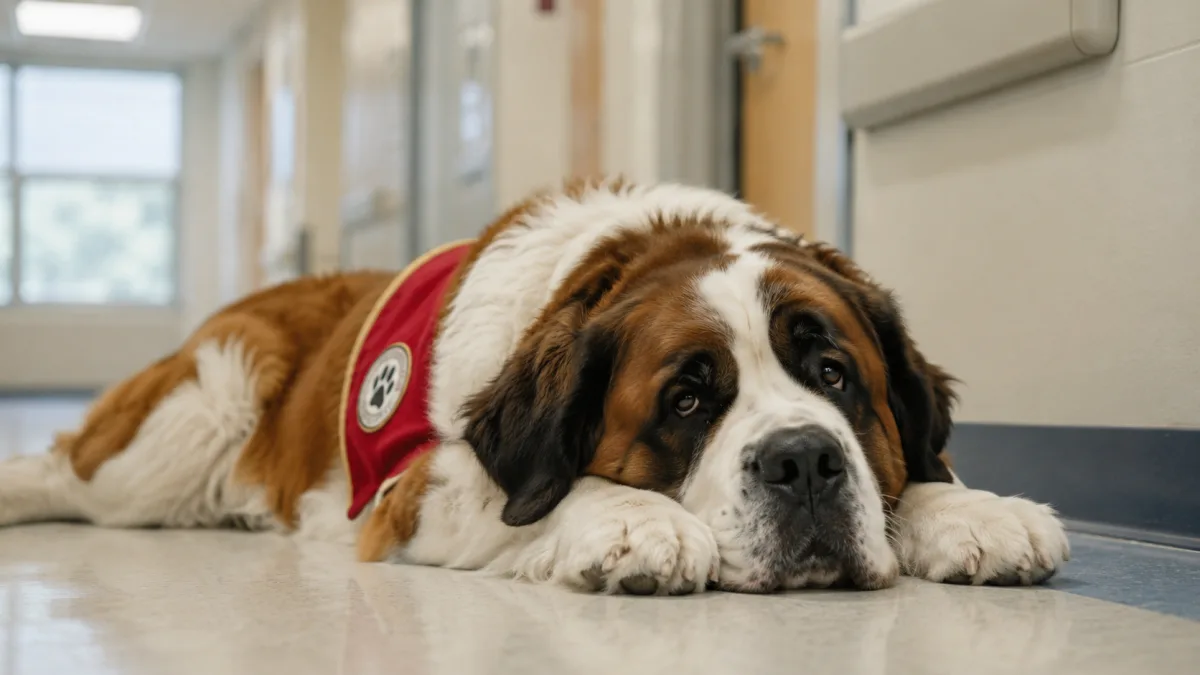
The same temperament that made these dogs remarkable on the alpine pass — patience, tolerance for physical contact, an unflappable quality around distress and noise — translates naturally into therapy work. Organisations such as Love on a Leash and Pet Partners register therapy dog teams, and Saint Bernards appear in the working rosters of both. The breed's size is an asset in this context: a large, calm dog lying beside a hospital bed or a nursing home resident is qualitatively different from a small one. The weight and warmth of the dog are part of what makes the interaction therapeutic.
The path to therapy certification requires solid obedience, reliable socialisation, and a dog that genuinely enjoys being handled by strangers — not merely tolerates it. For Saint Bernards with the right temperament, this is less a challenge than a natural extension of who they are. The breed is described by the AKC as notably patient and careful with children, and that patience tends to hold even in the busy, sometimes chaotic environments of schools, hospitals, and rehabilitation centres. Dogs trained with consistent positive reinforcement from puppyhood, who have been extensively socialised and who have learned to accept grooming, paw handling, and examination without anxiety, are the strongest therapy candidates.
The training investment at eight weeks pays returns in therapy visits at two years. And that long view — patience over months, consistency over sessions, rewards landed within two seconds of the right behaviour — is itself a thoroughly Saint Bernard quality.
Frequently Asked Questions
At what age should I start training my Saint Bernard puppy?
Training should begin the day the puppy arrives home, typically around eight weeks of age. At this stage the puppy is physically small enough to manage safely, and the early socialisation period — roughly 8 to 16 weeks — is when the brain is most receptive to new experiences. Basic commands like sit and name recognition can begin immediately. Puppy classes that combine socialisation with structured training are ideal from around 8 to 12 weeks, depending on vaccination status.
Can Saint Bernards be stubborn, and how do I handle it?
Yes — Saint Bernards can be selectively cooperative. They are not typically defiant in an aggressive way, but a dog that does not see the point of repeating a known command will simply stop engaging. The solution is to keep sessions short (10 to 15 minutes), vary the rewards to maintain interest, and avoid drilling the same command repeatedly in one session. If the dog shuts down, end the session positively with something the dog knows well and revisit the problem behaviour another time. Aversive training methods backfire with this breed by producing shutdown rather than cooperation.
What equipment do I need for leash training a Saint Bernard?
A front-clip harness or a Gentle Leader headcollar are the two most practical options for a dog that may outweigh its owner. Both redirect pulling force without causing neck strain. Standard collars are insufficient for a dog with the body mass of a Saint Bernard and should not be used as the sole attachment point during walks. As leash manners improve through training, the equipment becomes a safety backup rather than a constant management tool.
How much exercise does a Saint Bernard need?
Adult Saint Bernards do well with 30 to 45 minutes of moderate exercise daily — walks, off-lead play in a securely fenced area, or swimming. Puppies and adolescents under 18 to 24 months should avoid high-impact activity (sustained running on hard surfaces, jumping) until growth plates close. In hot weather, exercise should be scheduled for the cooler parts of the day given the breed's low heat tolerance. Mental enrichment — training sessions, food puzzles, scent games — supplements physical exercise and is particularly useful on hot or wet days.
Can a rescued adult Saint Bernard be trained?
Older dogs can absolutely be trained, and rescue Saint Bernards often settle into new routines with surprising speed. The fundamentals — sit, stay, come, leash manners — can be established at any age using positive reinforcement. An adult dog may arrive with specific problem behaviours from its previous environment, particularly if it was not well-socialised. For issues like reactivity, resource guarding, or significant fear responses, a certified professional trainer or veterinary behaviourist should be consulted early rather than after the behaviour has become entrenched.

Chiara Bradshaw
Covers education, culture and creative topics with an emphasis on readable explanations and verifiable references.



Leave a reply
Replying to