

The Samoyed's Arctic origins — what training is up against
In 1907, Sir Ernest Shackleton loaded nine Samoyeds onto the Nimrod for his attempt on the South Pole. These weren't pets along for the ride — they were working dogs selected for their endurance, their ability to haul heavy loads across ice, and their capacity to survive conditions that killed lesser animals. The breed had been doing exactly this kind of work for centuries alongside the Samoyede people of northwestern Siberia, a semi-nomadic tribe who used their dogs to herd reindeer, pull sleds, and sleep pressed against the family for warmth on nights that dropped to brutal cold.
Understanding Samoyed training starts with understanding that history. The dog you are teaching to sit in your living room is drawing on the same genetic memory that kept humans alive in the Arctic. That context explains almost every challenge — and every strength — you will encounter.
Males stand 21 to 23.5 inches at the shoulder and weigh 45 to 65 pounds; females run slightly smaller at 19 to 21 inches and 35 to 50 pounds. The AKC places the Samoyed in the Working Group, recognized since 1906. Their first American registration — a Russian import — set the template: these were serious working animals with serious working instincts, not simply white and fluffy companion dogs.
Effective Samoyed training requires working with that history, not against it. Short sessions, strong motivation, constant variety. The dogs that were most useful to the Samoyede people were adaptable problem-solvers — not mechanical command-followers. Three thousand years of selective breeding doesn't disappear because you bought a training clicker.
What the 'Sammy smile' tells you about this breed
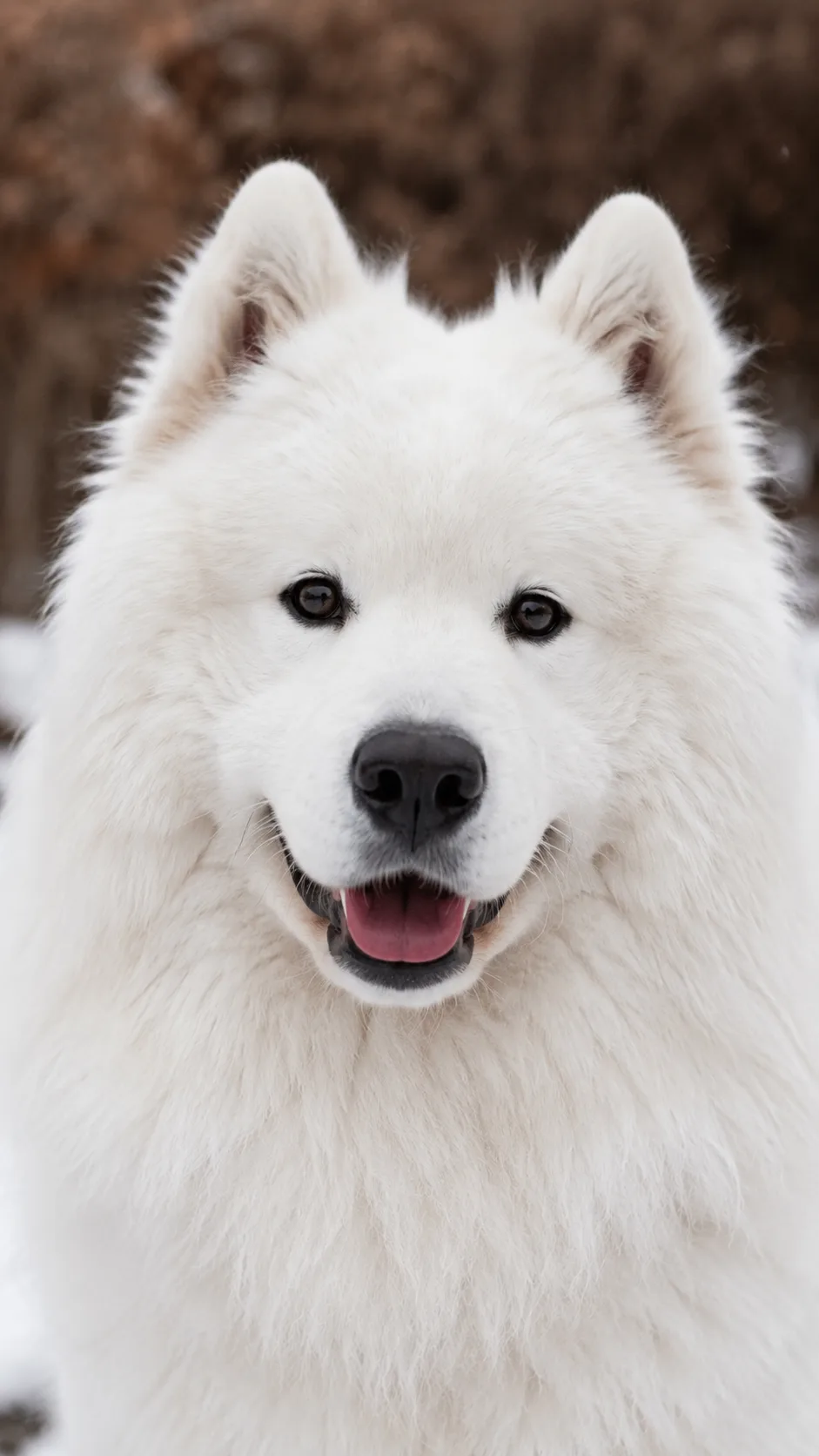
The Samoyed's upturned lip corners — the signature expression that gives the breed its nickname — are not decorative. In Arctic temperatures, drool freezes. A dog with loose, drooping flews accumulates ice around its muzzle while working, causing discomfort and, in extreme cold, genuine injury. The Samoyed's tightly upturned corners produce minimal saliva accumulation, an evolutionary refinement built over thousands of years in Siberia. The breed standard explicitly disqualifies drooping flews for this reason.
The smile is a training cue, if you read it correctly. A relaxed, smiling Samoyed is an engaged Samoyed. A Samoyed that goes flat-faced, avoids eye contact, or starts sniffing the ground mid-session has mentally checked out — the session has gone on too long, or become too repetitive. Experienced Samoyed owners learn to watch for this shift and end the session before it happens, always closing on a success the dog found genuinely rewarding.
That same physical resilience that shaped the smile also shaped a dog built for sustained effort in cold conditions. The white double coat isn't purely aesthetic either — the dense undercoat insulates against cold while the guard hairs reflect solar radiation in summer, keeping the dog cooler than a shaved coat ever would. The coat is a finely tuned thermal system. Shaving a Samoyed strips away that system: the guard coat grows back slowly and unevenly, and the dog ends up hotter, sunburn-vulnerable, and often permanently changed in coat texture. Never shave a Samoyed.
Samoyed temperament and why independent thinking matters in training
The Samoyed isn't stubborn in the way a dog that simply ignores commands is stubborn. The breed's independence is more nuanced than that — and understanding the mechanism makes it far easier to work with.
Herding reindeer is not like herding sheep with a border collie at close quarters, responding to a handler's moment-by-moment whistles. Reindeer cover vast terrain. A Samoyed herding for the Samoyede people had to assess situations independently, make judgment calls about where the herd was drifting, and respond without a human being close enough to give direction. Over generations, the breed developed what trainers call "free will" — an inclination to evaluate a situation and decide whether compliance makes sense in that moment, rather than defaulting to obedience.
This is excellent news for problem-solving tasks and terrible news if your training approach relies on drilling repetitive commands until the dog gives up and complies. A Samoyed doesn't give up — it disengages. Once a Samoyed has decided a training session is not worth its attention, you have lost that session. The far better approach is to make every session genuinely interesting: vary the commands, vary the rewards, vary the location. Novelty is not a nice-to-have for this breed — it's the mechanism that keeps engagement alive.
Food motivation is typically high. Most Samoyeds will work hard for a high-value treat, which gives trainers significant leverage during early obedience work. Pair that food motivation with short sessions — 15 to 20 minutes maximum — and you have the basic structure that works. Start puppy training early, around 8 weeks, focusing on sit, stay, come, leave it, and down. Positive reinforcement is non-negotiable: Samoyeds trained with harsh corrections shut down and become unreliable. The relationship between dog and handler is load-bearing — damage it, and training becomes exponentially harder. For those exploring training options within the breed community, the Samoyed Club of America's training guidance is a useful resource grounded in breed-specific experience.
Socialization during the critical window — roughly 3 to 14 weeks — shapes how the adult dog processes new people, environments, and animals. A well-socialized Samoyed is typically friendly and adaptable. One that misses that window can be wary and reactive, which creates compounding problems in training contexts. Expose puppies to varied sounds, surfaces, people of different ages, and other animals early and often.
Starting obedience training — age, sessions, and methods
Puppies can begin learning basic commands at 8 weeks. The key variables at this stage are session length, reward quality, and ending position. Sessions should run no longer than 5 to 10 minutes for very young puppies, scaling up to 15 to 20 minutes as the dog matures — but never longer, regardless of how well the session appears to be going. Samoyeds that peak early in a session and then get bored mid-drill develop a habit of half-effort that's hard to reverse.
Always end on a command the dog executes confidently. If you're working on a new skill and the dog is struggling, pivot back to something it knows well, get a clean response, reward generously, and close the session. This "end on success" principle matters more for Samoyeds than for most breeds because their memory of the emotional tone of a session influences how readily they engage next time.
Rotate through commands within each session rather than drilling one command repeatedly. A Samoyed that has done "sit" twelve times in a row is no longer learning — it's bored and complying minimally. The same dog asked to sit, then stay, then come, then sit again, with different treats and different tones of voice, is still engaged.
For owners who want to extend beyond basic obedience, the AKC Canine Good Citizen program is a natural first milestone — it tests real-world manners in a structured way and gives Samoyeds with high food motivation a clear achievement ladder. Many Samoyed owners use CGC as the gateway to formal sport competition, which suits the breed extremely well. You might also find it useful to compare notes with owners of other intelligent, independent breeds — this guide on Rottweiler training questions and this piece on Miniature Schnauzer training touch on similar themes of motivating independent-minded dogs.
Leash training and the sledding instinct
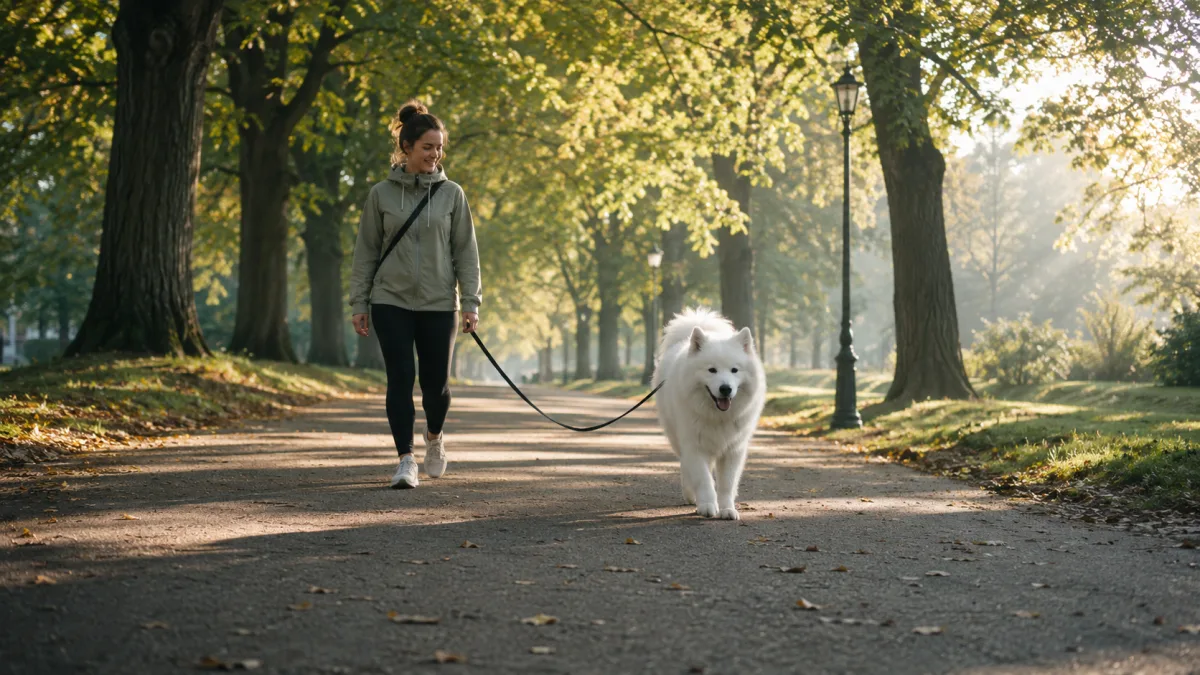
A Samoyed that pulls on leash is not misbehaving. It is doing exactly what three thousand years of breeding designed it to do.
Pulling a load is the Samoyed's native mode of forward motion. The leaning-forward gait that activates a sled harness is the same gait the dog slips into when it feels resistance on a standard back-clip harness — which is why back-clip harnesses are exactly the wrong tool for this breed. They engage the dog's pulling instinct rather than neutralizing it, turning every walk into a sled run.
A front-clip harness changes the physics. When a dog wearing a front-clip harness pulls forward, the clip position redirects its momentum to the side rather than forward, interrupting the pulling arc. A head halter works differently — because the dog's body follows its head, steering the muzzle steers the whole animal — but requires a careful desensitization period before most Samoyeds accept it without resistance.
Leash training itself needs to start early. The technique that works best is the opposite of counterforce: pulling back against a pulling Samoyed teaches it to pull harder. Instead, stop completely when the leash goes taut, wait for the dog to release pressure, reward the moment the leash goes slack, then resume. This is slow work — but it's the only approach that addresses the behavior rather than just suppressing it momentarily.
Off-leash recall is a separate conversation, and an honest one: many Samoyeds have unreliable recall off-leash, particularly in high-distraction environments. This isn't a training failure — it's a breed characteristic. Samoyeds worked at distance from their humans in Siberia; coming when called was not the primary selection criterion. Build recall with high-value rewards and consistent practice, but exercise off-leash in securely fenced areas. Related topics for large, active breeds — including leash behavior — are covered in this overview of the top 10 biggest dog breeds.
Vocalization — training the 'quiet' command
Samoyeds talk. This is not a training problem to solve — it's a breed characteristic to manage. They bark to alert, they howl at sirens, and many have a conversational "woo-woo" vocalization they use when greeting people they know. The Samoyed's proximity to wolf genetics shows up clearly in the howl, which can carry considerable distance and considerable volume.
The vocalization is deeply ingrained and stems partly from the same independence that makes training interesting — a dog accustomed to working at range from humans developed a range of vocalizations to communicate across distance. Early apartment-dwellers who acquire Samoyeds without researching this trait are often surprised.
Training a "quiet" command works, but requires consistency and timing. The technique that works best: when the dog begins barking, wait for a natural pause — even a brief one — then say "quiet" in a calm, flat tone and immediately reward the silence. Do not reward the bark, and do not reward if the dog restarts before you deliver the treat. The pause you're capturing is the absence of barking, not the presence of it.
Counter-intuitively, teaching the dog to bark on cue — "speak" — actually helps with the "quiet" command. By putting vocalization on command, you give the dog a structure: barking is something that happens when requested, not spontaneously. When a dog understands "speak," it grasps "quiet" more readily because the behavior has already been brought under voluntary control. Begin both commands at puppyhood for best results.
Exercise, climate, and coat care for active Samoyeds
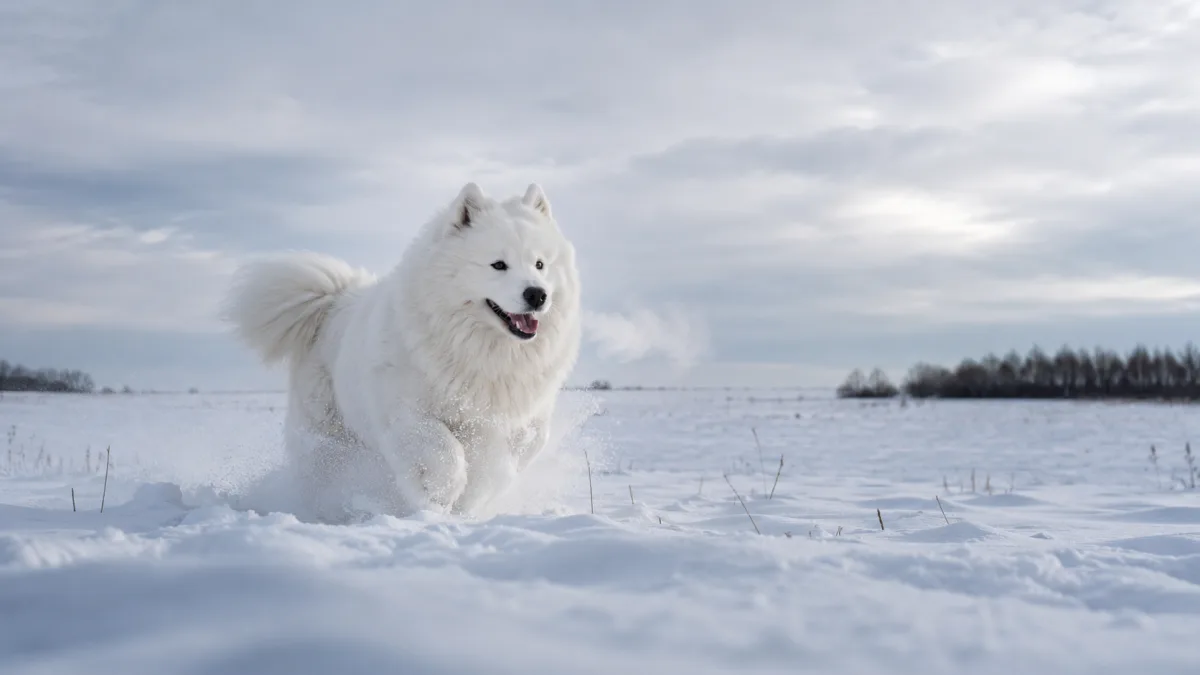
Samoyeds need substantial daily exercise — one to two hours across activities — and they're most enthusiastic about exercise that has a job built into it. Running alongside a bike, pulling a cart or sled, hiking with a pack, or competing in agility all engage the breed's working instincts in a way that a simple off-leash romp in the yard doesn't fully satisfy. Exercise is also a significant training variable: a Samoyed that hasn't burned energy is a Samoyed that will struggle to focus in a 20-minute obedience session.
In hot climates, exercise timing matters enormously. Despite the dramatic white coat, Samoyeds can and do overheat. Once temperatures climb above roughly 86°F (30°C), outdoor exercise should shift to early morning or evening. The double coat provides both cold insulation and summer cooling — the guard hairs reflect sunlight while the air gap between coat layers acts as thermal buffering — but this system has limits. Heat stroke is a real risk, and Samoyeds in warm climates need consistent access to shade, fresh water, and air conditioning during peak heat hours.
The coat has its own training angle: grooming handling should begin in puppyhood. A Samoyed that tolerates brushing, nail trims, and ear checks without resistance is far easier to care for when the adult double coat arrives. The breed "blows" its undercoat twice a year — a shedding event that produces impressive volumes of white fur over one to three weeks. Daily brushing during these periods prevents matting; weekly brushing during non-shedding periods keeps the coat healthy. Owners who condition their dogs to enjoy handling during training sessions often find grooming cooperation comes naturally as a side effect. For coat care reference points from another double-coated breed, this longhaired Dachshund grooming guide covers similar principles of coat conditioning and handling.
Health issues that affect Samoyed training
Several health conditions appear at elevated rates in the breed and are worth understanding before you start a long-term training program. Hip dysplasia is the most common orthopedic concern — OFA statistics show roughly 11.6% of evaluated Samoyeds are dysplastic, with the remainder distributed across excellent, good, and fair ratings. A dog with hip dysplasia may show reluctance to sit on command, difficulty with stairs or jumping, or a stilted gait that signals discomfort. Any training regression that appears suddenly in a physically active dog warrants a veterinary check before a behavioral explanation is assumed.
Progressive retinal atrophy (PRA) affects vision and can appear in the breed, including an X-linked form (XLPRA1) for which genetic testing is available. Night blindness is often the first sign. A dog losing vision may become more anxious in low-light training environments — something to consider if you notice a behavioral shift in evening sessions.
Pulmonic stenosis — a congenital defect of the valve between the right ventricle and pulmonary artery — occurs at elevated rates in Samoyeds compared to most breeds. Affected dogs may tire more quickly during exercise and can show exercise intolerance that resembles behavioral reluctance. Cardiac evaluation is part of CHIC (Canine Health Information Center) certification requirements for the breed.
Diabetes mellitus occurs in Samoyeds at a higher rate than the general dog population. Symptoms including increased thirst, urination, and appetite changes can affect a dog's ability to focus and sustain energy during training, and the condition is manageable with veterinary care once diagnosed.
The most breed-specific condition worth knowing in depth is Samoyed hereditary glomerulopathy — a kidney disease caused by a single base-pair mutation in the COL4A5 gene on the X chromosome. According to the Samoyed Health Foundation, the mutation results in a 90% reduction in type IV collagen production in the kidney's filtration membrane. Males have only one X chromosome and are severely affected, typically developing kidney failure and dying by 15 months. Females, carrying two X chromosomes, may carry the mutation with a slower disease progression. There is no cure — but a DNA test exists through Embark and other laboratories. Responsible breeders screen for this condition. A puppy from a tested litter is a meaningful starting point for any owner planning a long training investment.
Frequently Asked Questions
Are Samoyeds hard to train?
Samoyeds are intelligent but not naturally biddable — they were bred to make independent decisions, not to execute commands under direct control. This makes training more challenging than it is with retriever breeds, but not impossible. The key is short sessions (15 to 20 minutes), high-value food rewards, significant variety within each session, and consistent positive reinforcement. Harsh corrections reliably backfire with this breed. Owners who adapt their approach to the dog's independent nature — rather than trying to override it — generally get solid obedience results within a few months of consistent work.
When should I start training a Samoyed puppy?
At 8 weeks. Puppies this age are already forming associations and learning cause-and-effect. Basic commands — sit, name recognition, "come" — can begin immediately in 5-minute sessions. Socialization should run alongside training from the start, exposing the puppy to varied surfaces, sounds, people, and animals during the 3-to-14-week critical window. Early handling for grooming — brushing, touching paws and ears — should begin at the same time, before the adult double coat arrives.
Why does my Samoyed pull so hard on the leash?
Because pulling a load is their native movement mode. Samoyeds were sled dogs; the forward lean and resistance-against-harness gait is deeply instinctual, not a bad habit they developed. A standard back-clip harness reinforces this by activating the same muscle memory as a sled harness. Switch to a front-clip harness or, after careful desensitization, a head halter. Pair the equipment change with stop-and-wait leash training: the moment the leash goes taut, stop completely, wait for the dog to release pressure, and reward the slack leash before resuming.
How much exercise does a Samoyed need?
Plan for one to two hours of activity daily. Simple yard time doesn't fully satisfy — Samoyeds do best with exercise that has a purpose or challenge built in, such as hiking, bikejoring, agility, or cart pulling. In warm weather, schedule active exercise before 8 a.m. or after 6 p.m. to avoid heat risk. The double coat provides some thermal protection in both directions, but the breed is not heat-adapted the way it is cold-adapted, and overheating is a genuine risk above 86°F (30°C).
What AKC sports are good for Samoyeds?
The breed excels across a wide range — sledding, skijoring, and carting are the most historically appropriate, but Samoyeds also compete in agility, obedience, rally, herding (the reindeer-herding history translates to ducks and sheep today), and weight pull. The Samoyed Club of America runs a Working Samoyed Program with formal titles across multiple disciplines. The AKC Canine Good Citizen title is a natural early milestone before moving into competitive sport. Dogs with an active job to do are consistently easier to train and live with — sport competition channels the breed's intelligence and energy in a structured direction.

Chiara Bradshaw
Covers education, culture and creative topics with an emphasis on readable explanations and verifiable references.
Leave a reply
Replying to