
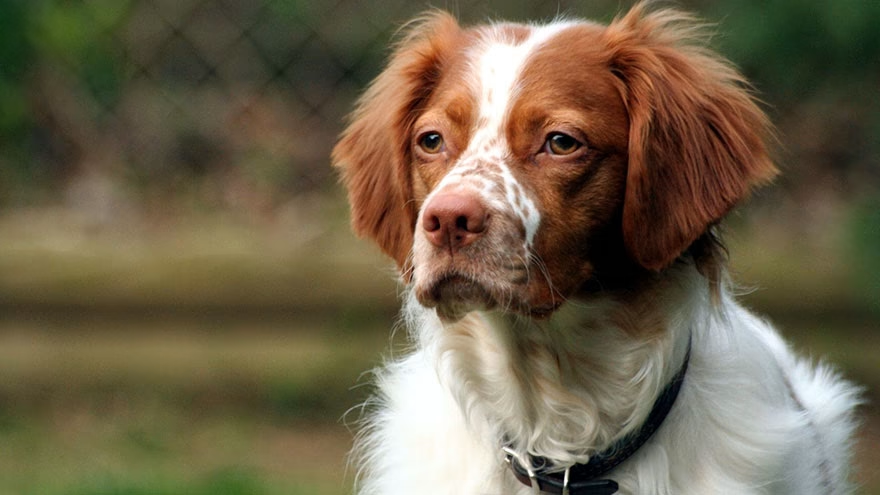
If you've been searching for a "Brittany Spaniel," here's something worth knowing before you go any further: the AKC officially dropped the word "Spaniel" from the breed's name in April 1982. Today the dog is simply the Brittany. That name change wasn't cosmetic — it corrected a genuine taxonomic mistake. The Brittany Spaniel, as it was once called, is not a flushing spaniel at all. It's a pointing dog, and that single distinction shapes almost everything about how this breed works, how it behaves in your home, and what it needs from you every day.
Is the Brittany a spaniel — and why did AKC change its name?
Traditional spaniels — Cocker Spaniels, Springer Spaniels, and their relatives — work by flushing birds into the air for a waiting gun. The Brittany does something fundamentally different: it scents game, freezes into a point to mark the bird's position, and then retrieves after the shot. That combination of pointing and retrieving, in a single compact dog, is the behavior of a continental gun dog, not a spaniel.
Breeders in France and the United States had long objected to the spaniel label. The AKC Board of Directors agreed, and in 1982 officially renamed the breed to reflect its actual function. The change matters for prospective owners because it explains an energy and drive profile that surprises many first-time Brittany owners who expected a mellow, house-friendly spaniel. The Brittany was built for all-day field work. That capability doesn't switch off indoors.
The breed belongs to the AKC's Sporting Group, stands 17.5 to 20.5 inches at the shoulder, and weighs 30 to 40 pounds — compact enough to work in dense cover, athletic enough to cover miles of ground without tiring. It has also earned more AKC Dual Champion titles than any other sporting breed, a record that reflects genuine versatility across both show and field performance.
What is the Brittany's history as a hunting dog?
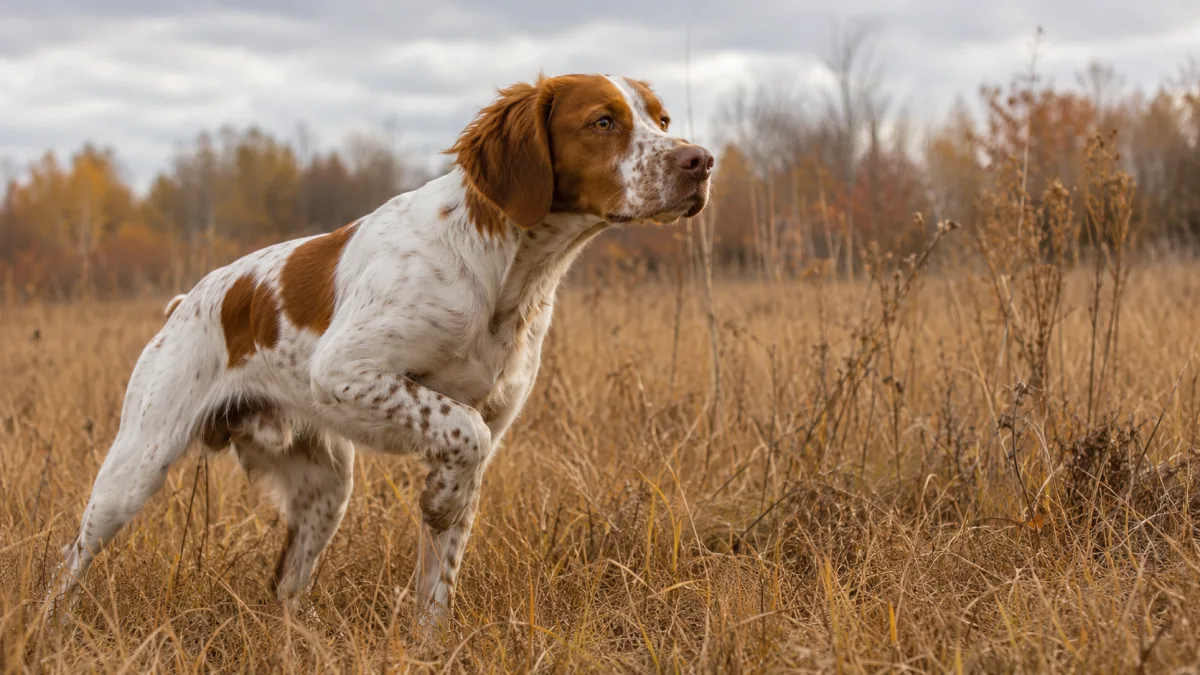
The Brittany takes its name from the Bretagne region in northwestern France, where images of orange-and-white hunting dogs appear in paintings and tapestries dating to the 17th century. The breed developed from crosses between French spaniels and English setters introduced by visiting sportsmen in the mid-1800s. The resulting dogs were woodcock specialists — fast, birdy, and capable of both pointing and retrieving — and they were popular not only with landed gentry but with poachers, who valued an obedient dog that could do the whole job without attracting attention.
Many of the early dogs were tailless or stub-tailed, a natural genetic trait that became associated with the breed. The Club de l'Épagneul Breton à Courte Queue — the Club for the Short-Tailed Brittany — was founded in France to preserve this characteristic. Some Brittanys carry a dominant bobtail gene that produces a naturally short or absent tail at birth. In countries where tail docking is prohibited, this gene has become more significant to breeders; in the United States, tails are traditionally docked to a short length for hunting work, reducing the risk of injury in thick cover.
The Brittany arrived in North America around 1925. American sportsmen were initially skeptical of the short tails, but the breed's field trial performance quickly won them over. The AKC recognized the breed in 1934. Today the Brittany consistently ranks among the most popular field trial dogs in the country, a position built on nearly a century of reliable, versatile hunting ability.
How much exercise does a Brittany Spaniel need?
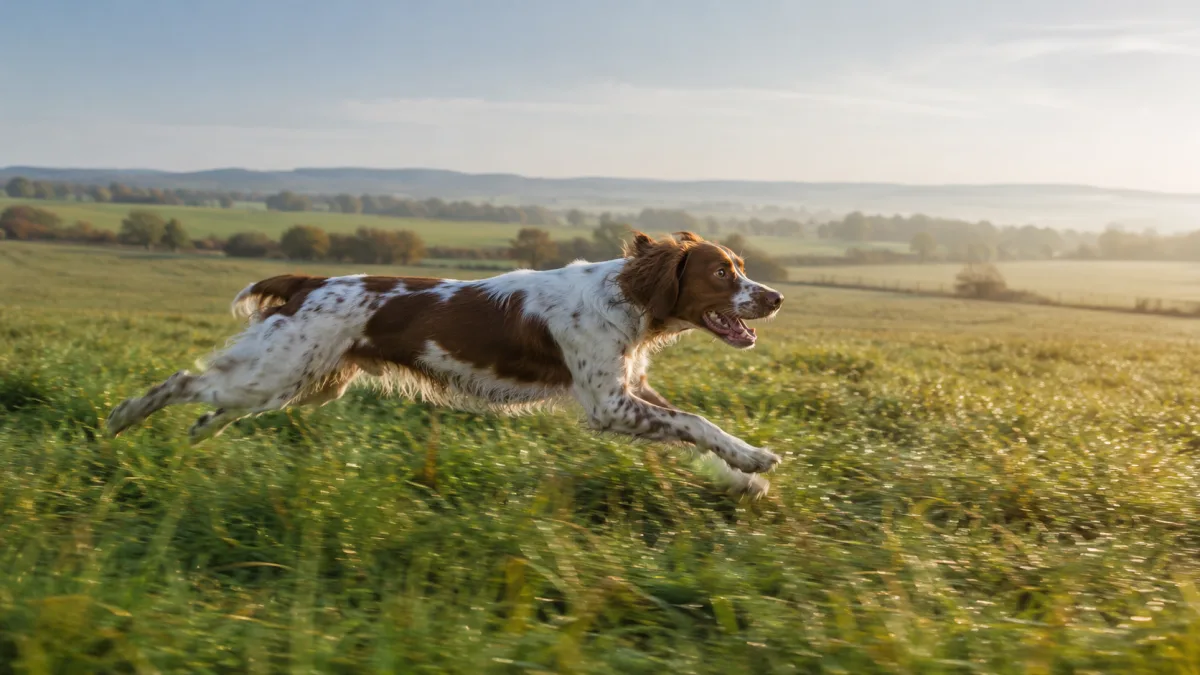
The honest answer is: more than most people expect, and more than most sources say. One to two hours per day is a minimum for a pet Brittany living in a home — not a target. A working or field trial Brittany may cover 30 miles or more in a single day's hunt. That's the metabolic baseline this dog was designed around.
A Brittany that gets a 20-minute leash walk and some backyard time will not be satisfied. The energy that isn't burned through exercise gets redirected — into counter-surfing, compulsive chewing, anxious barking, or fence-running. These aren't behavior problems in the traditional sense; they're the logical output of a dog with nowhere to put its fuel.
The breed excels at activities that combine physical exertion with nose work or problem-solving: like the German Shorthaired Pointer, the Brittany thrives at hunt tests and AKC field events that let it do exactly what it was bred to do. Agility, dock diving, flyball, and scent games all provide the mental load that separates a tired, content Brittany from a merely physically worn-out one. For families without access to hunting or field sports, a combination of long off-leash runs and structured training sessions is the most practical substitute.
VCA Animal Hospitals rates the Brittany at a perfect five out of five for jogging partnership — a useful signal for anyone evaluating whether their lifestyle fits this dog's needs.
Is the Brittany a good family dog?
Generally, yes — with one significant caveat about energy. Brittanys are affectionate, people-oriented, and patient with children. They are not guarded or territorial, they get along readily with other dogs and household pets, and they have no aggressive edge. The VCA profile rates them five out of five for compatibility with children, which aligns with the breed's reputation as a gentle, social companion.
The caveat is physical. A Brittany at full enthusiasm is a fast-moving, airborne-at-intervals dog. Young children — toddlers especially — can be knocked down during exuberant play, not out of aggression but out of sheer momentum. Supervision during interactions with very small children is sensible until the dog has learned to moderate itself.
The other family consideration is separation anxiety. Brittanys are strongly people-oriented, which is a social asset most of the time and a liability when the house empties for eight hours. Dogs left alone for extended periods regularly tend to develop stress behaviors. The breed is best suited to households where someone is home for a meaningful portion of the day, or where arrangements can be made for midday exercise and company. If you're considering this breed and want guidance on what ownership actually looks like day-to-day, the experiences shared at Brittany Spaniel breeder recommendations offer grounded perspective from people who know the breed closely.
What colors do Brittanys come in?
The AKC breed standard recognizes two color combinations: orange and white, and liver and white. Both can appear in clear patterns — distinct patches of color — or in roan, where the white areas are interspersed with colored hairs to create a flecked, ticked appearance. Tri-color Brittanys (liver and white with orange markings on the eyebrows, muzzle, cheeks, ear interiors, and lower legs) are permitted under the standard, though they are not preferred in the show ring.
Black is a disqualification under the AKC standard in the United States. This is a point of difference from European lines: French Brittanys (Épagneul Bretons) are recognized in black and white under their national standard, and these dogs do exist and are imported. But for AKC-registered American Brittanys, black in the coat is grounds for disqualification in competition. Anyone purchasing a puppy from a US breeder should be aware of this distinction, particularly if show participation is a goal.
How do you train a Brittany Spaniel?
The Brittany is quick and eager — it picks up new behaviors fast, and it genuinely wants to work with its handler. What it cannot tolerate is pressure. A raised voice, a sharp leash correction, a frustrated tone from the human end of the leash: any of these can shut a Brittany down mid-session. The dog goes quiet, avoidant, and reluctant to try anything, which is often mistaken for stubbornness. It isn't stubbornness. It's a stress response from a sensitive animal that has learned that trying leads to unpleasant consequences.
Positive reinforcement — food rewards, toy play, enthusiastic verbal praise — works reliably with this breed. Short sessions work better than long ones. Ending on a successful repetition, before the dog tires or the handler's patience frays, builds more reliable behavior than grinding through a long session to get compliance. Consistency matters more than force.
Early socialization is important not because Brittanys tend toward fearfulness, but because the breed's exuberance benefits from early exposure to varied situations, sounds, and people. A well-socialized Brittany is confident without being overwhelming. Obedience training, as VCA notes, is valuable not just for control but for the mental exercise it provides — structured thinking tires a Brittany in ways that physical exercise alone cannot. Comparing notes with owners of similarly intelligent sporting breeds like the Miniature Schnauzer reveals similar themes: engagement, variety, and positive framing are what build a reliable dog.
What are the most common health problems in Brittanys?
The Brittany is a generally healthy breed with a lifespan of 12 to 14 years, but several hereditary conditions appear with enough frequency that responsible breeders screen for them before breeding.
Hip dysplasia is the most structurally significant concern. The condition involves malformation of the hip joint, which leads to abnormal wear, pain, and arthritis as the dog ages. Some estimates suggest as many as one in four Brittanys is affected to some degree. OFA (Orthopedic Foundation for Animals) hip evaluations on both parents are standard practice among health-conscious breeders.
Idiopathic epilepsy appears in the breed at a notable rate. Seizures typically begin between one and five years of age and range from mild to severe. There is currently no definitive genetic test for epilepsy in Brittanys, which makes lineage research and breeder transparency especially important for prospective owners.
Progressive retinal atrophy (PRA) is a degenerative eye condition that causes gradual vision loss and can progress to blindness. CAER (Companion Animal Eye Registry) examinations, performed by a board-certified veterinary ophthalmologist, can detect early signs. The American Brittany Club recommends annual CAER exams for breeding stock between two and eight years of age as part of the OFA CHIC (Canine Health Information Center) program. Other recommended screenings include cardiac evaluation and thyroid autoimmune panels.
Choosing a breeder who participates in the CHIC program and provides OFA documentation for the parents is the most reliable way to reduce the probability of inheriting these conditions. For comparison, many sporting and working breeds share similar health priorities — the health screening considerations for Staffordshire Bull Terriers follow a similar logic of knowing a puppy's lineage before committing.
Grooming and coat care for the Brittany

The Brittany's coat is medium length, flat or slightly wavy, and dense enough to offer some protection in the field. It is not the high-maintenance coat of a Cocker Spaniel or an Irish Setter — there's far less volume, and the feathering (the longer hair on the ears, legs, and belly) is moderate rather than profuse. Weekly brushing is enough to manage shedding and prevent the feathering from matting. Dogs that spend time in heavy cover may need more frequent attention to remove burrs and debris from those longer sections. For a detailed look at working through feathered coats, the techniques outlined for grooming a longhair Dachshund address similar challenges with leg and ear feathering.
Shedding is average — the Brittany is not a heavy shedder, but it is not a low-shedding breed either. Professional grooming is optional rather than essential; many Brittany owners manage the coat at home with a slicker brush and a metal comb. The areas that need the most attention are the feathering behind the ears (prone to matting), the feet (where hair between the pads can trap debris and cause discomfort), and the belly. Nails should be trimmed regularly, and ears — drop-eared dogs are susceptible to infection from reduced airflow — should be checked and cleaned as part of a routine grooming session.
Frequently Asked Questions
What is the Brittany's lifespan?
The Brittany typically lives 12 to 14 years. VCA Animal Hospitals cites 12 to 13 years as a typical range. Good nutrition, regular veterinary care, and adequate exercise all contribute to dogs reaching the upper end of that range.
Does the AKC still call it a "Brittany Spaniel"?
No. The AKC officially dropped "Spaniel" from the name in April 1982. The breed is registered and shown as "Brittany." The old name persists in common usage and in search queries, which is why you'll still find "Brittany Spaniel" widely used outside official breed documentation — but in AKC competition and registration, the breed is simply the Brittany.
Are Brittanys born without tails?
Some are. A naturally occurring dominant gene — a mutation in the T-box transcription factor T gene — causes a proportion of Brittanys to be born with a naturally short or absent tail (a natural bobtail). Others are born with full-length tails that are traditionally docked short for hunting work. In countries where docking is prohibited, natural bobtails are particularly valued in breeding programs. In the United States, docking remains a common practice.
Is the Brittany good for apartment living?
Not ideally. The breed can settle reasonably well indoors when adequately exercised, but "adequately" means 1.5 to 2 or more hours of vigorous daily activity — a commitment that's difficult to meet without ready access to open space. An apartment Brittany that isn't getting enough exercise will find other outlets for its energy, and those outlets are rarely things owners want to come home to.
How does the Brittany compare to similar pointing breeds?
The Brittany is smaller and generally more tractable than breeds like the German Shorthaired Pointer, making it a popular choice for hunters who want a versatile gun dog that also functions well as a house companion. The German Shorthaired Pointer carries similar energy demands but in a larger, harder-driving package. The Brittany's sensitivity to training pressure is also more pronounced — it responds better to gentle handling than most pointers do.
The single thing most prospective Brittany owners underestimate is not the exercise requirement itself — most people know this breed needs activity — but what happens when that requirement goes unmet consistently. An under-exercised Brittany doesn't just get a little restless. It develops anxiety, redirects energy into destructive behavior, and can become genuinely difficult to live with. The breed was designed for full days of hunting; a 20-minute walk is not a substitute. Owners who can honestly provide sustained, vigorous daily exercise — and who enjoy an active lifestyle that makes this natural rather than effortful — will find the Brittany one of the most rewarding dogs available. Those who cannot should look at breeds designed for less demanding conditions.

Chiara Bradshaw
Covers education, culture and creative topics with an emphasis on readable explanations and verifiable references.


Leave a reply
Replying to