
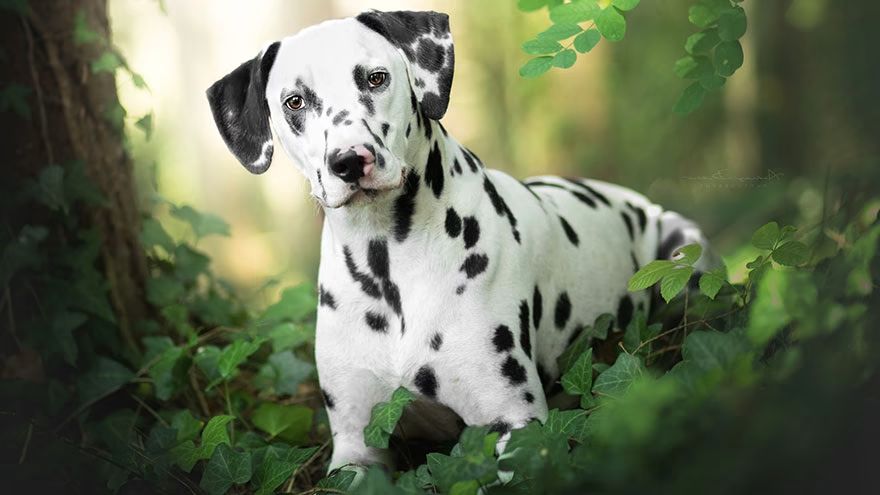
Before you buy a Dalmatian puppy, it's worth knowing what happened to the breed after 1996. When the live-action remake of 101 Dalmatians hit theaters, annual AKC registrations jumped from around 8,000 to more than 42,000 puppies within a few years. Puppy mills and backyard breeders flooded the market to meet demand. Within a decade, those poorly bred dogs were flooding shelters, and AKC Dalmatian registrations had fallen by 97%. The breed's reputation for temperament problems — largely a product of mass irresponsible breeding — lingered long after. Understanding that history is the single most important frame for evaluating any Dalmatian breeder today.
What is the Dalmatian's history and original purpose?
The Dalmatian takes its name from Dalmatia, a coastal region of what is now Croatia, though the breed's exact origins remain genuinely uncertain. Distinctly spotted dogs appear in Egyptian friezes and paintings dating back thousands of years, but whether those animals share a direct lineage with the modern Dalmatian is unknown. The first documented written reference to a Dalmatian-type dog comes from 1375, when Peter, Bishop of Đakovo, described a hunting dog from Dalmatia — white-coated with round black spots — and called it Canis Dalmaticus.
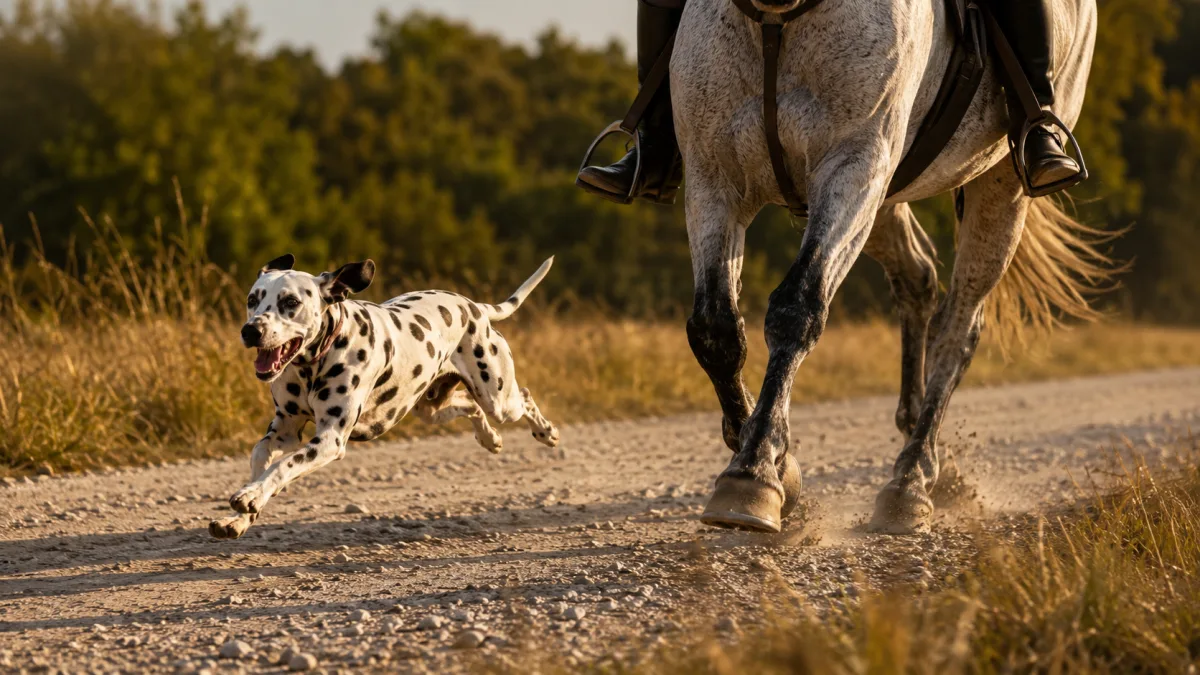
The breed found its defining purpose not in Croatia but in 17th-century England, where it became the quintessential coach dog. Dalmatians trotted alongside horse-drawn carriages for miles — in front, alongside, or even beneath the axle — protecting the horses from stray dogs and clearing the path through crowded streets. That job demanded extraordinary stamina; Dals were bred to cover 20 to 30 miles in a single outing without breaking down. Their unusual compatibility with horses made the transition to American firehouses a natural one. Horse-drawn fire wagons needed dogs that could run ahead through city streets, calm the horses during the chaos of a fire call, and guard the equipment when the crew was inside a burning building. The Dalmatian did all three. Even after gasoline engines replaced horses in firehouses, the dogs stayed — a tradition that endures as a cultural symbol. The AKC formally recognized the breed in 1888.
Why do so many Dalmatians go deaf — and how do you avoid buying a deaf puppy?
Congenital sensorineural deafness is the most significant genetic issue in the Dalmatian breed, and the numbers are sobering. According to data compiled from U.S. screening programs, approximately 8% of Dalmatians are bilaterally deaf — meaning they cannot hear in either ear — while another 22% are unilaterally deaf, hearing in only one ear. That means roughly 30% of all Dalmatians in the United States have some degree of congenital hearing loss. UK screening data from nearly 9,000 puppies shows lower overall prevalence (around 17.8%), suggesting that sustained selective breeding can move the needle, but the problem remains widespread in unscreened lines.
The mechanism behind this is tied directly to the breed's coat genetics. The extreme piebald gene expression that produces the Dalmatian's white base coat affects melanocytes — the pigment-producing cells that migrate to various tissues during fetal development. The inner ear's cochlea depends on a structure called the stria vascularis, which requires melanocytes to produce the endolymph fluid that transmits sound signals to the auditory nerve. When melanocytes fail to colonize the cochlea — a consequence of the same genetic pathway that creates white fur and sometimes blue eyes — that fluid never develops correctly, and the hearing cells die within the first three to four weeks after birth. The deafness is permanent and present from birth, though it only becomes apparent as the puppy grows.
The BAER test — Brainstem Auditory Evoked Response — is the only reliable way to detect this. It measures the electrical activity in the auditory pathway by playing clicks through headphones while the puppy is sedated or still. Each ear is tested independently, which is critical: a unilaterally deaf dog can appear fully responsive to sound in everyday settings, because the functioning ear compensates. Without a BAER test, you cannot know which ear, if either, is working. Responsible Dalmatian breeders BAER-test every puppy in every litter between five and twelve weeks of age, before the puppies go to their new homes. Results should be submitted to the OFA database. Ask the breeder for the OFA BAER paperwork for your specific puppy — not just the parents, but the individual puppy you are buying.
The Dalmatian Club of America recommends that breeders use only bilaterally hearing dogs in their breeding programs. Breeding a bilaterally hearing dog to a unilaterally deaf dog produces significantly higher rates of deaf offspring than breeding two bilaterally hearing dogs together. This is the primary lever breeders have to reduce the problem generation by generation.
What other health issues are common in Dalmatians?
The Dalmatian's second major health concern is a metabolic quirk unique to the breed: every single Dalmatian, regardless of bloodline, carries a genetic mutation in the SLC2A9 gene. Most dogs convert uric acid — a byproduct of purine metabolism — into allantoin in the liver, a water-soluble compound that passes through the kidneys with no difficulty. Dalmatians cannot do this efficiently. The SLC2A9 mutation impairs a transport protein that moves uric acid into liver cells for conversion, so uric acid accumulates in the bloodstream and gets excreted through the kidneys at high concentrations. The result is that Dalmatians form urate bladder and kidney stones — uric acid urolithiasis — at dramatically higher rates than any other breed. Dalmatians account for roughly 80% of all uric acid urinary stones reported in dogs worldwide.
Managing this risk requires a specific dietary approach. Purines — the compounds that break down into uric acid — are found in high concentrations in organ meats (liver, kidney, heart), some fish (sardines, anchovies), and certain legumes. A low-purine diet, combined with high water intake to dilute urine and reduce crystal formation, is the standard recommendation from veterinary nutritionists. Your vet may also discuss prescription diets formulated for urate-prone dogs. Keeping a fresh water source available at all times is not optional for this breed — it is a genuine health requirement. Hip dysplasia and eye disorders (including iris sphincter dysplasia) round out the CHIC-recommended screening list.
For a look at how another breed handles hereditary health screening, see our guide to Staffordshire Bull Terrier health problems.
How much exercise does a Dalmatian really need?
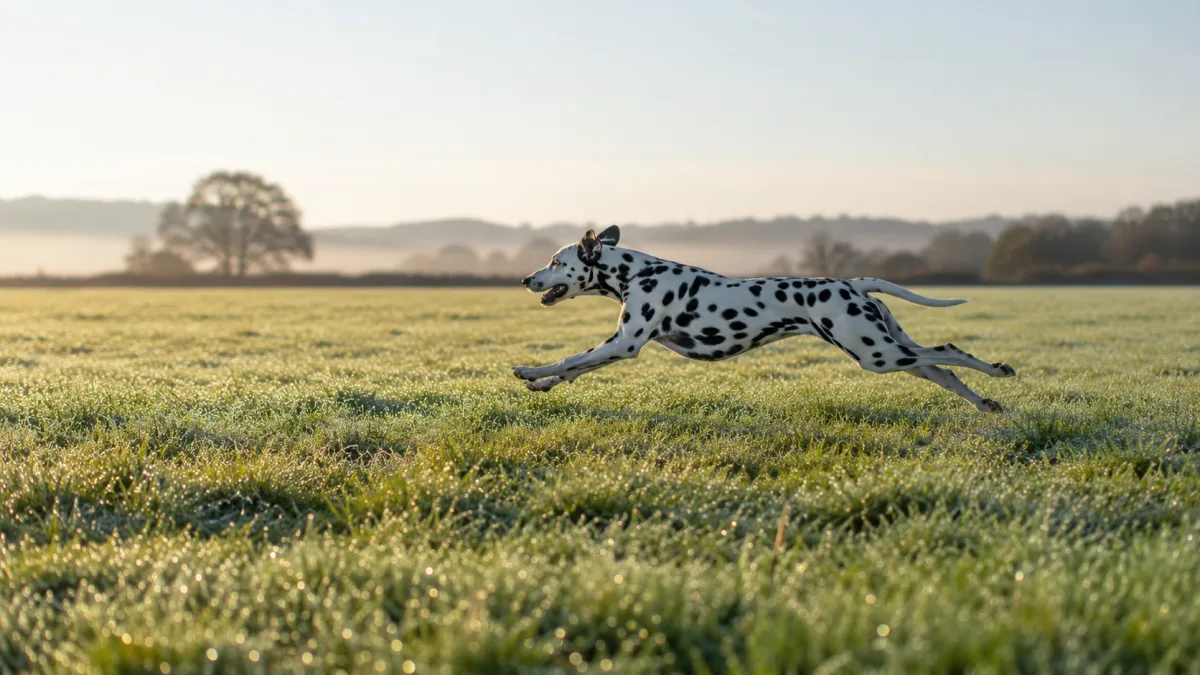
The Dalmatian was purpose-built to run. A coaching dog that covered 20 to 30 miles alongside a horse-drawn carriage is not going to be satisfied with a short walk around the block. Most adult Dalmatians need a minimum of 1.5 to 2 hours of meaningful physical activity every day. That means running, not strolling — long jogs, off-leash sessions in a securely fenced yard, fetch, agility, or canicross. A Dalmatian that gets real daily exercise is a calm, pleasant housedog. One that does not gets destructive, anxious, and loud.
There is an important caveat for young dogs. Dalmatian puppies under 18 months should not be pushed into sustained high-impact exercise — road running, prolonged jumping, long hikes — because their growth plates have not yet closed. Short, frequent play sessions are better than marathon outings for puppies. By contrast, Dalmatians under four years old are often still adolescents mentally, which means high energy combined with incomplete impulse control. Physical exercise alone will not solve the problem; training and mental stimulation through nose work, puzzle feeders, and obedience sessions matter just as much as miles covered.
A securely fenced yard is not a convenience — it is a necessity. Dalmatians are fast, curious, and have a strong roaming instinct. An unsecured garden is not a safe one for this breed, regardless of how well trained the dog appears. Looking for the most athletic dog breeds? See our overview of the top 10 biggest dog breeds for size and energy comparisons.
What should you look for in a reputable Dalmatian breeder?
A reputable Dalmatian breeder is not simply someone who owns two Dalmatians and has produced a litter. The baseline minimum is CHIC certification for both breeding parents: BAER testing (with results in the OFA database), hip dysplasia evaluation via OFA or PennHIP, and at least one elective test — either an ACVO eye examination or OFA thyroid panel. You can verify any dog's CHIC status yourself at ofa.org by searching the dog's registered name. If a breeder is unwilling to share this paperwork or cannot produce it, move on.
Beyond test results, look for a breeder who socializes puppies extensively before placement. Dalmatians that are isolated from varied human contact, sounds, and environments during the critical window between three and twelve weeks of age can develop lasting anxiety and reactivity — problems that become much harder to address after the puppy comes home. A good breeder will ask you as many questions as you ask them. They will want to know your exercise capacity, whether you have young children, your experience with high-energy breeds, and what your plan is if the arrangement does not work out. They should offer a written contract that includes a health guarantee and a take-back clause committing them to accept the dog back at any point in its life if you can no longer keep it.
Visit at least two or three breeders before deciding. Ask to see where the puppies are raised — whelping boxes in the main living area are a positive sign; puppies raised exclusively in outdoor kennels with minimal human contact are a red flag. Reputable breeders can be found through the Dalmatian Club of America's breeder listing. Budget $800 to $1,700 for a well-bred pet-quality puppy from health-tested parents; show-line puppies from proven bloodlines can exceed $2,500.
What questions should you ask before buying a Dalmatian puppy?
Knowing what to ask matters as much as knowing what to look for. The following questions will help you distinguish a responsible breeder from someone simply moving puppies.
- Can I see the BAER test results for this specific puppy, and are the parents' results on OFA?
- What are the hip scores for both parents?
- How many litters per year do you produce, and how many dogs do you own?
- Where are the puppies raised — in your home or in a separate kennel?
- At what age and how has this litter been socialized?
- What does your take-back policy look like, and is that in the contract?
- What diet are the puppies currently on, and what do you recommend for urate management?
- Can I contact previous buyers as references?
A breeder who hedges on the BAER question, deflects from health testing, or cannot connect you with past buyers is worth avoiding. Compare notes with owners of related breeds — see how questions are handled in our Miniature Schnauzer guide and the Rottweiler FAQ for reference on what good breeder transparency looks like across breeds.
Is Dalmatian rescue a better option than buying from a breeder?
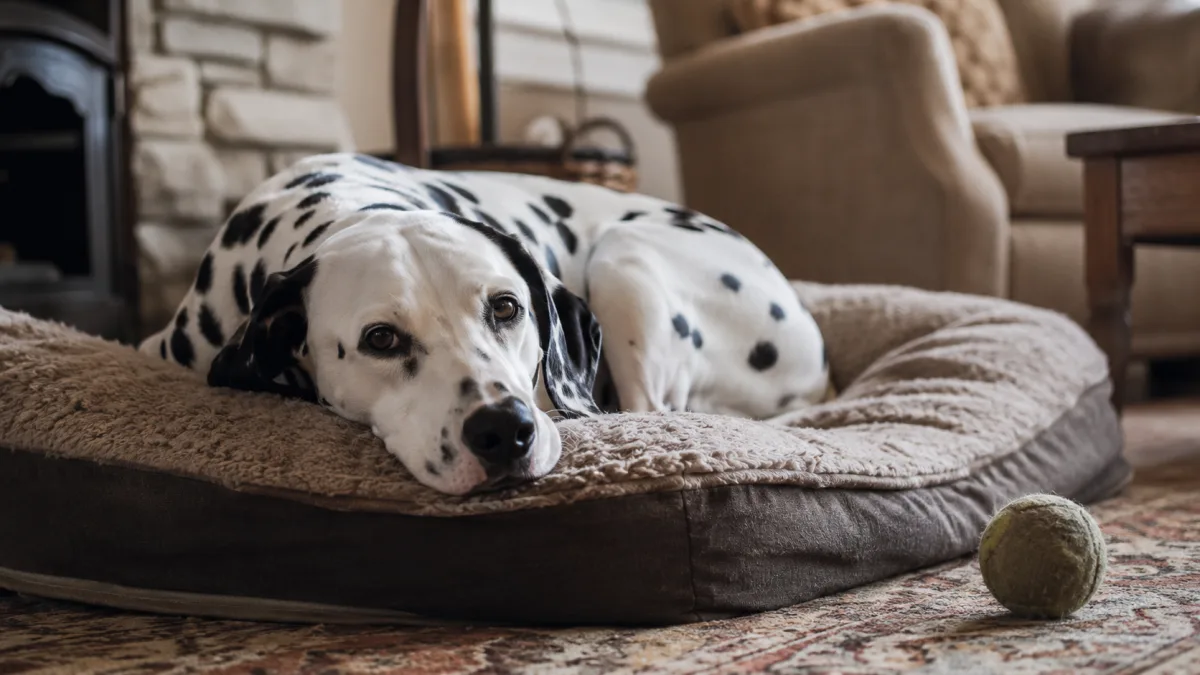
For many prospective Dalmatian owners, rescue is worth serious consideration — and not just for ethical reasons. Adult rescue Dalmatians come already past the destructive puppy stage, often house-trained, and with known temperament. Foster carers can tell you exactly how the dog behaves with children, other pets, and strangers. What you are adopting is a fully formed personality, not a blank slate.
The long shadow of the 1990s breeding boom means that Dalmatian-specific rescue organizations are well established and have decades of experience placing dogs in appropriate homes. Organizations like Dalmatian Rescue and Save the Dalmatians & Others Canine Rescue operate nationally, with regional networks covering most of the United States. Adoption fees typically run between $100 and $400 and cover spay/neuter, vaccinations, and microchipping — a fraction of the cost of a puppy from a reputable breeder. The main trade-off is availability: specific ages, coat patterns, or hearing status cannot always be guaranteed, and wait times for particular placements can be long.
Rescue is also a sound choice for someone who wants to verify temperament before committing. A Dal that has lived in a foster home for several weeks has a documented track record. That information is simply not available when you are choosing a puppy at eight weeks old.
Why was the 101 Dalmatians craze bad for the breed?
The story is a case study in what happens when breed demand outpaces responsible supply. Disney's animated 101 Dalmatians had already caused a registration spike when it was re-released in 1985, pushing annual AKC registrations from 8,170 to over 42,000 puppies at the peak in 1993. The 1996 live-action remake sent a second wave through the market. Irresponsible breeders — those with no interest in BAER testing, hip evaluations, or temperament selection — bred relentlessly to fill the demand. Puppies were sold to families who had no realistic understanding of the breed's exercise requirements, sensitivity, or health costs.
The consequences were predictable. Veterinarians began reporting elevated rates of aggression and anxiety in Dalmatian patients — not because the breed is inherently unstable, but because temperament is heritable and the dogs being produced came from parents selected for availability, not character. Shelters and Dalmatian-specific rescue organizations were overwhelmed. By the mid-2000s, AKC registrations had crashed by 97% — the steepest decline in the history of any breed on the AKC's records. The second film's studio took the unusual step of including a disclaimer asking viewers not to buy a Dalmatian on impulse.
The legacy matters today because some of the poorly bred lines from that era are still traceable in certain bloodlines. It is one more reason that CHIC health testing and breeder vetting are non-negotiable, not optional extras. Related considerations apply to all breeds that have experienced popularity spikes — see our piece on owning a Brittany Spaniel for a parallel discussion of breeder selection in another active breed.
Frequently Asked Questions
Are Dalmatians good family dogs?
Dalmatians are affectionate, loyal, and genuinely playful — traits that make them excellent companions for active families. They tend to be better suited to households with older children (school age and above) rather than toddlers, because their size and enthusiasm can knock small children over unintentionally. Proper socialization from puppyhood and a consistent training routine are essential. A Dalmatian that receives adequate daily exercise is typically a calm, easygoing housedog.
How much does a Dalmatian puppy cost from a reputable breeder?
A pet-quality Dalmatian puppy from a reputable breeder with documented CHIC health testing typically costs between $800 and $1,700. Puppies from show bloodlines with champion ancestry can run $2,500 or more. Lower prices from untested sources are a warning sign, not a bargain — the savings on the purchase price often reappear as veterinary costs.
Do Dalmatians shed a lot?
Yes. Despite having a short, sleek coat, Dalmatians shed year-round — the short hairs work their way into upholstery and clothing in ways that longer-coated breeds do not. Weekly brushing with a rubber curry comb helps manage the volume. This is one of the breed's less glamorous realities that prospective owners frequently underestimate.
Can a deaf Dalmatian be trained?
Bilaterally deaf Dalmatians can be trained effectively using hand signals and vibrating (not shock) collars for distance communication. Many deaf Dals live full, happy lives with owners who adapt their training approach. The key requirements are a securely fenced environment at all times — since a deaf dog cannot hear approaching traffic — and an owner who is committed to learning visual communication methods before bringing the dog home.
What is the Dalmatian's lifespan?
The typical Dalmatian lifespan is 12 to 14 years. Dogs that receive appropriate low-purine diets, consistent exercise, and routine veterinary care — including monitoring for urate stones and hearing status — tend to reach the upper end of that range. Hip health and urinary management are the two variables most within an owner's control over the long term.

Chiara Bradshaw
Covers education, culture and creative topics with an emphasis on readable explanations and verifiable references.



Leave a reply
Replying to